
Cryptography
The cryptography of the system serves QUIC and TLS 1.3 (The network: TCP as a library in the process), the signature of the system description at boot, and the key derivation of a named principal.
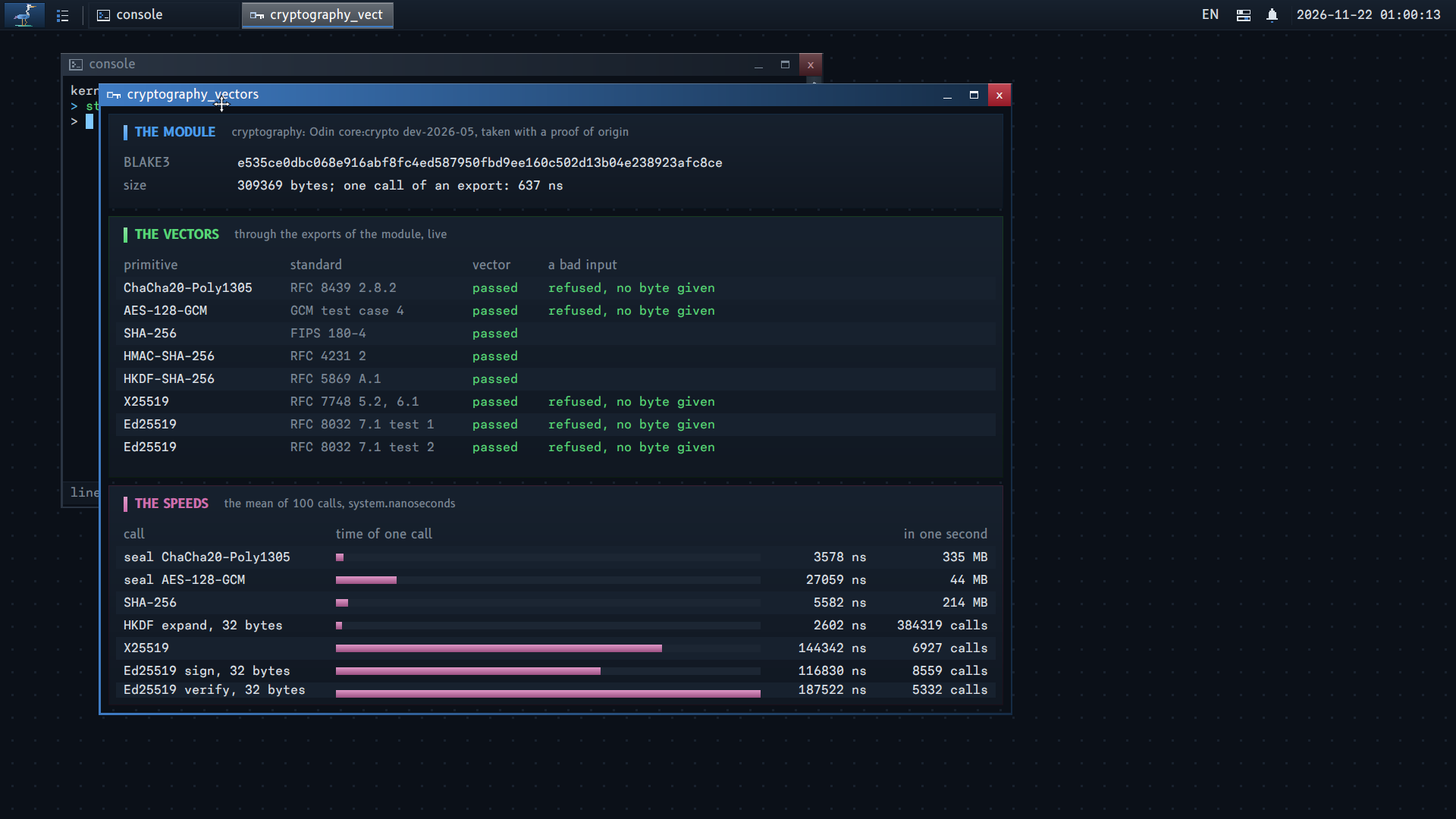
The idea in plain words. The system writes no cryptography of its own. It takes proven code, keeps a record of its origin, and adapts it only to the forms of the system (memory of the caller, no allocation). A change of the origin fails a check until the change is read and its new hash recorded, and each primitive passes the published test vectors on the machine.
For whom. A reader who uses the module cryptography, and a reader who updates its code.
Read before. QUIC: Packet protection (the first layer, built) and QUIC: TLS 1.3 for QUIC (the second layer, built), for the use of each primitive.
The map of this guide. "1. The rule" and "2. The origin, and its license" give where the code comes from. "3. The layout" and "4. The proof of what changed" give how it is kept. "5. The primitives, and their tests" lists them. "6. The module cryptography" gives its exports, "6a. Ed25519 in the boot program" and "6b. Ed25519 in the root service" the two copies outside it, and "7. What is not done" closes.
1. The rule: proven code, in the forms of the system
The system does not write cryptography from nothing. It takes existing code and adjusts it, with wrapper functions and a compatibility layer, so that the code uses the primitives of this system: tables and modules.
What it means here:
- Proven code is the source. The primitives come from existing code with a permissive license. Their arithmetic and their constant-time code stay as they are.
- The code is in the repository. It is not an opaque import of the collection of the compiler.
- Only the shell changes. The changes are listed, and a check proves them (section 4).
- The forms of the system. The code becomes a module with exports, a description and a hash (properties 10 and 11). The caller supplies the memory (property 14). An error is a value (). Batches go over tables where that form fits.
2. The origin, and its license
- Origin: Odin's
core:crypto, from the compiler that the flake pins: the releasedev-2026-11aof Odin, in the fork thatflake.nixfetches by its commit and its hash. The fork changes the compiler only, notcore:crypto. When the compiler changes,modustool cryptography-taketakes the files again. - License of Odin, and of
core:crypto(its README: "This library is made available under the zlib license"): the zlib license, insrc/library/modus/cryptography/LICENSE.odin.txt. Its second clause, "Altered source versions must be plainly marked as such", is met by the first line of each file that is taken. - fiat-crypto: the field arithmetic of
core:crypto/_fiatis a port of fiat-crypto, which gives three licenses. Odin chose BSD-1-Clause; its text is insrc/library/modus/cryptography/LICENSE.fiat-crypto.txt, with the first part that is taken. - Review: the README of
core:cryptosays that the packages "have not received independent third party review". The system relies on the RFC test vectors (section 5) and on the timing rules of the origin. It does not claim more.
3. The layout
The taken code keeps the folders of its origin, so that its import paths need one rule. Each package declares the name of its origin after the prefix modus_ (package modus_sha2, package modus__subtle), so that a host program can import both the copy and core:crypto: Odin refuses two packages of one declared name in one program. The code calls a package by its import name, which comes from the import path, so no import and no call changes. Beside it lie the compatibility layer that the system wrote and the manifest that names the origin of each file. The design: src/md/infrastructure/cryptography_package_names.md.
| Path | What it is |
|---|---|
src/library/modus/cryptography/<name>/ | The files that are taken, with the folder names of the origin (_chacha20, chacha20, _subtle, ...), so that the import paths of the origin need one rule only. The files of a folder declare package modus_<name of the origin package>; an import names the package by the last element of its path, as in the origin: import "modus:cryptography/sha2" gives sha2. |
src/library/modus/cryptography/compatibility_crypto, compatibility_endian, compatibility_bits, compatibility_bytes, compatibility_memory | The compatibility layer: the helpers of the origin (zero_explicit, compare_constant_time, the little-endian loads, rotate_left32, add_u64, alias_inexactly, and the zero and zero_explicit of core:mem) over the primitives of this system. The packages have their own names; the import keeps the name of the origin as its alias |
src/library/modus/cryptography/chacha20/chacha20_implementation_portable.odin | A file of this system in the place of chacha20_impl.odin of the origin: that file chooses among three implementations with core:sys/info, which a module does not have. The one implementation here is the portable one of the origin, unchanged |
src/library/modus/cryptography/origin.manifest | One line for each file that is taken: the file, the file of the origin, the BLAKE3 hash of the origin file |
erase_secret_bytes (src/runtime/memory.asm): the compatibility zero_explicit calls it.
- Why the compiler cannot remove it: the code of a module calls it by its symbol, in an object that nasm made. The modules link with no link-time optimization, so LLVM does not see its body and must take the call as a read and a write of the memory that the pointer reaches. A store of zeros that the compiler emits itself (to a variable that is dead after it) can be removed; this one cannot.
- The origin used a volatile
memsetand a fence: that is also not removable, but it depends on how the compiler treats volatile stores.
4. The proof of what changed
A reader must be able to trust that the cryptography is the code of its origin, with only the changes that the project lists. A check proves it at each modustool check: it applies the listed changes to the origin and compares the result with the file of the repository, byte for byte.
modustool cryptography-origin (also in modustool check) reads the manifest. For each file:
- the origin file, under
ODIN_ROOTof the compiler that built the tool, has the BLAKE3 hash of the manifest. If not, the compiler of the flake changed; - the origin with the listed changes is the file of the repository, byte for byte.
The listed changes, all in tools/modustool/checks/cryptography_origin.odin (cryptography_packages and cryptography_import_changes, applied in this order):
- 1. The first line: "// Altered source: Odin dev-2026-11a, <origin path>; only its package name and its imports changed (...)".
- 2. The line
package <name>of the origin, a whole line exactly one time, becomespackage modus_<name>. The name is the one of the row of the folder of the origin incryptography_packages; a folder with no row, and a package line that is missing or doubled, fail the check. - 3.
"core:crypto"becomescrypto "modus:cryptography/compatibility_crypto". - 4.
"core:crypto/hash"becomeshash "modus:cryptography/compatibility_hash"(before the next rule, which would send it to a copy of the origin package). - 5.
"core:crypto/becomes"modus:cryptography/. - 6.
"core:encoding/endian","core:math/bits"and"core:bytes"become the compatibility packages, with the name of the origin as their alias.
The check also covers the folders, not only the listed files: Odin compiles each .odin file of a package folder, so a new file in a folder of a copy would change the code with no line of a manifest.
- It walks each folder of
src/library/modus/cryptography. Each.odinfile must be a line oforigin.manifestor a line ofsystem_files.manifest, and no file is in both or two times. system_files.manifestlists the files that the system wrote (the compatibility layer, the files in the place of a hardware dispatch, the tests), each with its BLAKE3 hash. A change of one of them fails the check until its new hash is written:modustool cryptography-system-hashesprints the lines.- A file of the system in a folder of
cryptography_packageshas the package line of the copy,package modus_<name>, exactly one time: a file that keeps the name of the origin would bring back the clash withcore:crypto. - An origin path starts with
core/crypto/and holds no..; a file of the repository starts withsrc/library/modus/cryptography/and holds no... A line cannot take a file from another part of Odin or of the host. - A symbolic link anywhere under
src/library/modus/cryptographyfails the check: a folder of a copy that points elsewhere would bring.odinfiles that no list names. - A file that is not a
.odinfile, aLICENSE.*file of the top folder or one of the two manifests fails the check: a#loador aforeign importcould read it, and no list has its hash. - The system list is a tripwire, not a proof of review: whoever changes a file of the system also writes its new hash. The review of the change reads it.
A new file comes with modustool cryptography-take <origin> <file>, which writes it and prints its line of the manifest.
Listed adjustments
A taken file can also have listed adjustments: cryptography_adjustments in tools/modustool/checks/cryptography_origin.odin names, for one file of the origin, lines of the origin and the lines in their place. The lines of the origin must be in the origin exactly one time: when the origin changes them, the check fails and the adjustment must be read again. The first line of an adjusted file says so.
There are three groups of adjustments.
Argon2id takes no allocator. Three adjustments of argon2id/argon2id.odin: its import of core:mem goes to compatibility_memory; the parameter allocator of derive becomes work_memory, the blocks that the caller supplies; the allocation of the blocks becomes a check that work_memory has the bytes that the parameters ask and is aligned on 8 bytes, else the result Out_Of_Memory before any work. The code of a module, with an entry or with no entry, has no allocator. The origin erases the blocks at its end.
One correction of ChaCha20, as five adjustments of _chacha20/chacha20.odin and four lines of the system's own chacha20/chacha20_implementation_portable.odin. The fault of the origin: check_counter_limit refused the block with the counter 2^32 - 1, which RFC 8439 allows, and its branch for the counter of 64 bits allowed a call that wraps the counter. QUIC header protection (RFC 9001, section 5.4.4) takes the counter from the ciphertext of a packet, so a peer could stop a process with one datagram. The correction allows a call that ends on the last block, refuses a call that goes past it, refuses each call after it until seek or init, and puts back the first word of the IV that the 64-bit increment of the implementation carried into. It is offered to Odin as its pull request 8329. When the release that the flake pins has it, the adjustments go.
The table of the base point of edwards25519 is read where it is used. One adjustment of _edwards25519/edwards25519_table.odin removes the package variable GE_BASEPOINT_TABLE := &Gen_Multiply_Table_edwards25519_lo[0], and two adjustments of _edwards25519/edwards25519_scalar_mul.odin pass &Gen_Multiply_Table_edwards25519_lo[0] in its place. The compiler writes the address of such a variable at the start of a program, which a module with an entry never runs (Module contract: Package variables are constant data at the load), and modustool rule-checks refuses such a variable. The library module cryptography passes the Ed25519 vectors on the machine with the variable: how its load filled it is not proven, so the adjustment makes the code depend on no start.
5. The primitives, and their tests
Each primitive passes the published vectors of its standard, on the host and on the machine. The table names each primitive, the packages of the origin that hold it, and its vectors.
40 files are taken, in 22 package folders (src/library/modus/cryptography/origin.manifest). Each line of the table has a host test with its published vectors (src/library/modus/cryptography/vectors), and the module runs the same vectors on the machine (section 6).
| Primitive | Origin packages | Vectors |
|---|---|---|
| ChaCha20 | _chacha20, _chacha20/ref, chacha20, _subtle | RFC 8439 2.3.2, 2.4.2, A.1 |
| Poly1305 | poly1305, _fiat, _fiat/field_poly1305 | RFC 8439 2.5.2 |
| ChaCha20-Poly1305 | chacha20poly1305 | RFC 8439 2.8.2, and a changed byte that open refuses |
| SHA-256, SHA-384, SHA-512 | sha2 (sha2.odin, sha512_impl_hw_gen.odin) | FIPS 180-4, "abc" |
| HMAC | hmac | RFC 4231, test case 2 |
| HKDF | hkdf | RFC 5869 A.1 and A.3 |
| X25519 | x25519, _edwards25519, _fiat/field_curve25519, _fiat/field_scalar25519 | RFC 7748 5.2 and 6.1 |
| Ed25519 | ed25519 | RFC 8032 7.1, tests 1 and 2, and a changed signature that verify refuses |
| AES-128-GCM | aes (aes.odin, aes_ecb.odin, aes_ctr.odin, aes_gcm.odin, aes_impl.odin), _aes, _aes/ct64 | The GCM specification, test case 4, and a changed tag that open refuses |
| BLAKE2b | blake2b, _blake2 | RFC 7693, appendix A, on the host only |
| Argon2id | argon2id | RFC 9106, section 5.3; the blocks are erased after the derivation; too few blocks is Out_Of_Memory. On the host only: cryptography_vectors does not run it on the machine; unlock runs the module there (modustool test principals) |
What the system puts in the place of the hardware code. The origin chooses a hardware implementation by the processor features, which it reads with core:sys/info; a module does not have that package. On another processor the origin itself compiles a generic file. A file of the system takes the place of that dispatch, with the procedures of that generic file, unchanged:
sha2/sha256_implementation_portable.odin;aes/aes_implementation_portable.odin;_aes/hw/no_hardware.odin(the packageaes_hw, which says that no hardware GHASH is used);chacha20/chacha20_implementation_portable.odin.
So the code that runs is the portable code of the origin: the bitsliced, constant-time AES of _aes/ct64, and the portable SHA-2 and ChaCha20.
compatibility_hash takes the place of core:crypto/hash for hmac and hkdf. The origin package imports each hash of Odin, core:io and core:os; this one has the SHA-2 algorithms only, with the names of the origin.
core:reflect stays an import of the compiler collection: aes_impl.odin sets the variant of a union with it. It is not cryptography, and its code is in the hash of the module.
HAS_RAND_BYTES is false. ed25519.private_key_generate of the origin draws from the operating system; here a key comes from the generator of the process (src/library/modus/random), through private_key_set_bytes.
6. The module cryptography
Processes reach the primitives through one module, cryptography, so the code is shared by hash and a key never leaves the process that holds it: the module runs in that process. Its exports take only bytes of the caller, read each byte once, and erase every secret that they leave behind.
A call from src/library/modus/quic, through its procedure table quic.Cryptography: the seal of a 1-RTT packet is one call of seal_with_chacha20_poly1305 with the key, the nonce, the header as additional data, the frames, and the place of the result.
src/modules/libraries/cryptography is one module of code with exports, a description and a hash. A process imports it through its import slots, as agenda imports calendar; the console can call it.
The code of each export but argon2id is the support package src/library/modus/cryptography_primitives, with the same names and signatures; each export of the module calls it. A host program cannot load a module, so the QUIC peers of the tool, the host tests of quic and the native viewer fill quic.Cryptography from that package, and run the code that the module ships. The hash of the module names that code too, because the module compiles the package in.
| Export | Parameters | Result |
|---|---|---|
seal_with_chacha20_poly1305, seal_with_aes_128_gcm | key, nonce (12), additional data, text, result, error | The sealed text and its tag of 16 bytes |
open_with_chacha20_poly1305, open_with_aes_128_gcm | key, nonce, additional data, sealed text, result, error | The text, or Not_Authentic with no byte |
sha256, hmac_sha256 | text (and key), result | 32 bytes |
hkdf_sha256_extract, hkdf_sha256_expand | salt and input, or key, info and length; result, error | 32 bytes, or length bytes (1 to 8160) |
x25519 | scalar, point, result, error | 32 bytes; a point of small order, whose shared secret is 32 zero bytes, is Bad_Value for argument 2 |
ed25519_public_key, ed25519_sign, ed25519_verify | private key or public key, message, signature, error | 32 bytes, 64 bytes, or 0 / Not_Authentic |
argon2id | password (1024 bytes at most), salt (8 to 64), the cost (a record Argon2id_Cost: the KiB of the blocks, 8 for each lane at least; the passes, 1 to 64; the lanes, 1 to 16, computed one after the other; the bytes of the key, 4 to 64), the blocks (Bytes of the caller), result, error | The key: the bytes that the cost names. unlock derives the key of the passphrase of a named principal with it (Principals): 19456 KiB, 2 passes, 1 lane, 32 bytes |
header_protection_mask_with_aes_128, header_protection_mask_with_chacha20 | key (16 or 32 bytes), sample (16 bytes), result, error | The 5 bytes of the QUIC header protection mask (RFC 9001, sections 5.4.3 and 5.4.4; QUIC) |
The forms of the system.
- The caller supplies each byte. A Text parameter is the bytes of the caller; the result is a buffer of the caller. For a seal, a hash or a key, a buffer that is too small gets no byte, and the count says the size that it needs (the rule of a Text result). For an open, a buffer that is too small is the error
Too_Smallwith a negative count: a caller that reads a count of zero or more as a success must not read the old bytes of its buffer as an authentic text. - Each byte of the caller is read once. Another thread of the caller, or another process that can write the memory of an argument, can change it during the call. So the module reads the header of each Text and of the result once, at the entry, and copies each input that the code of the origin reads more than once into its own memory, with a limit:
| Input | Why the origin reads it more than once | Copy, and its limit |
|---|---|---|
| The sealed text of an open | The tag is checked over the text, then the text is decrypted: a change between the two gives a forged text with a positive count | Into the result (each byte read once), then the open in place; the tag into the module |
| The nonce, the additional data | The nonce makes the key of Poly1305 and the stream; the additional data is short | Into the module: 12 bytes; 2048 bytes (the header of a QUIC packet with its token, or a Retry Pseudo-Packet: one datagram) |
The message of ed25519_sign | It is hashed two times, for r and for the digest of R, A and M: two signatures with one r and two messages give the private key | Into the module: 4096 bytes (the content of a TLS 1.3 CertificateVerify has 146) |
The message and the signature of ed25519_verify | Read once by the origin; copied for one rule | Into the module: 4096 and 64 bytes |
The info of hkdf_sha256_expand | Read once for each block of output | Into the module: 1024 bytes (a TLS 1.3 HkdfLabel has 514) |
| The output of HKDF, HMAC, Ed25519 | The origin computes in its output and reads it back (each block of HKDF; R of a signature) | Made in the module, copied to the result at the end |
- Which arguments must be private memory of the caller: the result of each export. A seal computes the tag over the bytes that it wrote in the result, and an open decrypts in place in the result after it copied the sealed text there; a result that another party writes during the call gets a tag over its bytes, or a text that was not checked. The text of a seal and the input of a hash are read once and can be in shared memory; the hash is then of the bytes that the call read.
- A result that overlaps an argument with an offset is the error
Bad_Valuefor argument 5 (the code of the origin would stop the process); a result at the same address as the text (in place) is right. - A nonce never comes two times with one key: that is the duty of the caller. With ChaCha20-Poly1305, a repeated nonce gives the XOR of the two texts and the key of Poly1305; with AES-GCM, it gives the key of GHASH, and with it forgeries.
- A failure is an error record. A key or a nonce of another size gives
Too_Small,Too_LongorEmpty, with the number of the argument and the size that it must have. A tag or a signature that does not verify gives the new kindNot_Authentic(src/library/modus/contract/errors, with its sentence insrc/library/modus/sentence). An open leaves no byte of a text that is not authentic in the result: it erases what it wrote. A caller cannot take a failed open for a success, because the count is negative. X25519 givesBad_Valuefor argument 2 for a point of small order, whose shared secret is 32 zero bytes: it is a point that shares no secret, not a text that is not authentic. - Secrets are erased, and so is the stack below each export. Each export copies a key into its own frame and erases the copy. The frames of the code of the origin under it also hold secrets: the SHA-512 of an Ed25519 private key (its scalar and its nonce prefix), the expanded AES key, the words of the ChaCha20 key, the states of SHA-2 and HMAC. So each export, after its work, calls
erase_stack_below_the_caller(src/runtime/memory.asm): it writes 0 in the 16 KiB below the stack pointer. The largest frames under an export are its own copies (8160 bytes of HKDF output and 1024 bytes of info, or 4096 bytes of a message, or 2048 bytes of additional data) and the frames of the origin under them (states of some hundred bytes, points of 160 bytes, the bitsliced AES state), together under 12 KiB. This is a reasoned size, not a measure (llc -stack-size-sectioncan measure the frames). What stays: the registers after the return, the copies that the caller makes, and the memory of the caller. The cost is 2048 stores of 8 bytes in each call, some hundred nanoseconds; a QUIC packet makes two calls (the AEAD and the header protection mask). - The erasure goes from the top down, and a thread needs 24 KiB of stack.
erase_stack_below_the_callerwrites from just below the stack pointer down to 16 KiB below it, 8 bytes at a time. If the stack of the thread is shorter, the first store past its bottom hits the unmapped page under the stack, and the process stops there: no byte of the mapping under that page (a ring, a region that another process shares) is written. So a thread that calls the module or draws random bytes needs 16 KiB below its frame at the call, and its own frames: 24 KiB in all. The threads ofsystem.thread_starthave 64 KiB by default (THREAD_STACK_PAGES) and the main thread 256 KiB; a thread started with fewer than 6 pages, or one that has used more than 40 KiB of its 64 KiB at the call, stops at its guard page. - One call at a time per thread, no hidden state, no allocation. The code of the origin runs with a zero
context.runtime.default_context()stores the default random generator of the runtime, whose state is thread-local, and a module has no thread-local data (the convert step of the tool refuses it). - A key of zeros is valid for the AEADs and HKDF, as their standards say. X25519 refuses the result of zeros, not the key.
What the module boundary costs, measured by cryptography_vectors on the machine (the mean of 100 calls, host load about 20):
| Call | Time |
|---|---|
| One call of an export through its import slot | 4 to 12 ns |
| Seal 1200 bytes with ChaCha20-Poly1305 | 2.4 us (about 490 MB/s) |
| Seal 1200 bytes with AES-128-GCM | 11.2 us (about 106 MB/s): the portable bitsliced AES |
| SHA-256 of 1200 bytes | 4.7 us (about 250 MB/s) |
| HKDF expand, 32 bytes | 1.4 us |
| X25519 | 67 us |
| Ed25519 sign, verify | 80 us, 110 to 137 us |
So the module form costs nothing that matters next to the primitives.
The seam for batches. The module contract describes a table as a parameter (Module contract: Tables and bytes as parameters). The module has no batch export yet: seal or open a table of packet records in one call. QUIC calls the exports one packet at a time, through one procedure table of its own (src/library/modus/quic), so that a batch export later changes that one table only.
6a. Ed25519 in the boot program
The boot program verifies the description signature (Trusted boot) with src/library/modus/cryptography/ed25519, linked into the boot program. It is the code that the module cryptography runs; the boot program calls it directly, because no loader runs before the kernel.
- What it links:
ed25519,_edwards25519, the fields of_fiat,sha2(SHA-512),_subtleand the compatibility layer. No allocator: the code of the origin runs with a zerocontext, as in the module. No system entropy: a verification draws nothing. - The stack: the stack of the firmware. The largest frame is the table of the double scalar multiplication, under 2 KiB. A frame larger than one page calls
__chkstk(src/boot/jump.asm). - The calling convention: the boot program is built for the Microsoft x64 convention, and the compatibility layer calls
erase_secret_bytesanderase_stack_below_the_callerofsrc/runtime/memory.asmas"c"procedures, which is that convention on this target. The formWIN64ofsrc/runtime/memory.asmhas a wrapper for each of the two: it keepsrdiandrsi, which belong to the caller in that convention, and passesrcxandrdxto the body of the System V form. With no wrapper, the erase writes at the address of a stalerdi. - Vector registers: the boot program is not the kernel. It runs before the kernel, with the state of the firmware, and its copies use
xmm0toxmm4(Architecture: The kernel has no vector code). The portable code of the origin needs no vector instruction. - No secret: a verification uses a public key, a message and a signature. The boot program does not call
erase_stack_below_the_caller.
6b. Ed25519 in the root service
The root service verifies the signature of a replacement row (Module contract: Who may replace a module) with the same src/library/modus/cryptography/ed25519, compiled in through src/library/internal/root/replacement_signature. The root service imports no module, so it cannot call the module cryptography. It links the same packages as the boot program, runs the code with a zero context, and verifies only: it holds no private key. The tool signs the rows on the host, with the same package.
7. What is not done
- No hardware AES or SHA. AES-NI and the SHA extensions need the processor features; a device of the system can give them later.
- The independent review. The README of the origin says that its packages "have not received independent third party review"; the system adds the RFC vectors and the proof of origin, not a review of the arithmetic.
- The batch exports (section 6).