
Randomness
This guide says where a process gets random bytes, how the generator works, where the seed of the system comes from, and how strong the system claims it is.
The terms are in Glossary: random seed, random generator, entropy report, seed strength.
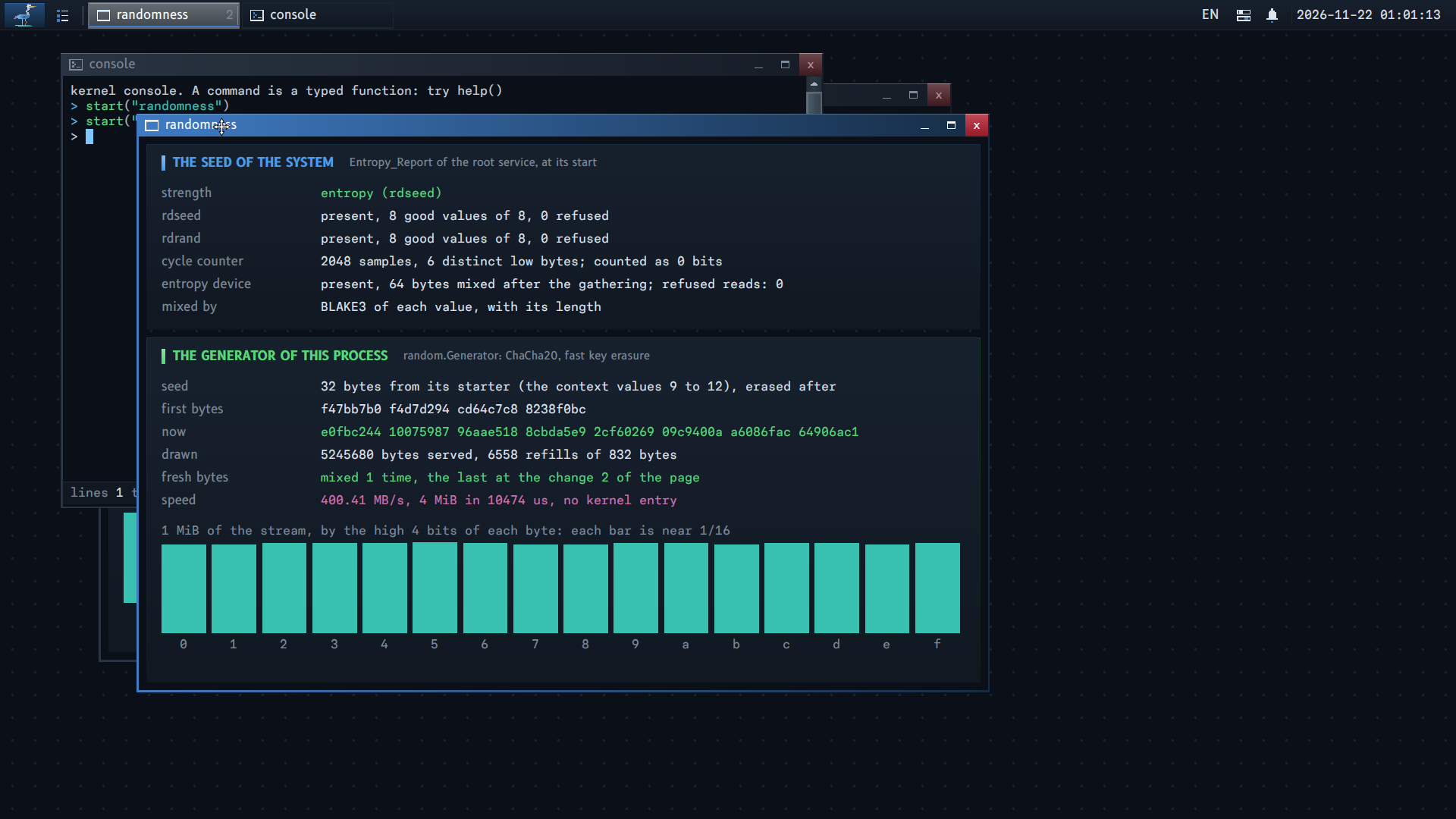
The idea in plain words. A process asks no service and no kernel for random bytes: its starter gives it a seed of 32 bytes in its context, and it draws from its own generator in its own memory. The root service gathers the seed of the system from the processor at boot, mixes in the bytes of the entropy device when the machine has one, and the system says how strong that seed is, so a process that makes a key can refuse a weak one. While a process runs, the root service writes new bytes in its fresh bytes page every 30 seconds, and the generator of the process mixes them into its key.
For whom. A reader who needs random bytes in a process, and a reader who must know how far to trust them.
Read before. Module contract: The context (the values of the seed).
The map of this guide. Section 1: where a process gets random bytes. Section 2: the generator. Section 3: the seed of the system, and what is claimed. Section 4: the tests. Section 5: what is not built. The fresh bytes of a running process are in section 3, "Fresh bytes for a running process".
1. Where a process gets random bytes
A process draws random bytes from its own random generator, a record of fixed size in its own memory (property 14). A draw makes no kernel entry and no call. The generator starts from the random seed of the process: 32 bytes that its starter writes in the context values 9 to 12 (op.CONTEXT_VALUE_SEED).
- The root service has no starter. At its start, before it starts any process, it gathers its own seed from the sources of the processor (section 3).
- Each starter (root,
console,errors,imports,frames,locks,rings,address_space,debugged,fault_ring,kernel_events,return_fault) gives each child 32 bytes of its own stream (random.values_with_seed).system.process_startrefuses a start whose seed is 32 zero bytes: a starter cannot forget it. - The process reads its seed once (
random.generator_from_context), which erases it in the context, and attaches the fresh bytes page of the process when the root service mapped one (section 3).
The forms that the system can take, weighed against the properties:
| Option | Against the properties | Chosen |
|---|---|---|
| A kernel operation that gives random bytes | Property 1: the kernel has 34 counted operations; this one needs no kernel: a process runs rdrand with no handle, and the root service can give a seed. A kernel entry for each draw is also a cost on a hot path (QUIC draws a connection ID and a nonce for each handshake) | No |
A service random that answers each request | Property 5: a call for each draw. The pool of a service is one shared state for all processes | No |
| A seed for each process at its start, and a generator in the process | Property 14 (the state is memory of the process), property 20 (no ambient access: the seed is a value of the context, which only the starter writes), property 5 (no call and no kernel entry for a draw) | Yes |
What a starter knows. The starter of a process knows its seed. A child has no secret from its starter, which already chooses its code and its grants. Two processes that one starter starts do not know the streams of each other.
The fault process reads value 14. fault reads its "zero" address from the value 14 of its context, which no starter writes: the seed is in the values 9 to 12.
2. The generator
src/library/modus/random/generator.odin: ChaCha20 with fast key erasure (D. J. Bernstein, "Fast-key-erasure random-number generators", 2017).
- Each refill runs ChaCha20 with the key of the generator and the nonce 0 for 13 blocks (832 bytes). The first 32 bytes are the next key; the next 800 bytes are served in order.
- The key that made a refill is overwritten at once. Each byte is erased (
erase_secret_bytes) when it is served. So a copy of the state after a draw does not give the bytes before it. reseedmixes new bytes into the key: the next key is BLAKE3 of a domain text, the old key and the new bytes.- The fresh bytes page. At each refill, and before the bytes of a key (
fill_for_a_key) or of a child seed (seed_for_a_child), the generator reads the change count of the fresh bytes page of the process. When the page has a change that the key does not have, the next key is BLAKE3 of the domain textkernel random: the fresh bytes of a process, version 1, the old key and the 32 bytes of the page, and the buffer is dropped. One change is mixed once. A draw from the buffer reads no page.generator_from_contextattaches the page of the context;random.fresh_bytes_attachattaches it to the generator of another thread. - A zero generator is not seeded: a draw from it stops the process, so that no process draws from a known key.
- One generator belongs to one thread. Two threads that draw from one generator at once would get the same bytes (two equal nonces, two equal child seeds). A second thread gets its own generator, seeded with
seed_for_a_childof the first. A draw or a reseed sets a flag of the generator with an atomic exchange; a second draw that finds it set stops the process with the sentence "random: two threads drew from one generator at once ...", instead of a bounds check later. The check costs one atomic exchange for each draw. It finds two draws that overlap, not a generator that two threads use one after the other (which gives no equal bytes). - The stack is erased after a refill and after a hash of a key. The frames of ChaCha20 under
refillhold the words of the key that made the refill, and the frames of BLAKE3 underkey_derivehold the old key and the chaining values.fillcallserase_stack_below_the_callerafter each refill, andreseedandentropy_gatherafterkey_derive(the same 16 KiB as in Cryptography: The module cryptography). So "the key that made a refill is overwritten at once" holds for the record of the generator and for the stack below the draw. - The ChaCha20 is the code of Odin's
core:cryptothat the system took (Cryptography), checked against RFC 8439.
Speed: 4 MiB in 12.4 to 38.7 ms in the process randomness (108 to 339 MB/s, host load 19 to 22). A draw of 32 bytes for a TCP secret costs about 0.1 to 0.3 us.
3. The seed of the system, and what is claimed
The root service hashes, with BLAKE3, each value of each source, each with its length (random.entropy_gather, key_derive):
| Source | How it is read | Its checks | What it can claim |
|---|---|---|---|
rdseed | 8 values of 64 bits, when CPUID 7 says the processor has it | A value with the carry clear (empty), all ones (a known fault of some processors of AMD), or equal to a value before it, is refused and read again, 32 times for each value at most | The entropy source of the processor, by its specification: strength entropy |
rdrand | 8 values, when CPUID 1 says the processor has it | The same | The generator of the processor, which the processor reseeds: strength processor |
| The cycle counter | 2048 deltas of rdtsc around a short loop | None: its count of distinct low bytes is shown, as a sign of life only | 0 bits: this system does not measure its entropy. A seed from it alone has strength weak |
| The entropy device | 2 reads of 32 bytes through the entropy service, after the gathering, when the machine has the device, then 1 read every 30 seconds; mixed with reseed | A read with no byte, with one value only, or equal to the read before is refused, and the key stays as it was | No change of the strength: the bytes add to the key, below |
The strength of the seed is the strongest source that gave all its values. The root service writes it on the log: "root: the random seed of the system, strength ...". It gives the facts of the gathering, never the seed, to the process randomness (its context values 0 to 7).
The reads are not merged. The reads of rdrand and rdseed through a procedure value (processor_values in src/library/modus/random) carry #side_effects: without it, LLVM keeps one value for all the reads (a machine test then shows "rdrand present, 1 good, 255 refused").
No claim beyond the sources. The system does not test the output of rdseed or rdrand for quality. A processor whose generator is wrong or hostile gives a wrong seed, with no sign; the jitter of the cycle counter is mixed in so that such a processor alone does not fix the seed, but this system claims no bits from it.
A machine with no rdrand and no rdseed. The seed comes from the cycle counter only. Each process still starts and draws. The log and the window say "weak (the cycle counter only)" in the color of a failure. modustool test random runs such a machine (-cpu max,-rdrand,-rdseed).
Each process knows the strength of its seed. The starter writes the strength of the seed of the system in the context value op.CONTEXT_VALUE_SEED_STRENGTH with the seed: a member of op.Seed_Strength (Weak, Processor, Entropy). A child's seed comes from its starter's stream, so it has the same strength. random.seed_strength(generator) gives it. A value that names no member refuses the seed: random.generator_from_context gives false, and the process has no generator, so each key that it asks for is refused. A reader never takes such a value for the strongest strength.
Each process chooses the least strength that it accepts. The functions let the process state what it tolerates; a seed below that is an error of the call, not a stop.
random.fill_for_a_key(generator, output, least_strength, error)gives bytes for a key, a nonce or another secret only when the seed of the process hasleast_strengthat least.- If the seed is weaker, the call gives the error kind
Seed_Too_Weak(value: the strength of the seed; limit: the strength asked), with the sentence "the random seed of this process has the strength weak (the cycle counter only), and the call asks for processor (rdrand) at least: it made nothing". It writes no byte. - The system does not refuse for the process, and a plain draw with no requirement (
random.fill) stays as it is. - QUIC and TLS ask for
processorat least (Tls_Configuration.least_seed_strength): on a machine with nordrandand nordseed, a handshake does not start, and the caller gets the error. - The exports of the module
cryptographytake each key as an argument and draw no random byte, so they have no such parameter.
The boot-time problem: who seeds root. No process runs before the root service, so it cannot get a seed from a device process. It takes one from the processor at its start; the entropy service adds bytes later, below.
The entropy device. When the machine has the entropy device of virtio (virtio-rng-pci in QEMU) at the place 19 of bus 0, the root service starts the entropy service, the process entropy, after the compositor. It asks for two reads of 32 bytes and does not wait for them. Its loop mixes each read into its generator with random.device_bytes_mix, which calls reseed: the next key is BLAKE3 of a domain text, the old key and the bytes. When both reads are in, the log has:
root: the entropy device gave 64 bytes in 2 reads: 64 bytes mixed into the random generator of the system; refused reads: 0
- One more source, never the only one. The bytes add to the key and do not replace it. A device that lies cannot remove what the processor gave.
- A read that adds nothing is refused. A read with no byte, a read whose bytes all have one value (zeros, all ones), and a read equal to the read before it leave the key as it was. Each one counts in "refused reads", as does a read that the entropy service answered with an error. These checks find a broken device. They are not a protection against a hostile one, which passes them with ease: the protection is the mix, whose key always has the bytes of the processor in it.
- The strength does not change. The seed strength stays the claim of the processor: the system cannot check the bytes of the device, and the processes that start before the reads have no bytes of the device.
- Which seeds have the bytes. Each process that the root service starts after the line.
input, the compositor and the processes that start while the device answers have the seed of the processor only. - The entropy service and its ring. The service holds the registers of the device, one message interrupt, the memory of its queue, the machine with the right Physical and a copy of the configuration of the device. The root service makes the entropy ring, of 32 records (
RING_CAPACITYofsrc/library/modus/contract/entropy_service), and gives it to the service as the role 0 of its context. The completion of aReadcarries the count that the device gave, at most the count asked whatever length the device says, then the bytes, 8 in each of its six other values. Its status isOk,Bad_CommandorDevice_Error; when it is notOk, the values are an error record. The service answers one command at a time, in order, and erases its buffer after each answer. At its start its log hasentropy: ok, a queue of <size>. - A machine with no device starts as before, with one line:
root: no entropy device at the place 19 of the bus: the random seed of the system has the sources of the processor only.
The entropy report carries the facts of the device to the process randomness: present or absent, the bytes mixed, the refused reads. It counts the two reads of the start only. The design is in The entropy device in the repository.
Fresh bytes for a running process. A seed is given once, at the start. So a process that starts before the reads of the device has no byte of the device, and a reader who copied the state of a generator once could compute each byte that it gives after the copy. The fresh bytes refresh closes both:
- The source and the rate. 30 seconds after the reads of the start, and then every 30 seconds, the root service asks the entropy service for one read of 32 bytes, and mixes it into its generator with
random.device_bytes_mix, with the same refusals. - The bytes of each process. After a read that it mixed, the root service draws 32 bytes of its stream for each process that has a fresh bytes page, and writes them there. Each process has its own bytes, and no process reads the bytes of another.
- The page. One page for each place of the table of the processes of the root service, in one memory object. The root service maps the page, read-only, at the fixed range
Fresh_Bytes_Page, into each process that it starts by its name, into the compositor and into each disk process. It writes the page to zero when a new process takes the place. The form ismodus:contract/fresh_bytes. - The mix in the process. At a refill and before a key, never at each draw (section 2). The page changes once in 30 seconds, and the same bytes mixed again add nothing; a mix costs a BLAKE3 hash and the 800 bytes of the buffer.
- No device, no refresh. A machine with no entropy device writes no fresh bytes, and each page keeps the change count 0.
- The cost of a refresh, counted: one read of 32 bytes of the device, two BLAKE3 hashes (the hash of the read that finds a repeat, and the new key) and at most 1024 bytes of the stream in the root service, one write of a page for each process, and one BLAKE3 hash in each process at its next refill or key.
The root service writes one line at the first refresh, and none after it:
root: the first fresh bytes: 32 bytes of the entropy device mixed into the random generator of the system, then 32 bytes of its stream in the fresh bytes page of each of 9 processes; a read every 30 seconds after this one, with no line
A refused read writes one warning. After 3 refused reads in a row, the root service asks for no more, with root: the entropy device gave 3 refused reads in a row: no more fresh bytes for the running processes. An entropy service that stops writes root: the entropy service stopped: no more fresh bytes for the running processes. The lines of a refused read are log facts of the root service, with the counts as fields: root.Fresh_Bytes_Read_Added_Nothing, root.Fresh_Bytes_Reads_Refused_In_A_Row, root.Entropy_Answer_Out_Of_Order, root.Entropy_Reads_Late and root.Entropy_Service_Stopped_Early (Developer tools: The log).
A read that never completes. Each read has a deadline of 60 seconds from its ask, READ_DEADLINE_MILLISECONDS of src/library/internal/root/entropy_read_deadline: the hang bound of the system, not a measure of the device. Each other document points here for this number. The entropy service serves one read at a time, so a device that takes a read and never ends it holds every later read. Past the deadline, each read in flight counts as refused, in the entropy report for the reads of the start, the root service stops the entropy service, and it writes one line, here for the two reads of the start: root: the entropy device did not answer a read in <seconds> seconds: 2 reads count as refused, and the entropy service stops: no more bytes of the device, with the deadline in seconds. The seed keeps the sources of the processor and the reads that ended. The design is in A missing or silent part of the machine in the repository.
The design is in Fresh bytes for a running process in the repository.
4. The tests
- Host tests (
odin test src/library/modus/random):- the generator gives the ChaCha20 stream of its key after its first 32 bytes, then the stream of the next key;
- each served byte is erased;
- two seeds give two streams, a zero seed is refused, and a child seed is not part of the later stream of its starter;
- a statistical smoke test on 1 MiB: the count of one bits within 6 standard deviations, and a chi-square of the 256 byte values between 150 and 400. It finds a gross fault, and proves nothing about the quality;
- each fallback with sources of the test: none,
rdrandof all ones,rdrandthat repeats one value,rdrandalone, andrdseed; - a read of the entropy device of zeros, of all ones, of one byte, with no byte, or equal to the read before leaves the key as it was and counts as refused; a good read changes the key and counts its bytes; the strength does not change;
- the report goes through the context values and back, with the facts of the device;
- a change of the fresh bytes page is mixed at the next refill and once, not at a draw from the buffer; a key and a child seed mix it at once, and the bytes of the key are the stream of BLAKE3 of the domain text, the old key and the page; a page in the middle of a change and a key refused for its strength mix nothing;
generator_from_contextattaches the page only when its range is mapped.
odin test src/library/modus/contract/entropy_service: the bytes of a read go through the values of a completion and back, and a count above the limit gives the limit.odin test src/library/modus/contract/fresh_bytes: a write is read once, a change in progress and a cleared page give no bytes, and the page of a process is at its fixed range only with the bit of its range.odin test src/library/internal/root/entropy_read_deadline: a time before the ask and one before the deadline are not past it, a deadline that does not fit is the end of the clock, and the deadline and each later time are past it.modustool test missing_devices, its third machine: an entropy device whose source never answers; the root service writes the line of the deadline, and a processrandomnessstarted after it logs "randomness: the entropy device: 0 bytes mixed after the gathering; refused reads: 2".modustool test random, three machines:- two with the processor of the host (strength
entropy), with two processesrandomnessin the first; - the first with the entropy device: the root service writes the line of the two reads, and
randomnesslogs "randomness: the entropy device: 64 bytes mixed after the gathering; refused reads: 0"; then the root service writes the line of the first fresh bytes, and each of the two processesrandomnesslogs "randomness: the fresh bytes of the root service are mixed into the generator of this process, at the change N of its page" before the picture of its window; - the second with no entropy device: it starts with the sources of the processor, and
randomnesslogs "randomness: the entropy device: absent"; - one with no
rdrandand nordseed(strengthweak). - The first 16 bytes of the stream of the 4 processes all differ: two processes give different streams, and a restart gives different streams.
- two with the processor of the host (strength
serverandfetchtake the secret of the initial sequence numbers of TCP from their generator (modustool test tcp).
5. What is not built
- Fresh bytes for every process. The device services, the TPM service,
input, a terminal and each process that another process starts get no fresh bytes page. - A strength of the entropy device. The device adds bytes and no claim.
- The TPM (property 17) as a source.
- A measure of the jitter of the cycle counter (as
jitterentropydoes). Without it, the claim stays 0 bits.