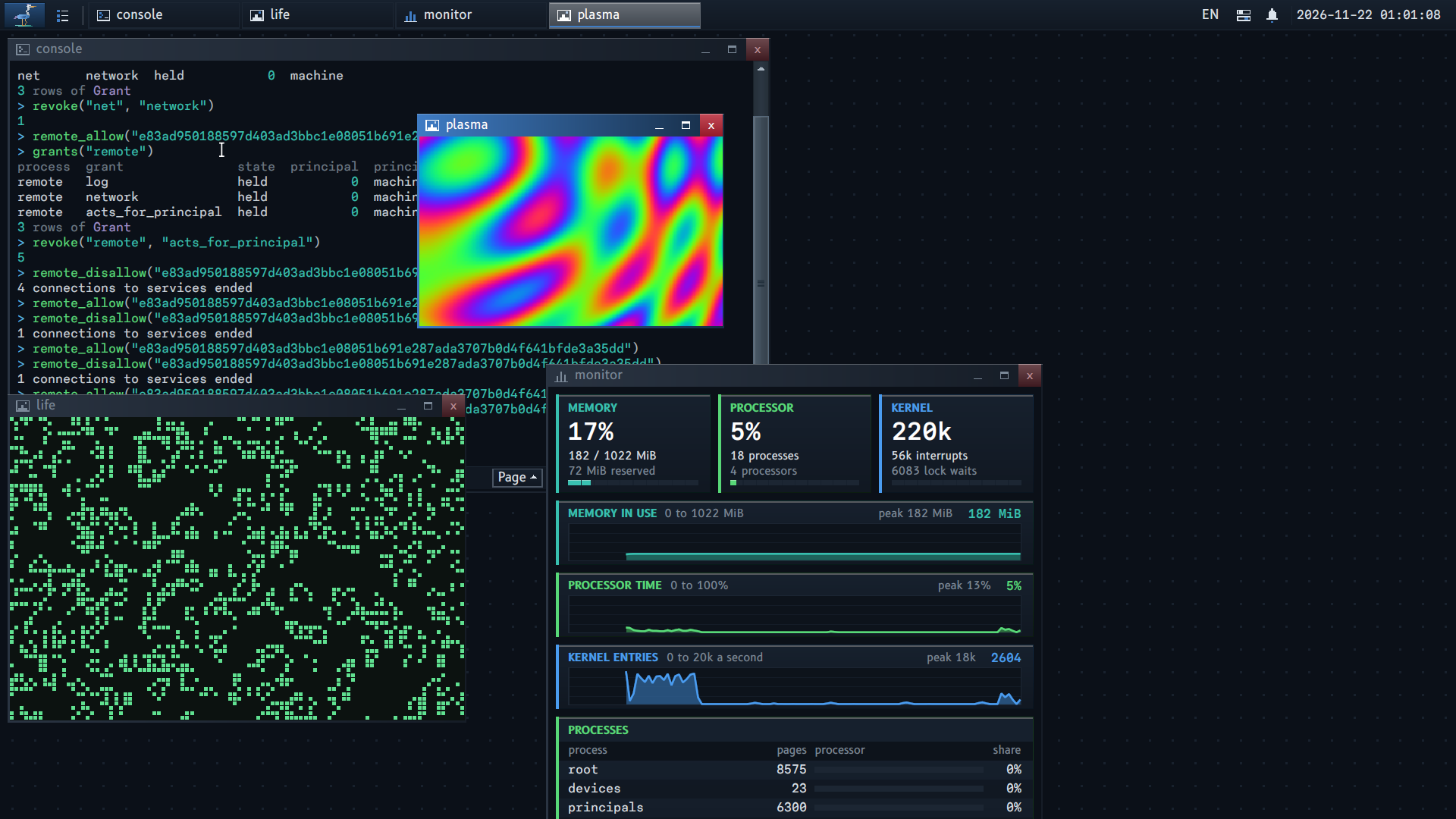
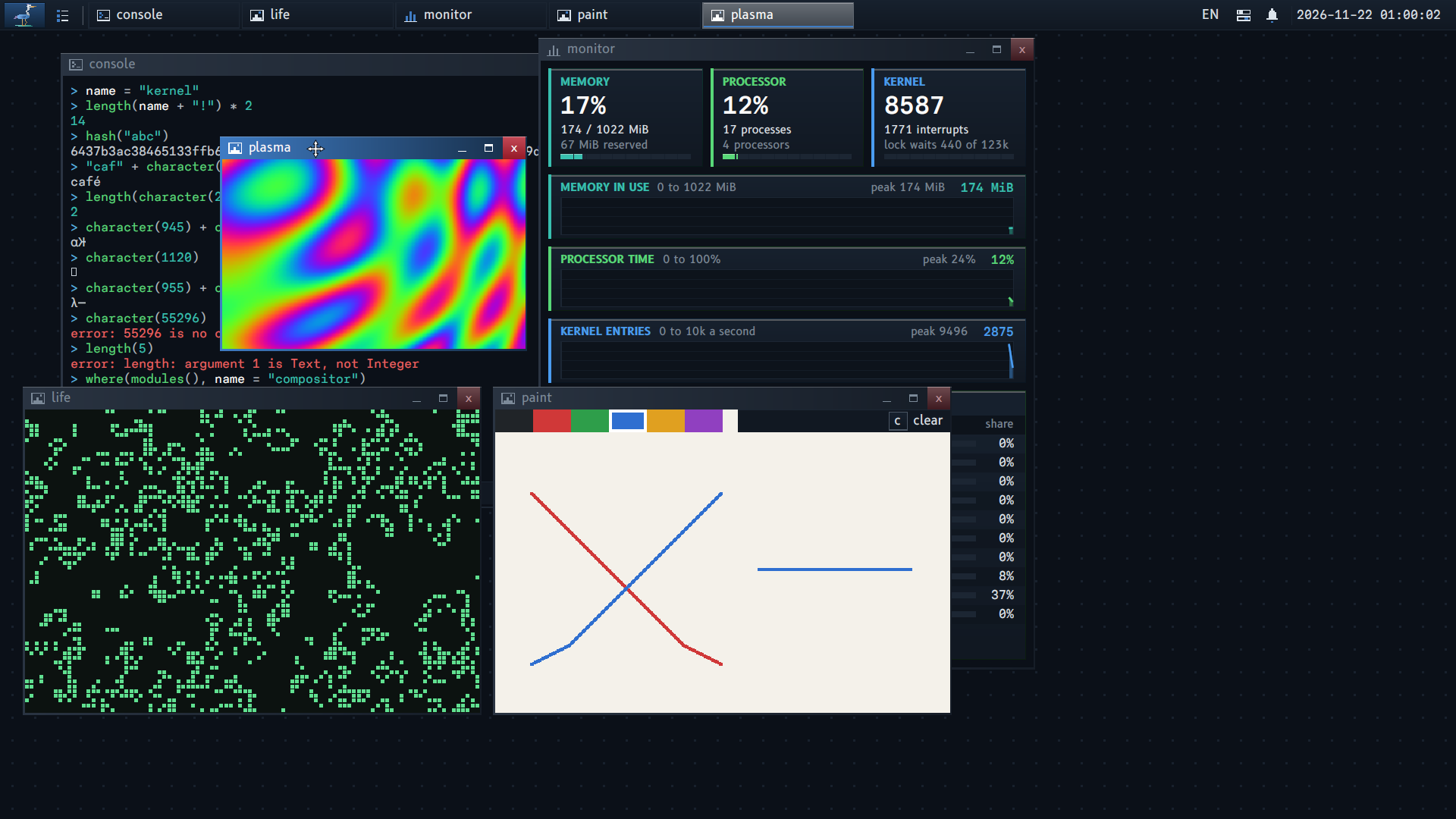
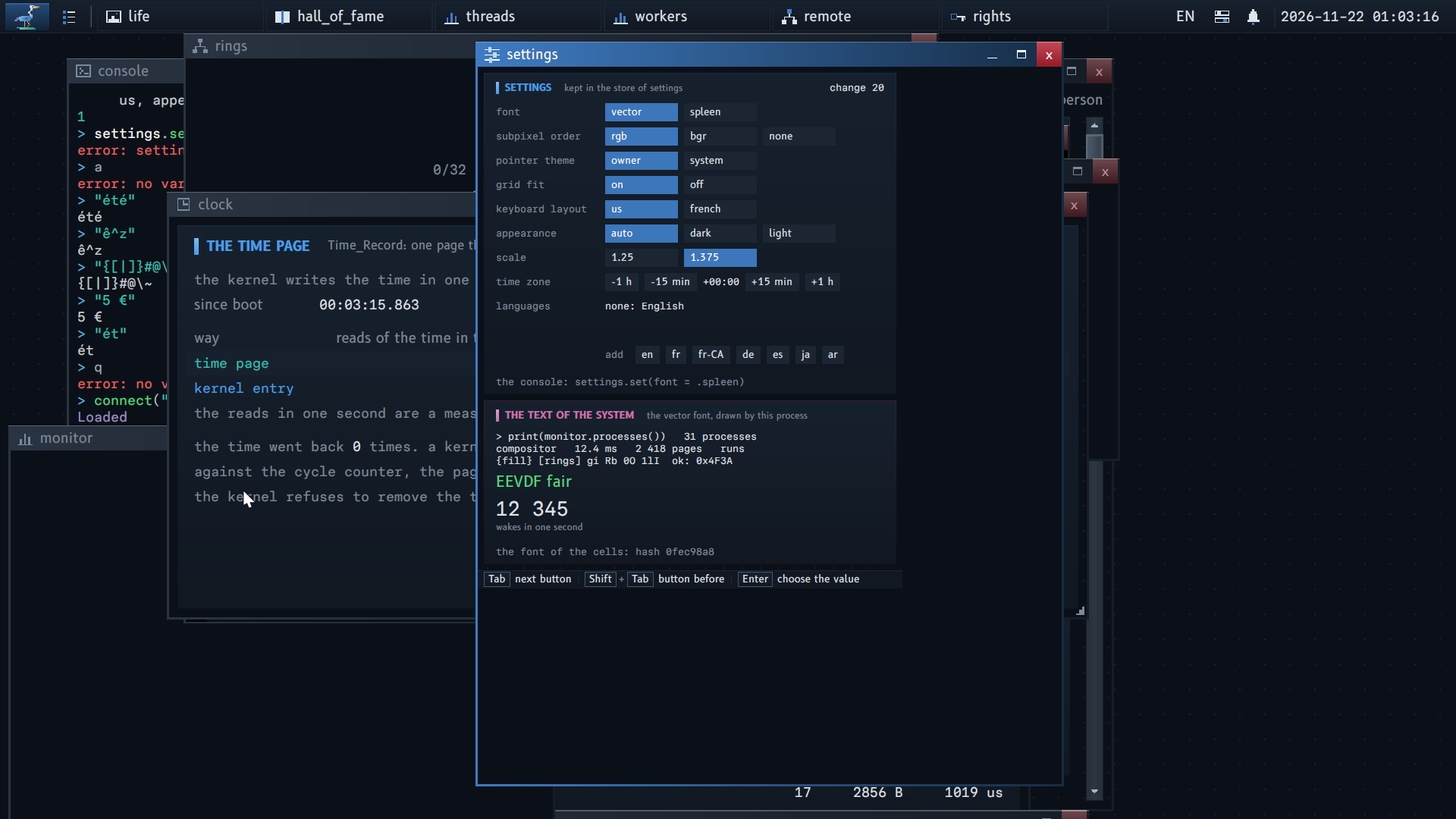
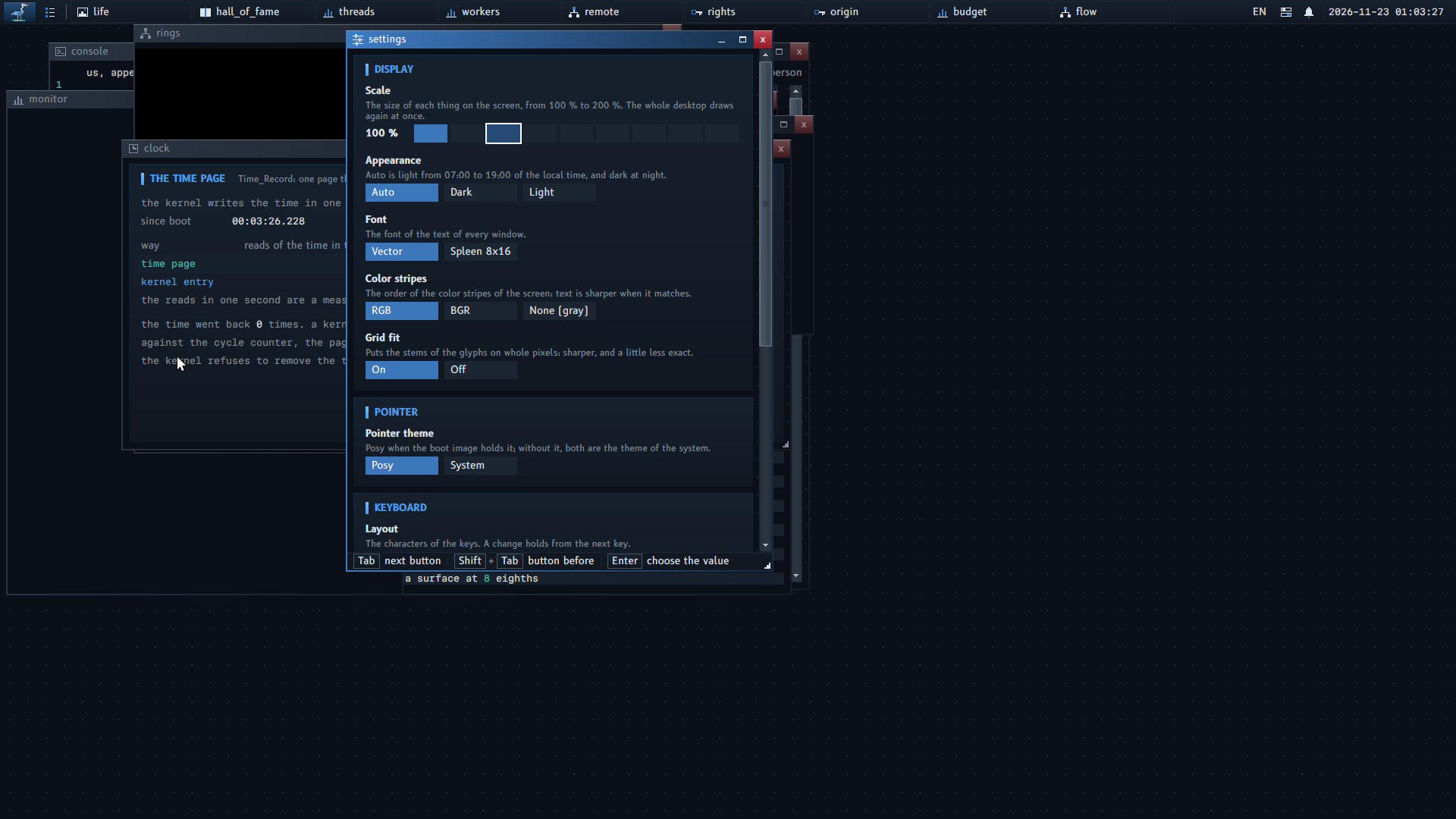
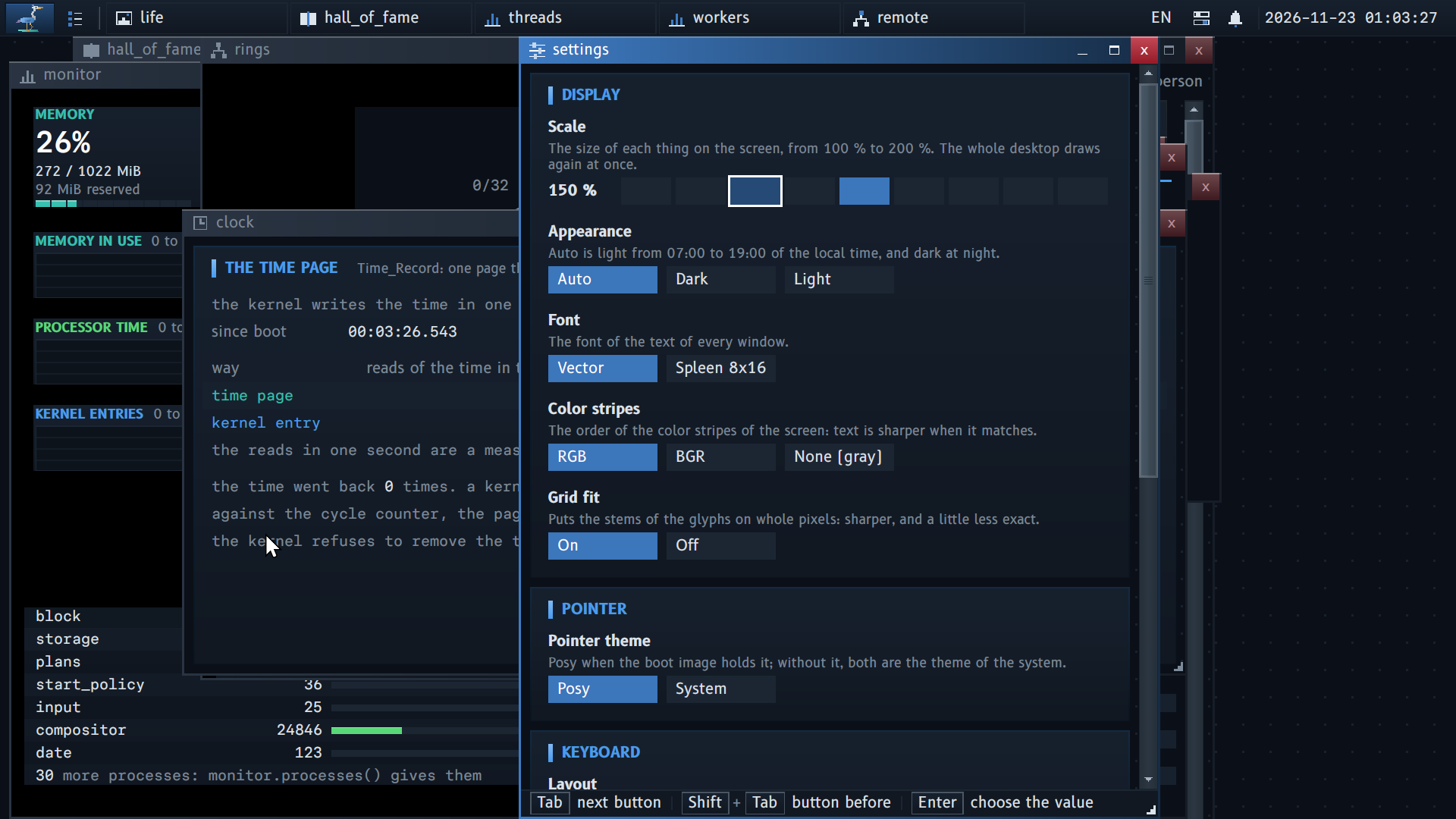
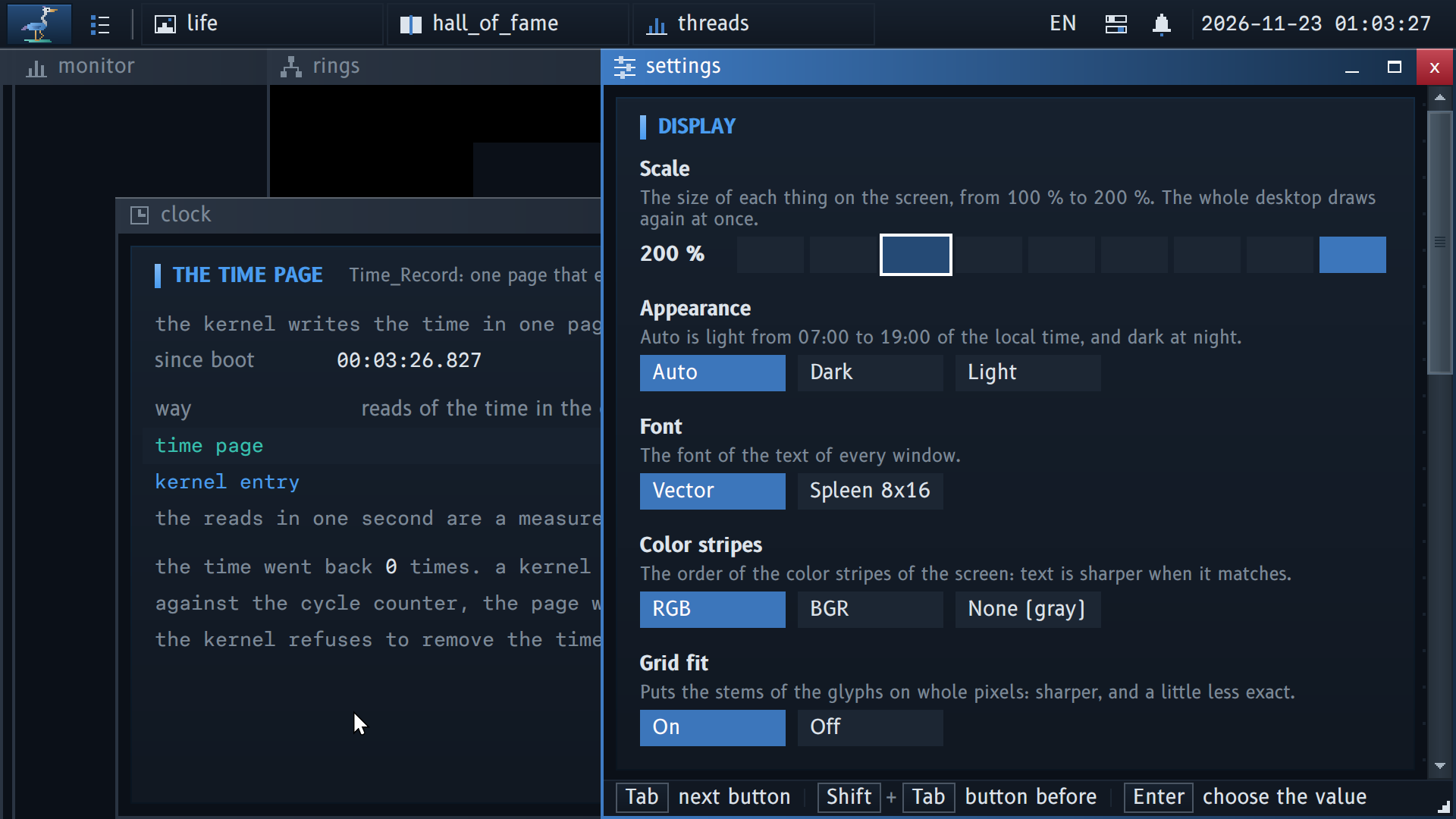
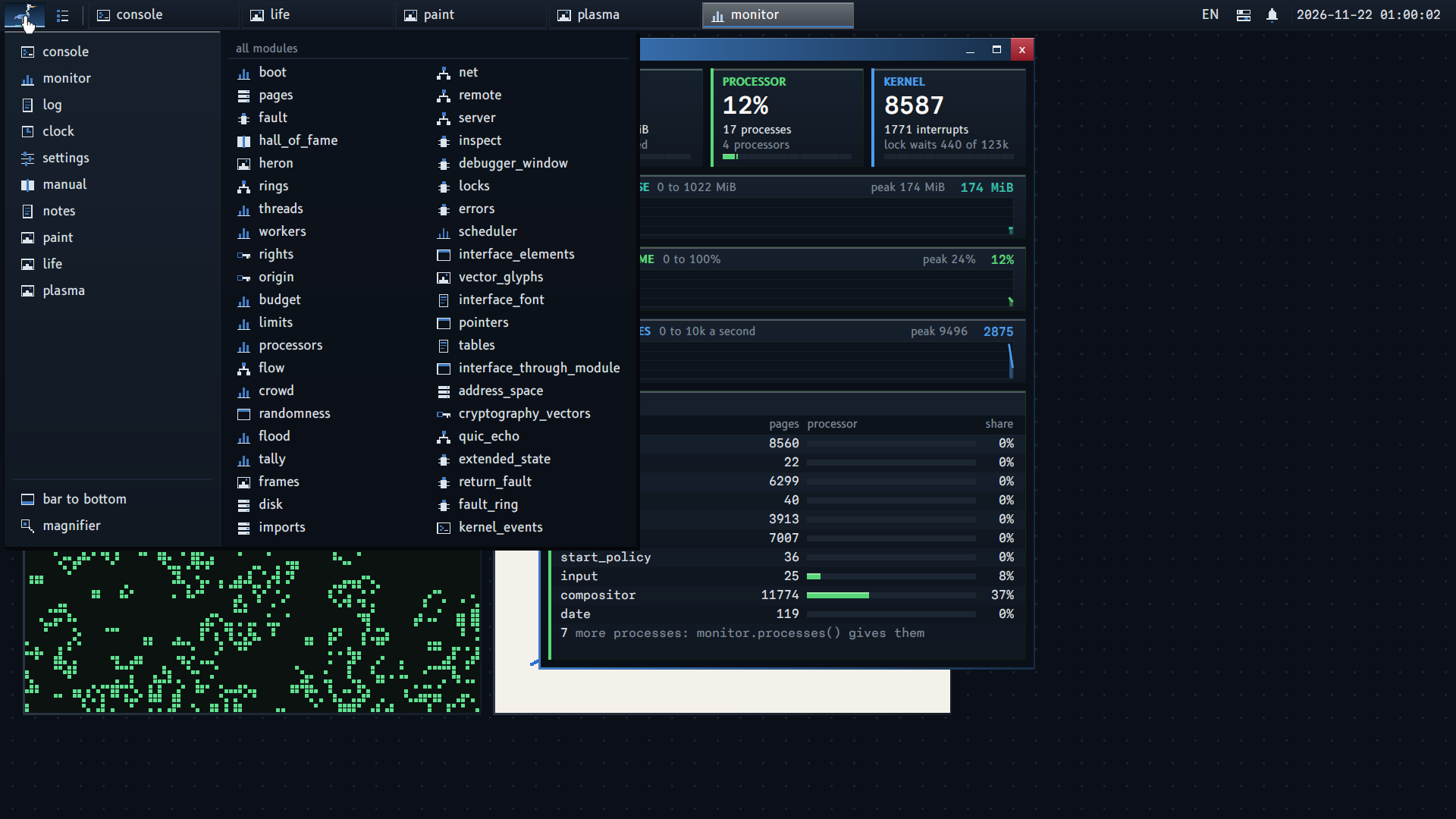
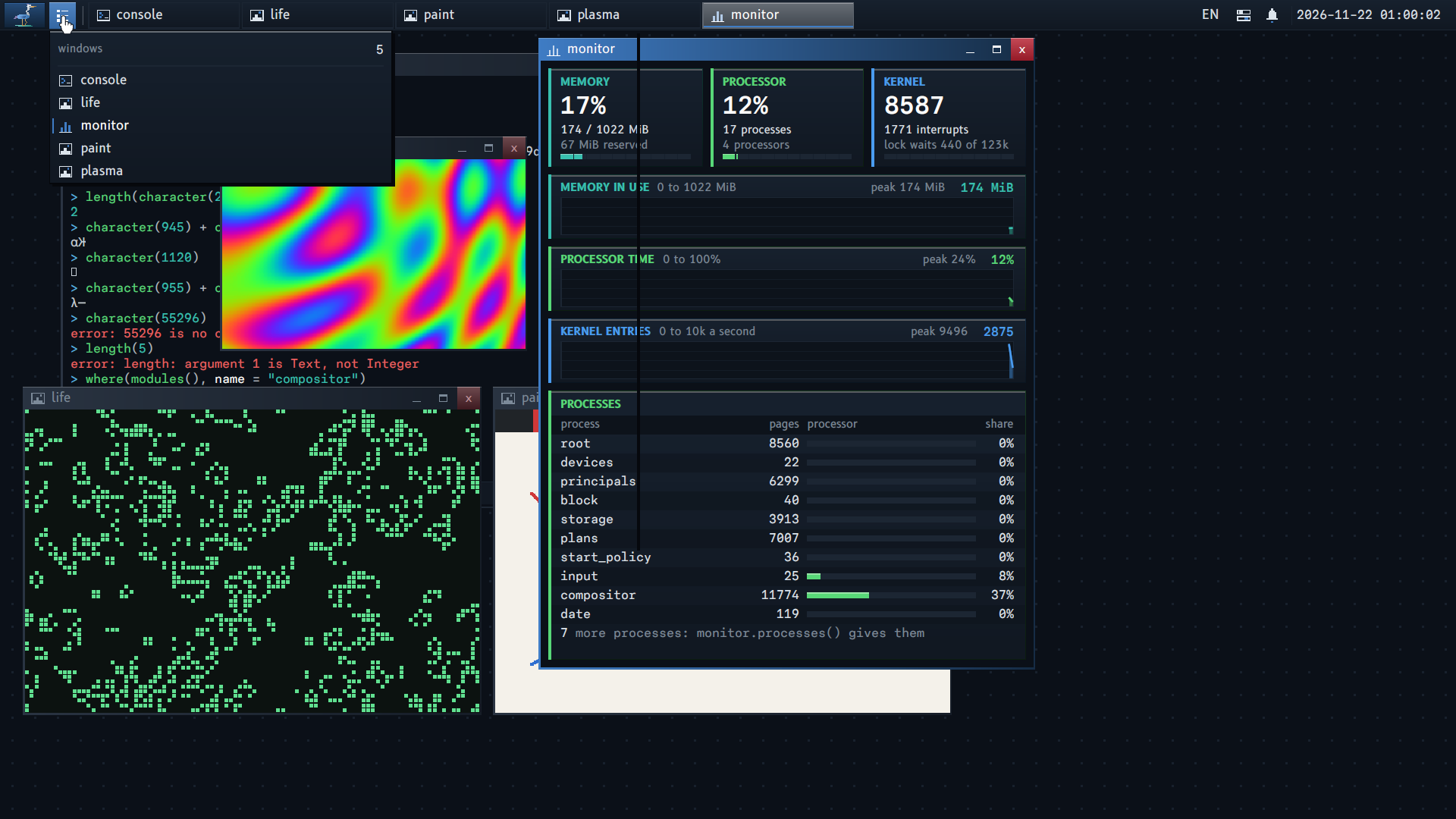
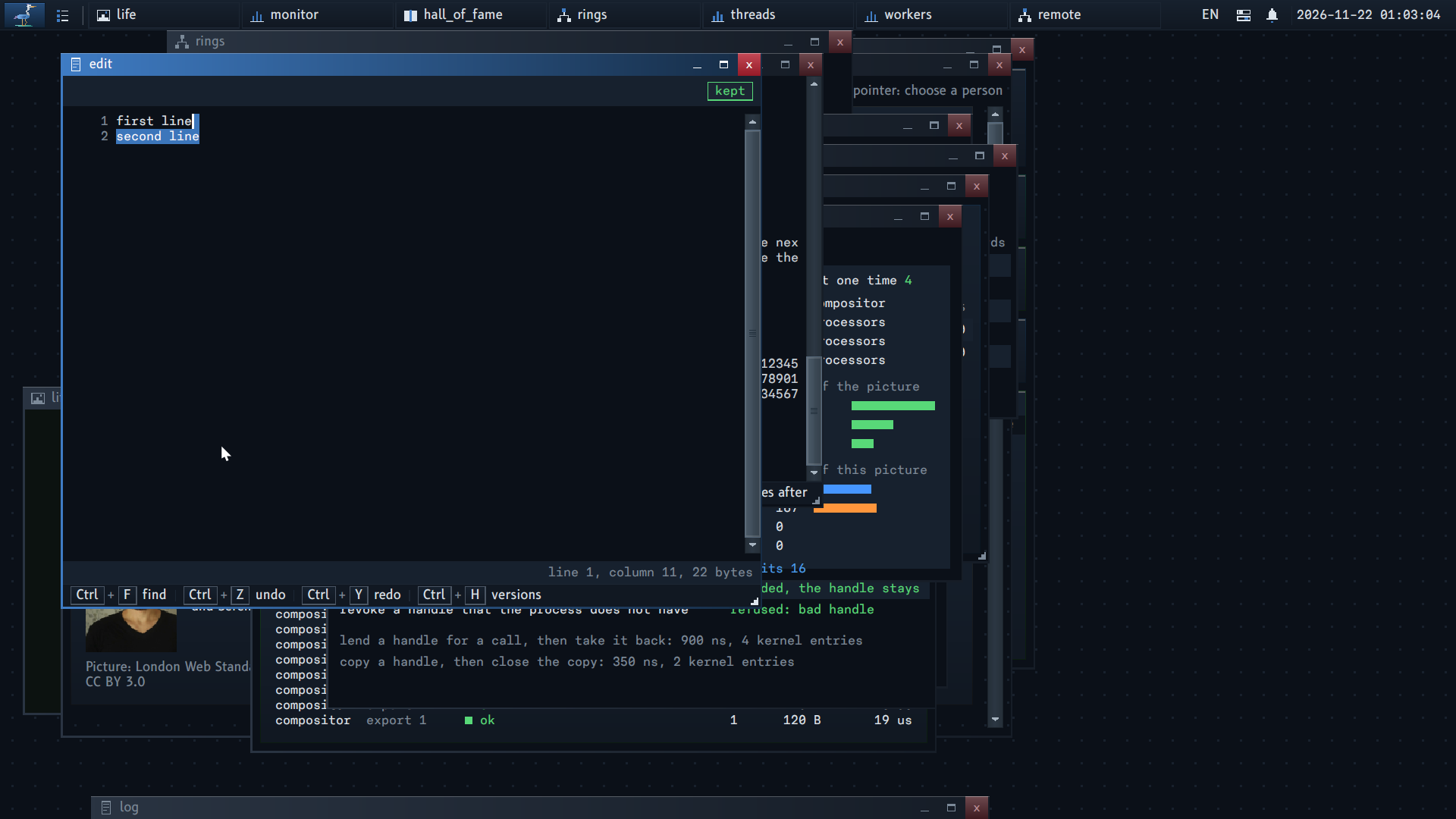
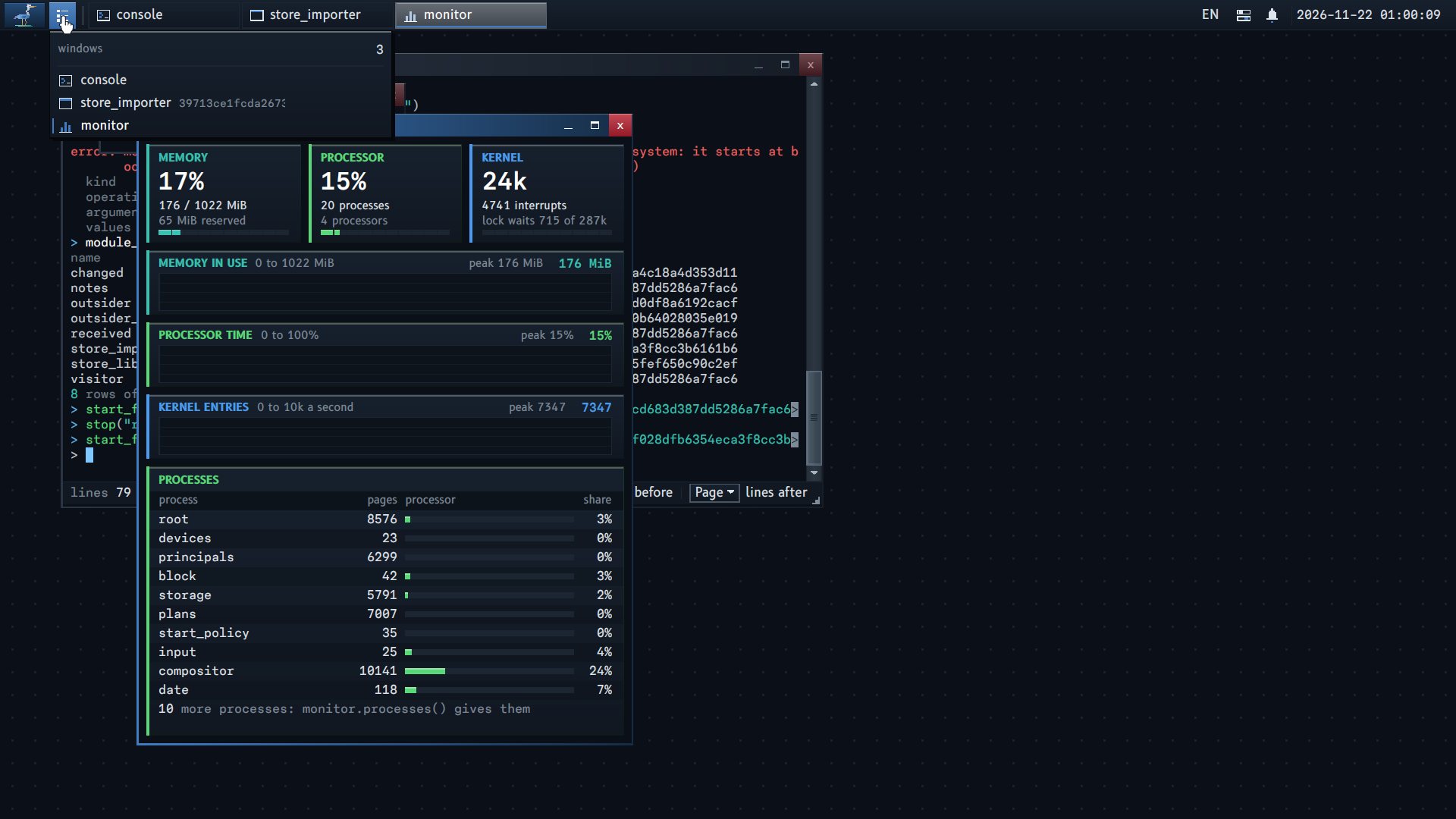
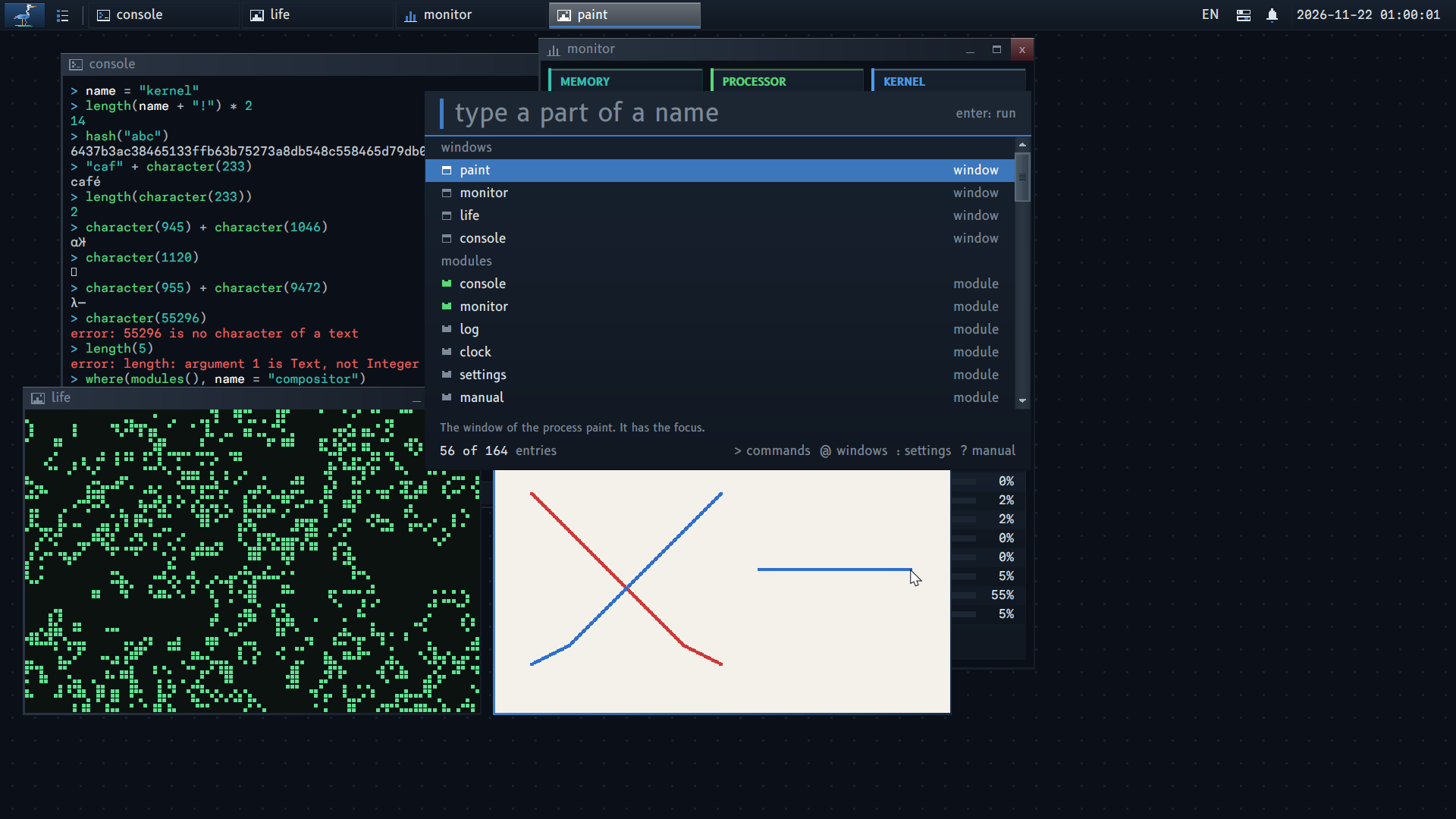
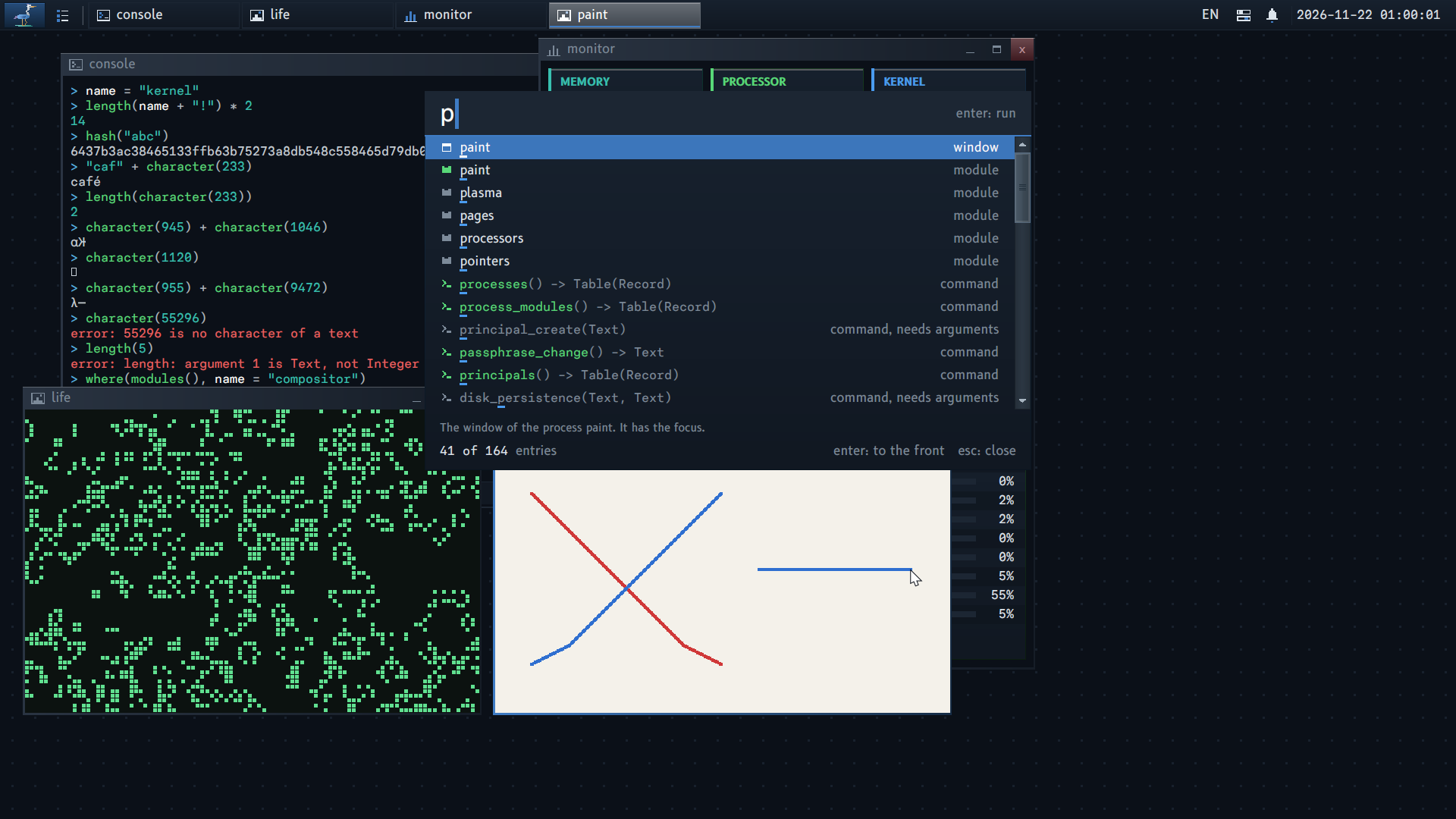
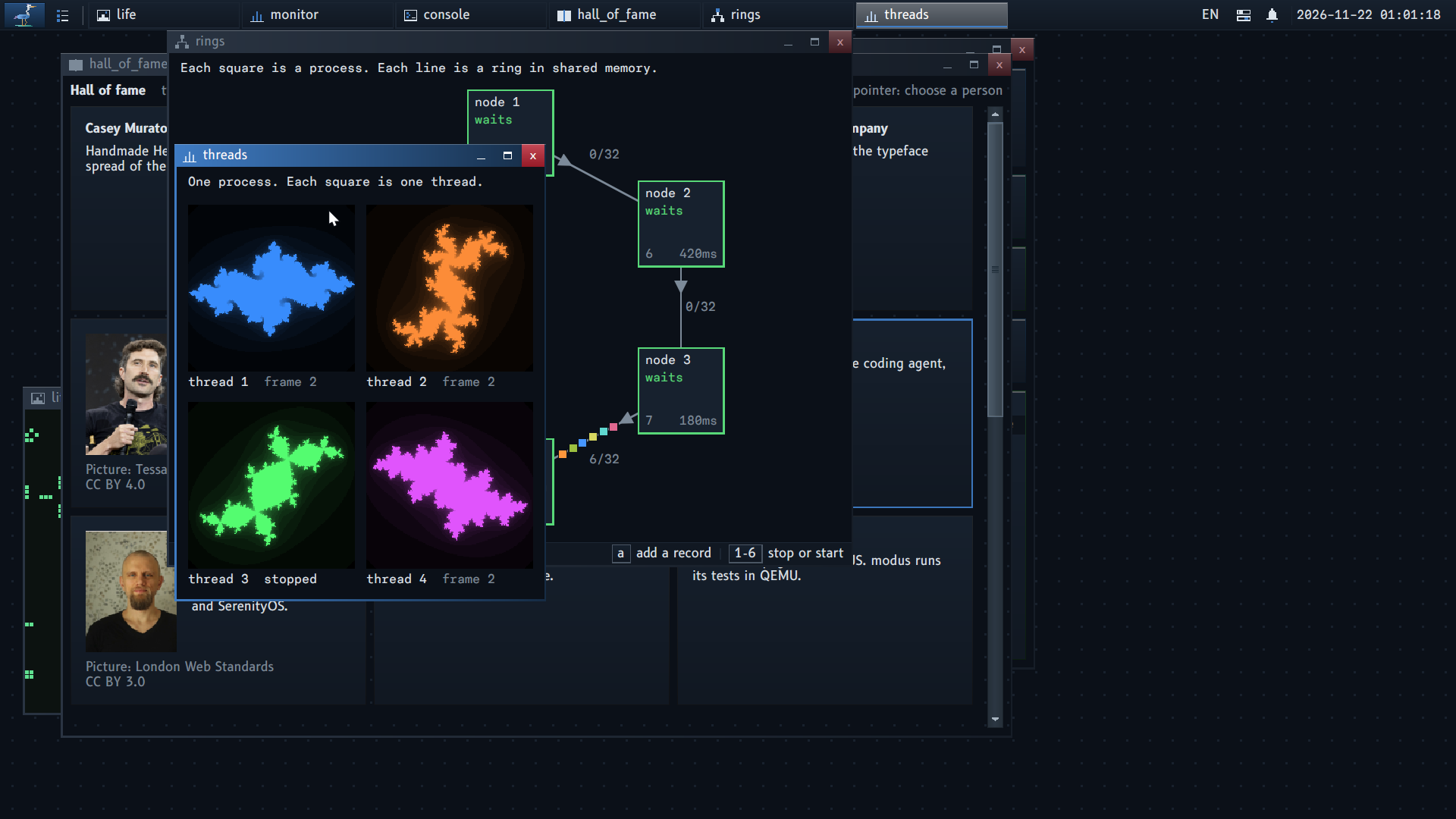
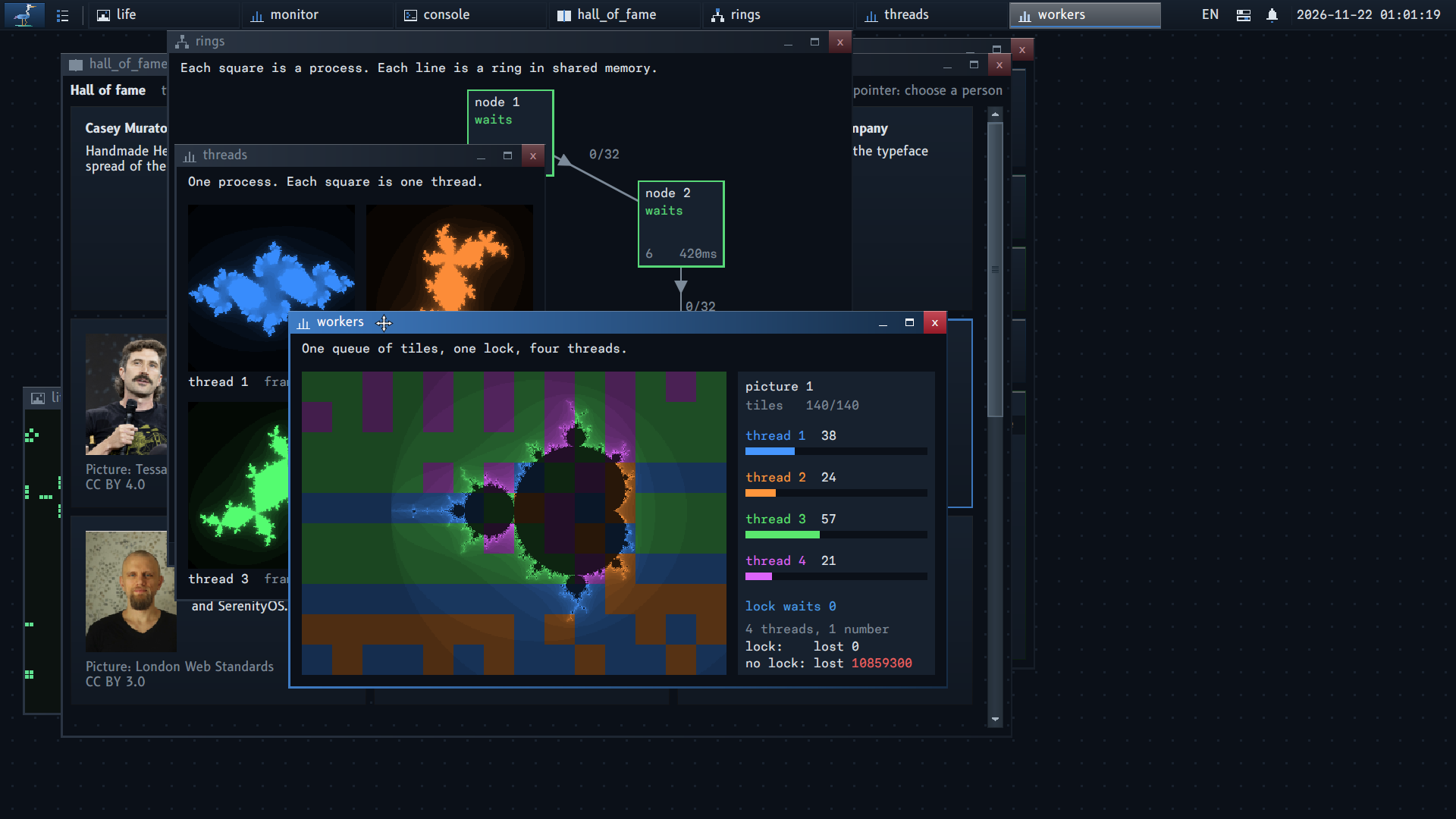
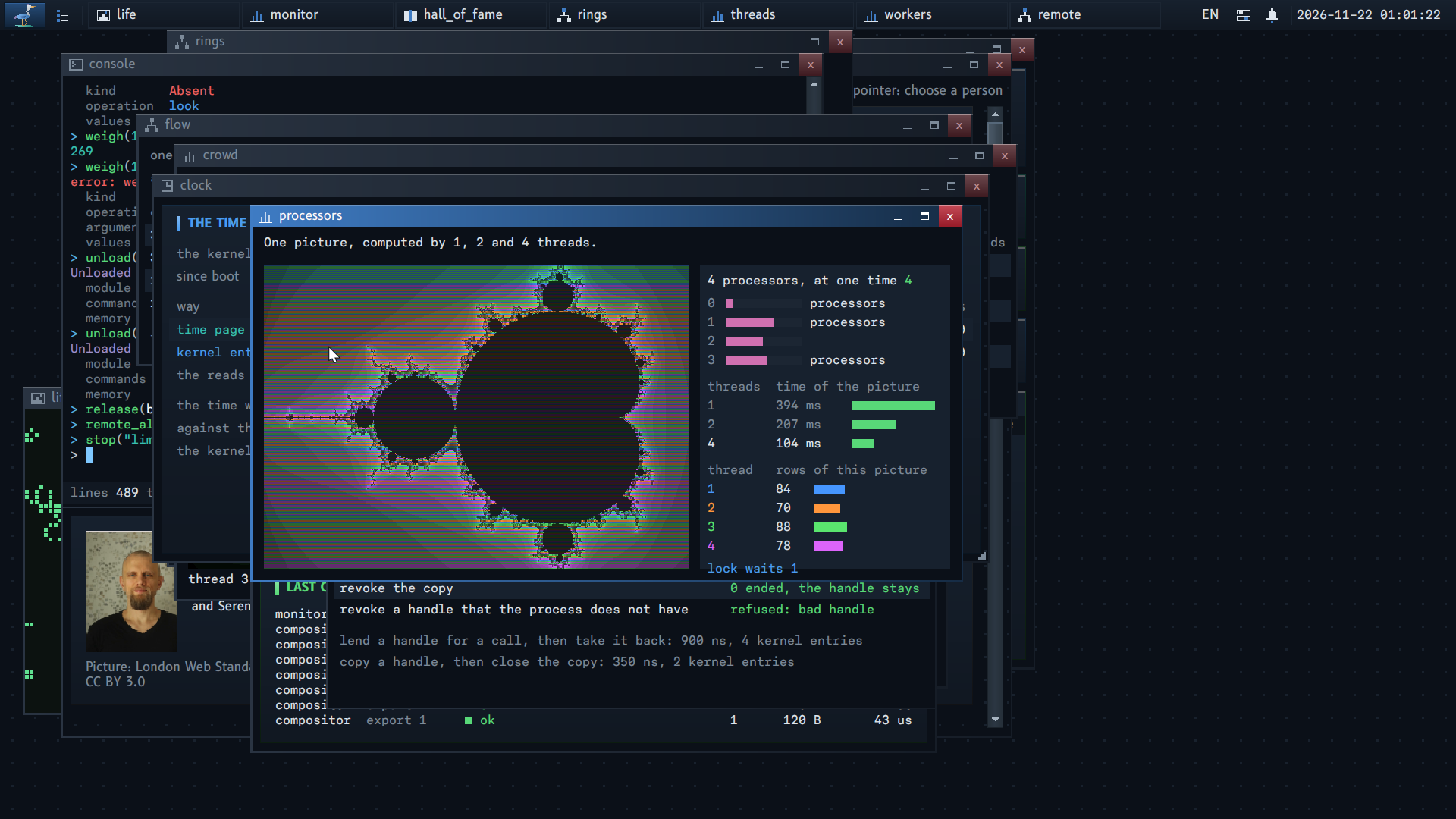
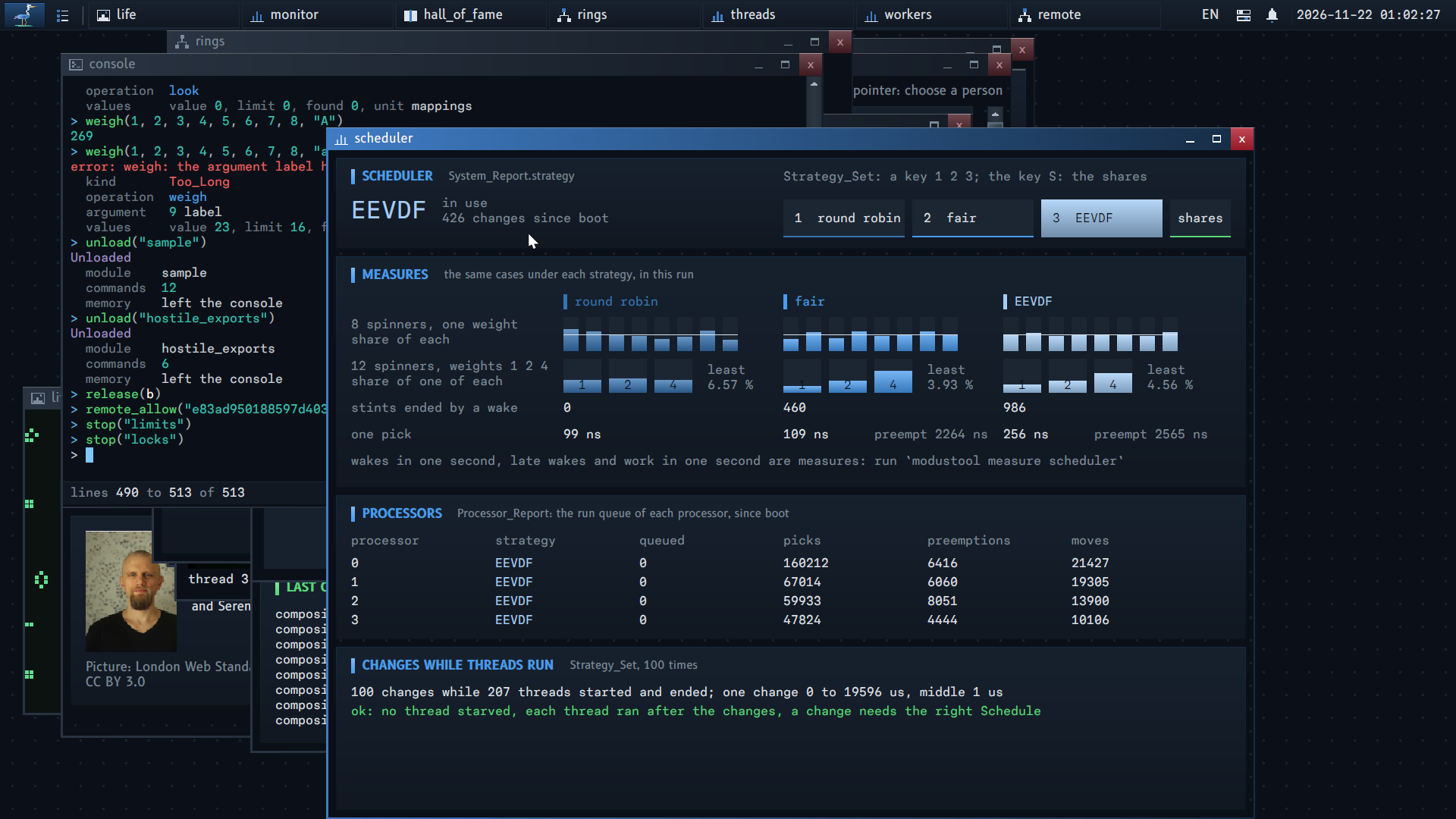
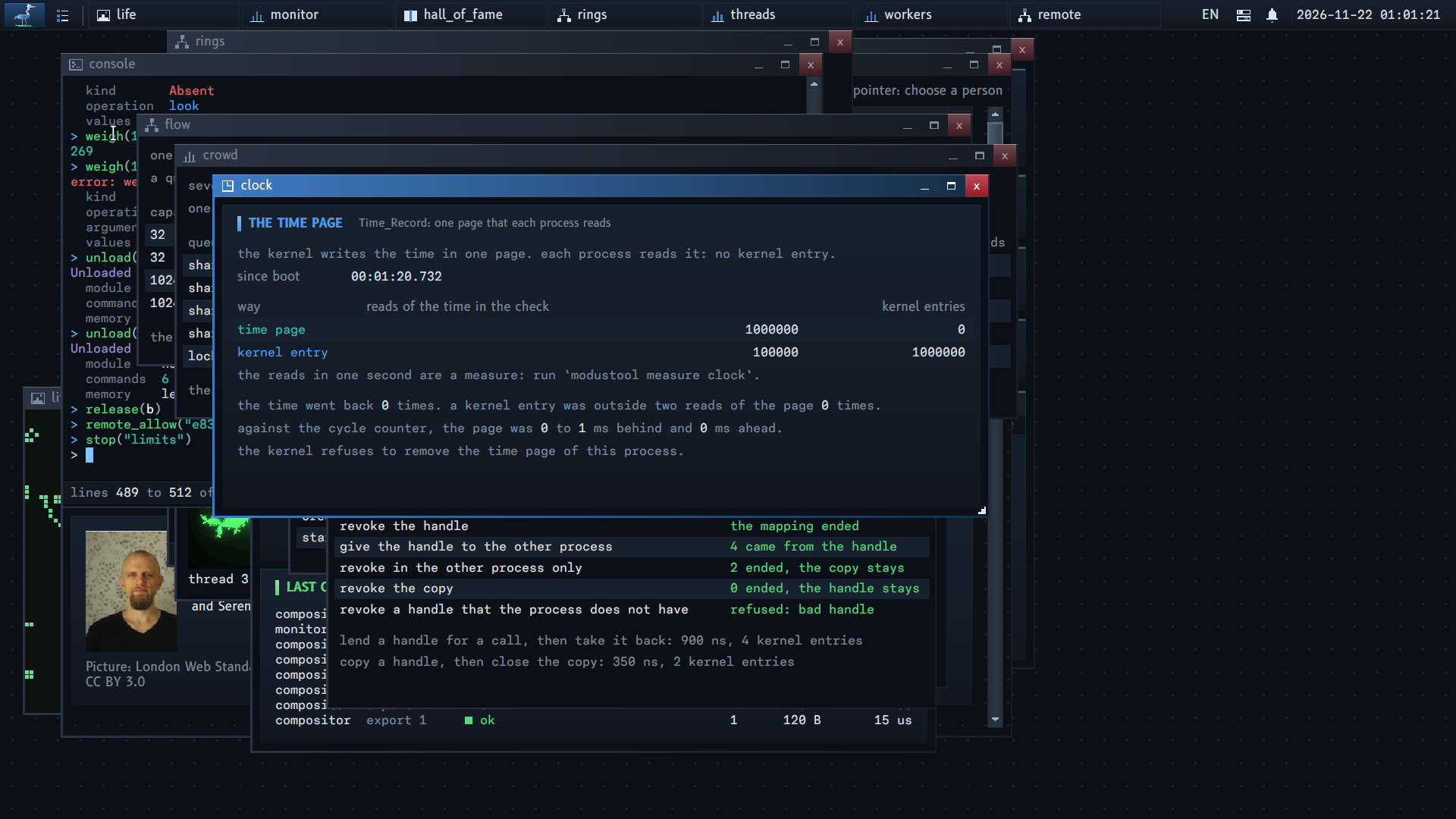
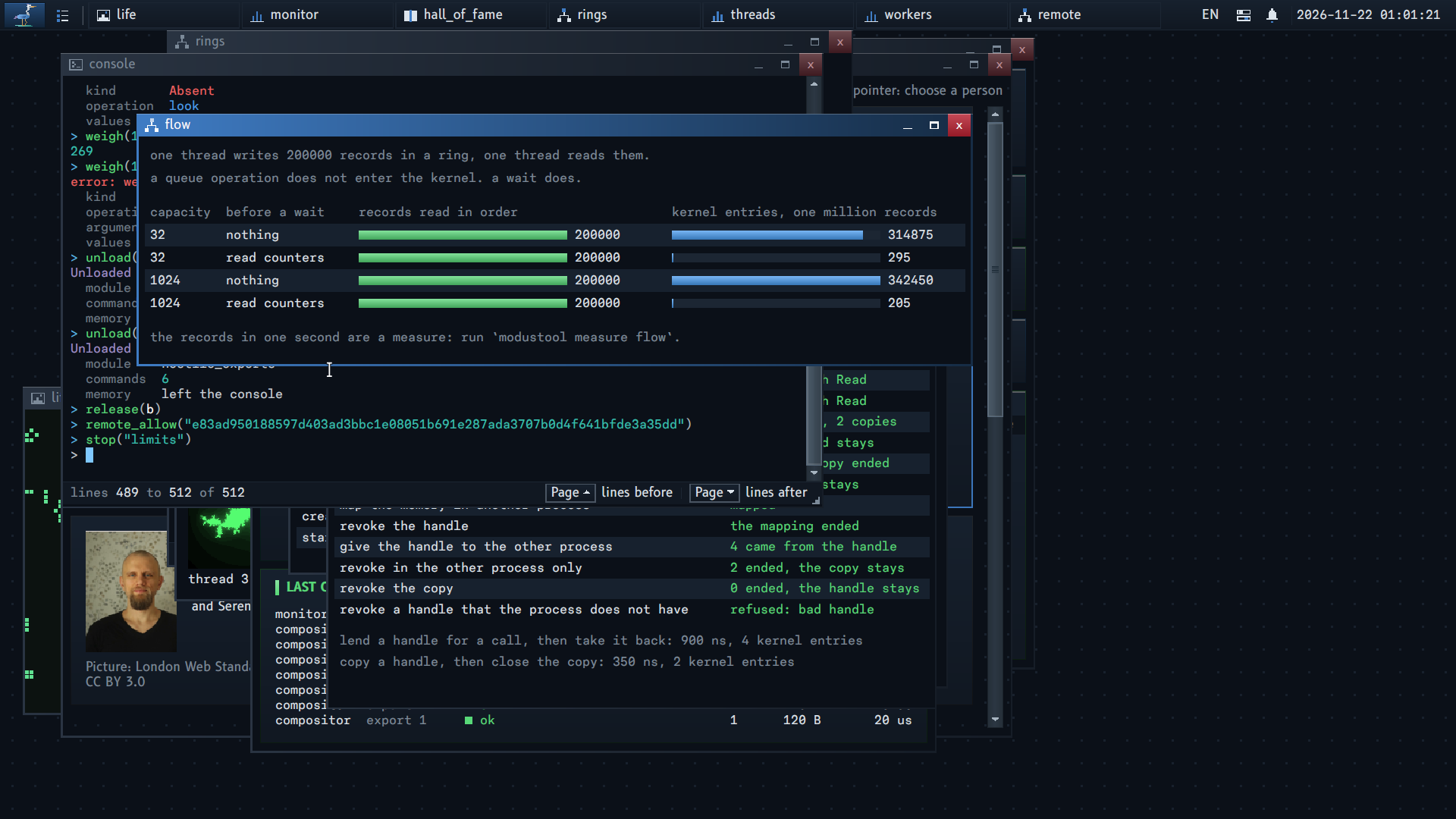
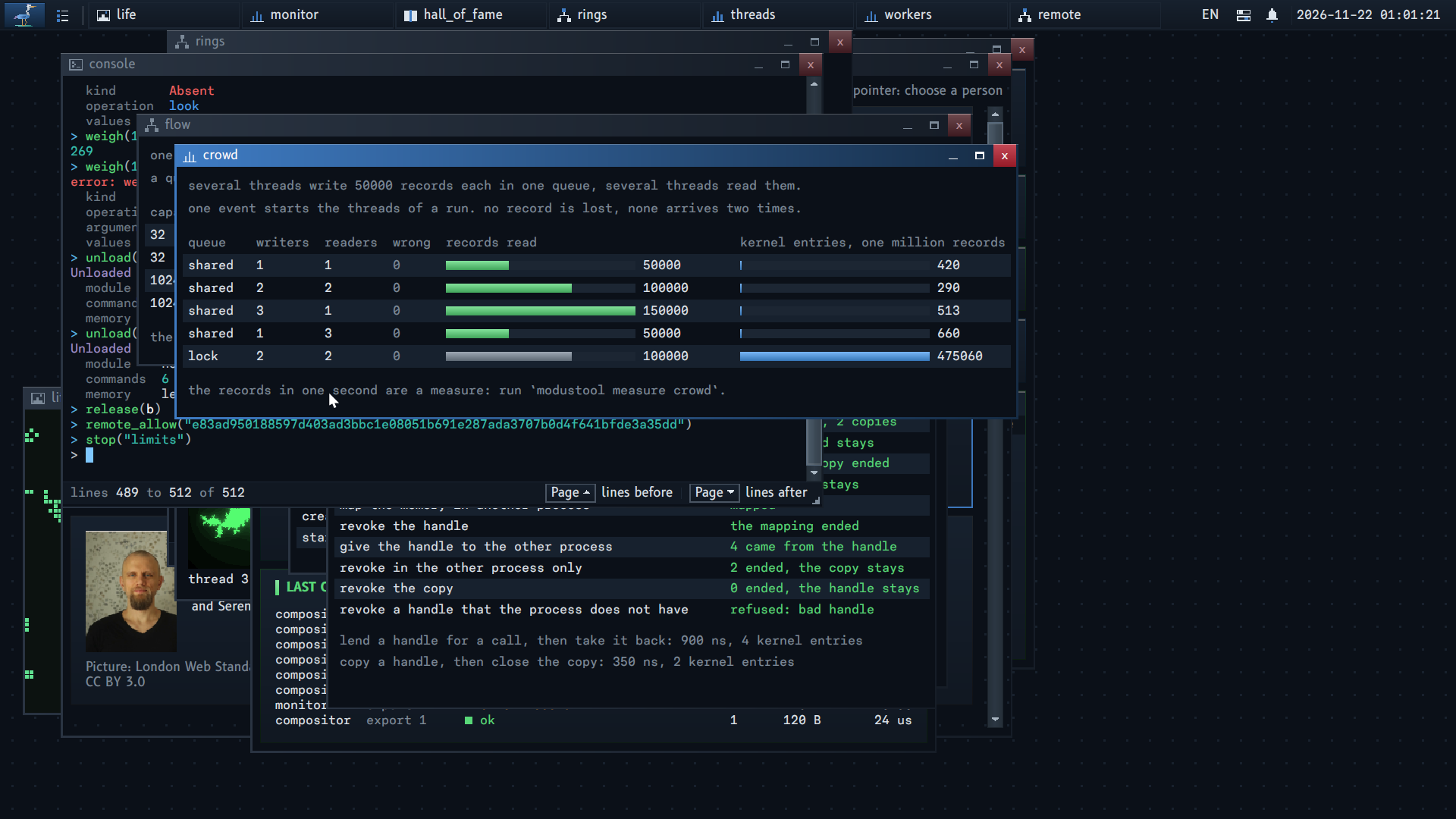
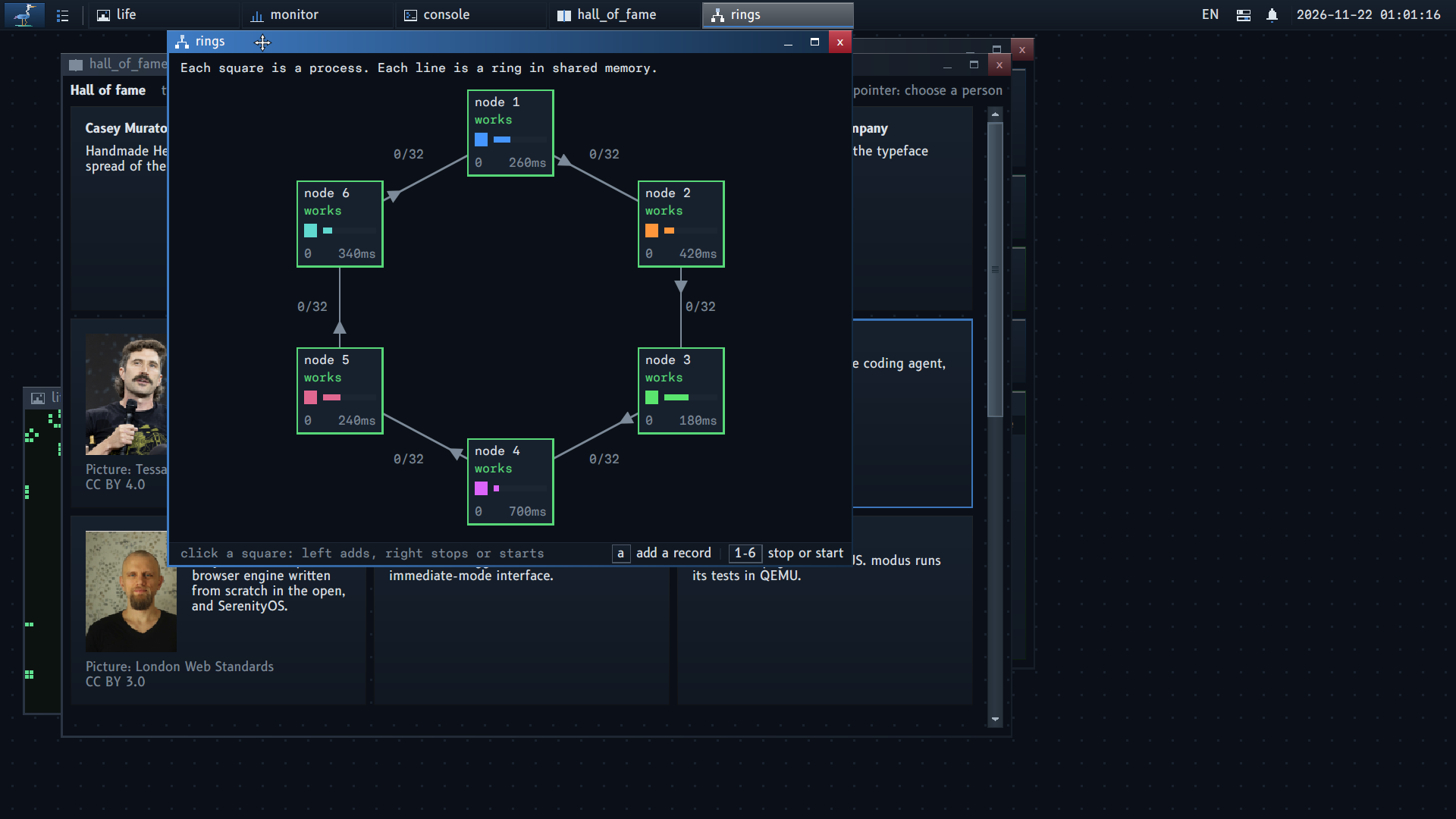
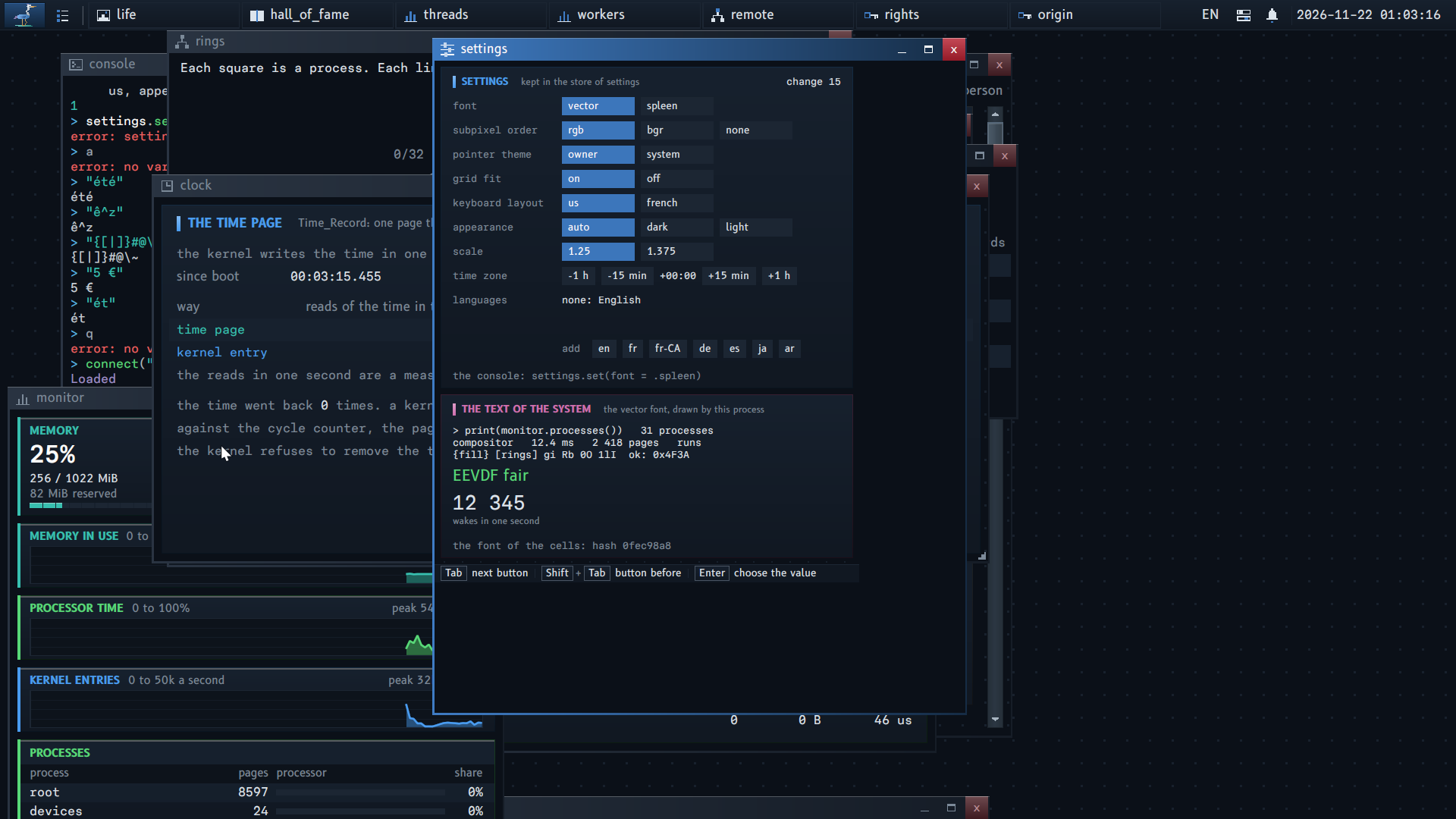
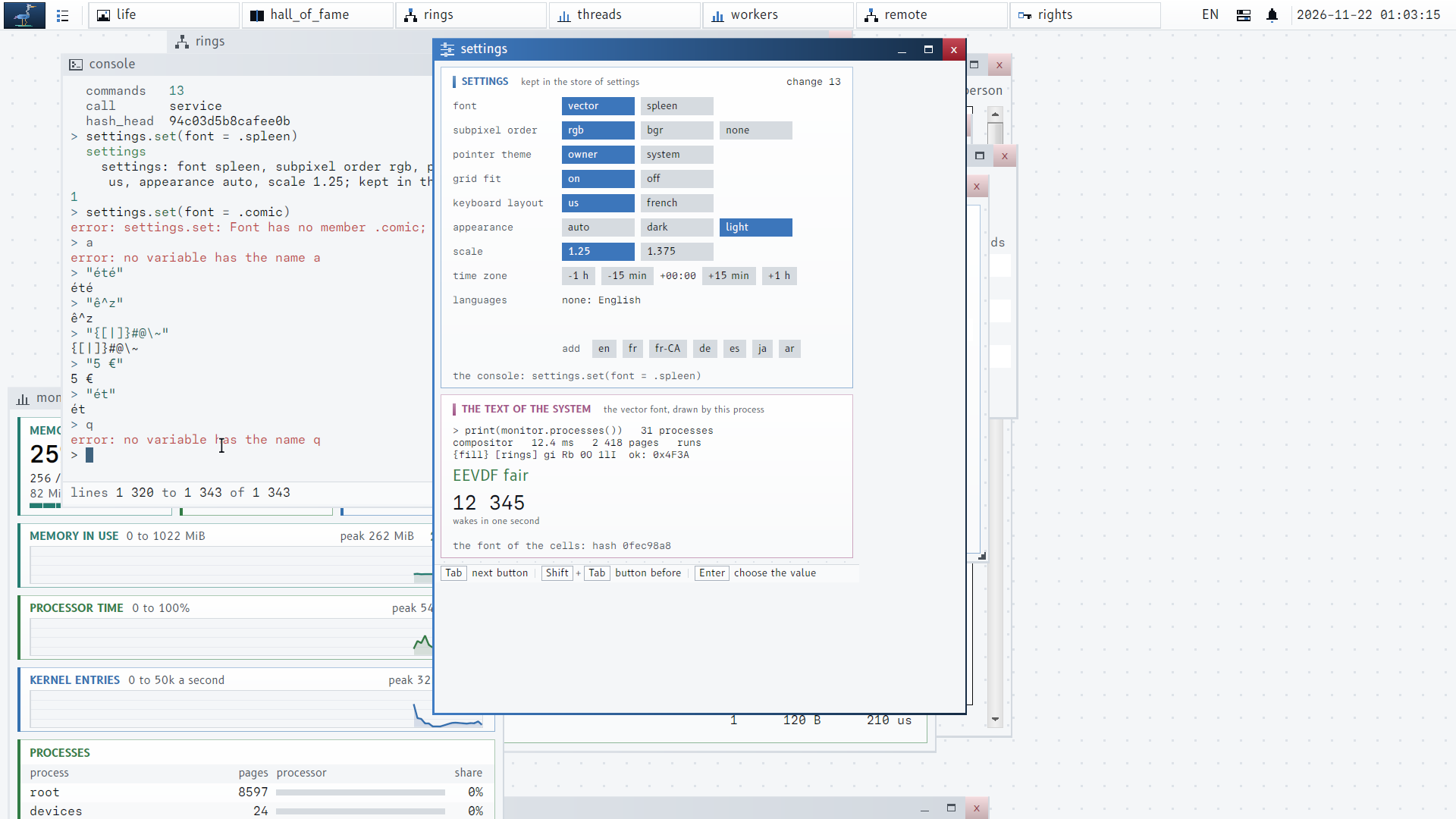
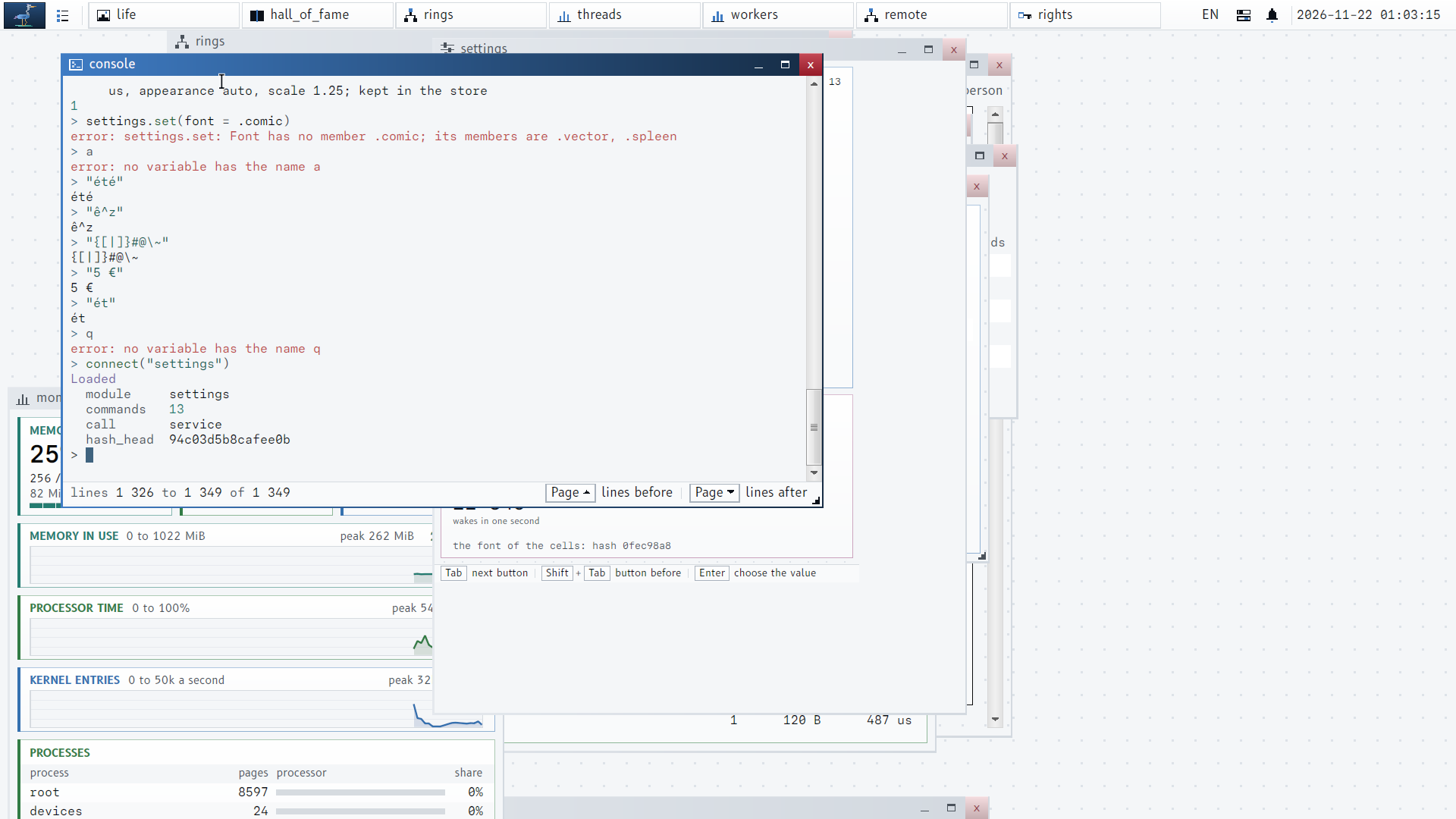
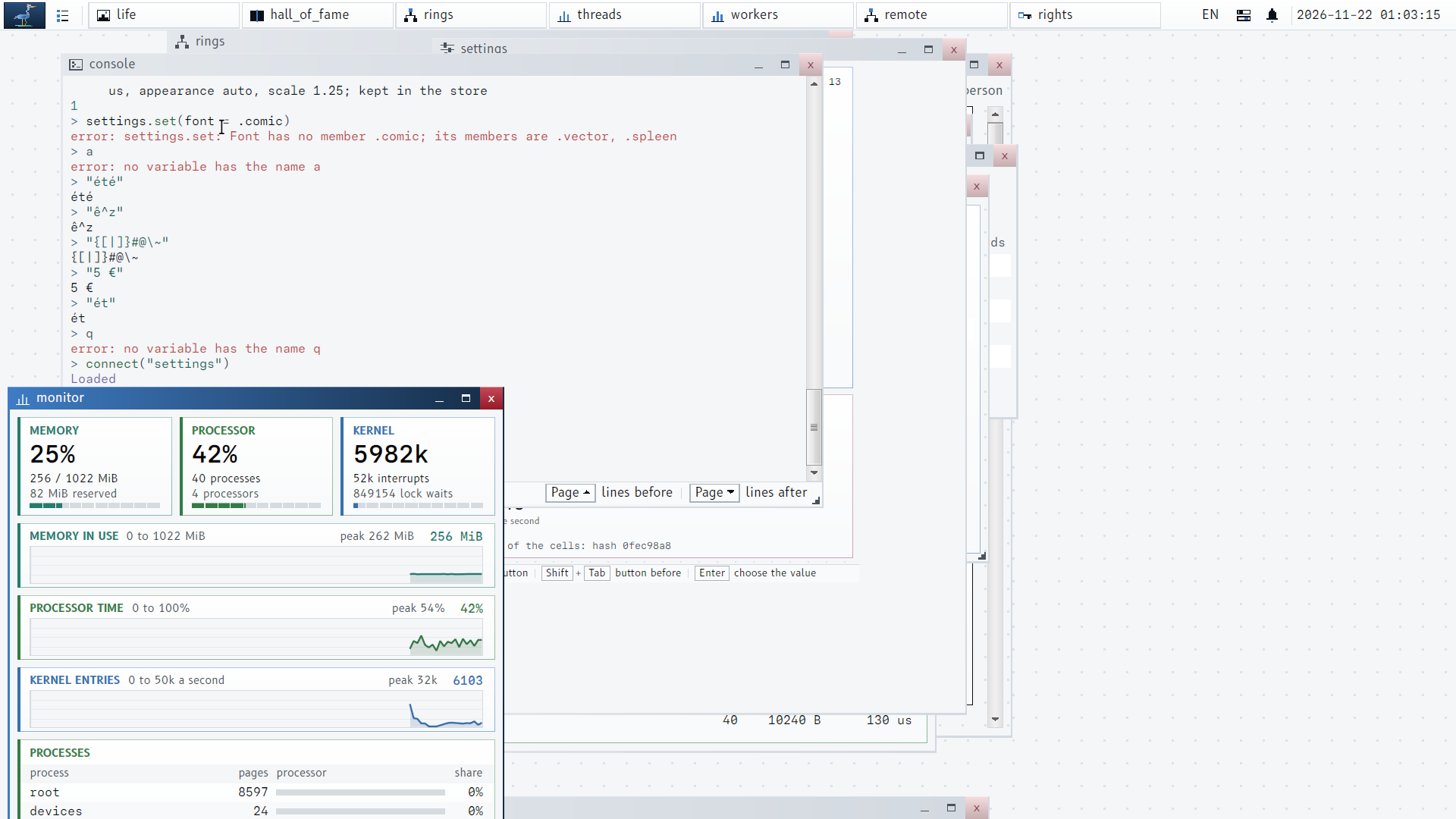
141 pictures of the screen of modus, in 11 groups.
The machine tests take each picture under QEMU, and the repository holds them. A picture of this page is at one half of its size, and opens at its full size: one pixel of the picture for one pixel of the screen of the system. Each caption says what the picture shows, and links to the guide of its subject.
The desktop and the palette
The windows, the bar with its two menus, the palette that the key super opens, and the pointer. 29 pictures.
The palette: the key super opens one list of the processes, the windows, the commands and the settings, which narrows at each typed key. Guide: The design rules
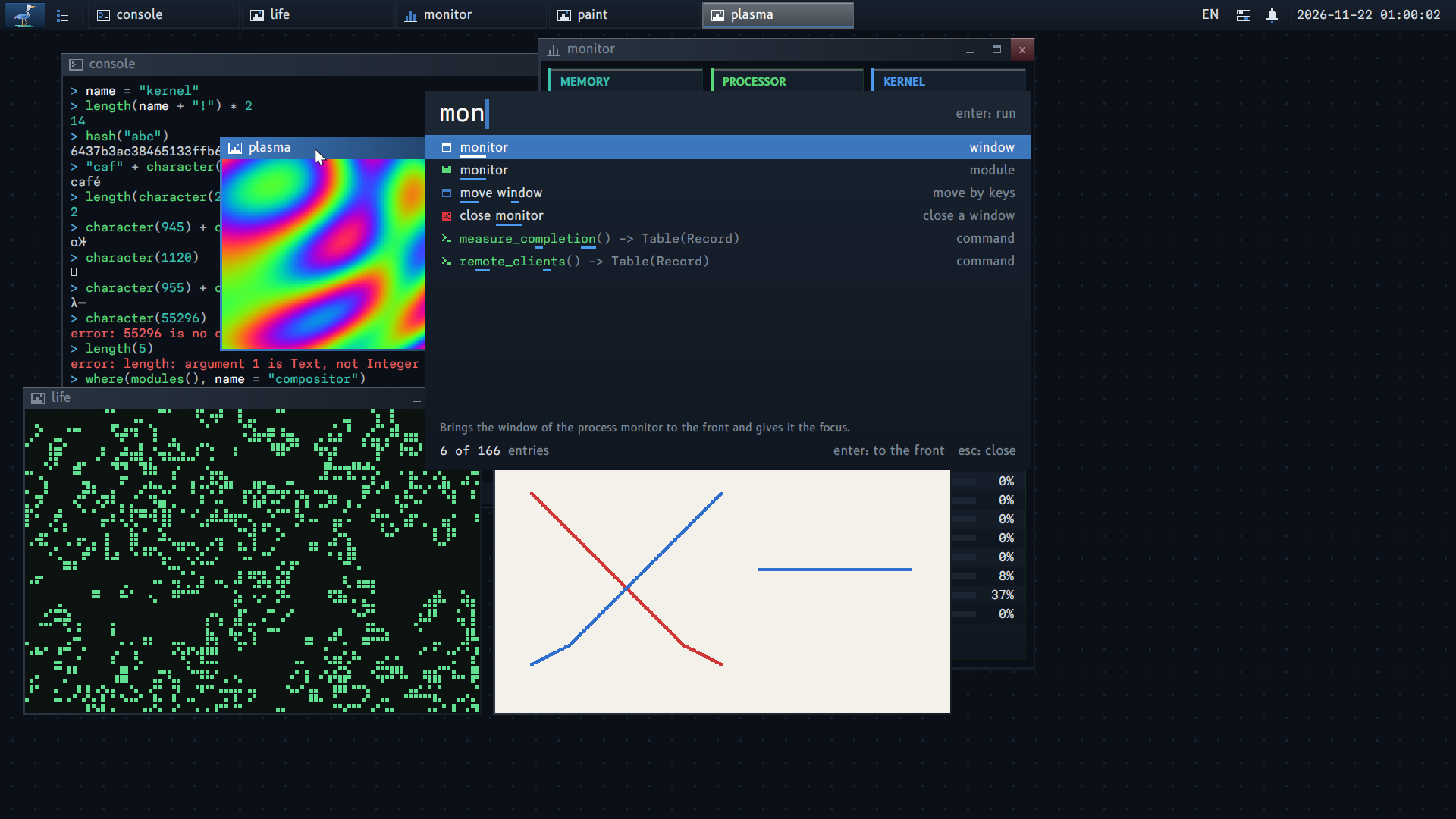
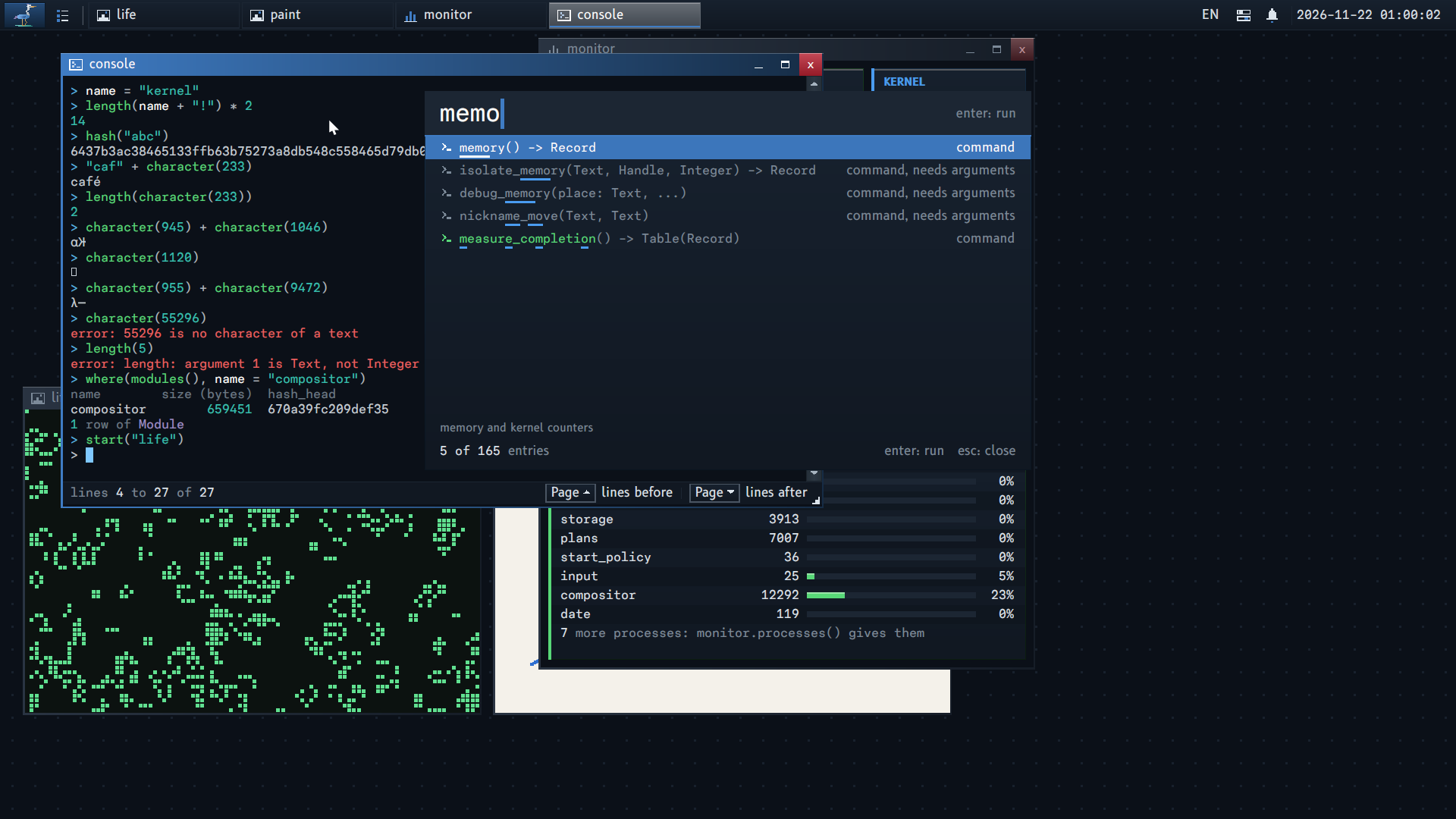
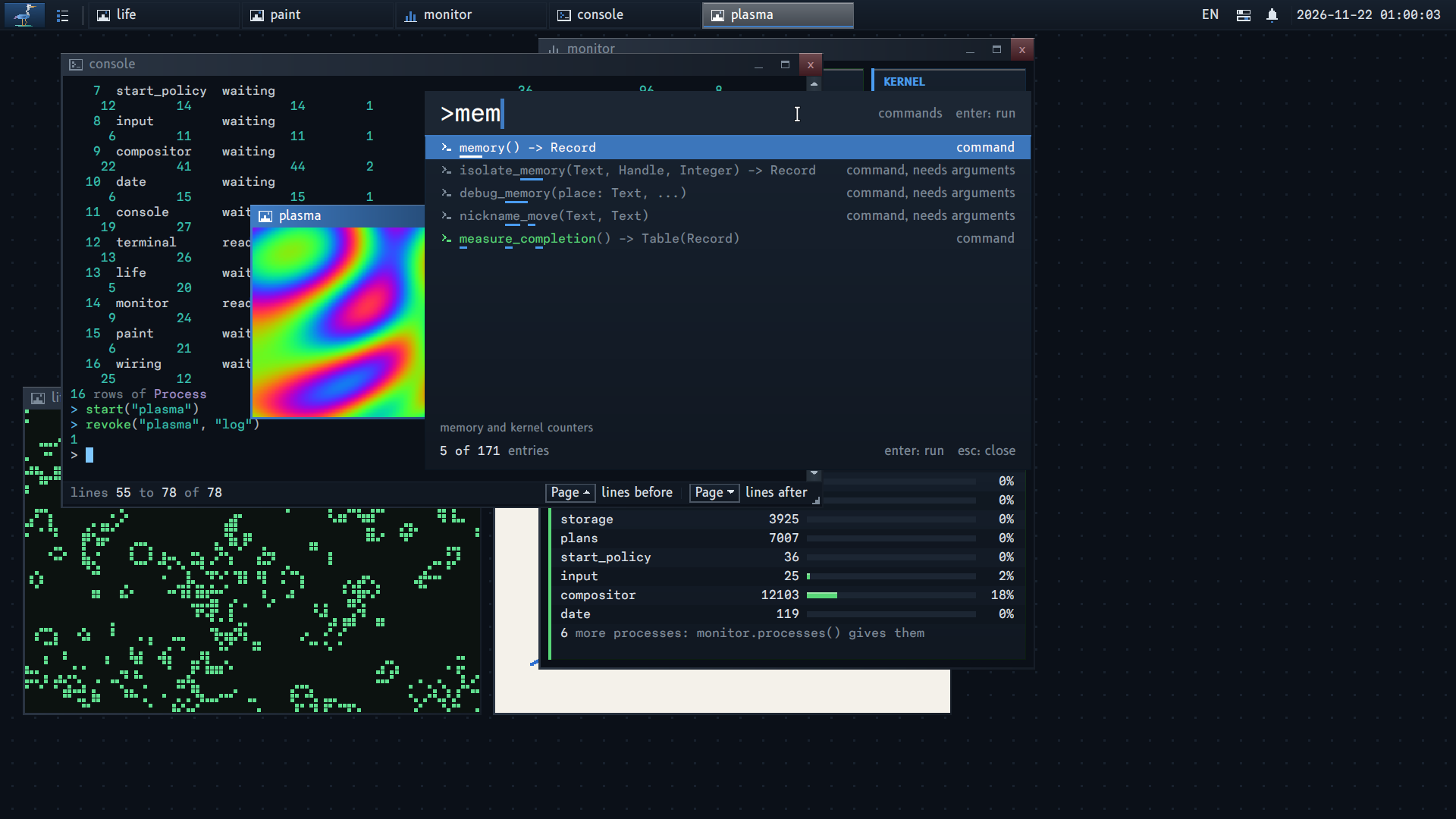
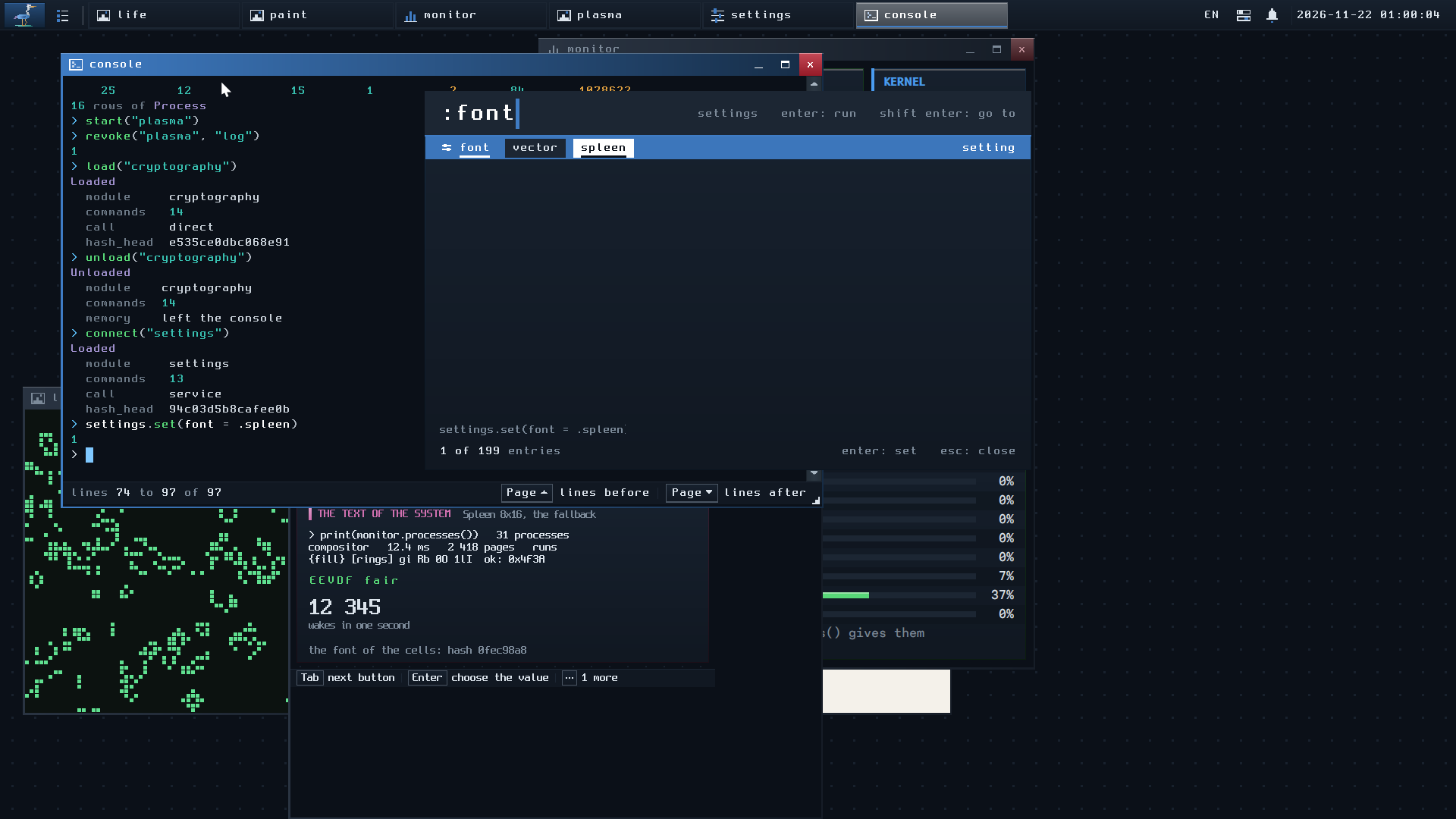
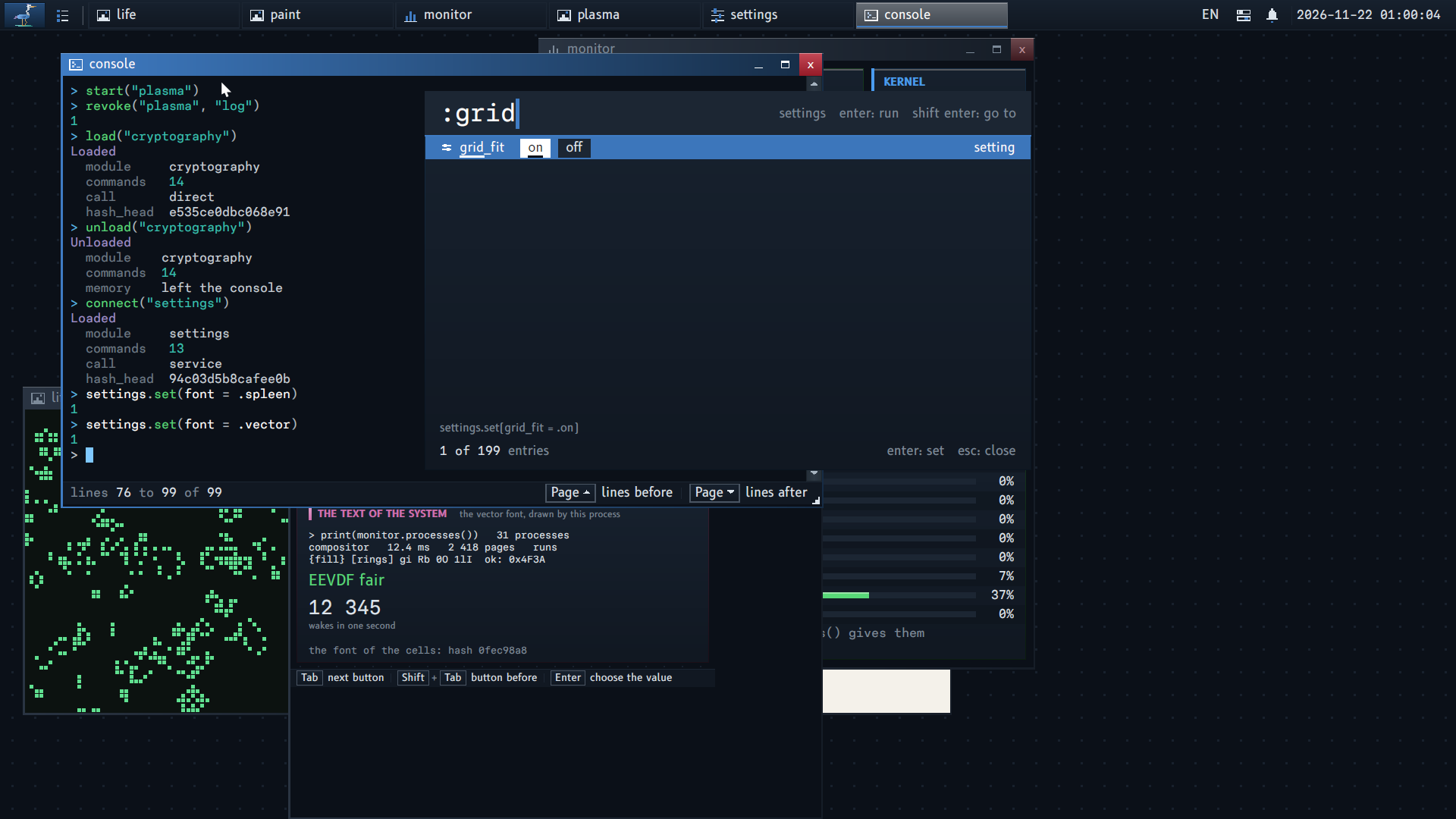
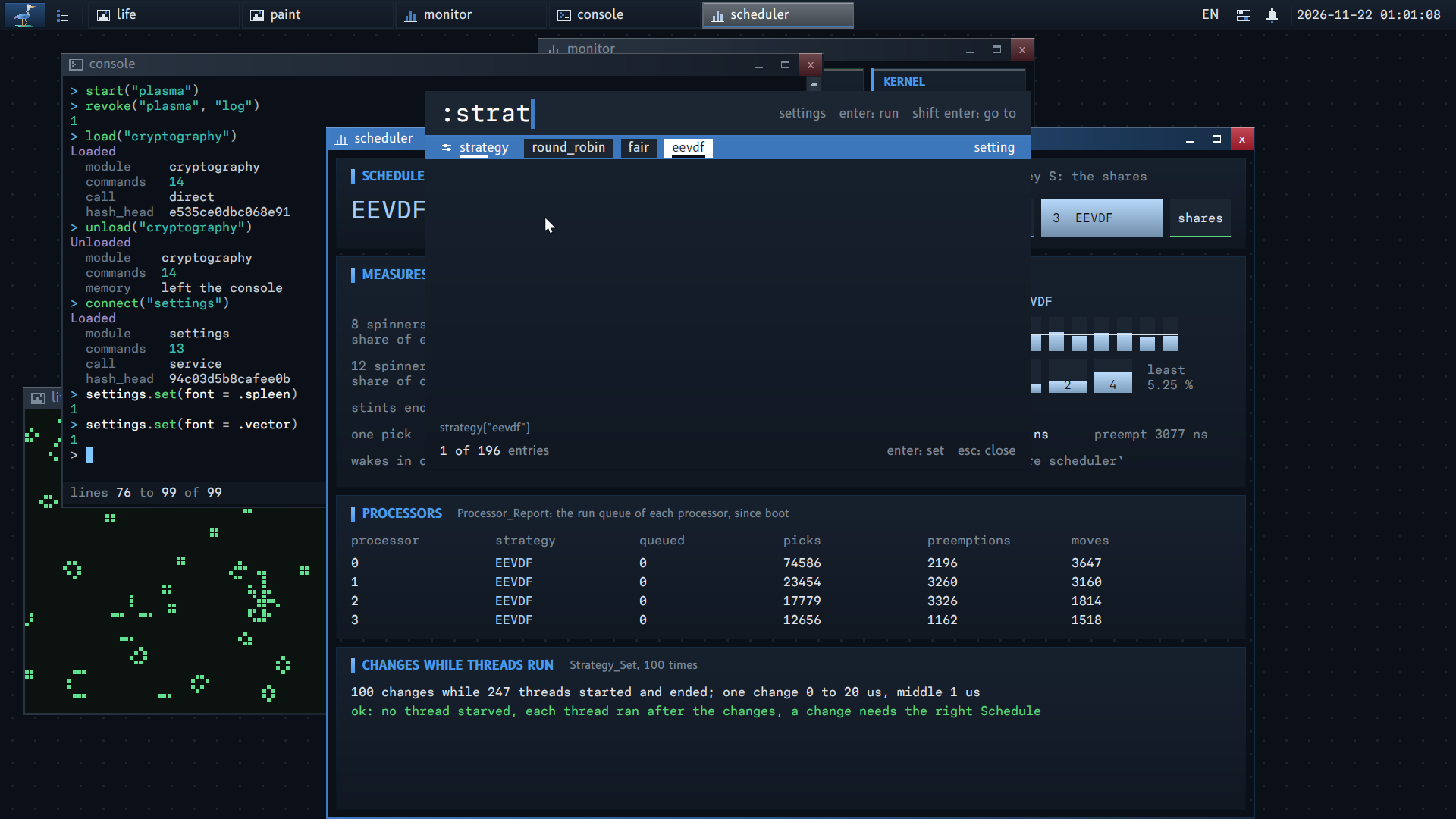
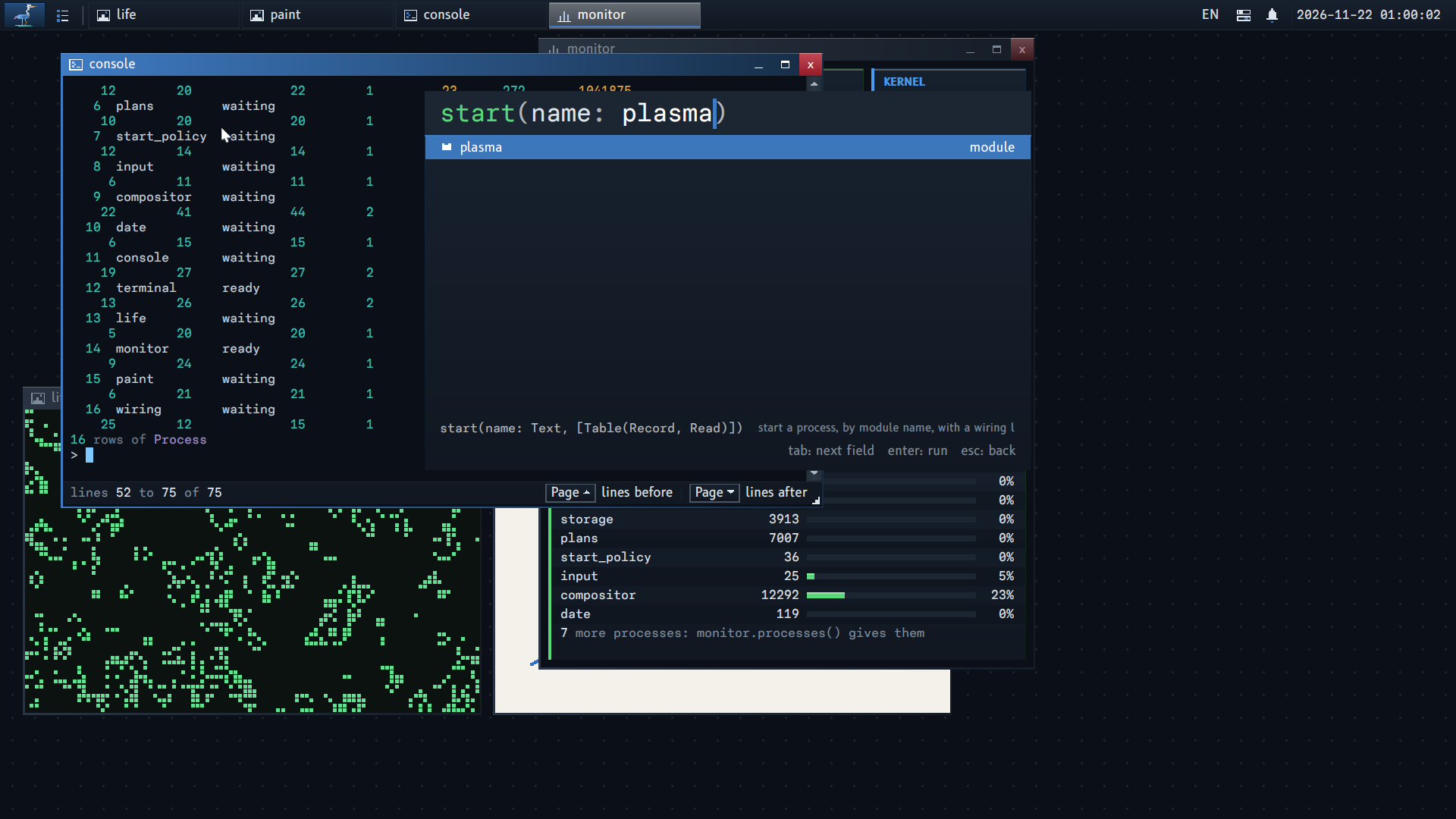
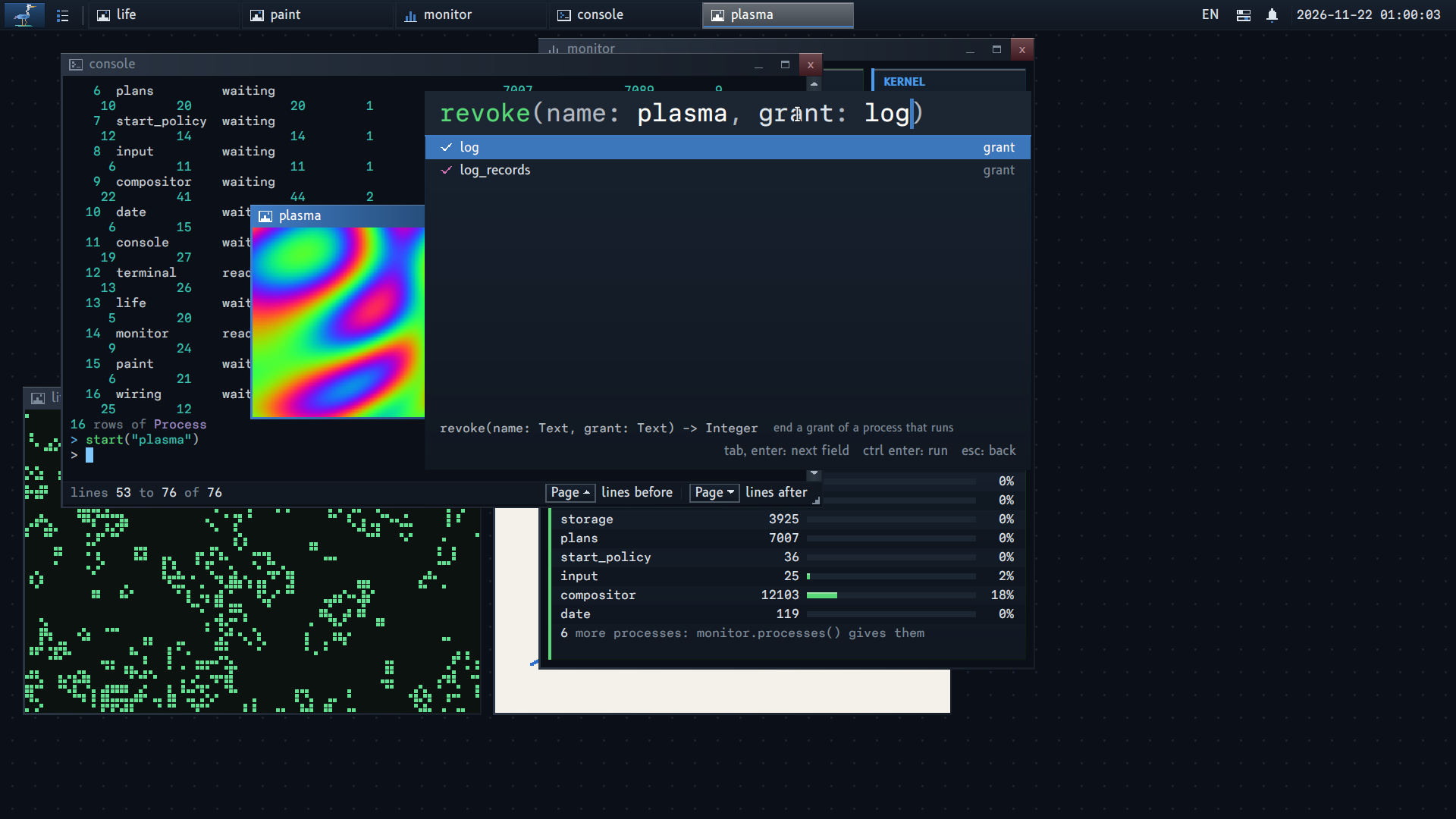
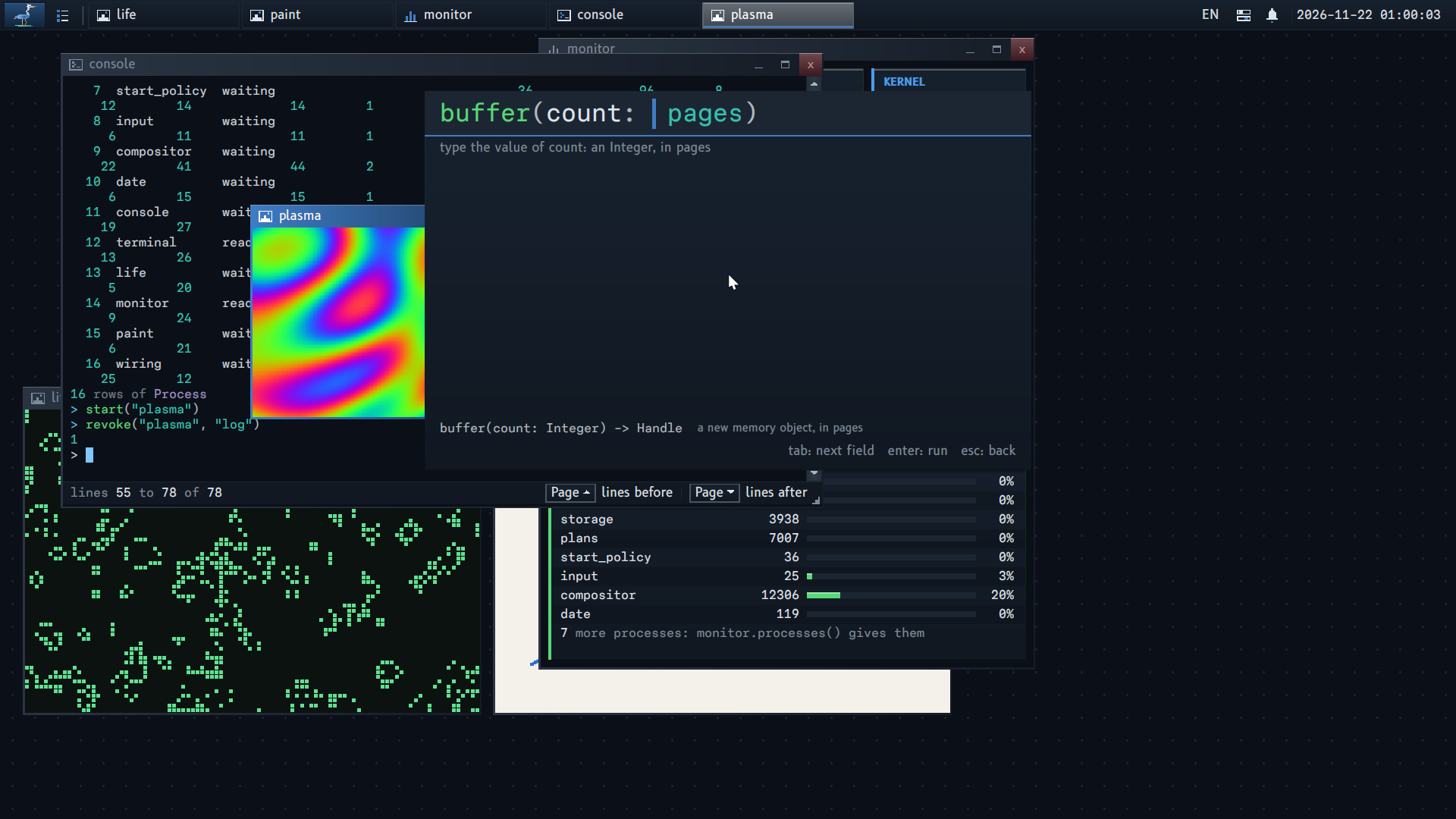
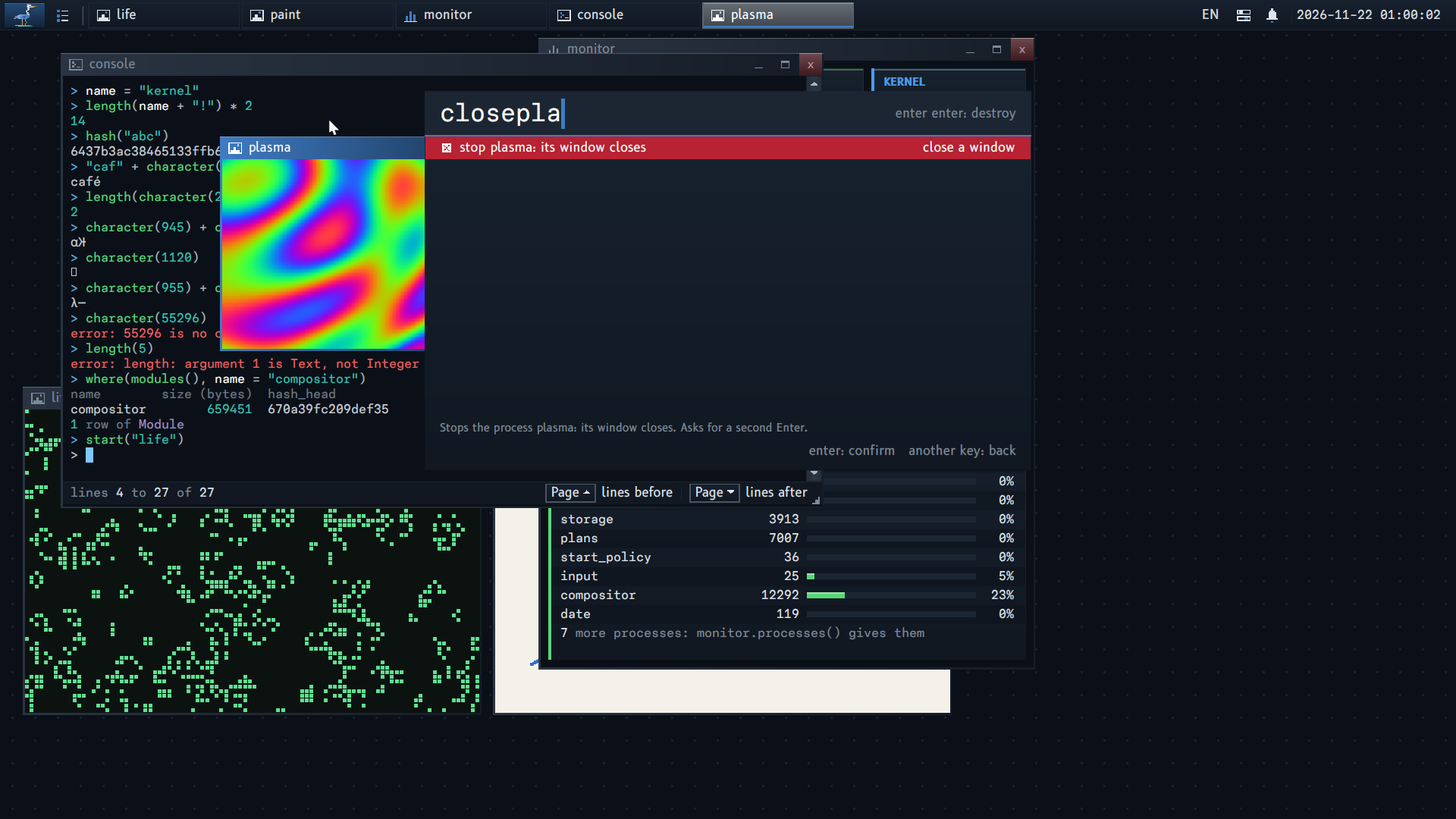
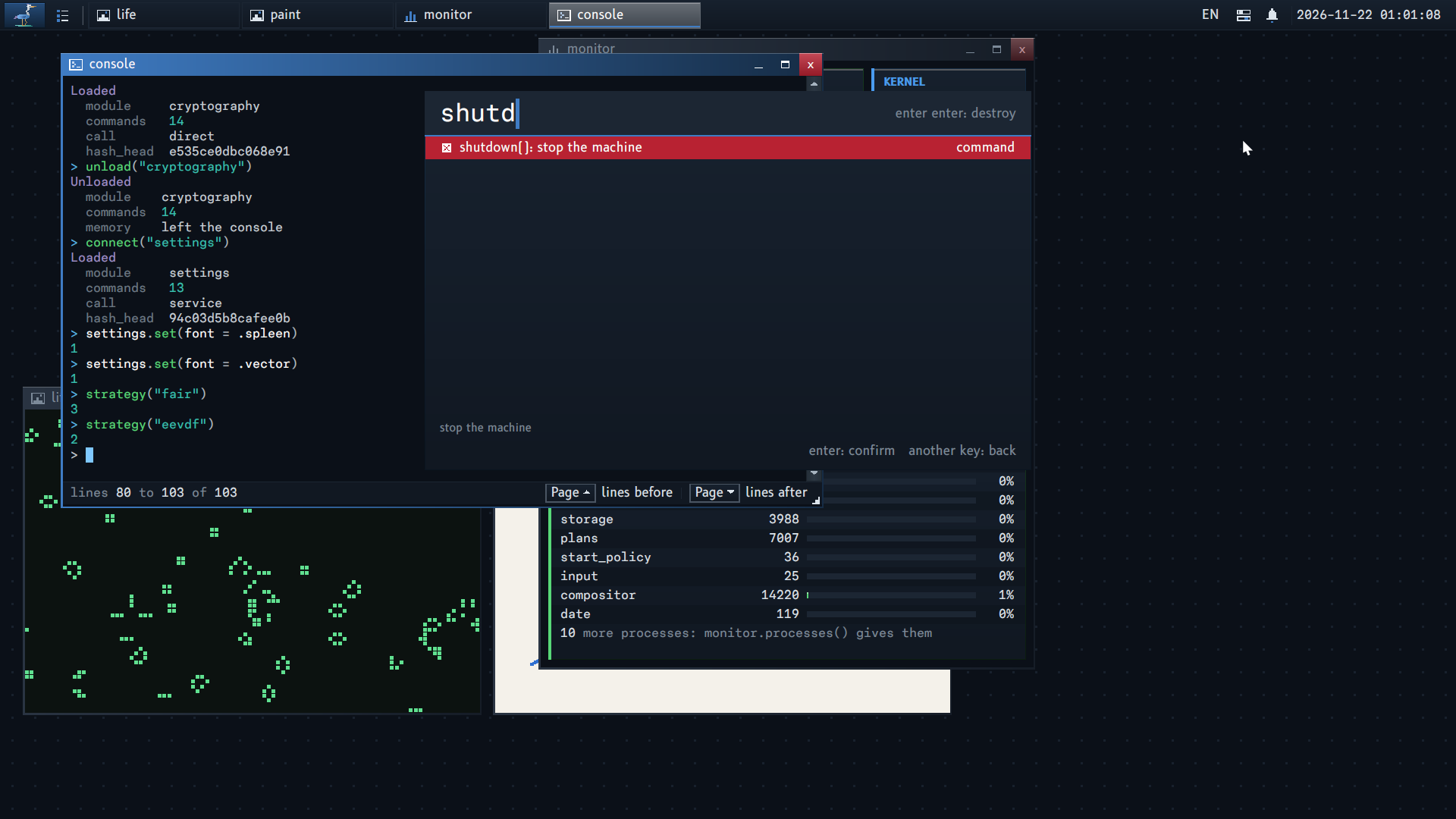
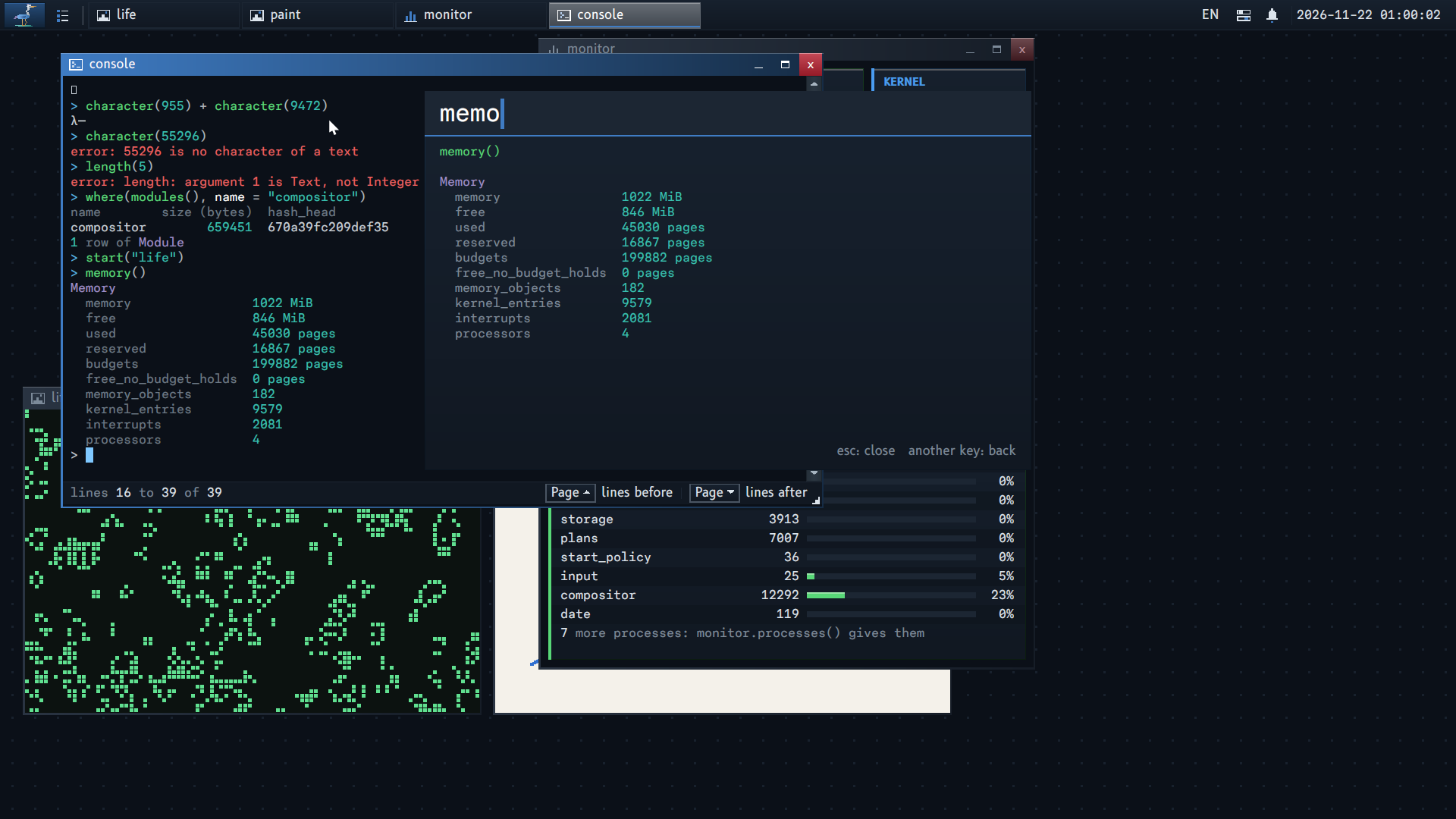
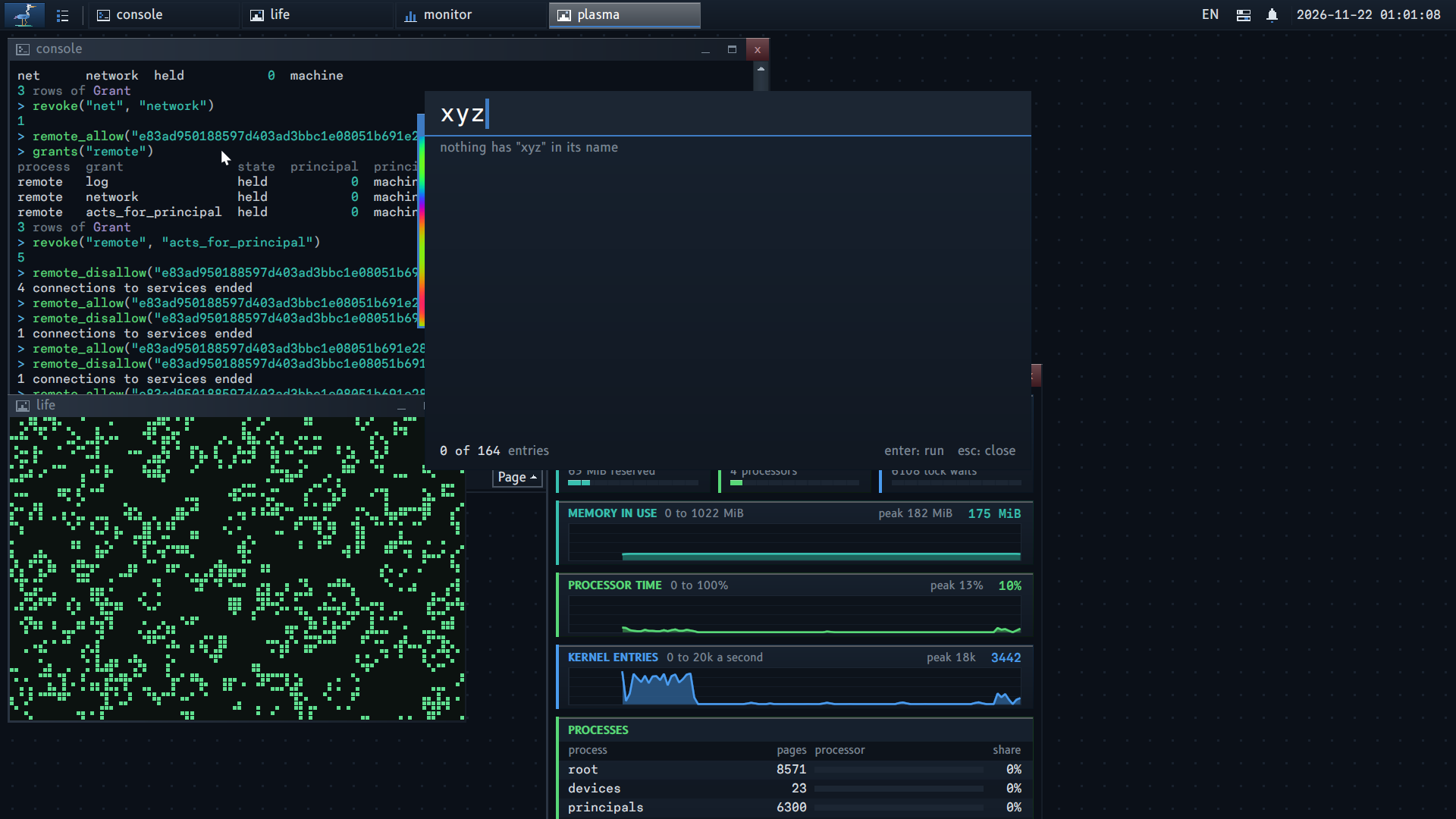
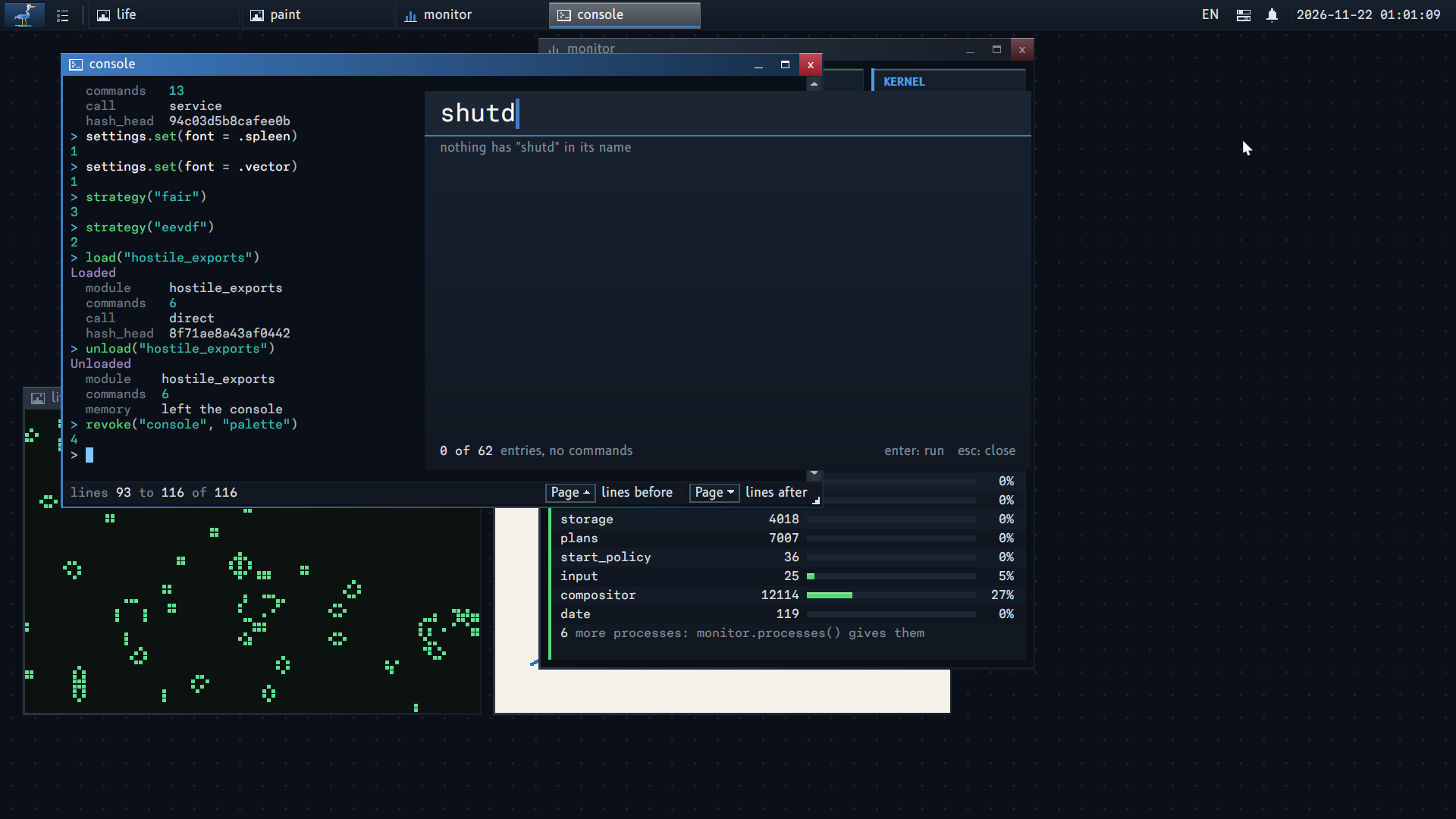
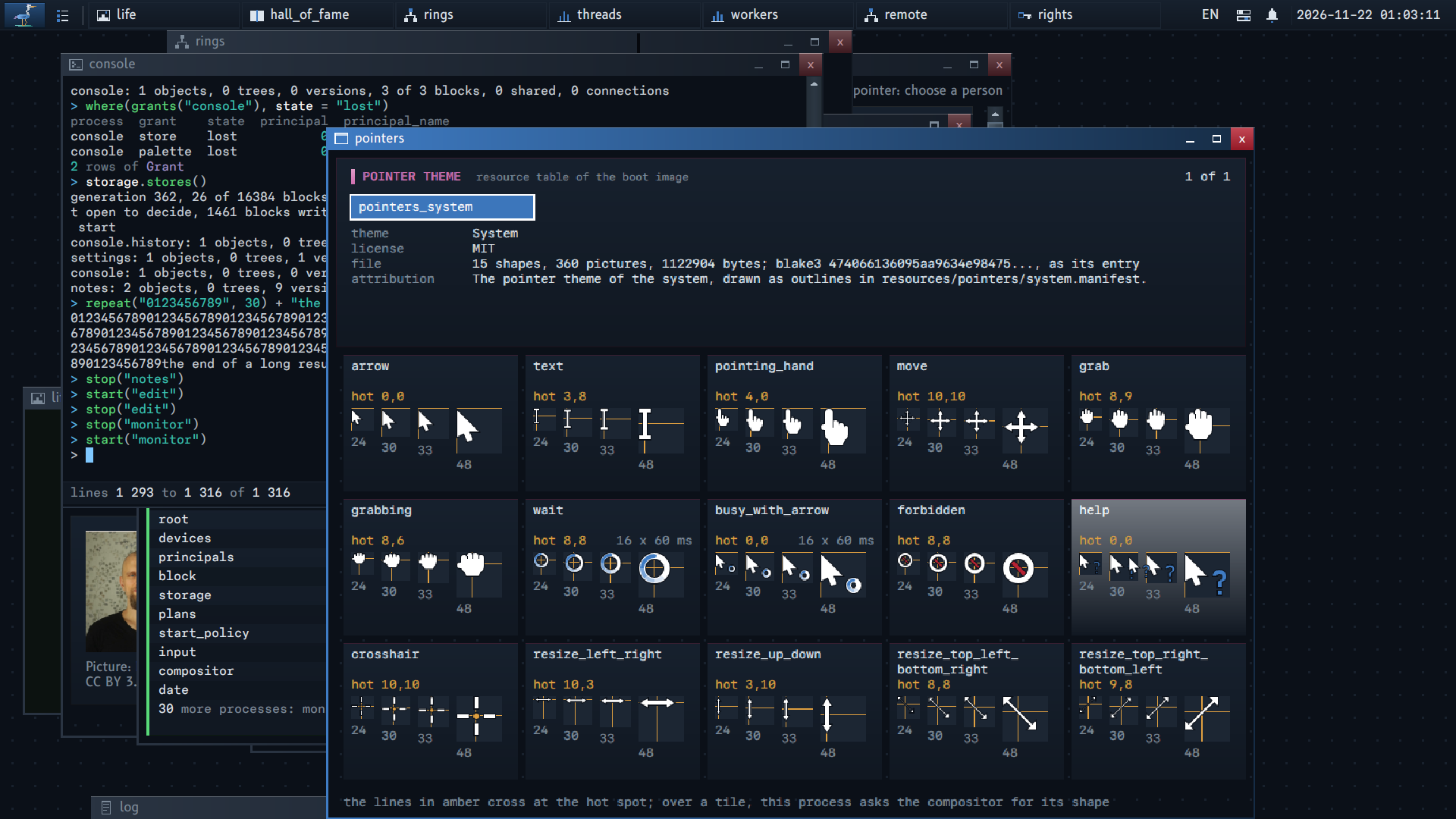
The palette with no letter typed: the windows first, then the processes, each with the icon of its kind.Guide: The design rulesThe letter p in the palette: windows, modules and commands in one ranking, with each matched letter marked.Guide: The design rulesThe letters mon in the palette: the window of monitor comes before the process of the same name, and Enter brings it to the front.Guide: The design rulesThe letters memo in the palette: the commands of the console that match, each with its signature.Guide: The design rulesA prefix keeps one kind in the palette: the sign > lists the commands only.Guide: The design rulesThe font as one row of the palette, a button for each value: Right and Enter set Spleen behind the open panel.Guide: The design rulesThe palette offers to go to the window of settings, where a button acts on the same setting: Shift and Enter.Guide: The design rulesThe scheduling strategies as one row of the palette: a button for each strategy, a line under the one in use.Guide: The design rulesA command with a parameter in the palette: start asks for a name, and the list gives the modules that match.Guide: The design rulesA command with two parameters in the palette: revoke has the name plasma, and the list gives the grants of that process.Guide: The design rulesA number with its unit in the palette: buffer takes a count of pages, and the band shows pages after the 4 that was typed.Guide: The design rulesThe palette asks for a second Enter before it stops a process and closes its window.Guide: The design rulesThe palette asks for a second Enter before the command shutdown, which stops the machine.Guide: The design rulesA command chosen in the palette runs as a line of the console: memory() is in the console behind the panel.Guide: The design rulesThe palette with letters that nothing matches: it says that nothing has them in its name.Guide: The design rulesThe palette after the console lost its grant palette: the count says that it has no commands, and shutdown is not found.Guide: The design rulesThe pointer pictures: each shape of the pointer theme of the system, in the dark form and in the light form at 24 and 48 pixels, with the lines of its hot spot.Guide: Pointer picturesThe pointer over the text of the console takes the shape of a text cursor.Guide: Pointer pictures
The console and the terminal
The console, where a command is a typed function, the terminal that draws the lines of a process, and the log. 14 pictures.
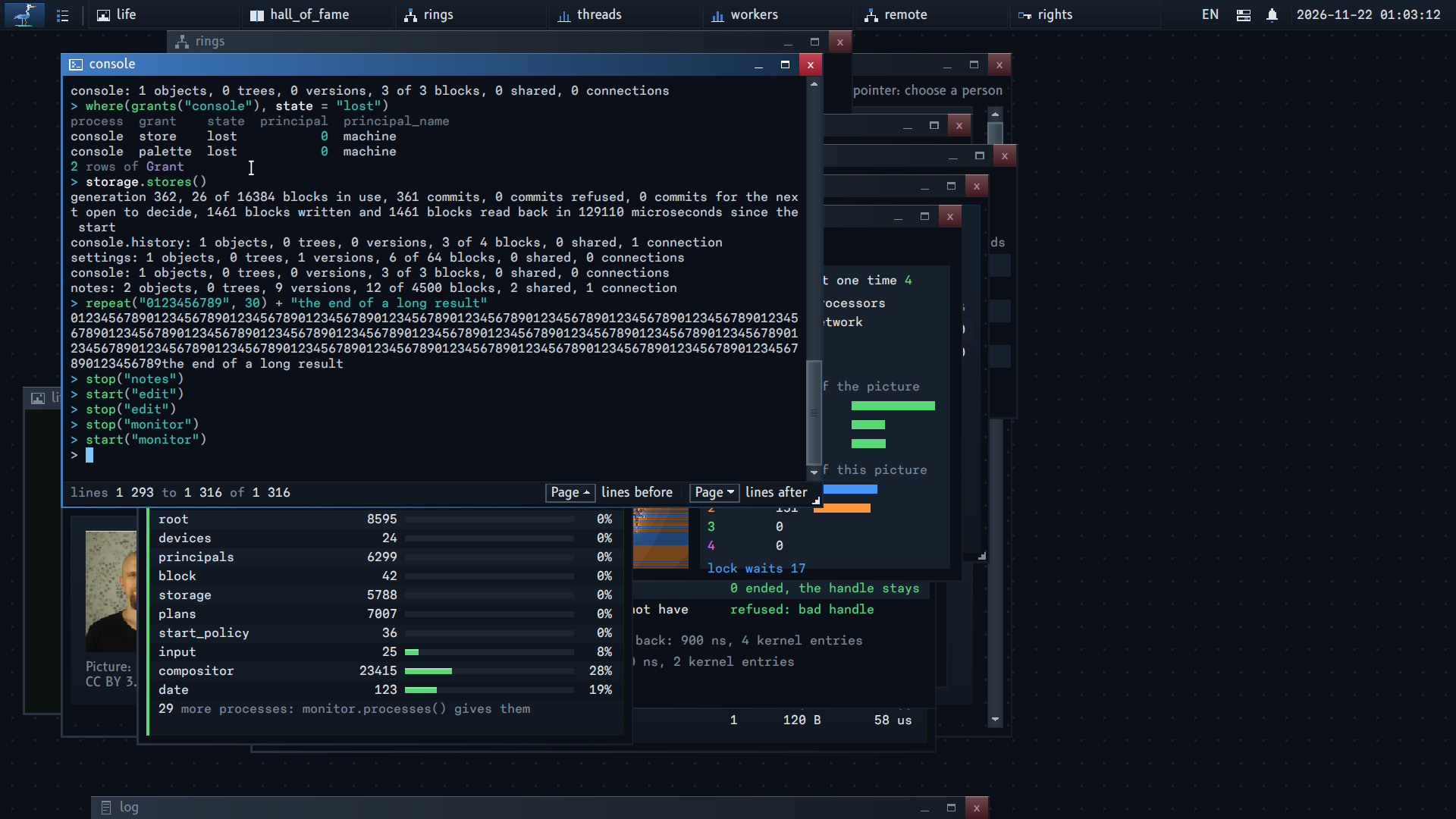
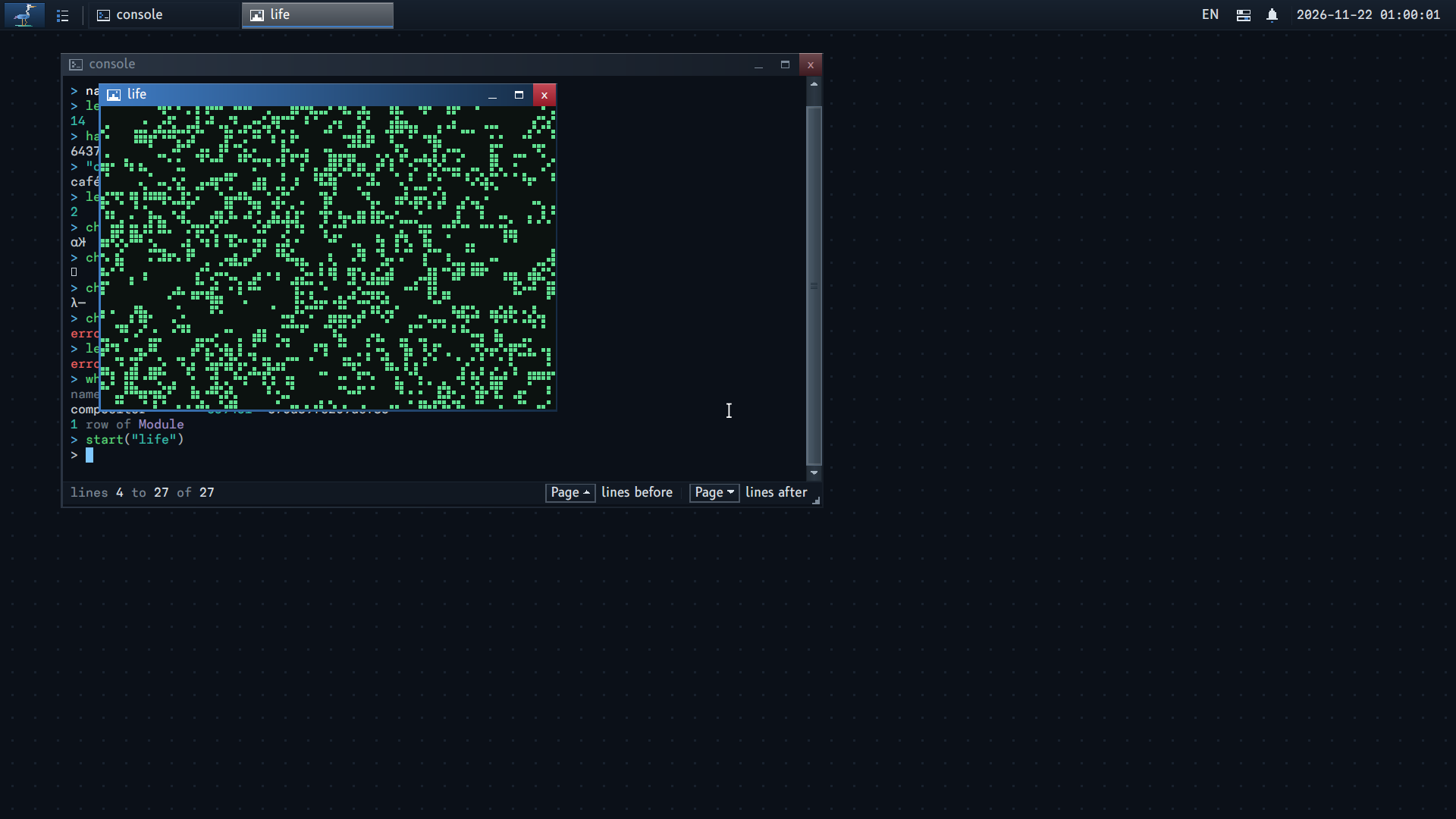
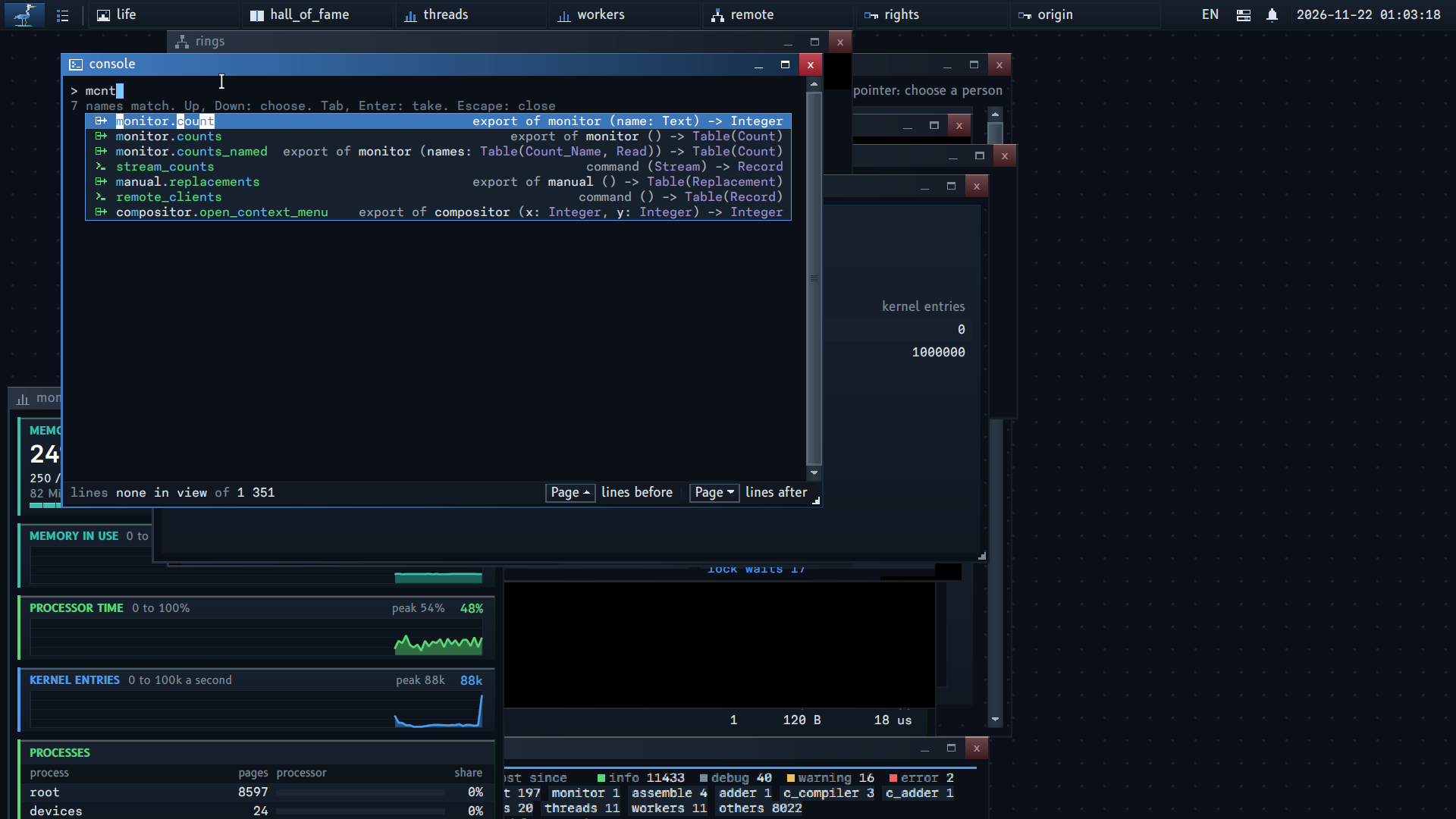
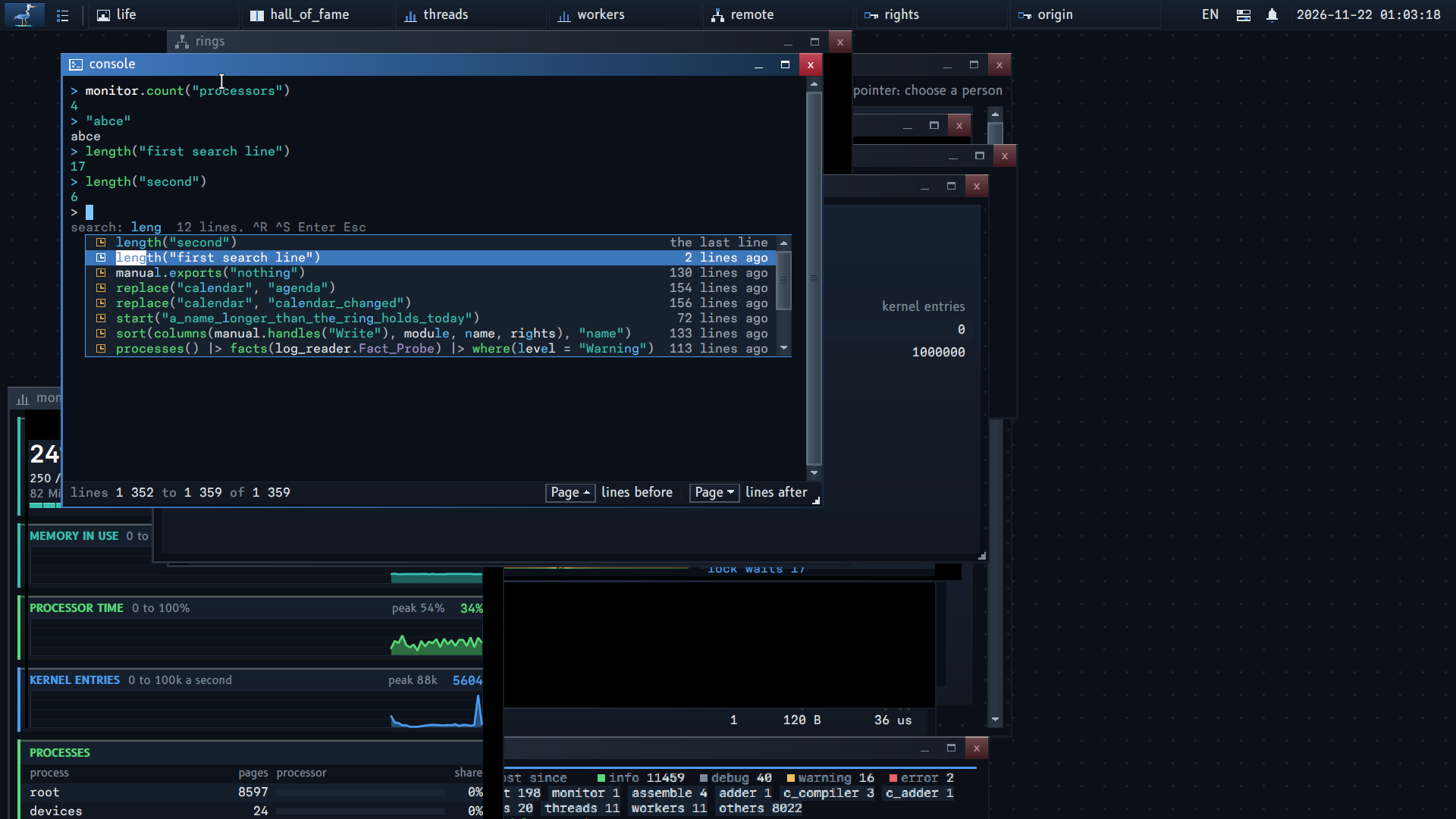
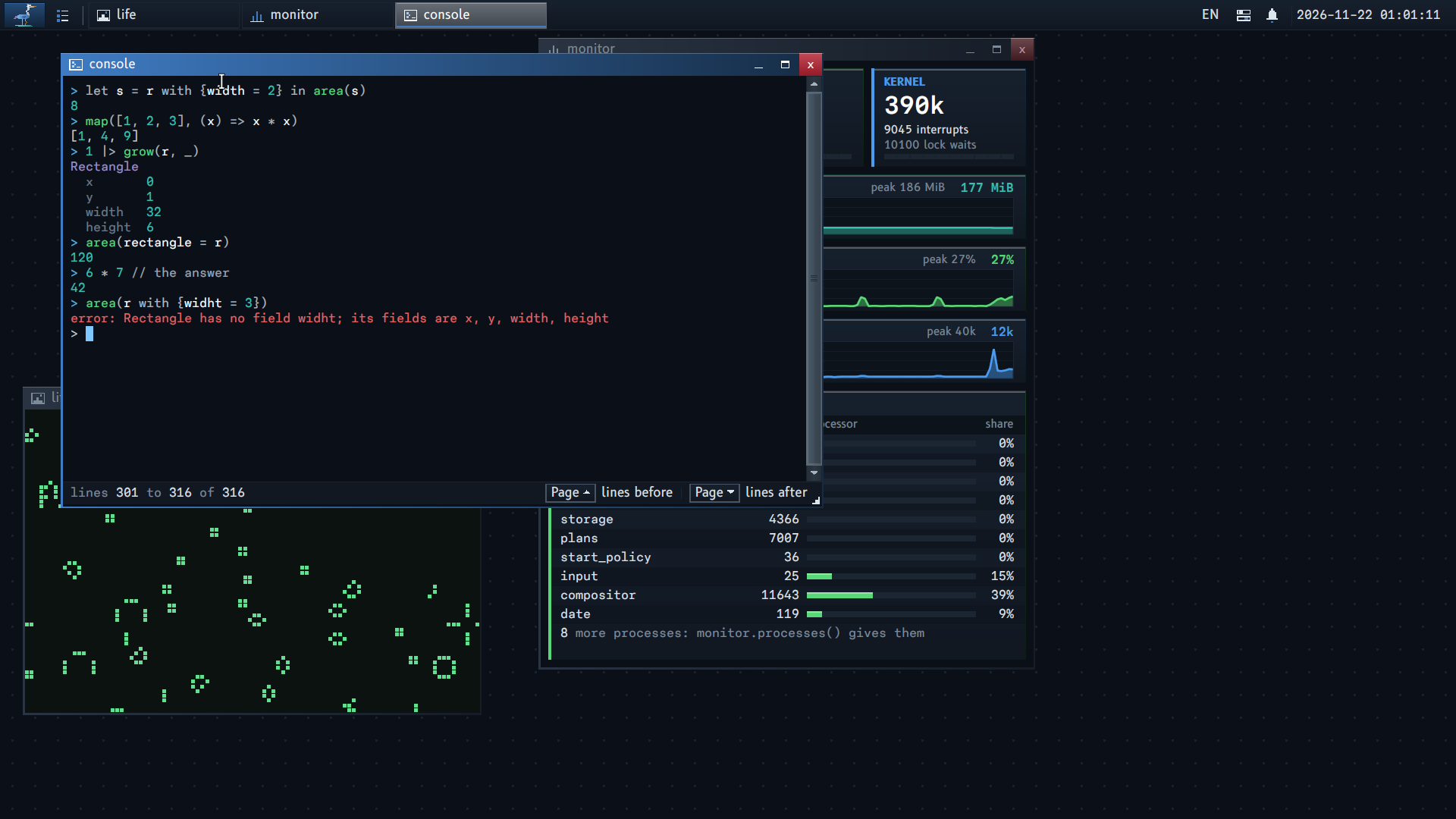
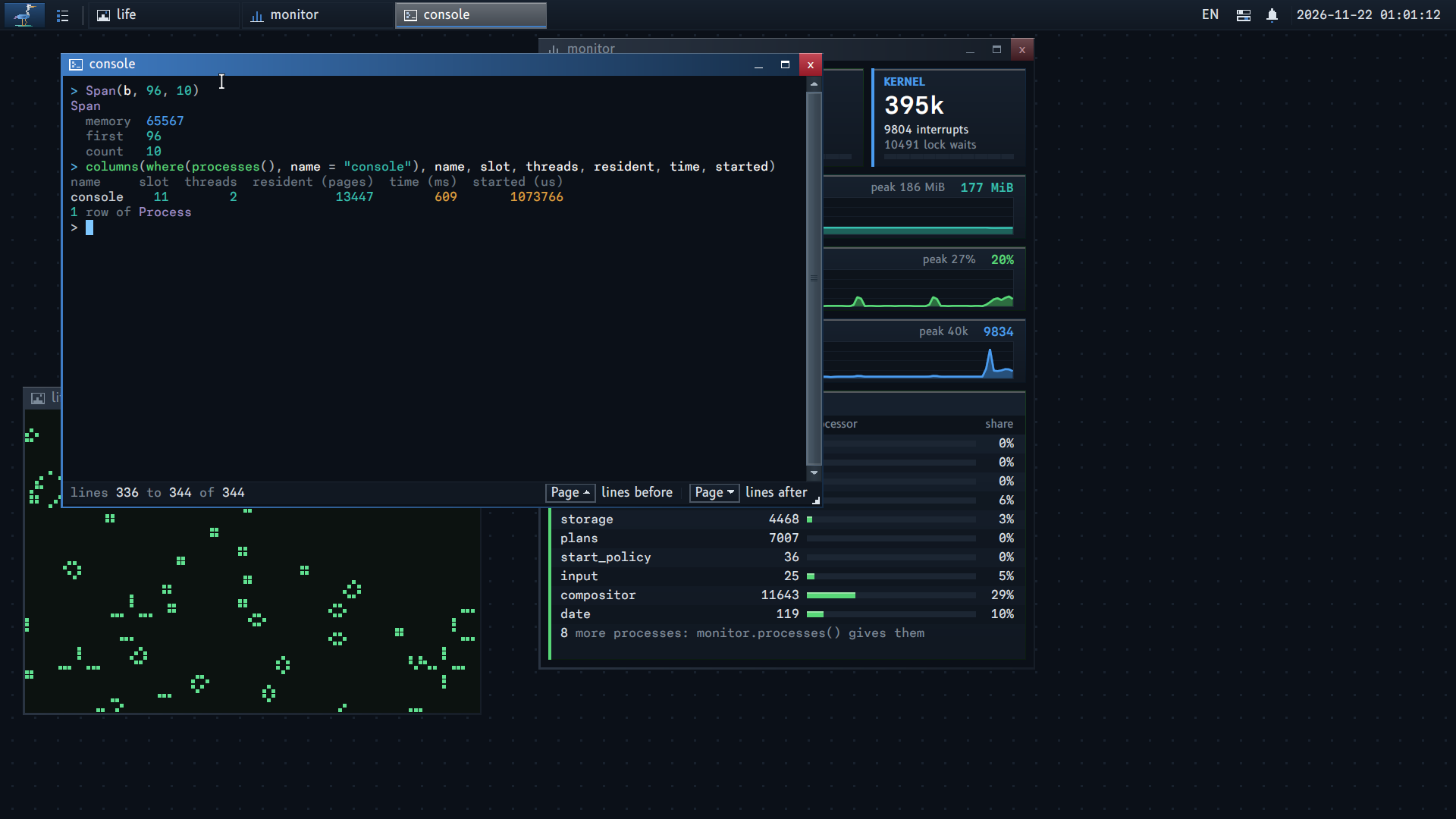
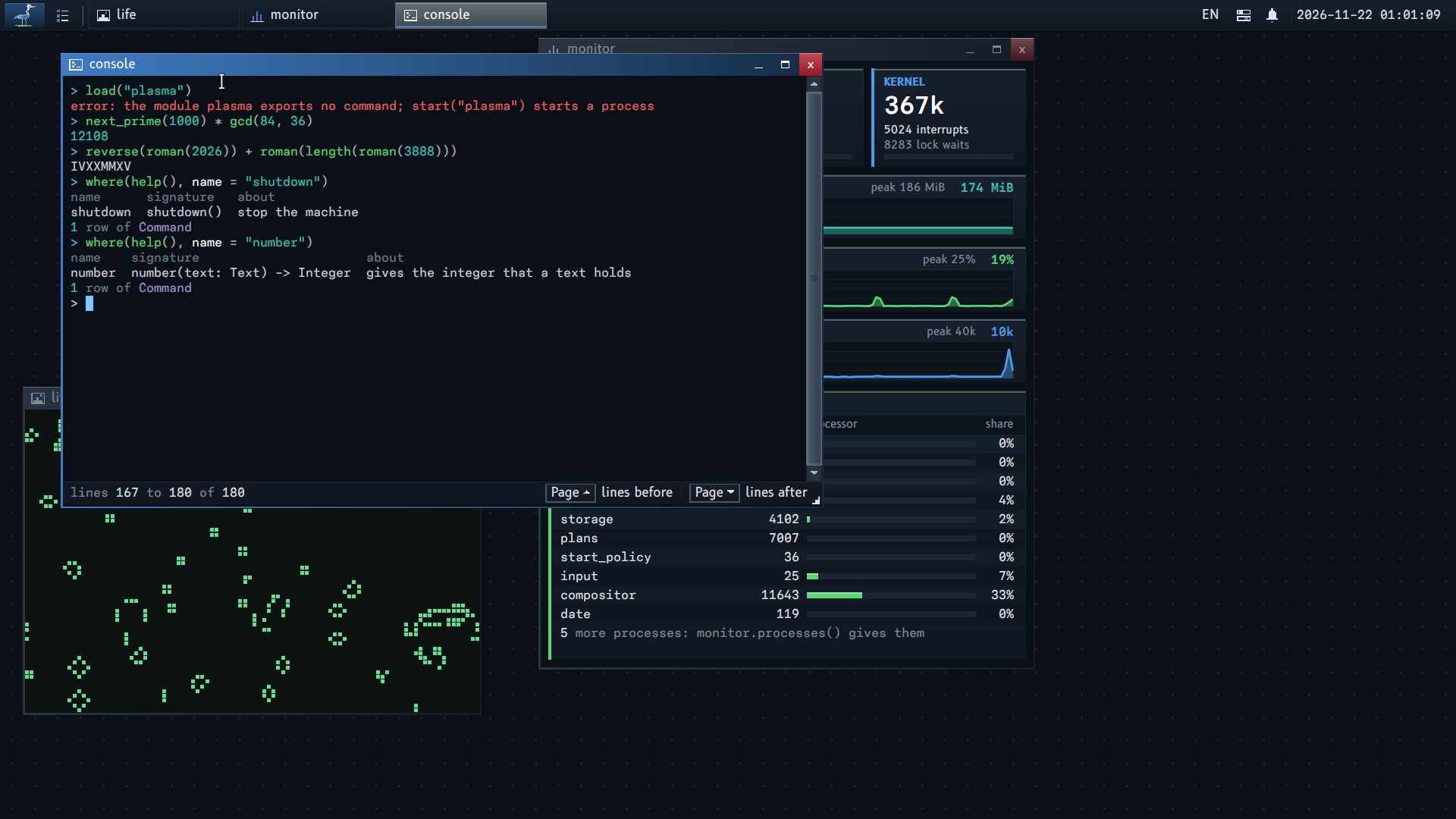
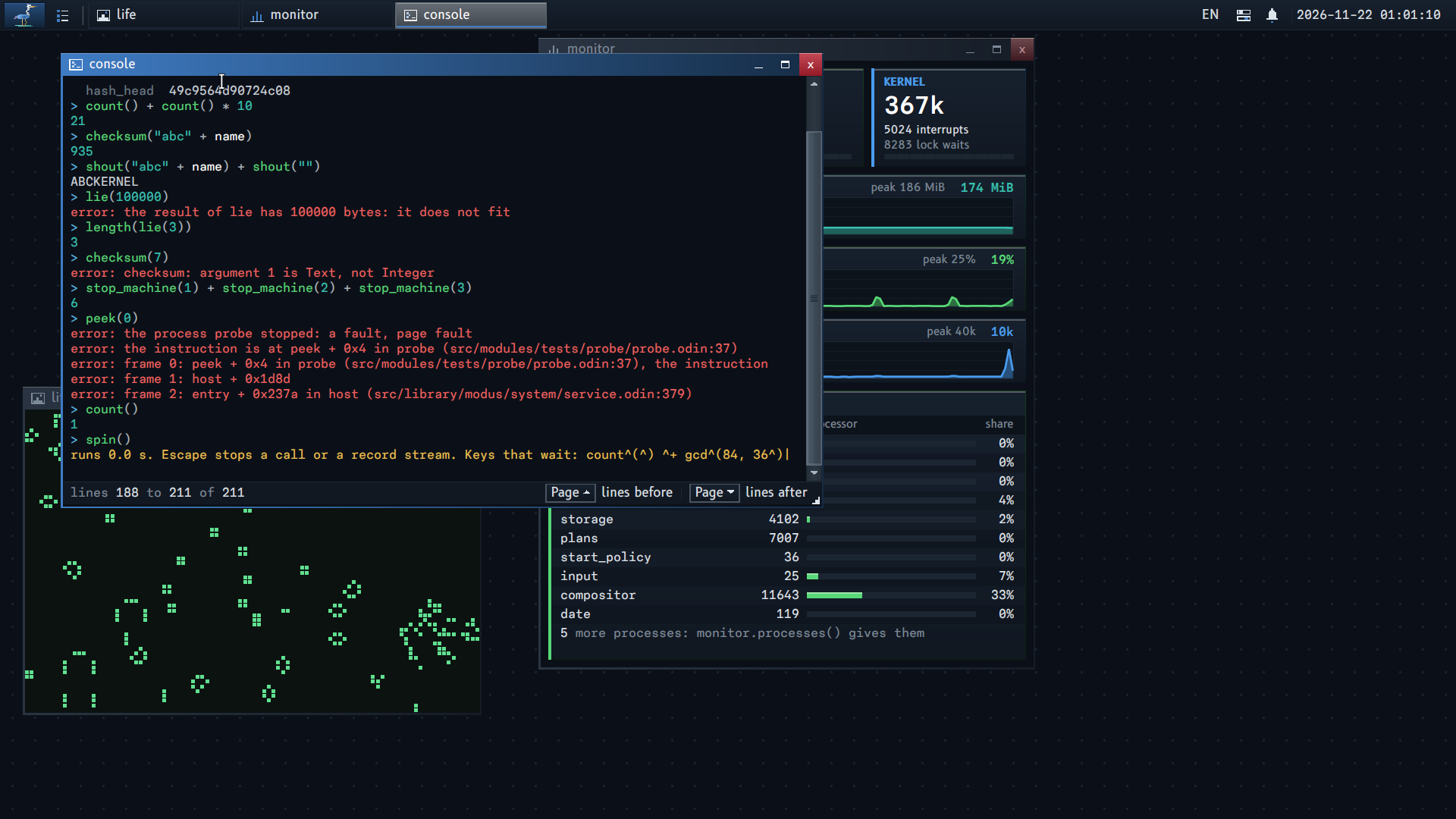
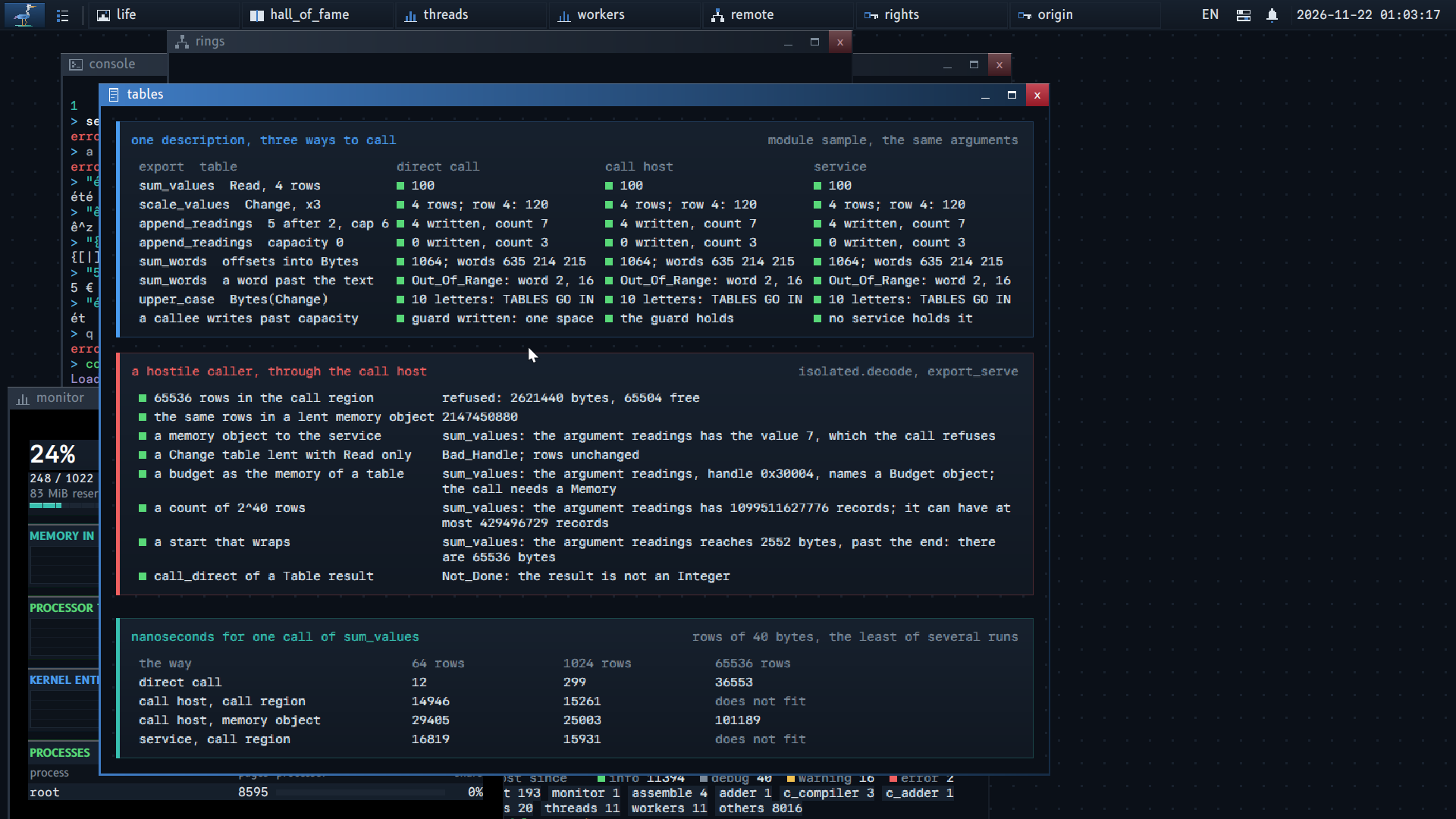
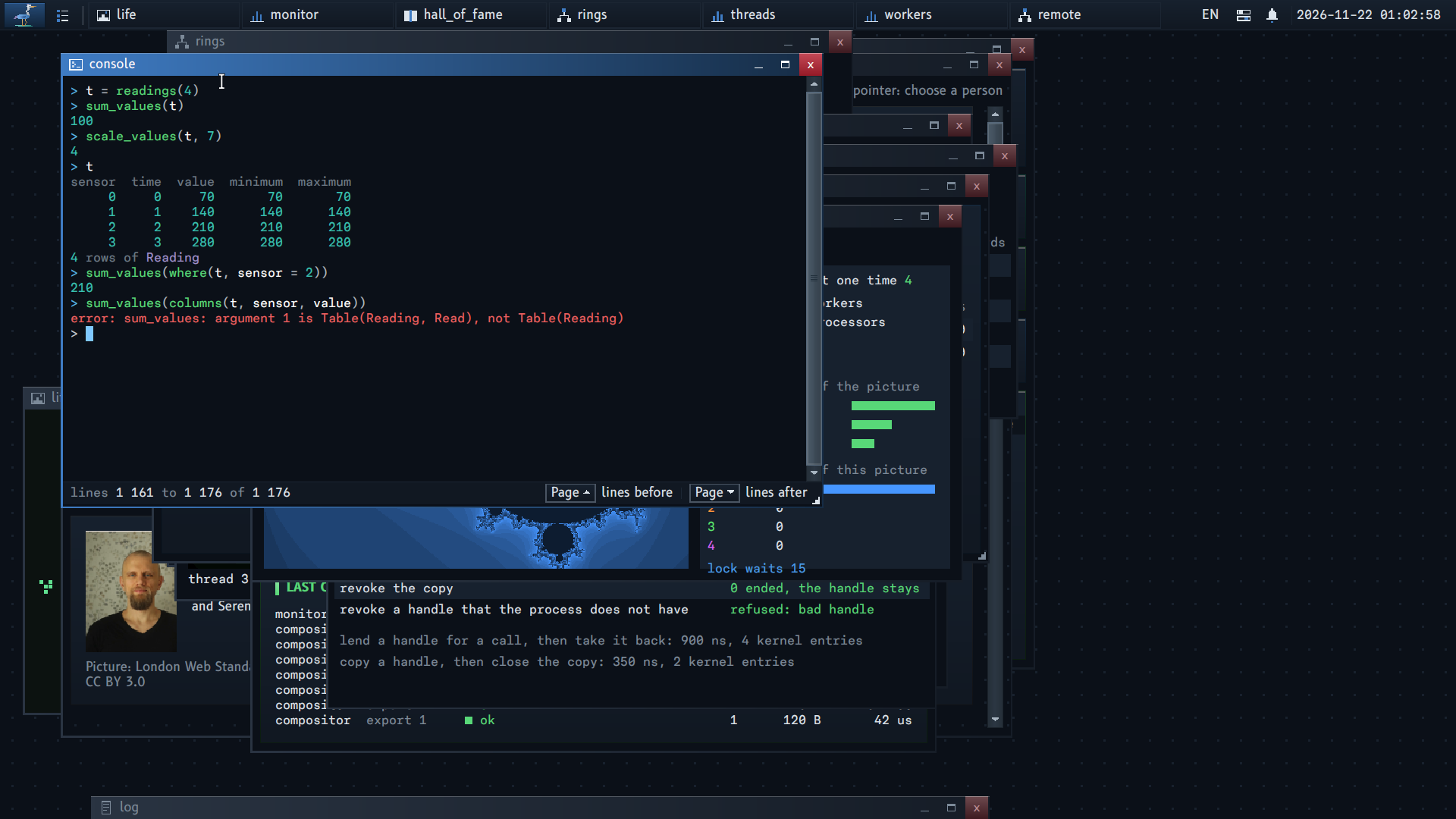
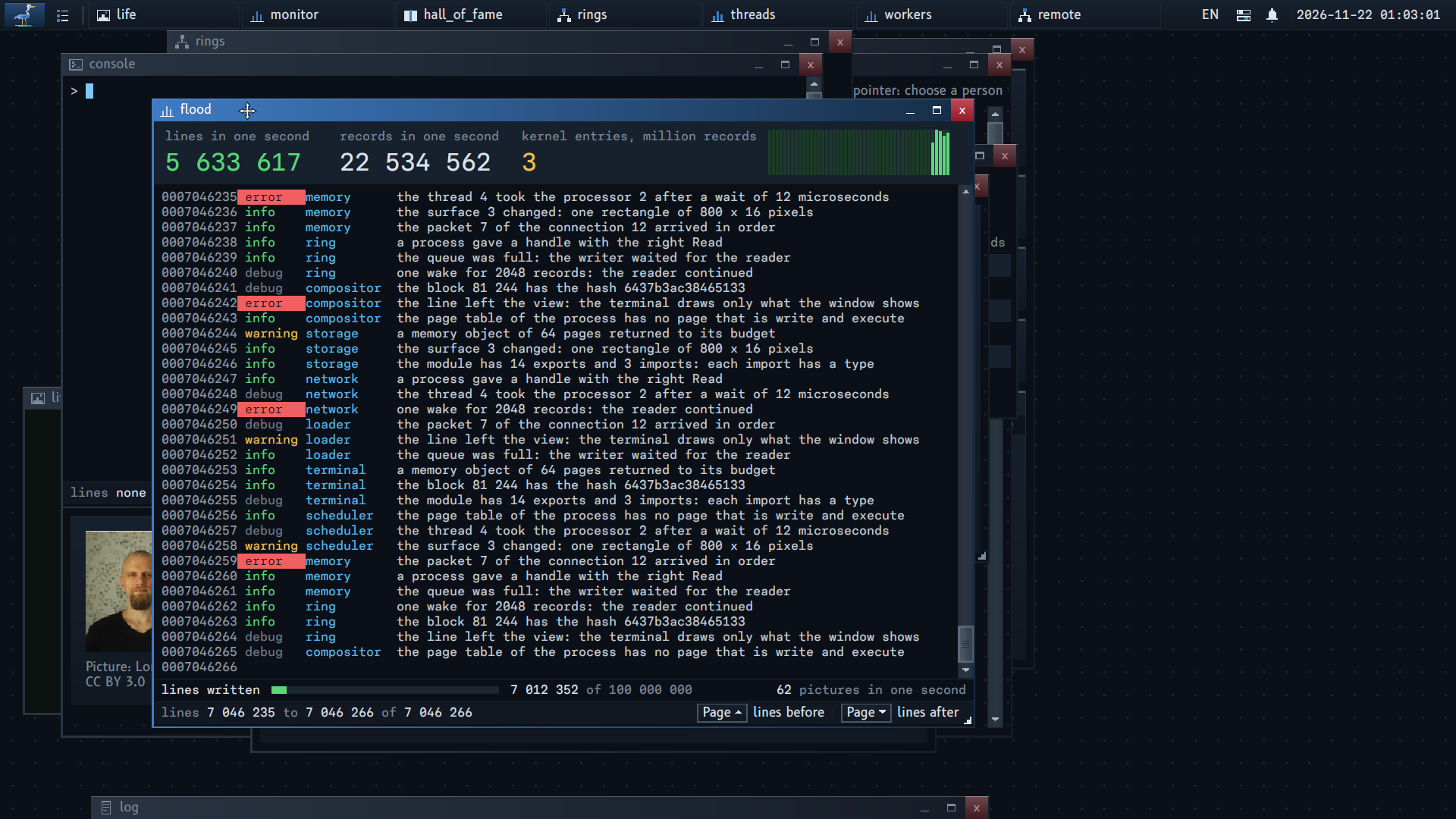
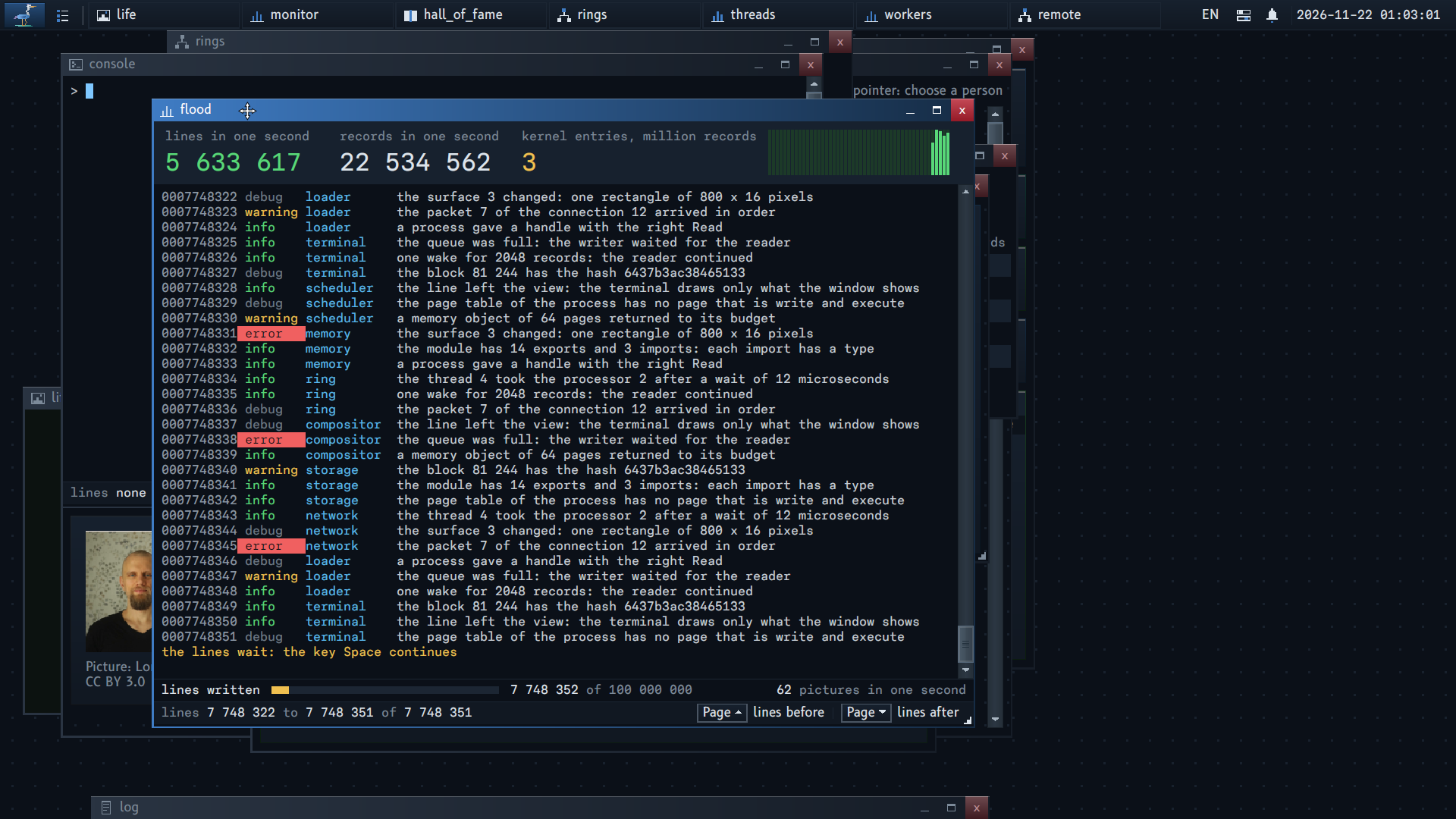
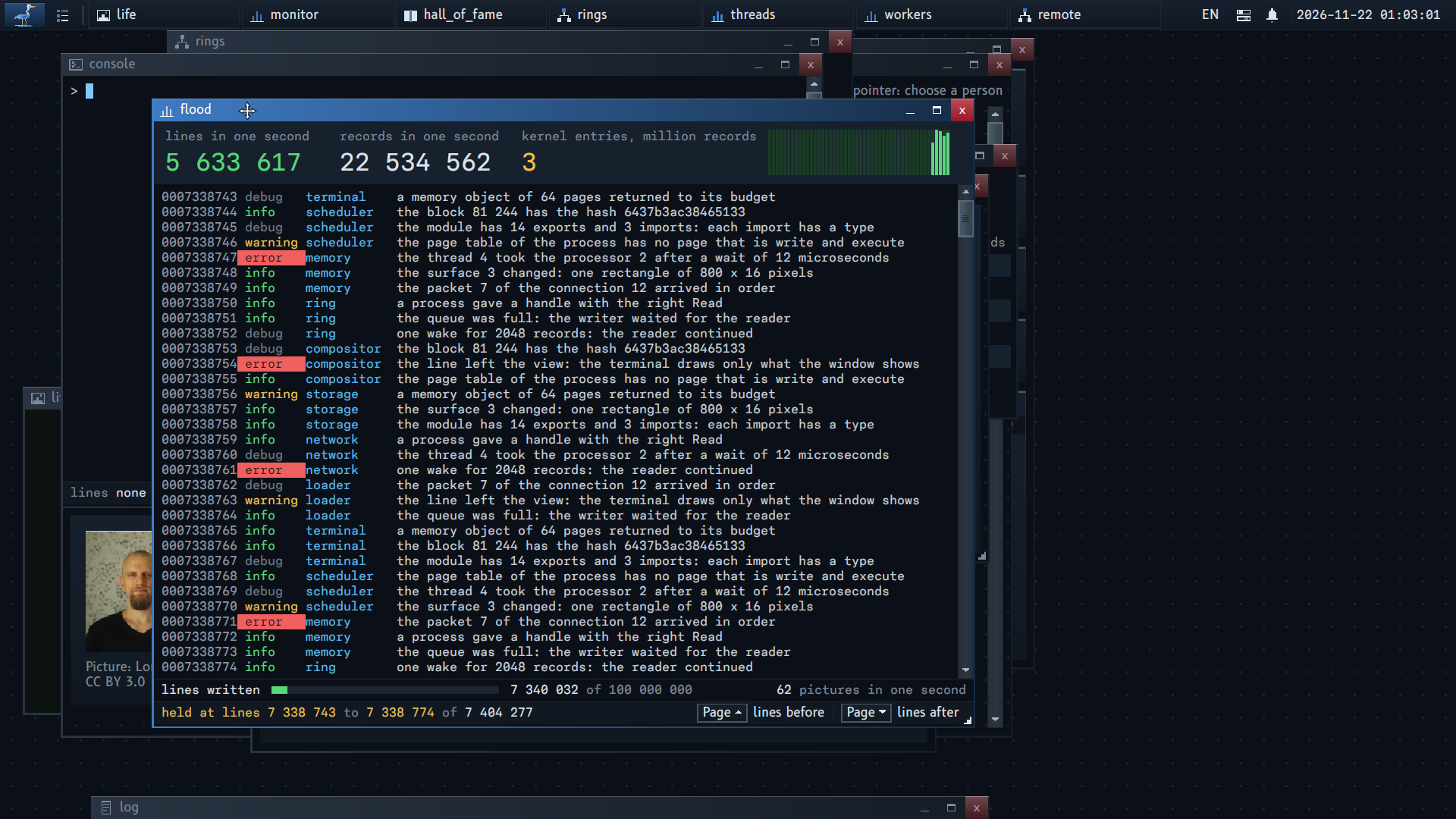
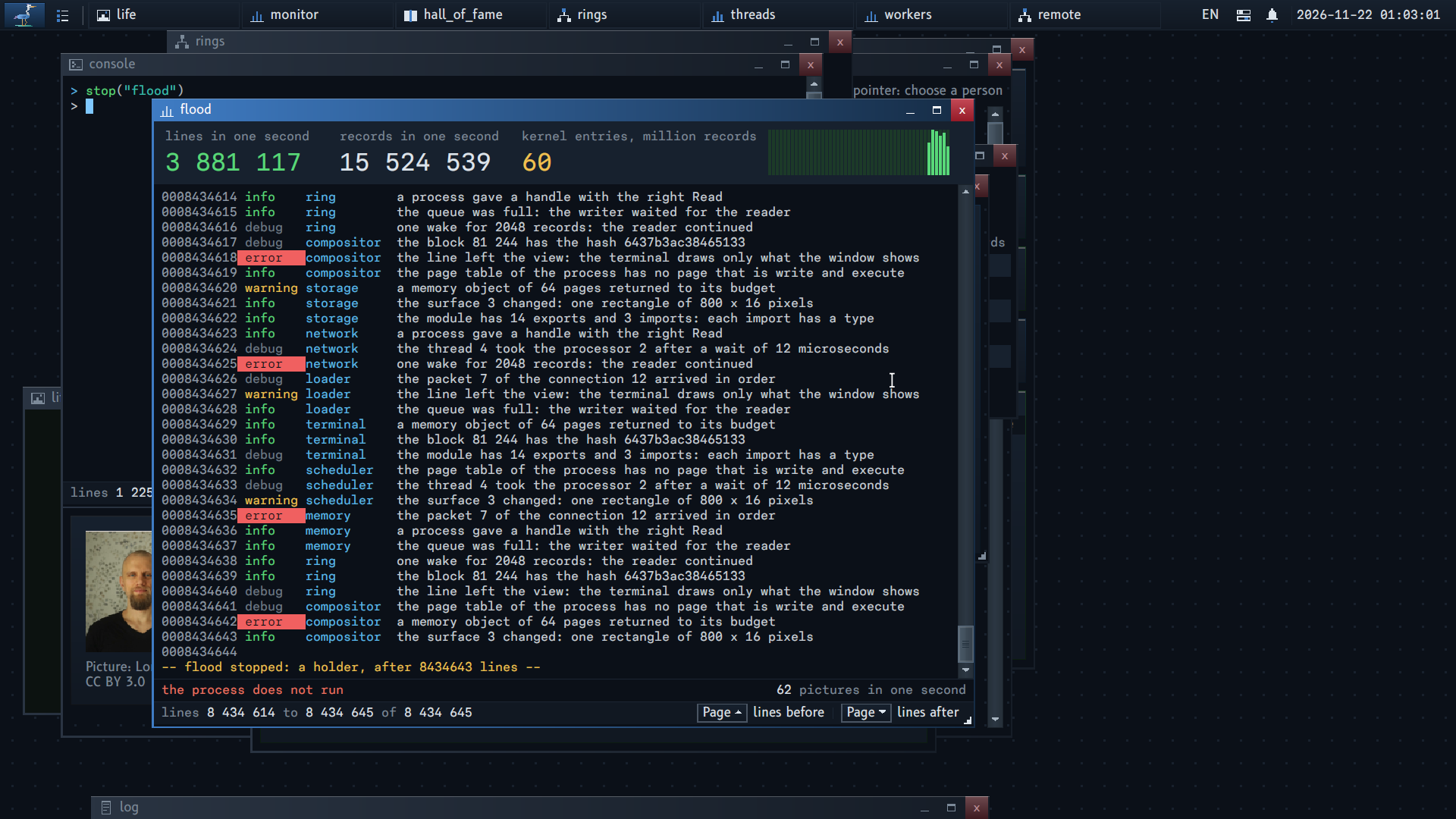
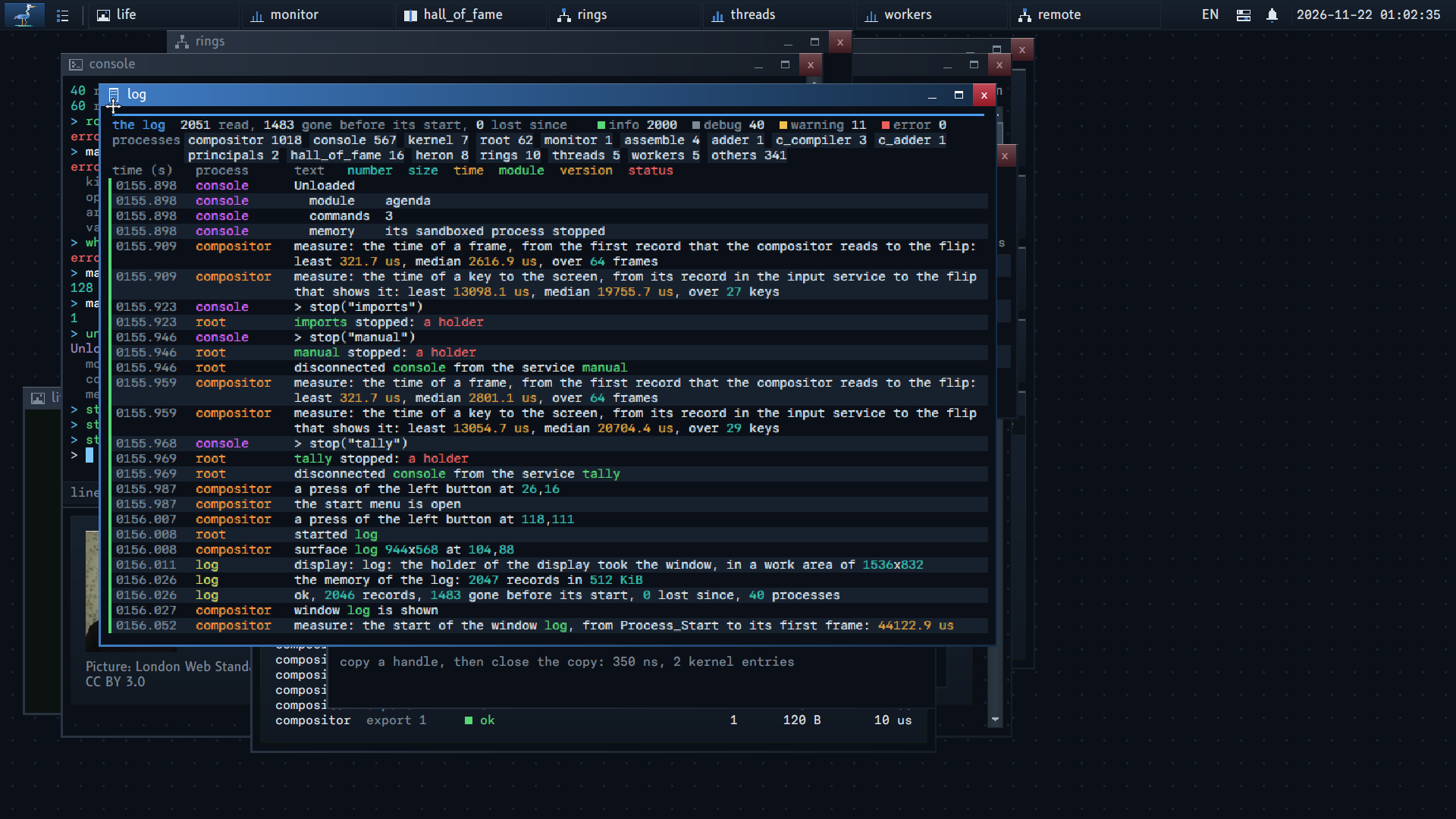
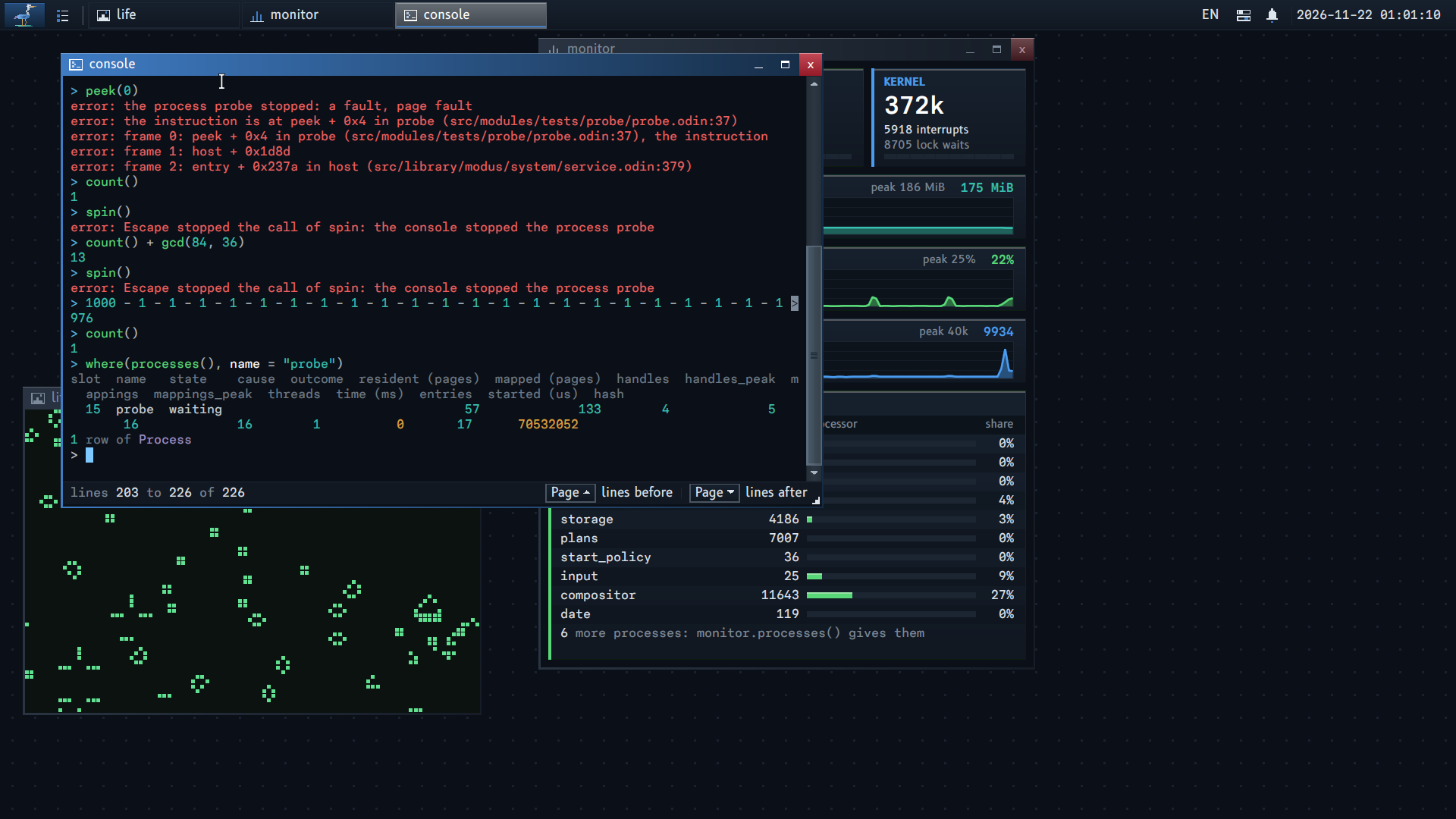
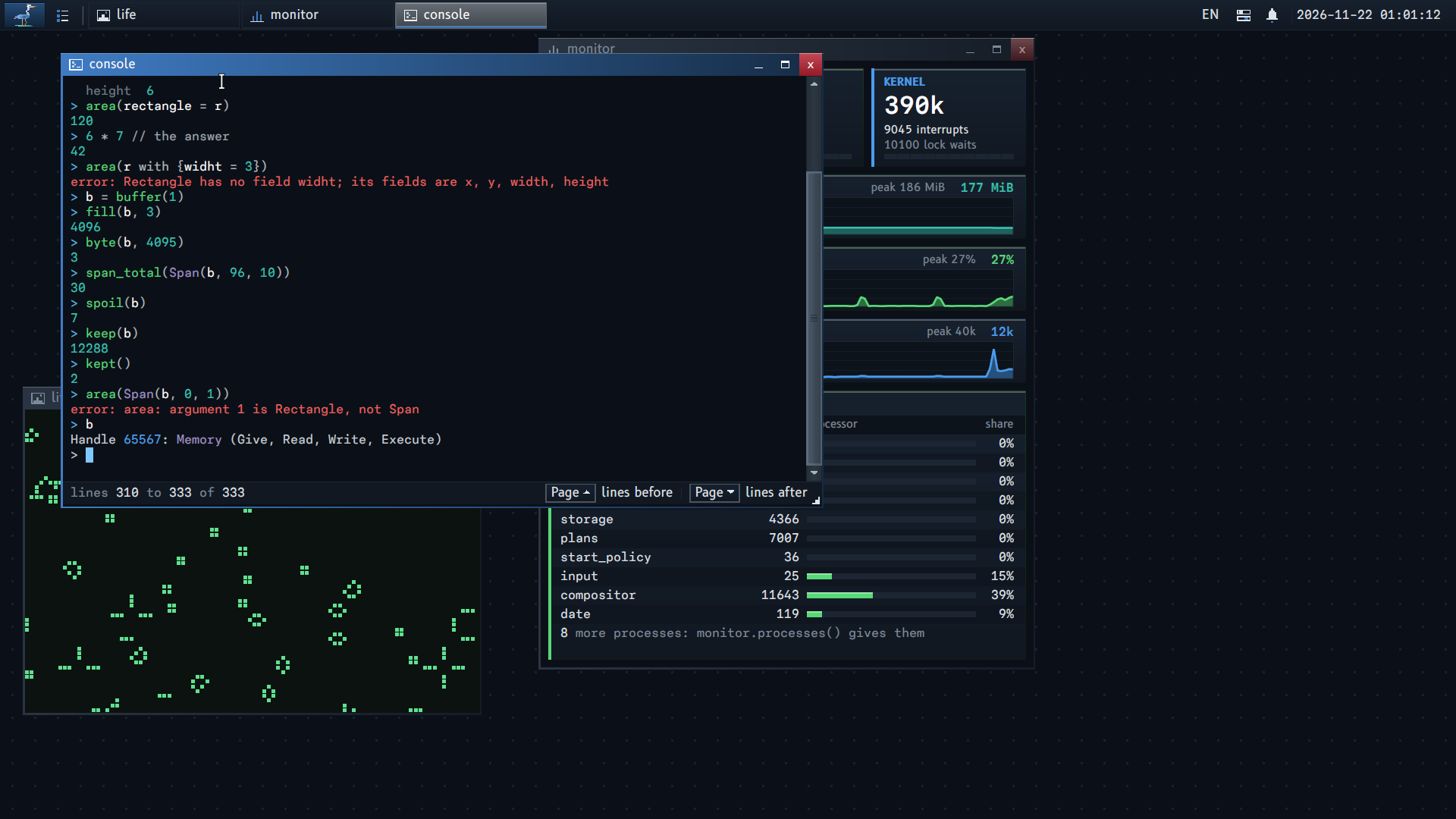
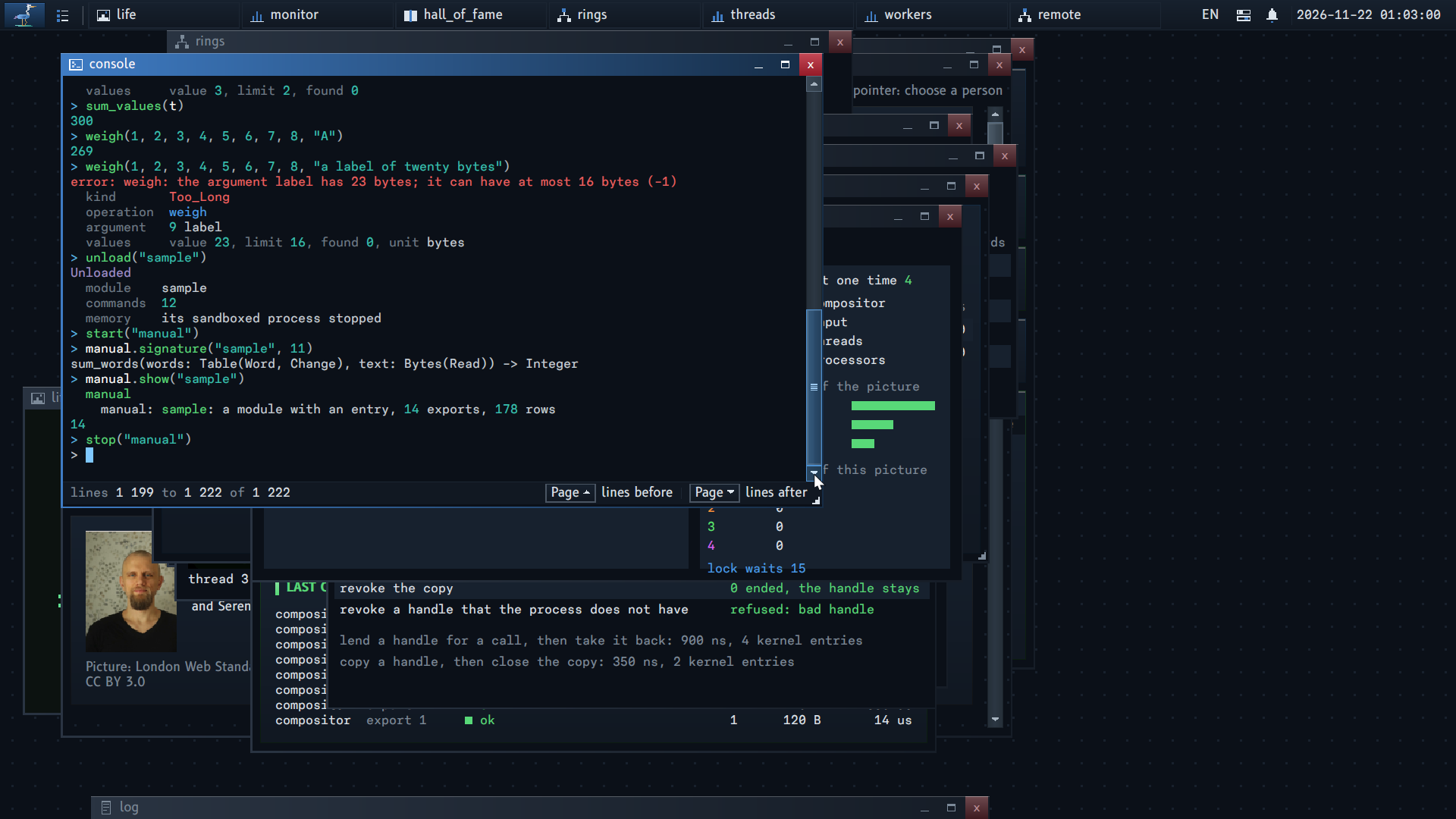
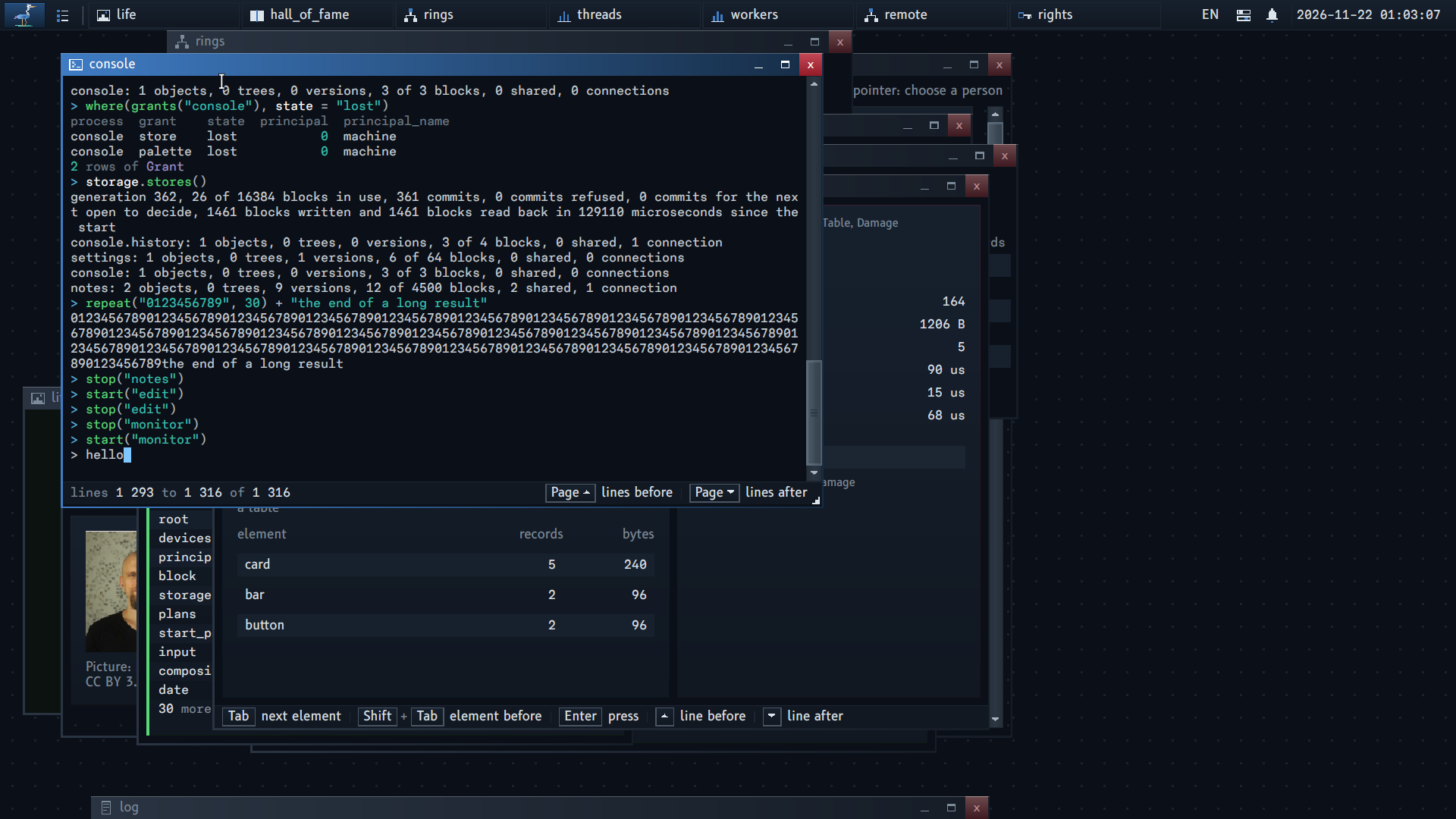
The console at the start of the machine, with the window of life that one of its lines started.Guide: The line of the consoleThe completion list of the console: mcnt matches monitor.count by a fuzzy match, with the matched letters lit and each signature.Guide: The line of the consoleThe history search of the console: Control-R and a part of a line.Guide: The line of the consoleLex in the console: let, a record literal and with, a function given to map, |> with _, a named argument, a comment, and a refusal in red.Guide: The line of the consoleThe console: a record with a handle, then a table of numbers, a size in pages and two times, each in the color of its kind, each unit in the head.Guide: The line of the consoleLines of the console: commands compose, an error says what to do, and the signature of the command shows under the line.Guide: The line of the consoleA line runs in the second thread of the console: the console keeps the keys, and Escape stops the call.Guide: The line of the consoleTables as parameters: one description and three ways to call, a hostile caller, and the time of one call.Guide: Module contractA table as a value of the console: a variable holds it, commands read and change it, and a wrong direction is an error.Guide: Module contractA terminal with no escape sequence: flood writes millions of styled lines in one second, and the terminal draws only the view.Guide: The line of the consoleA key is a record from the terminal to its process: flood stops its lines at the key Space, and shows it in its edit line.Guide: The line of the consoleThe view of a terminal is held while the process continues to write.Guide: The line of the consoleThe process stopped: its terminal stays, with the lines that the process wrote.Guide: The line of the consoleThe log: records with a time, a process and a level, and each value of a text in the color of its kind.Guide: Developer tools
The mark and the graphics
The process that plays the animations of the heron of the mark, and the hall of fame of the people whose work inspired the system. 3 pictures.
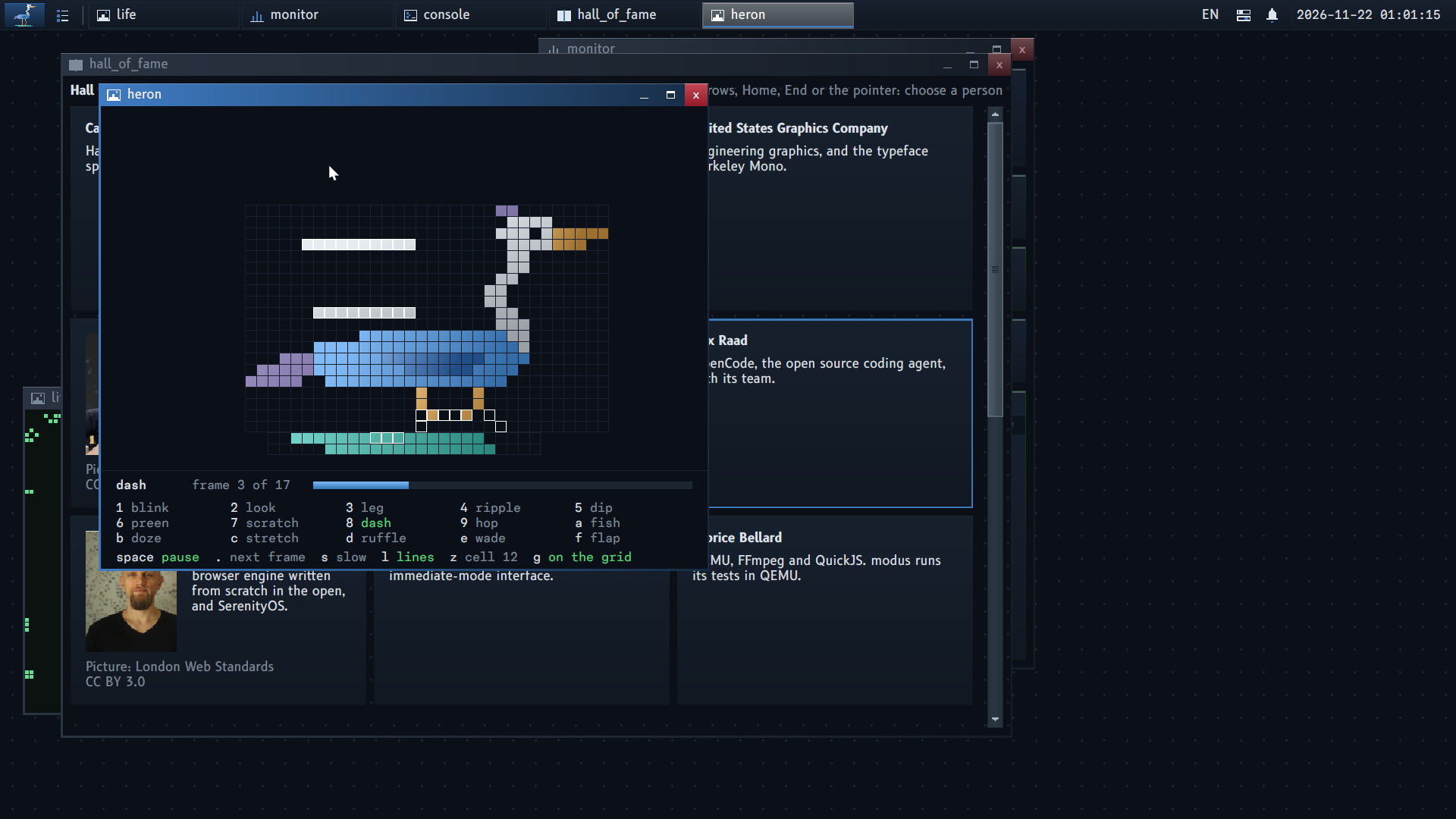
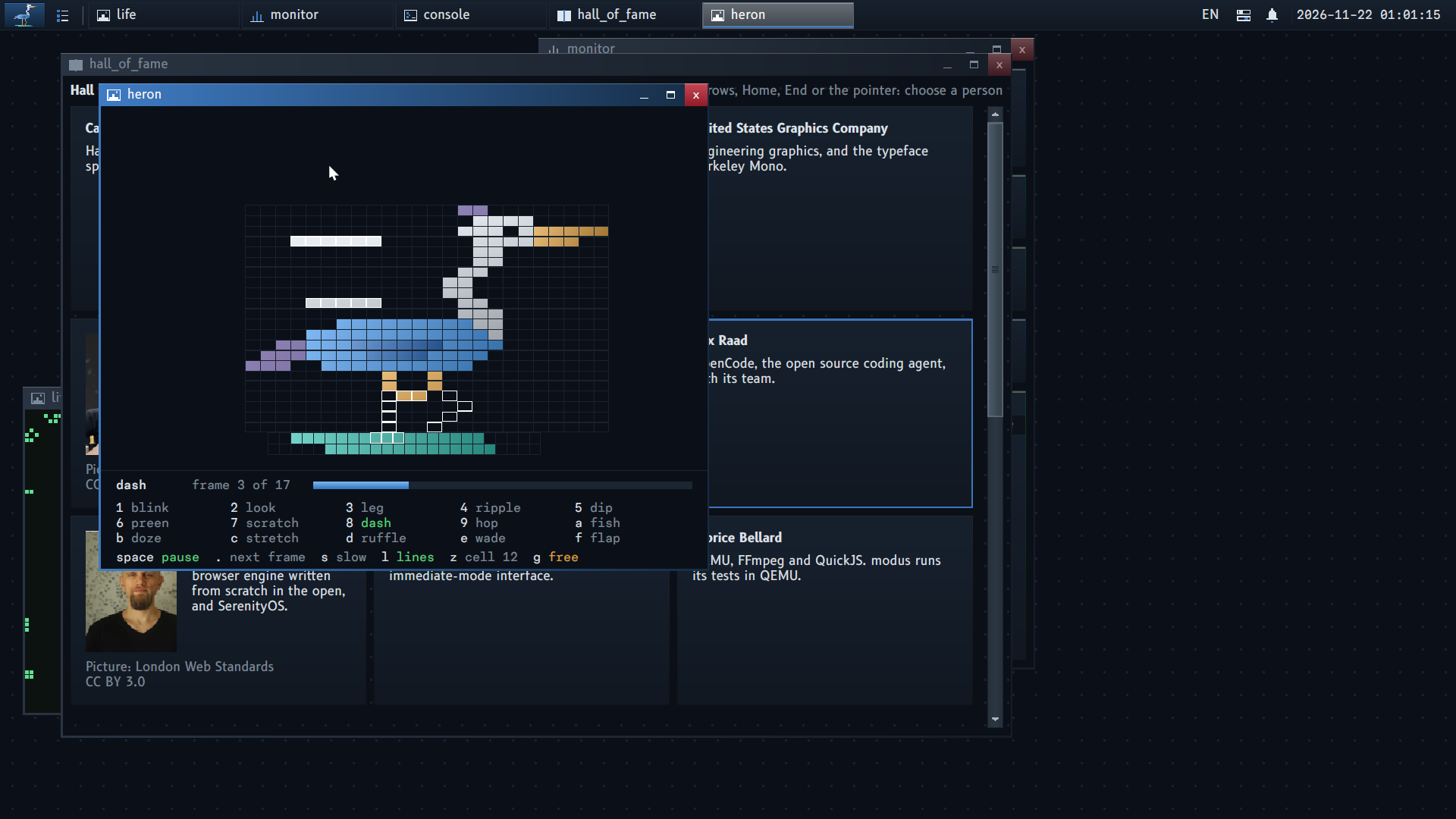
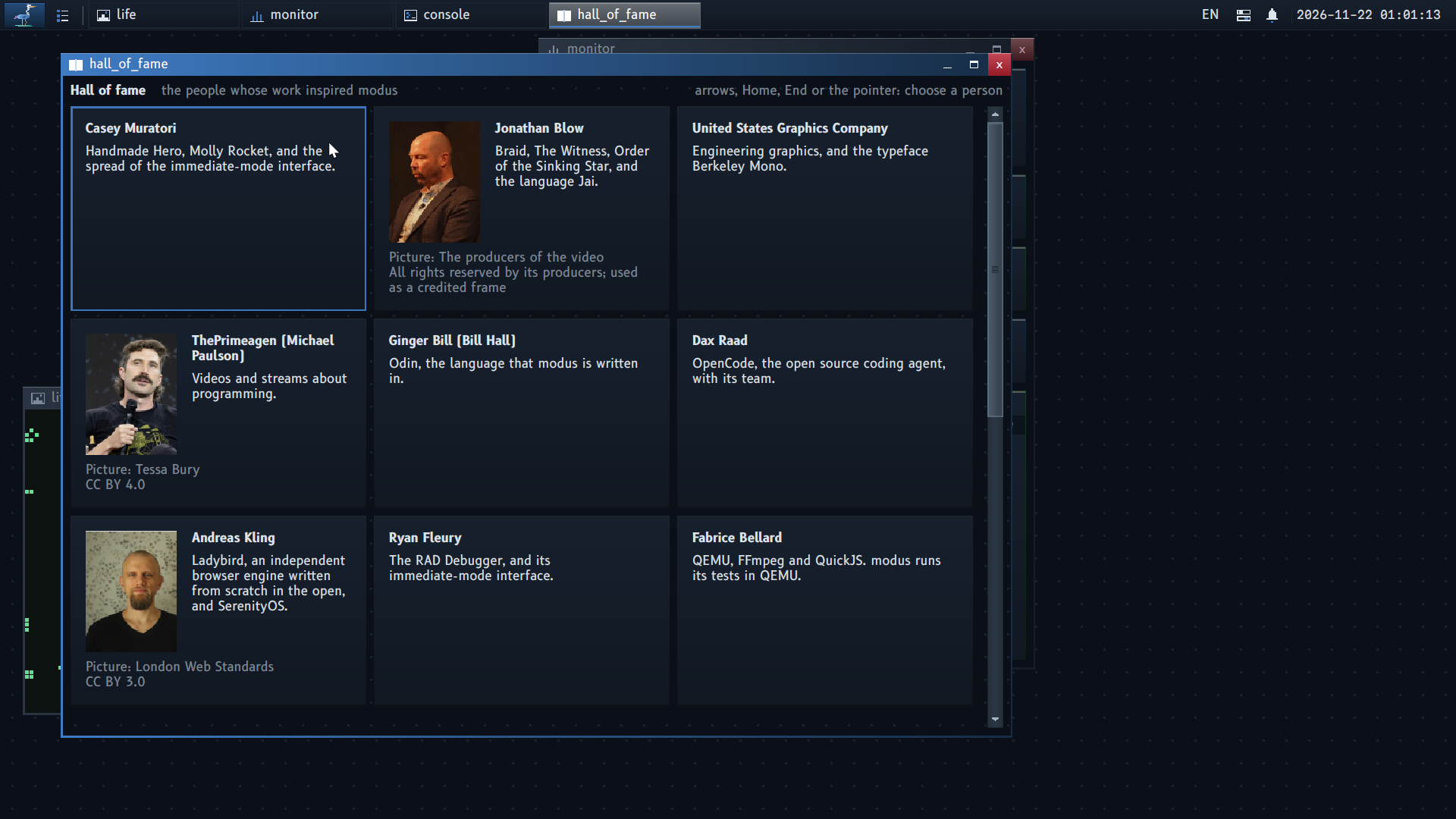
The process heron: the heron of the mark held at a frame of its dash, in whole square cells, with the lines of the cells.Guide: The design rulesThe same frame in the free way of the process heron: the frame is stretched, and its cells become rectangles.Guide: The design rulesThe hall of fame: the people whose work inspired modus, each on a card with a portrait and its credit, or with no picture.Guide: The interface of the processes
Rights, grants and faults
Modules that show what a process reaches and what the kernel refuses: rights, revocation, isolation, budgets, faults and errors. 13 pictures.
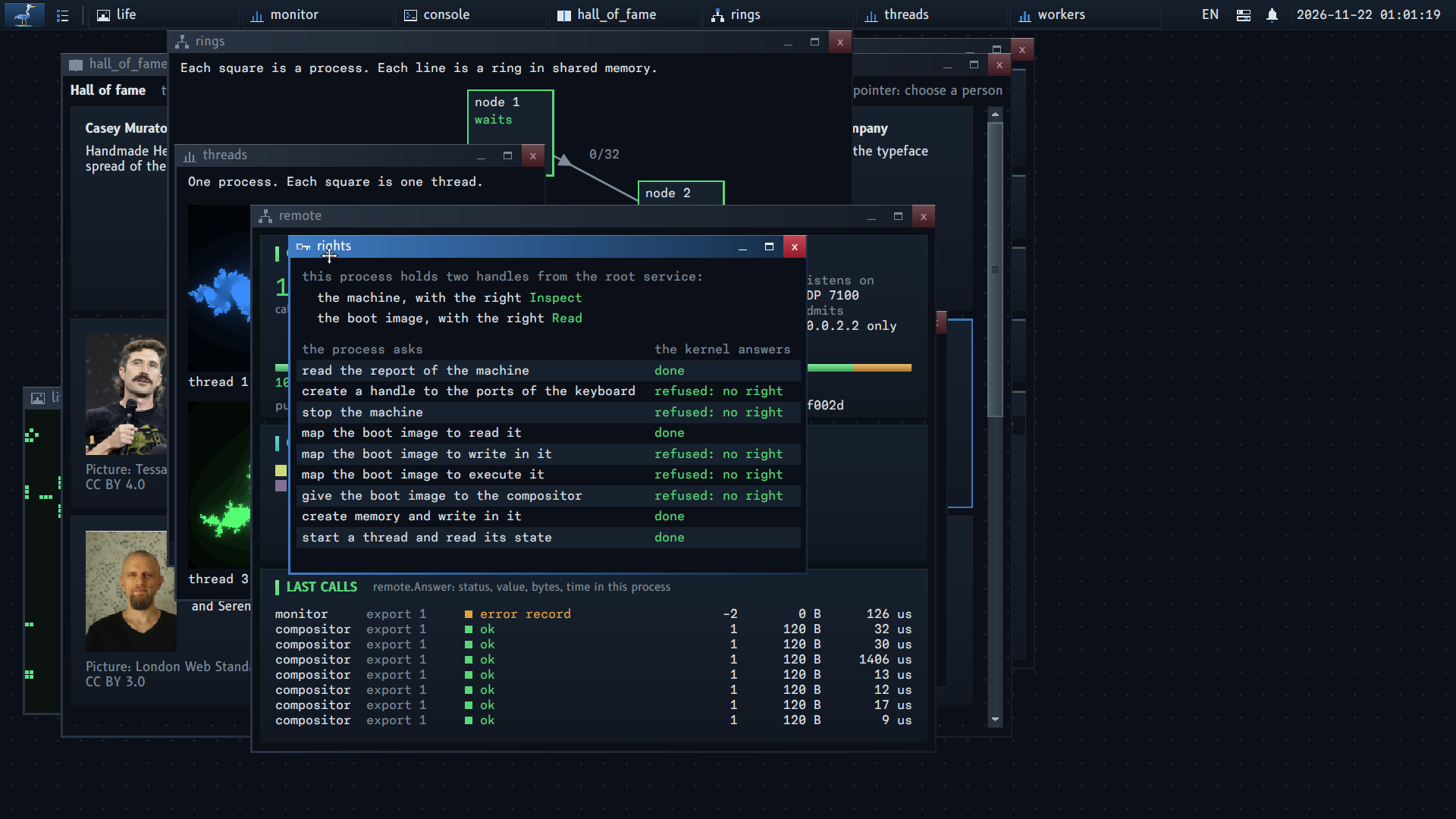
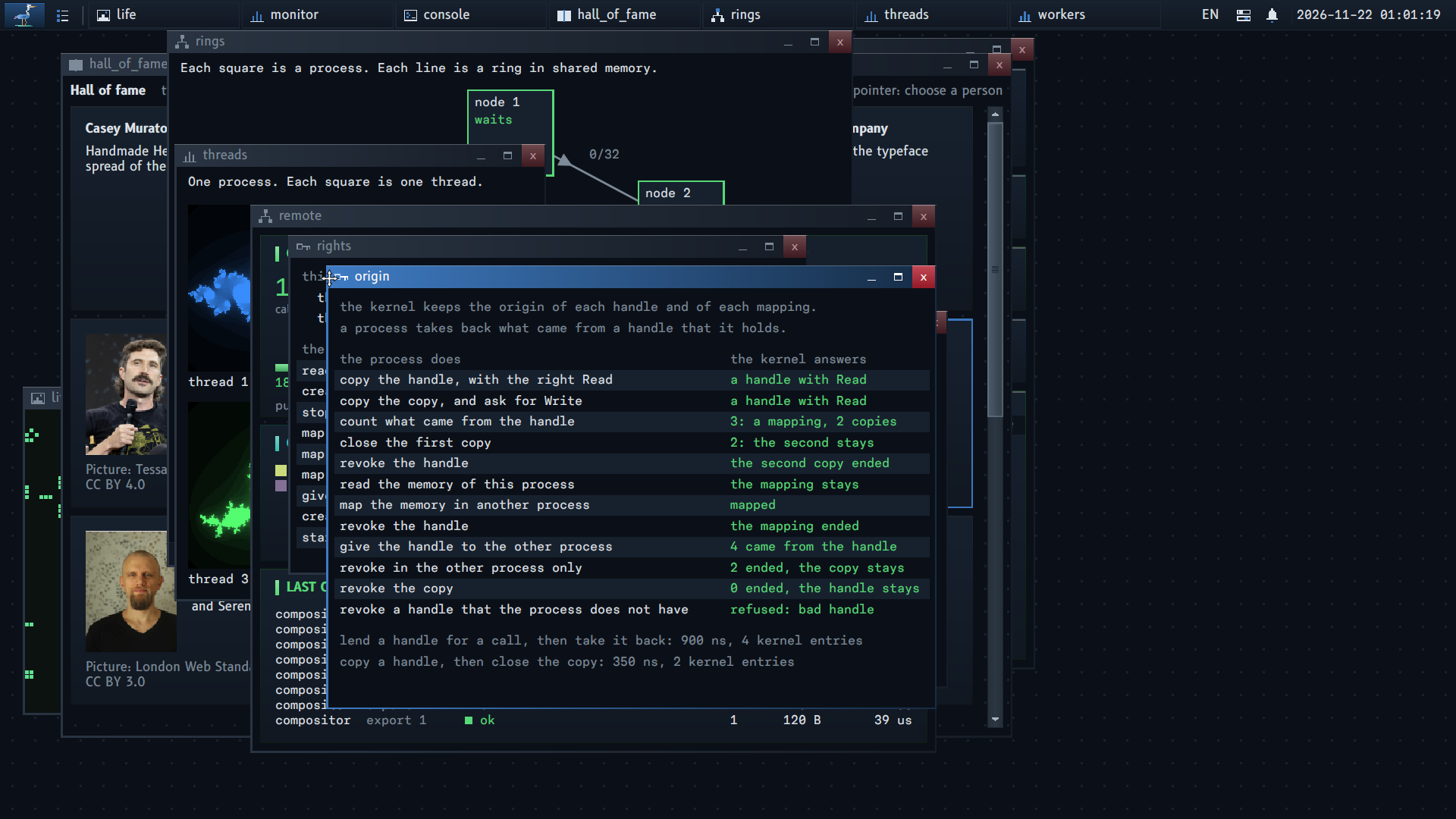
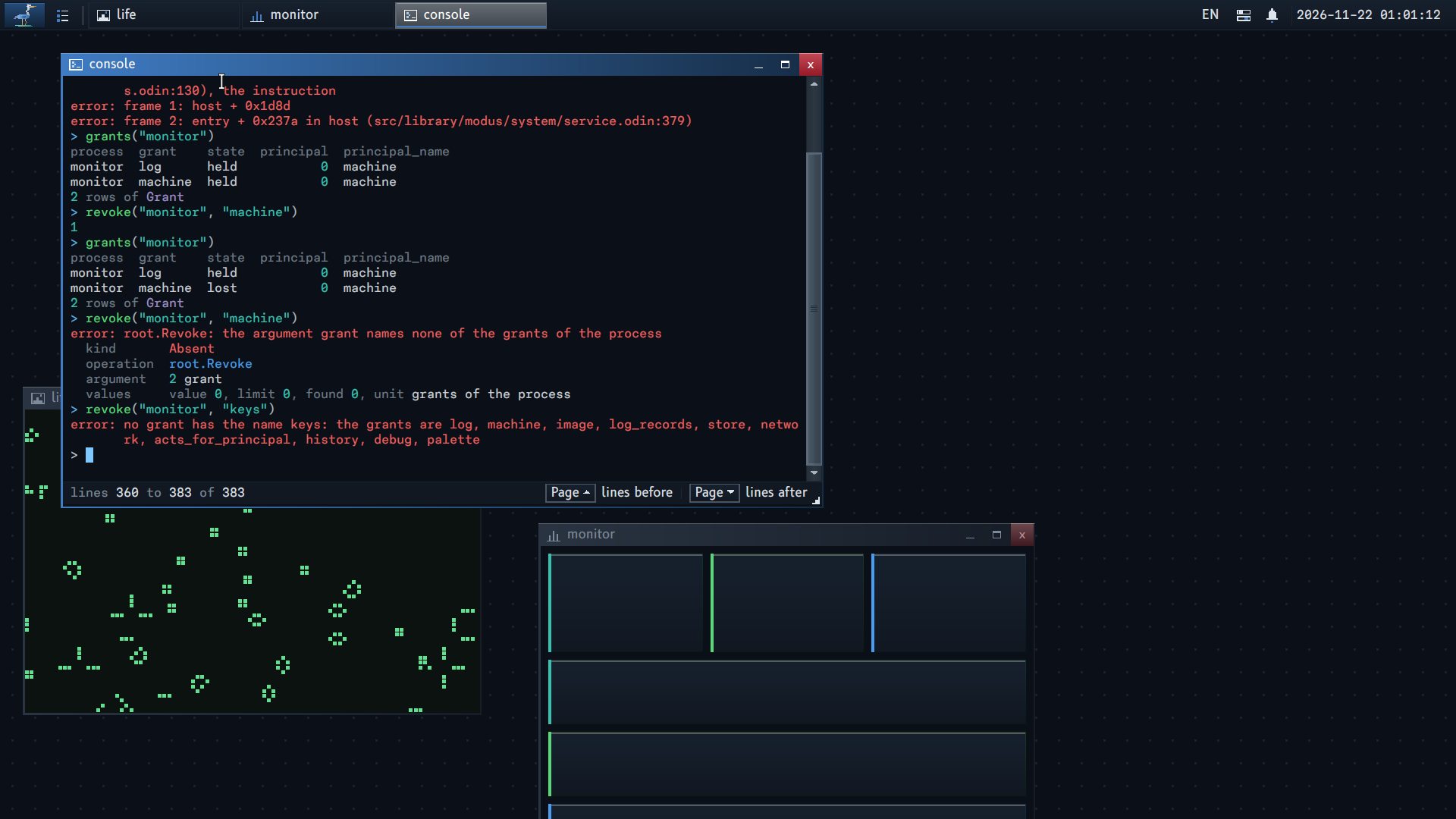
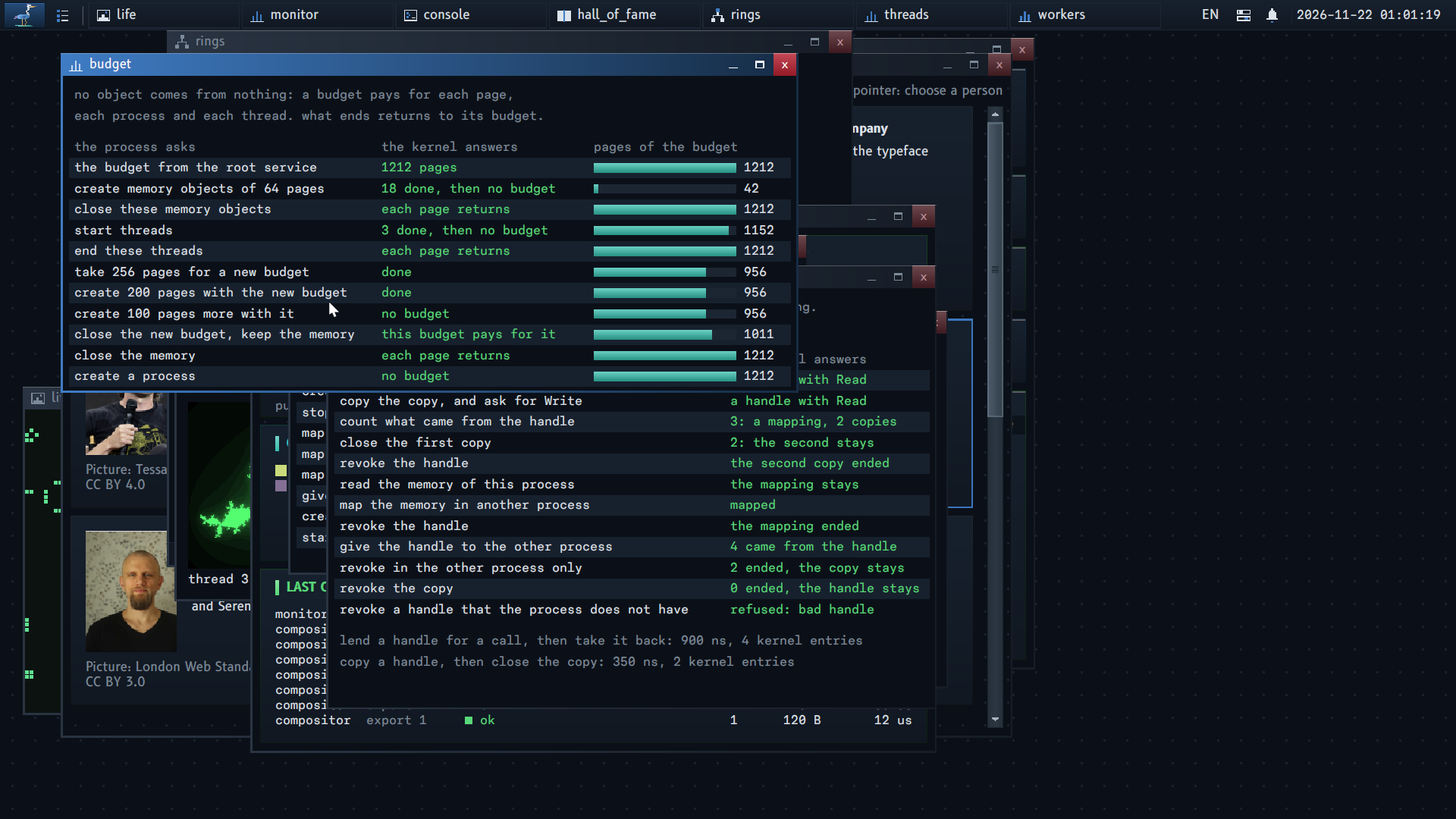
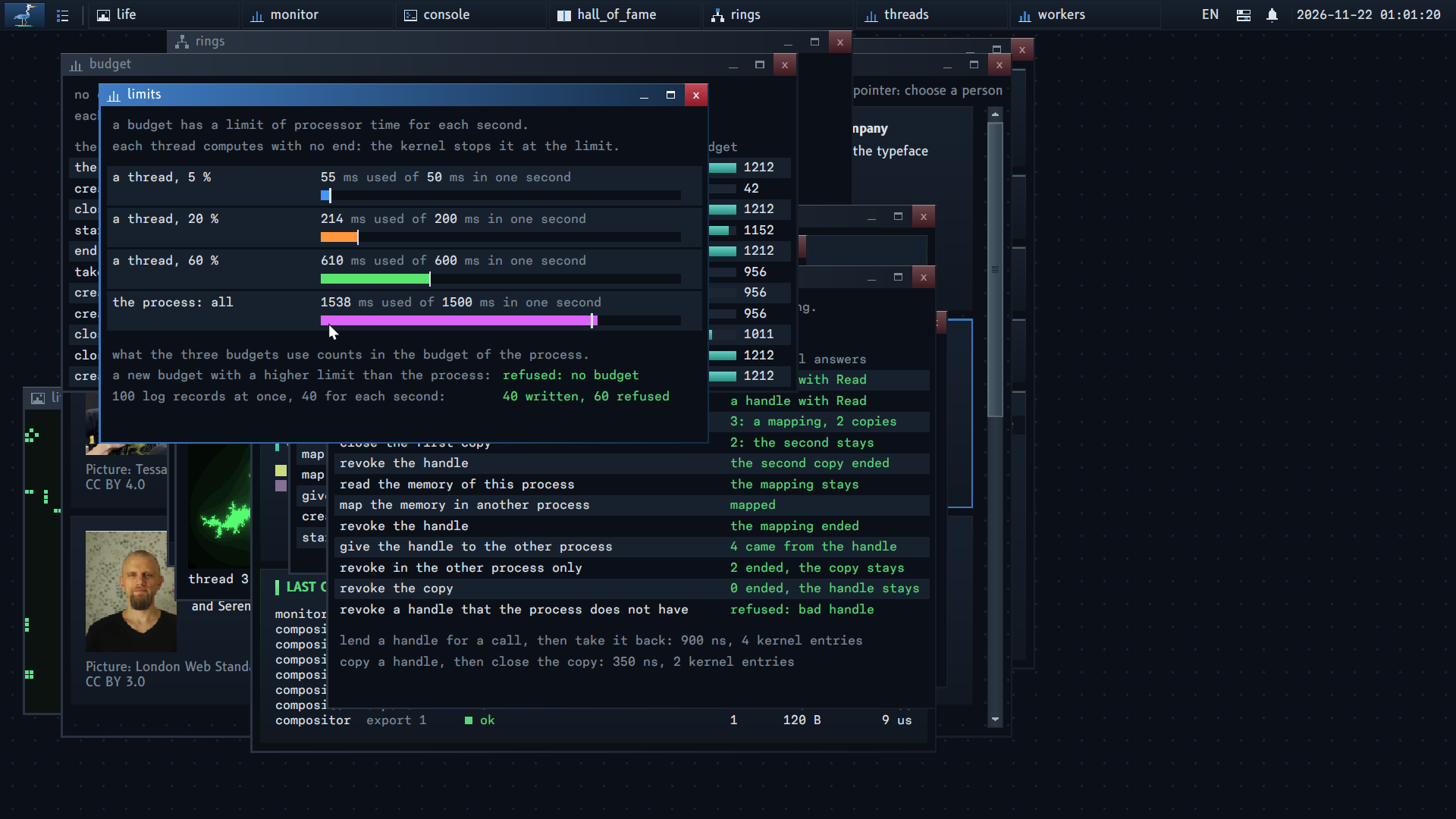
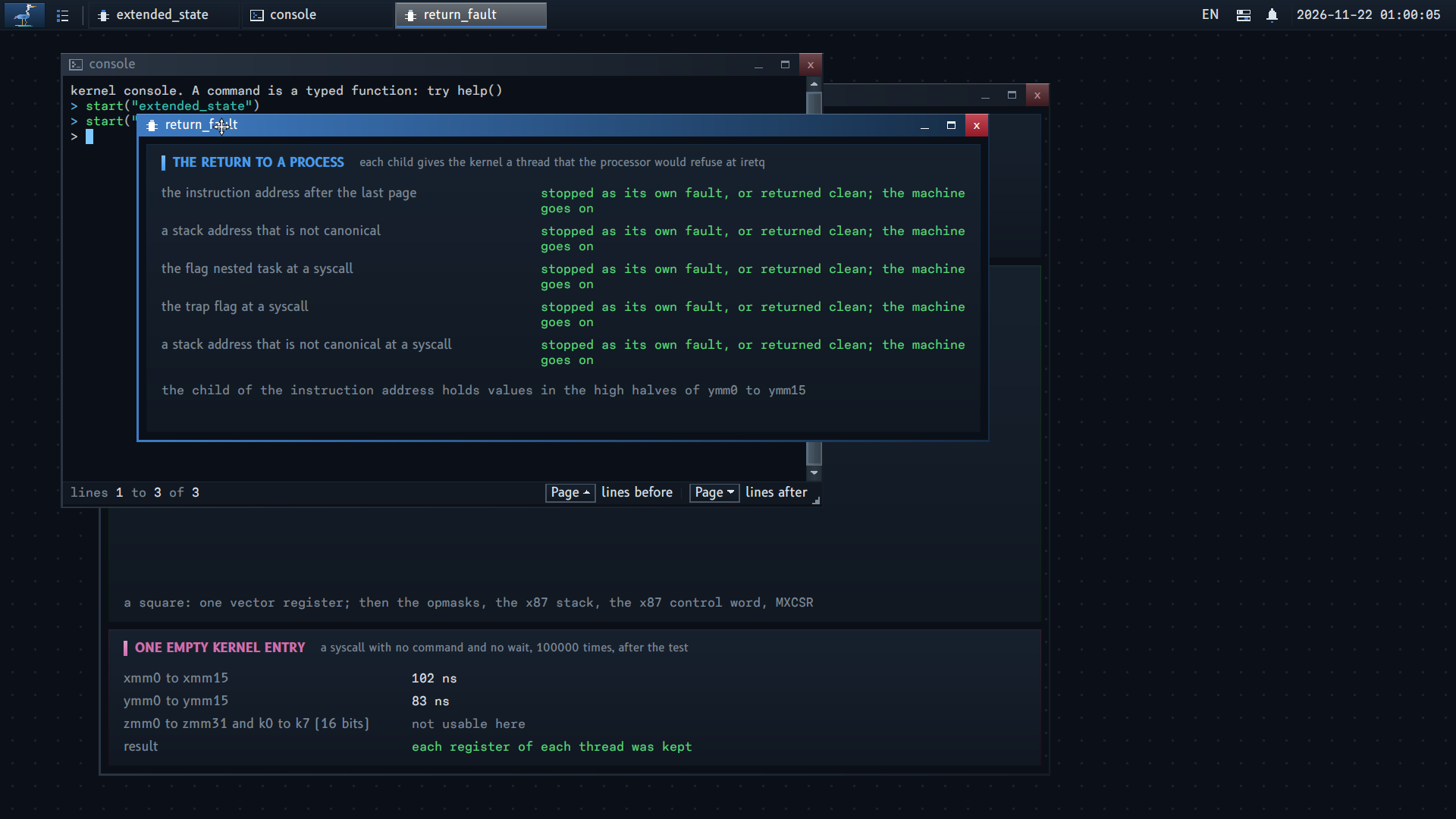
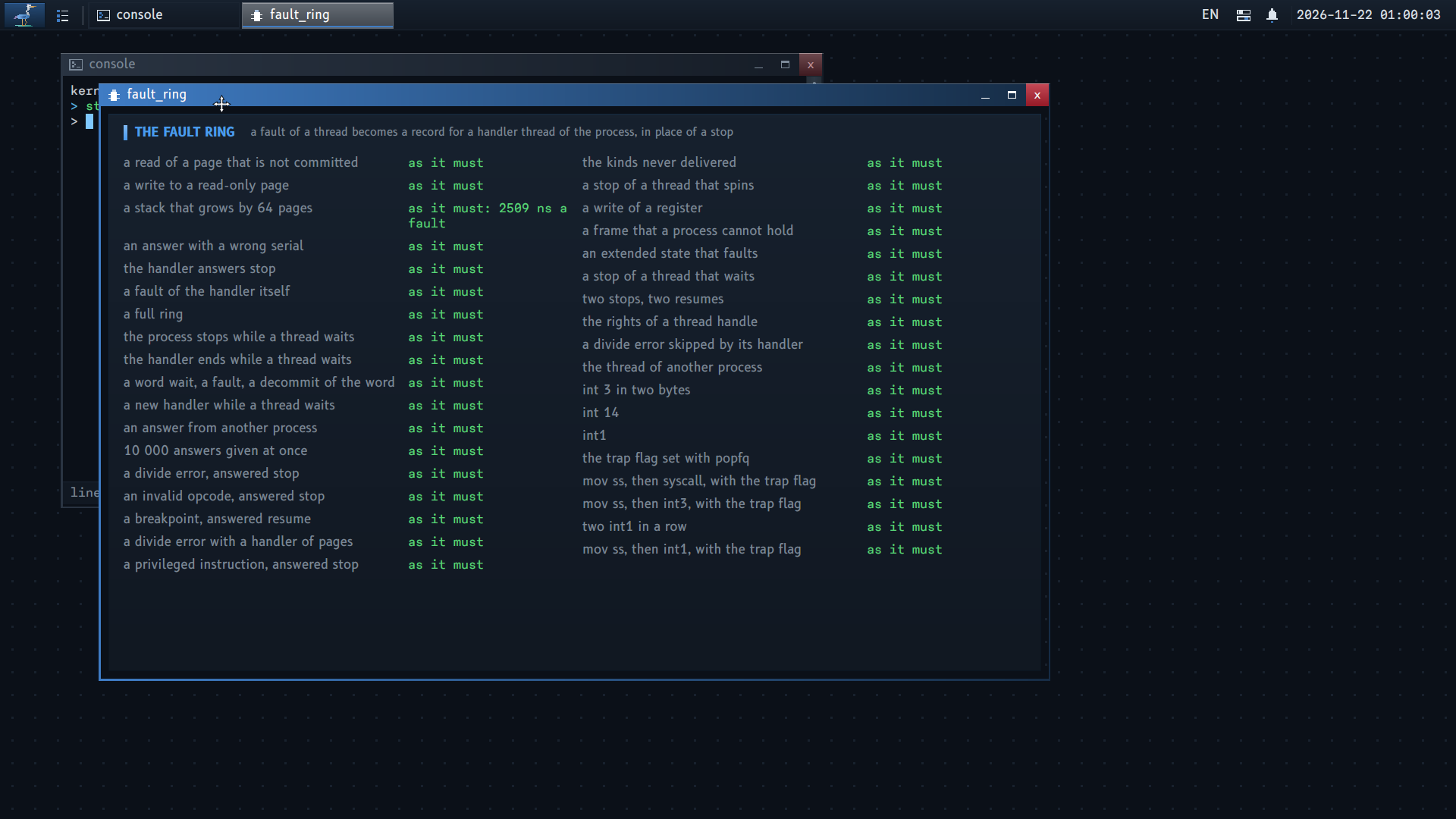
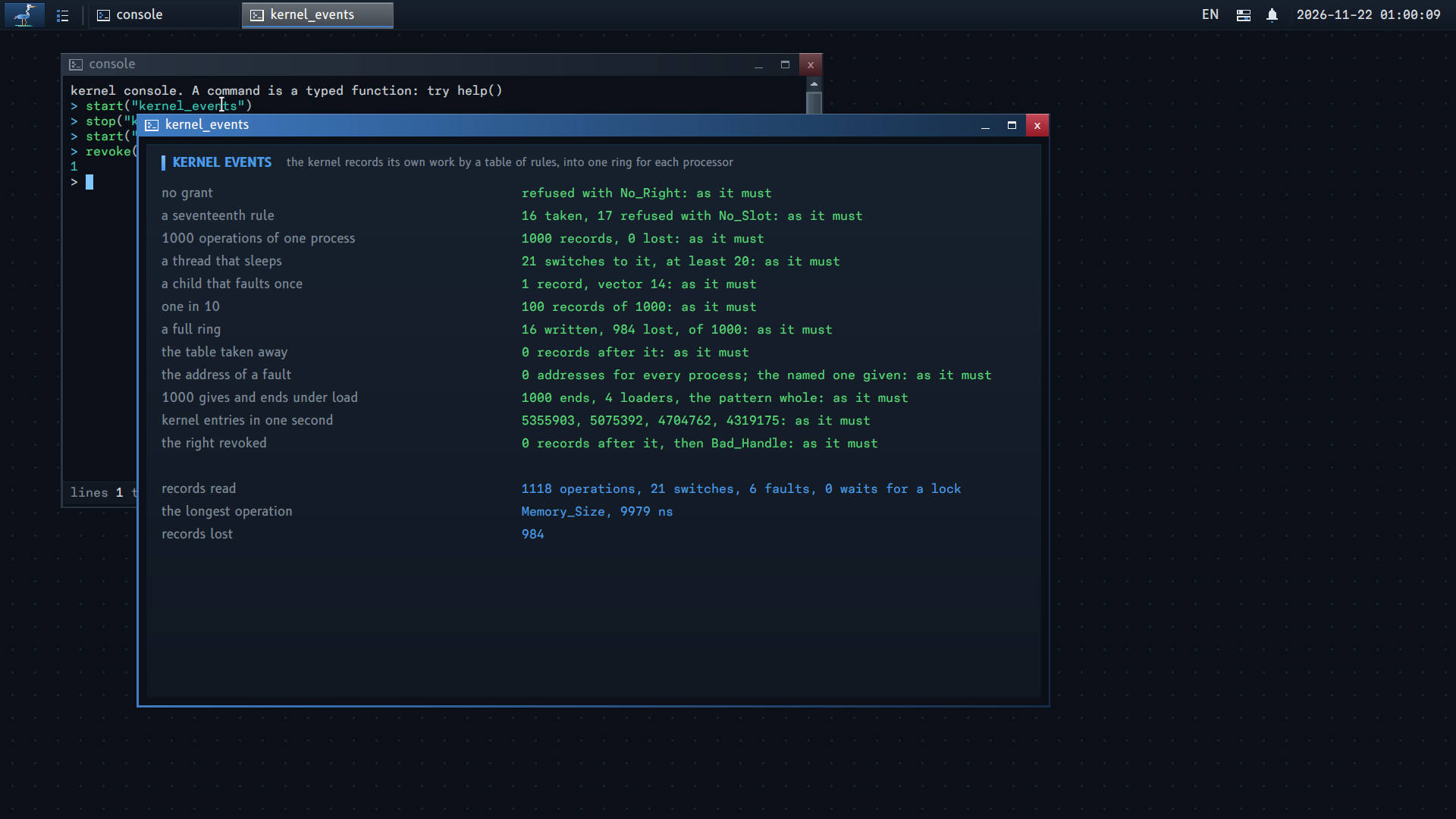
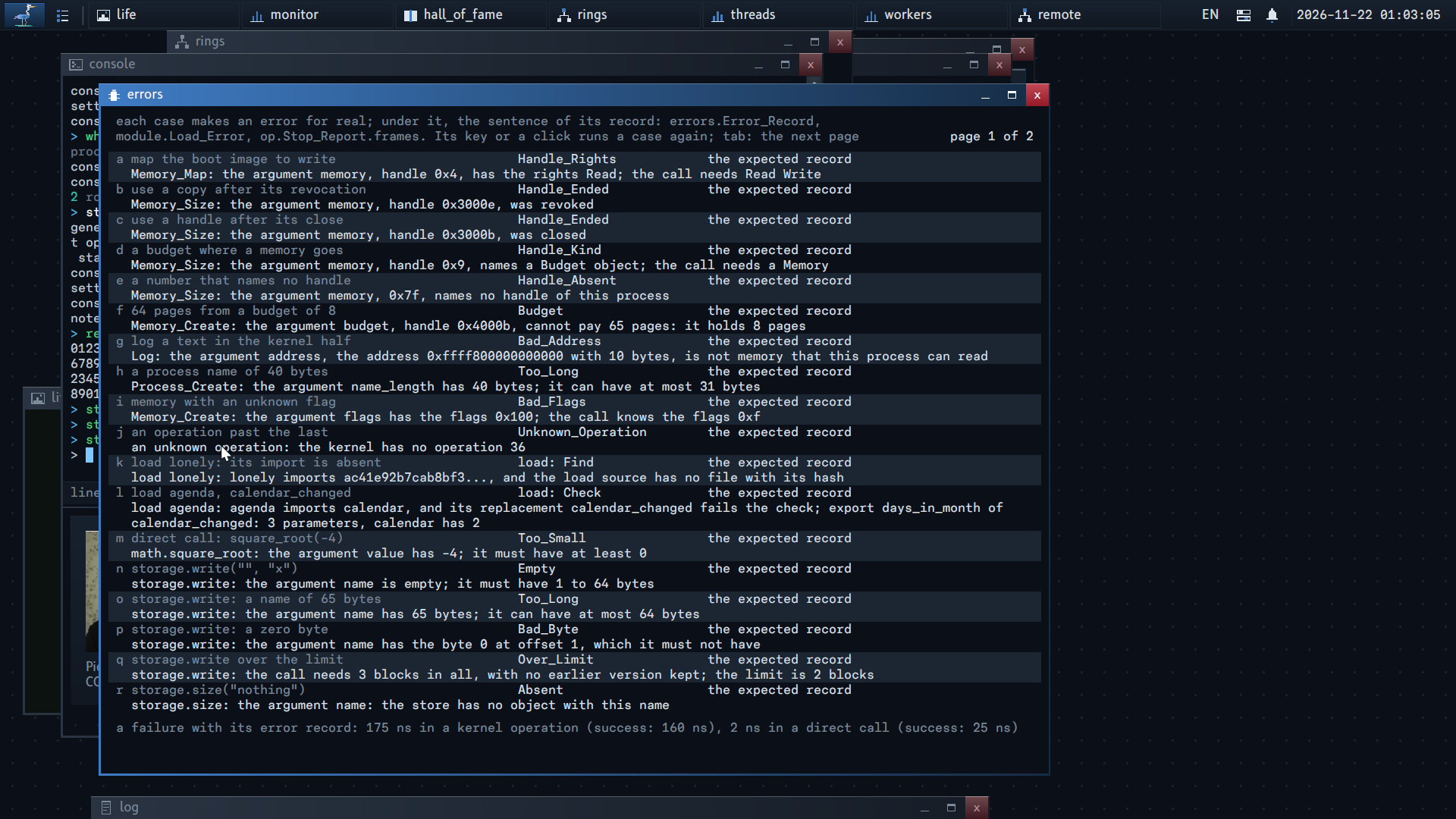
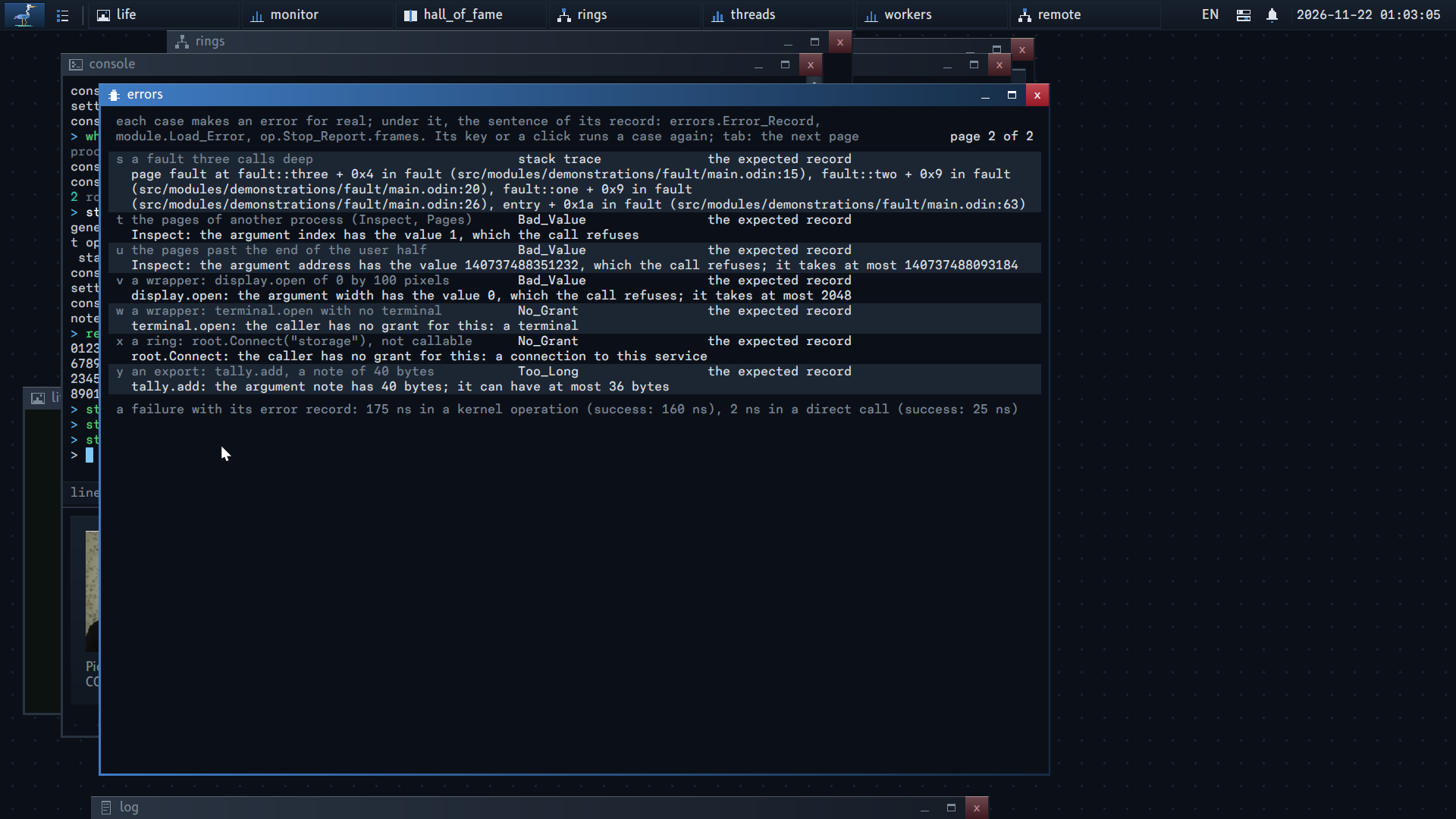
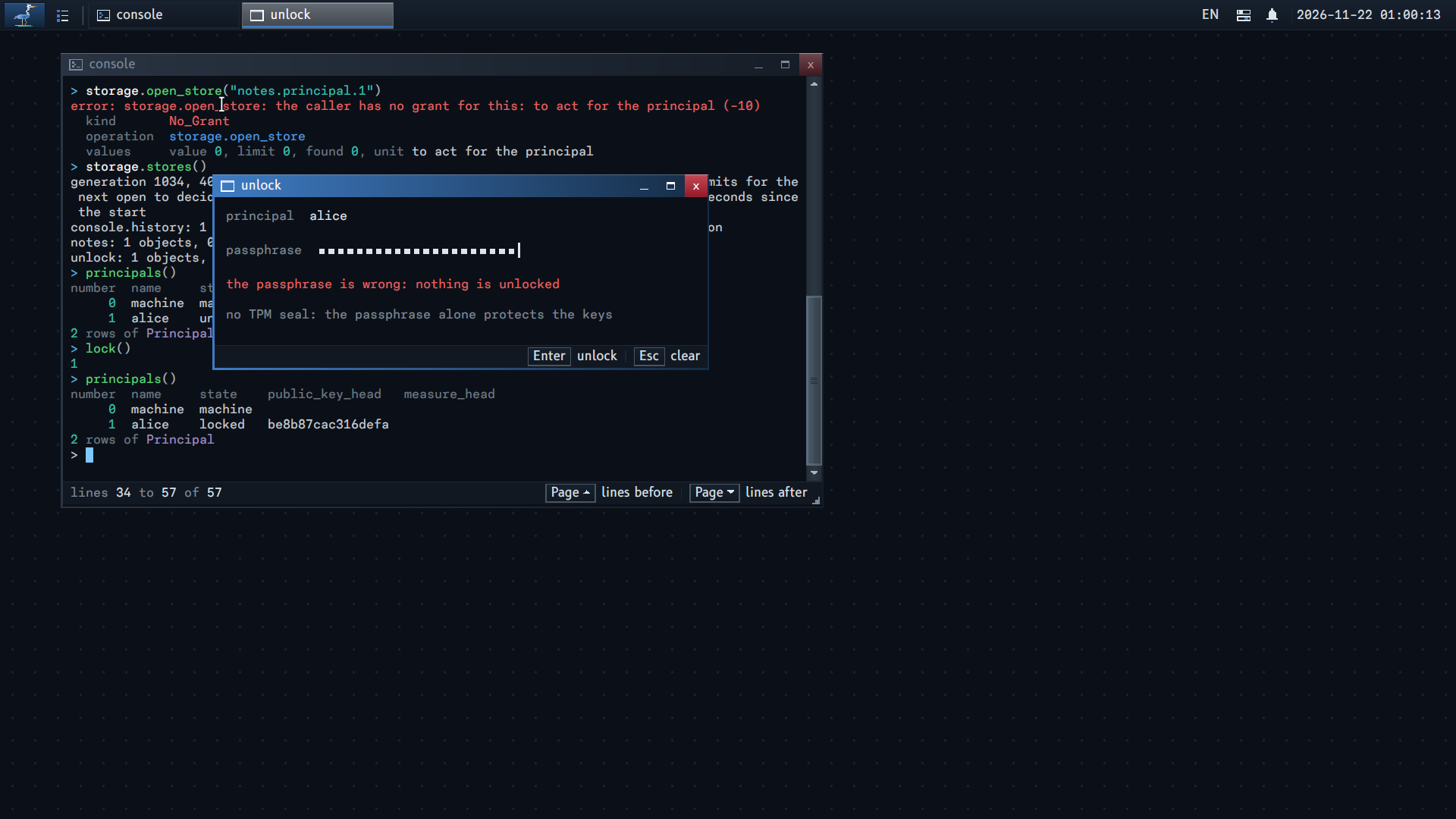
A process with a part of the rights of two handles: the kernel does four operations and refuses five.Guide: ArchitectureThe origin of a handle: twelve cases of copies, gifts and revocations, with the answer of the kernel.Guide: ArchitectureRevocation: the console takes back what it lent, and the root service ends the machine grant of a process that runs.Guide: ArchitectureAn isolated call: a module that faults or loops stops alone.Guide: Module contractA record and a lent handle in an isolated call: the module has the rights of the description, for the time of the call.Guide: Module contractA budget pays for each page and each thread: the kernel refuses when it cannot pay, and each page returns.Guide: ArchitectureThe limits of a budget: three threads use 5, 20 and 60 percent of one processor, and the kernel refuses 60 of 100 log records.Guide: ArchitectureThe return to a process: the kernel stops each of five children whose thread the processor would refuse, and the machine goes on.Guide: ArchitectureThe fault ring: a fault of a thread becomes a record for a handler thread of its process, which repairs it or stops the process.Guide: ArchitectureThe kernel events: the kernel records its own work by a table of rules, and a process reads the records only with the right Events.Guide: ArchitectureErrors that diagnose: each case makes an error for real, and the lines under it are the whole sentence of its error record.Guide: Module contractThe second page of the process errors: the stack trace of a fault, whole, then refusals of Inspect, of a wrapper, of a ring and of an export.Guide: Module contractThe window of unlock: the passphrase of a named principal, shown as dots.Guide: Principals
Modules
One file in several roles, the replacement of an import, and the information that each module carries. 11 pictures.
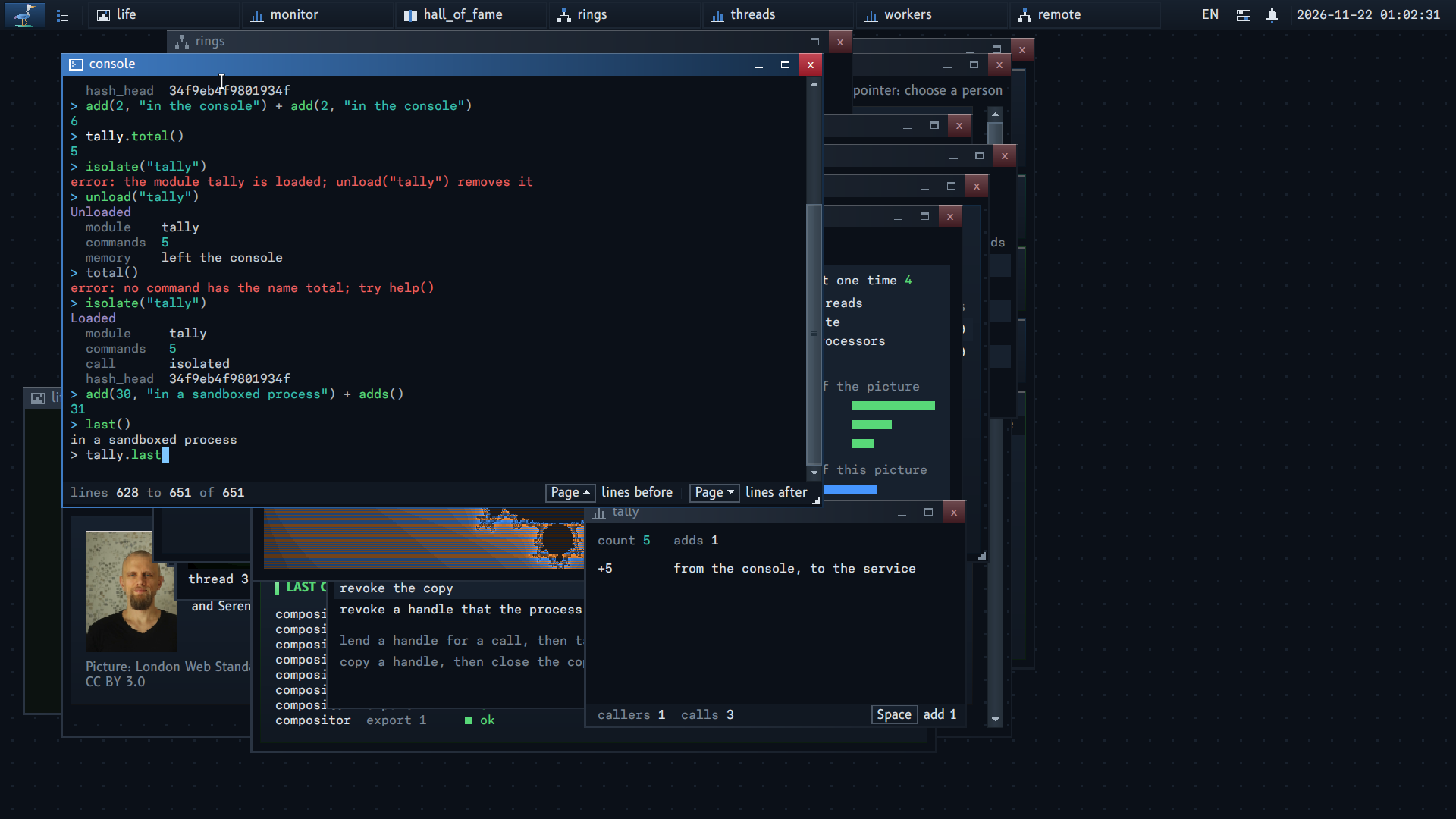
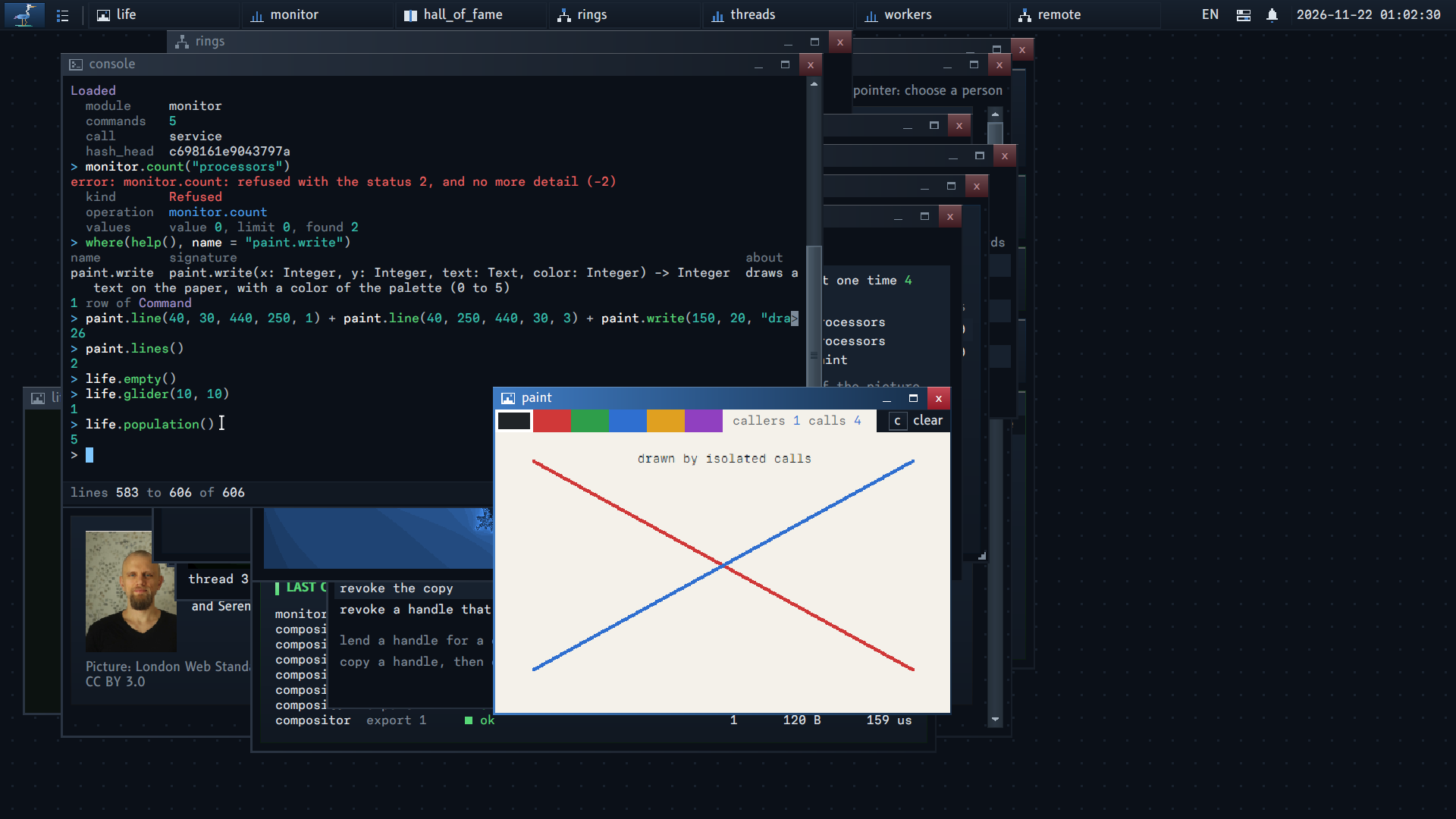
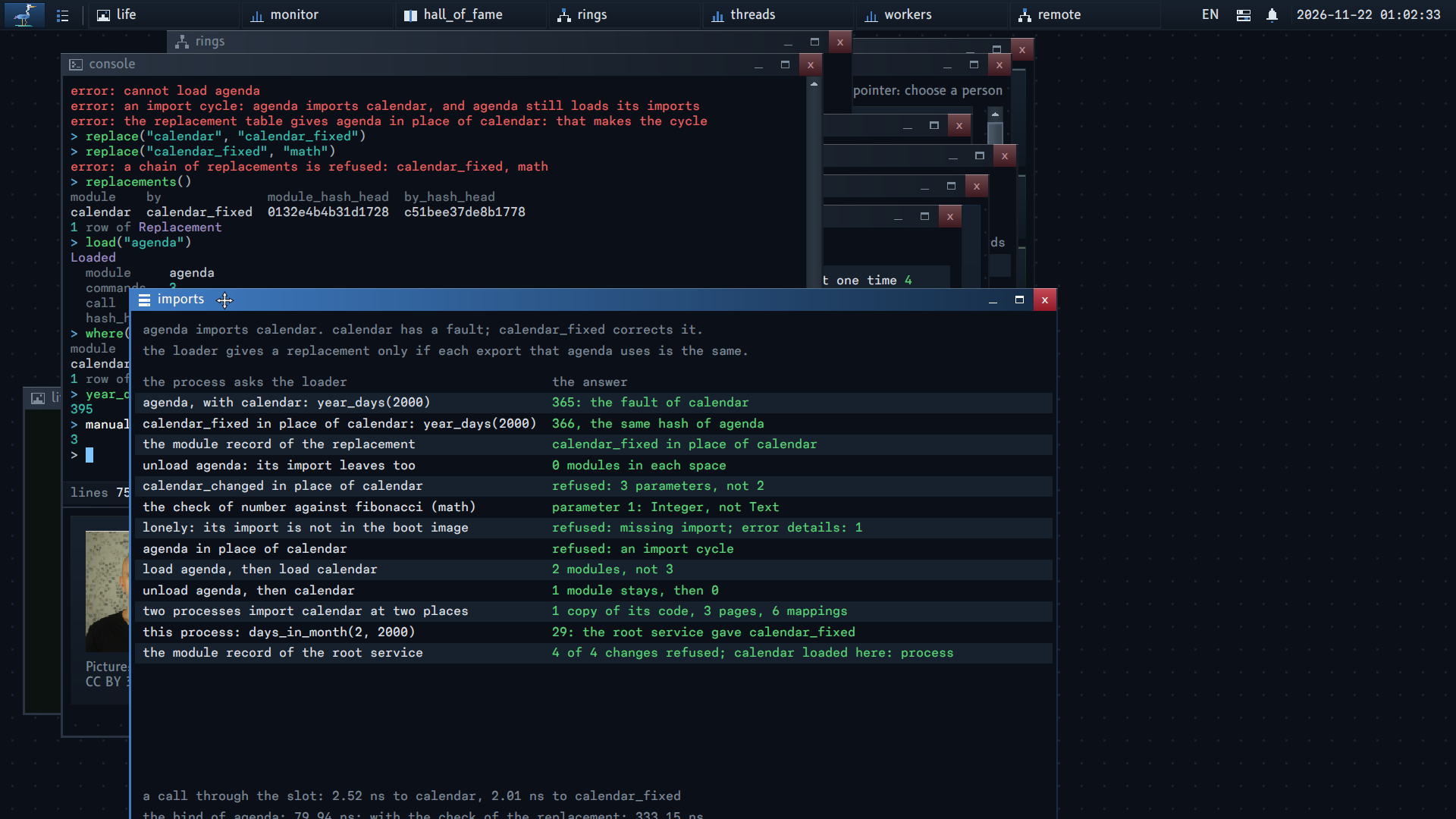
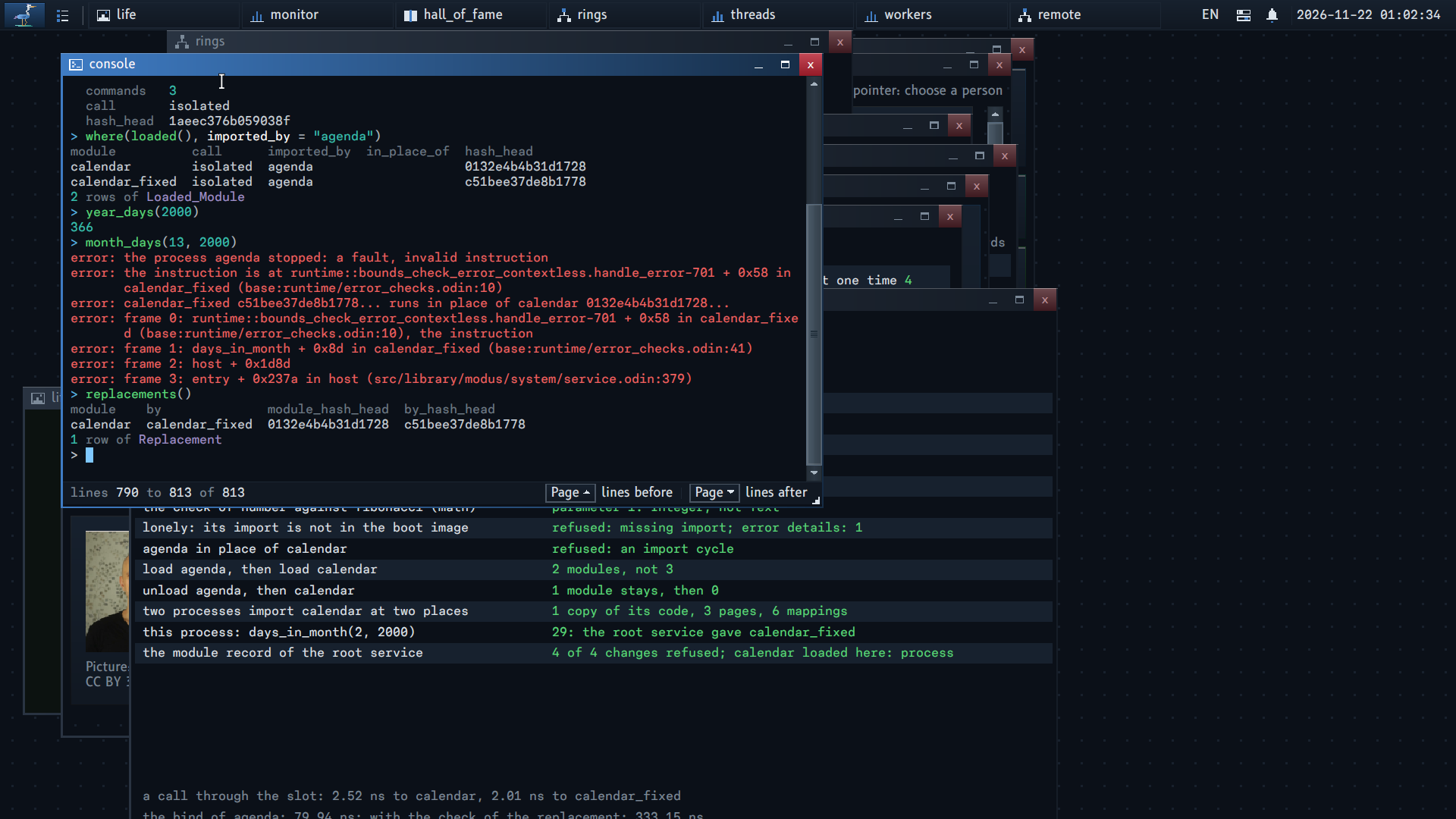
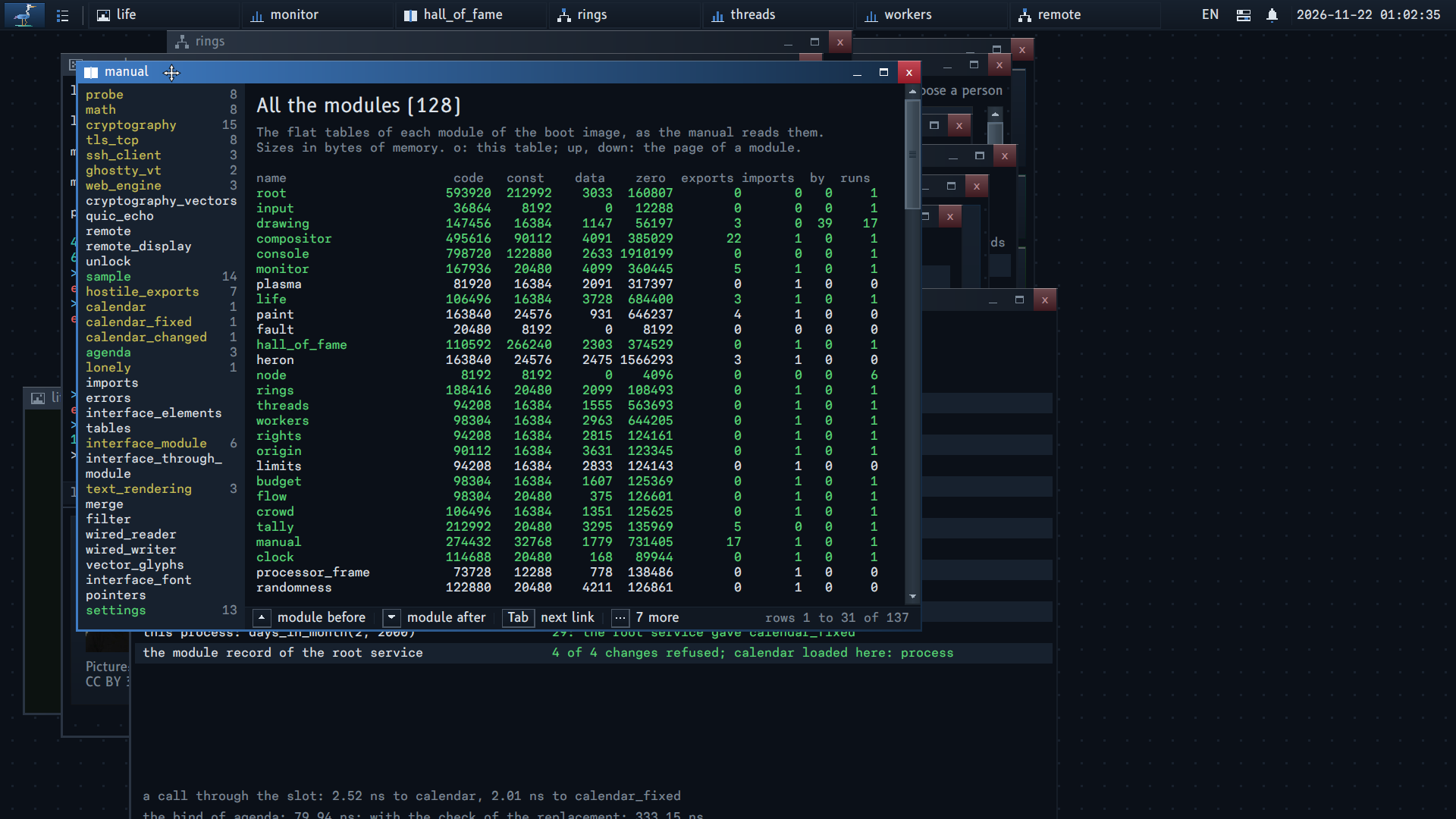
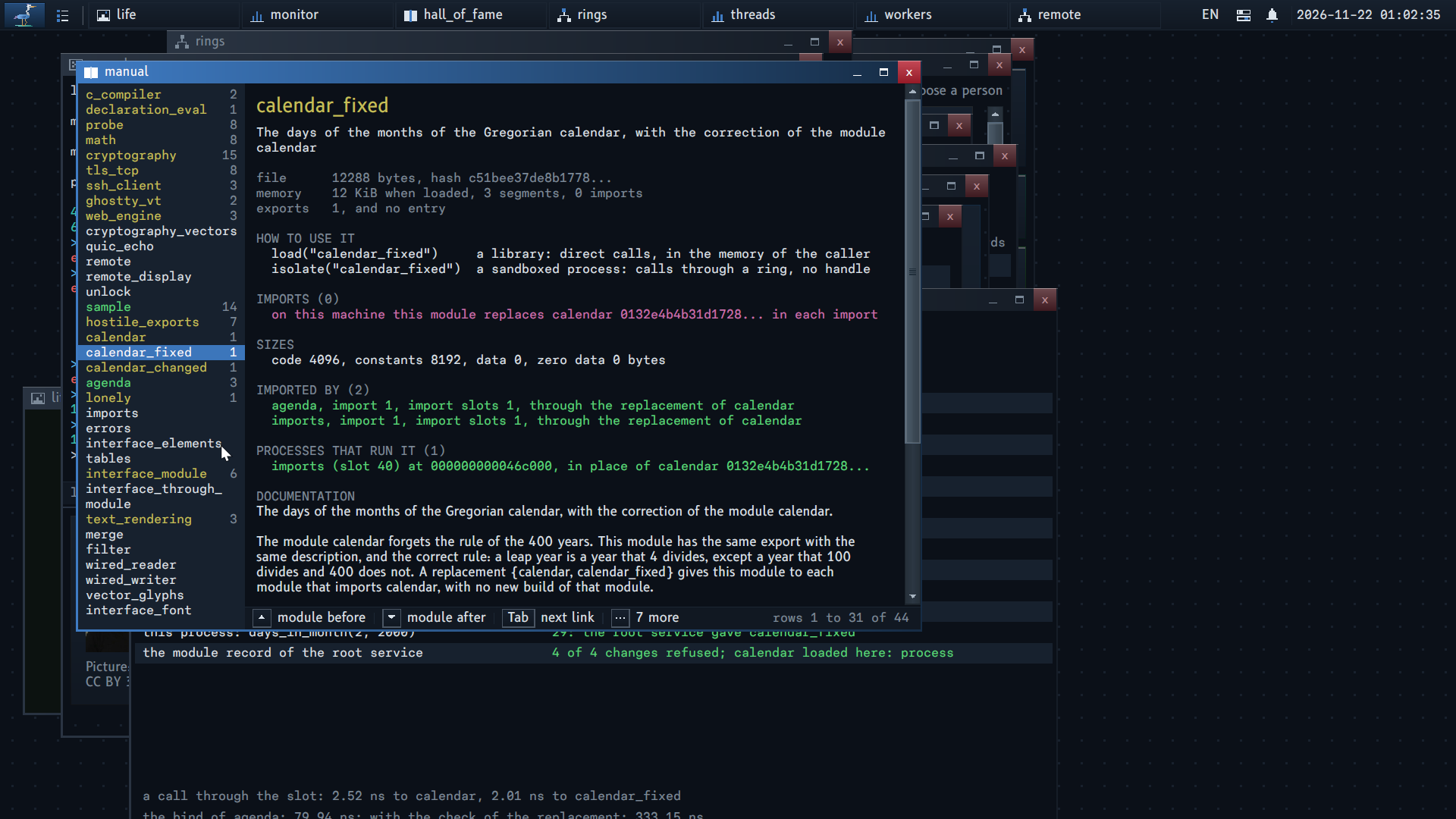
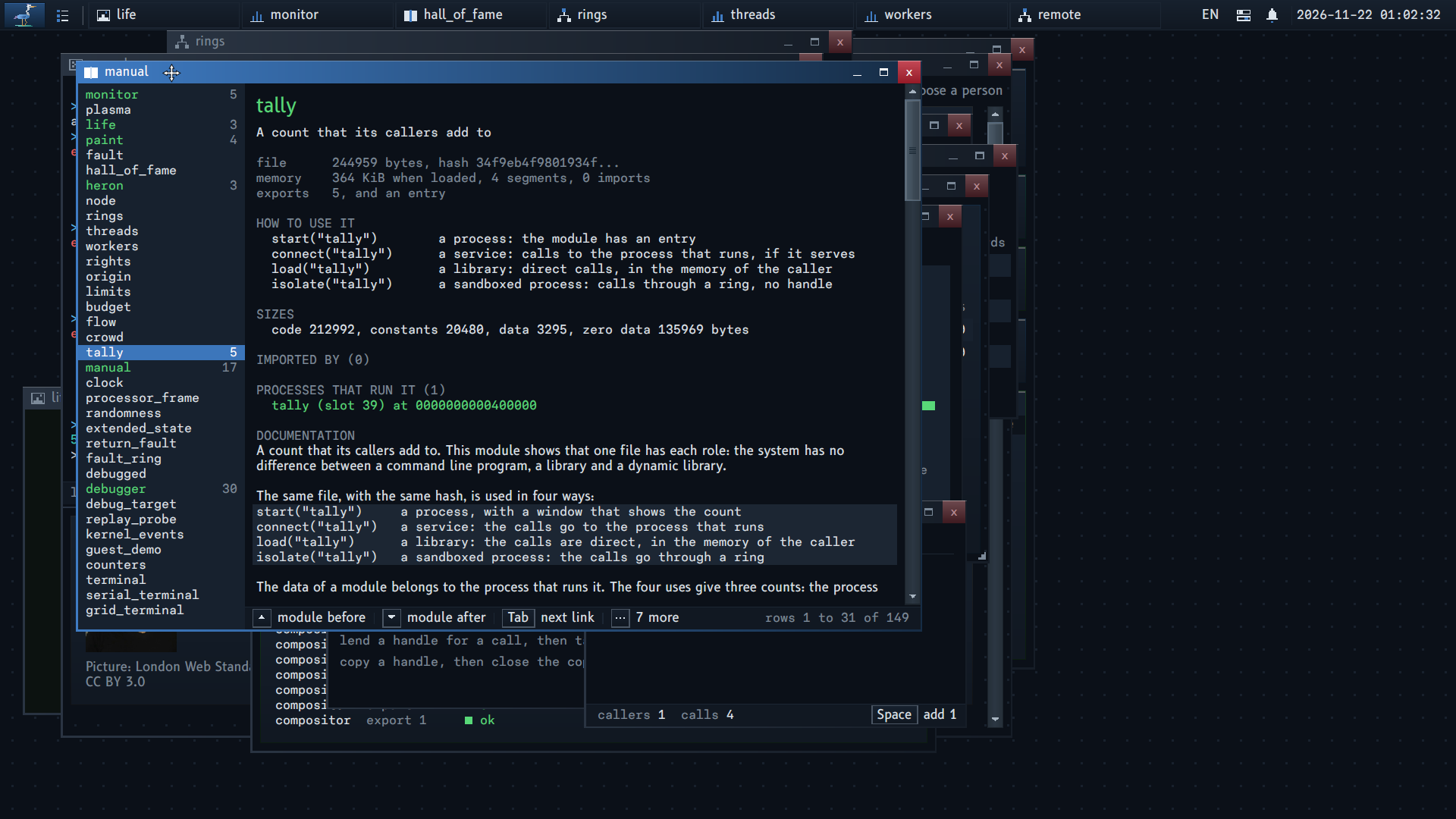
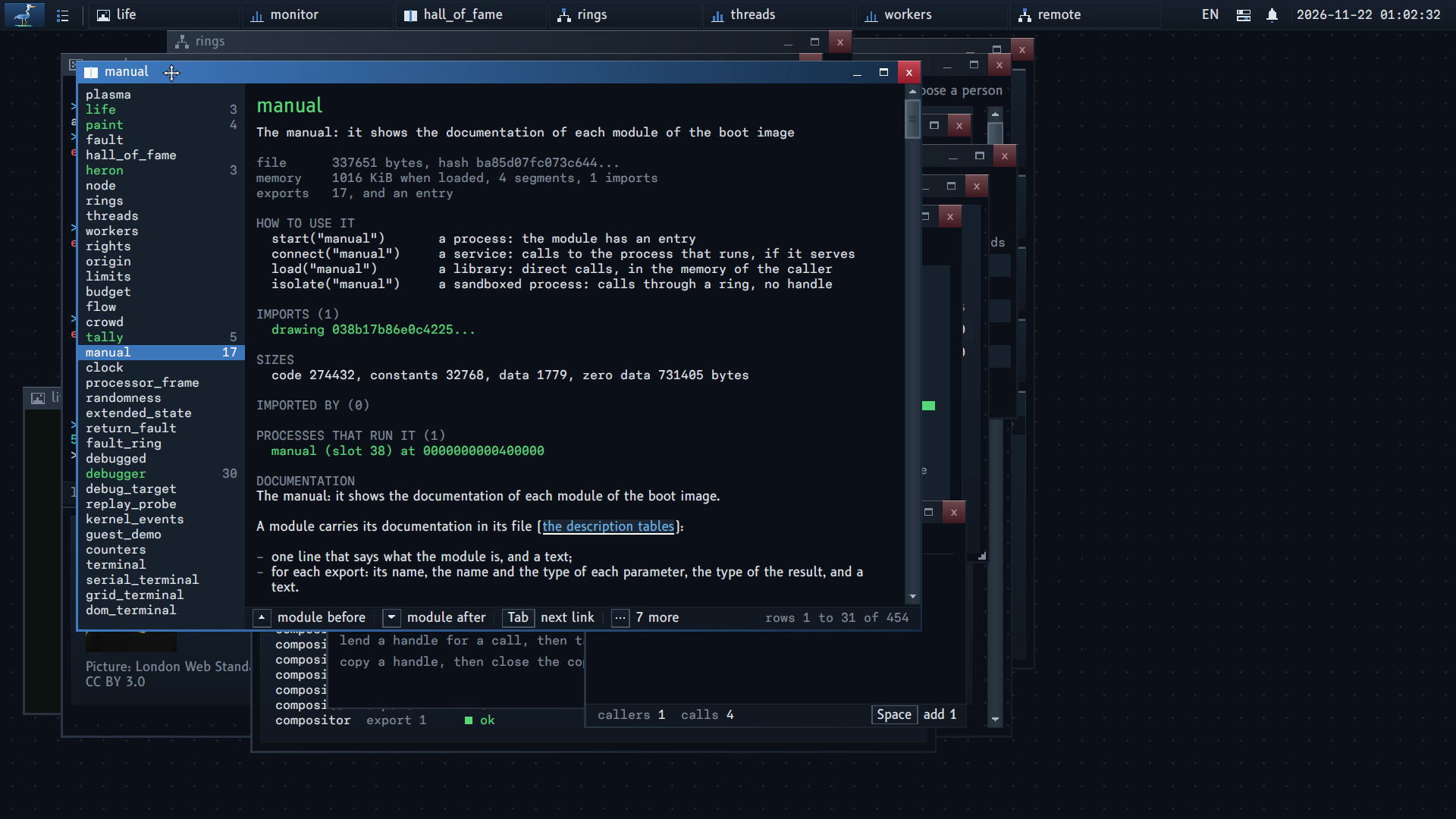
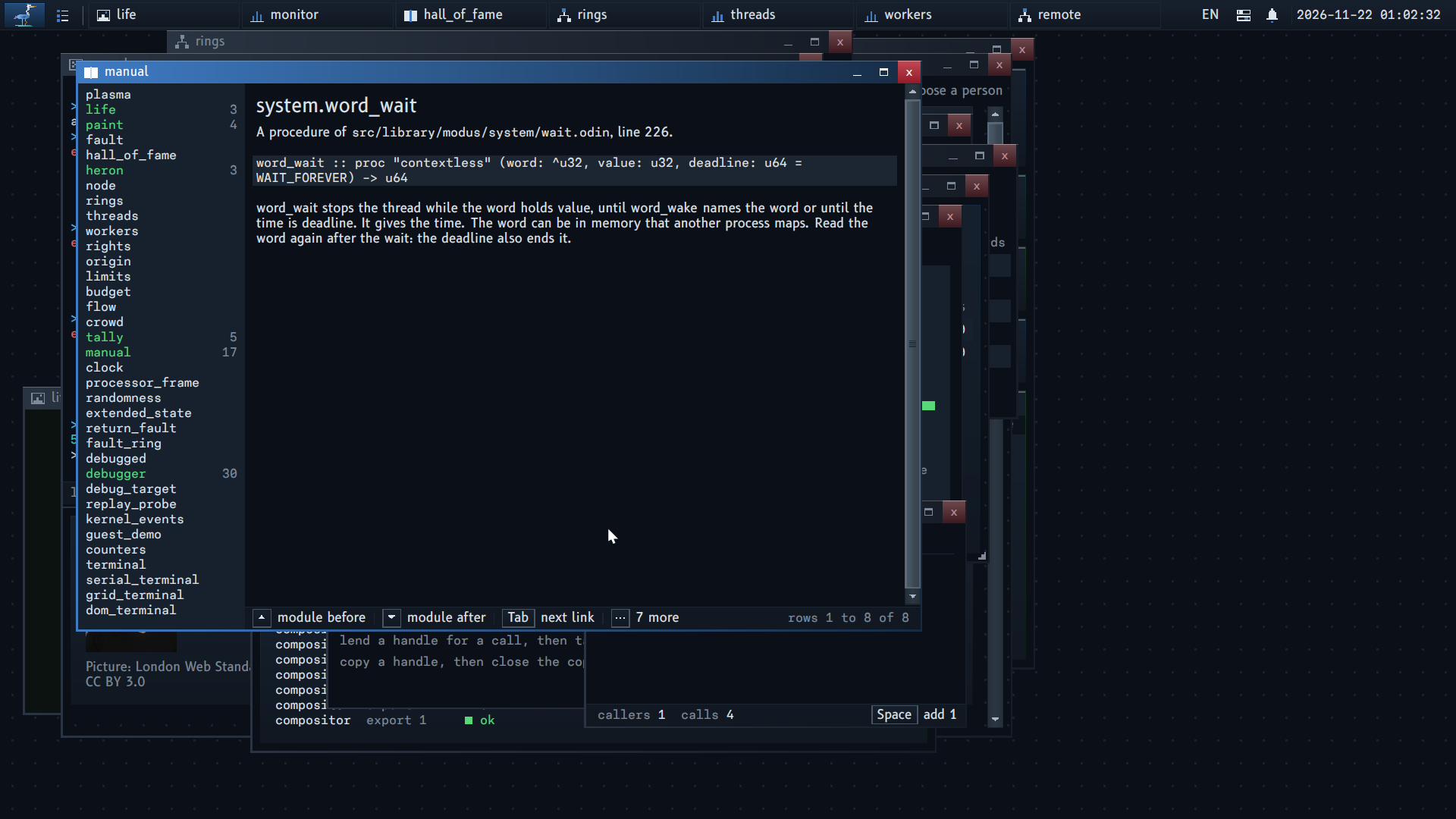
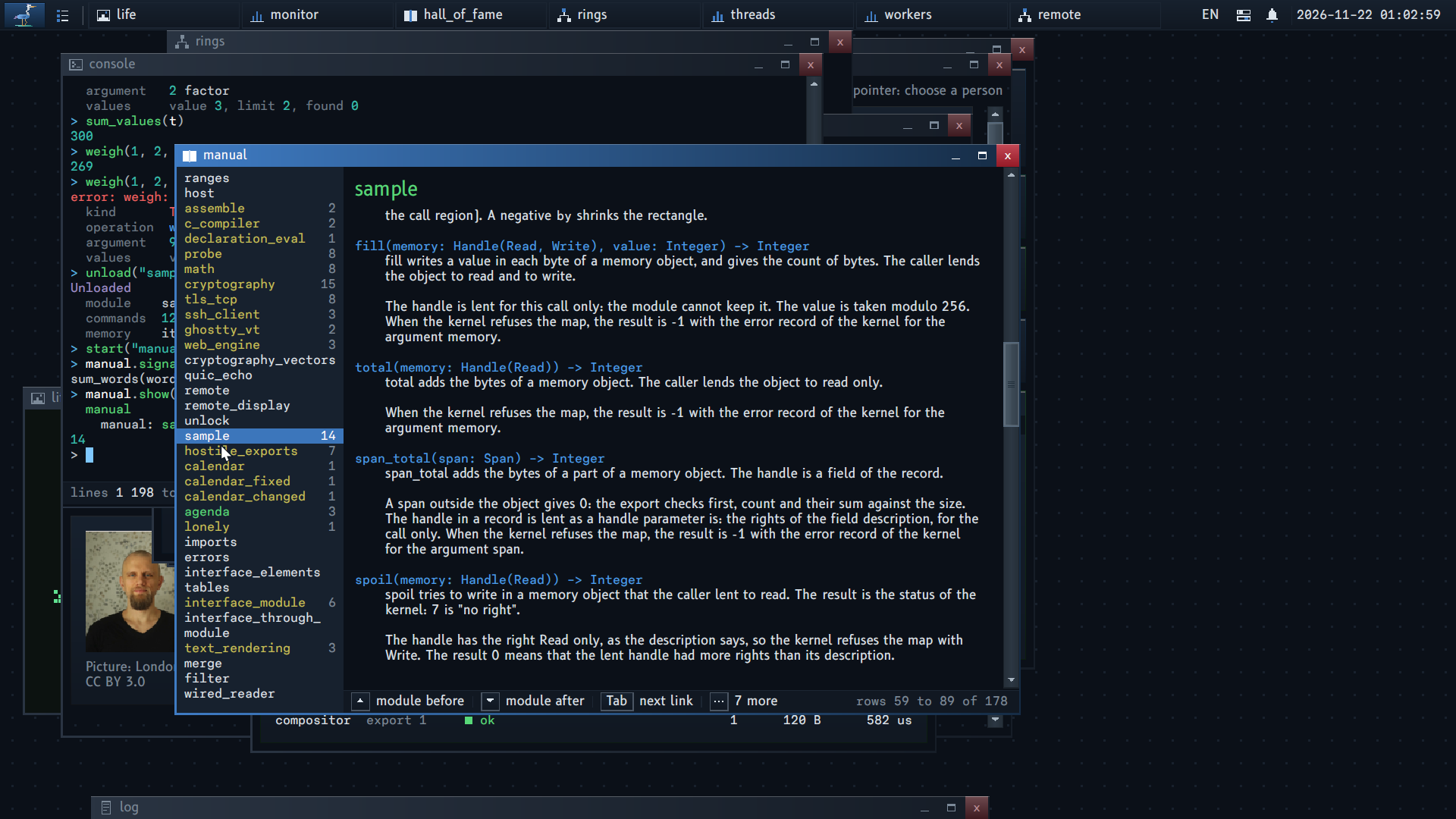
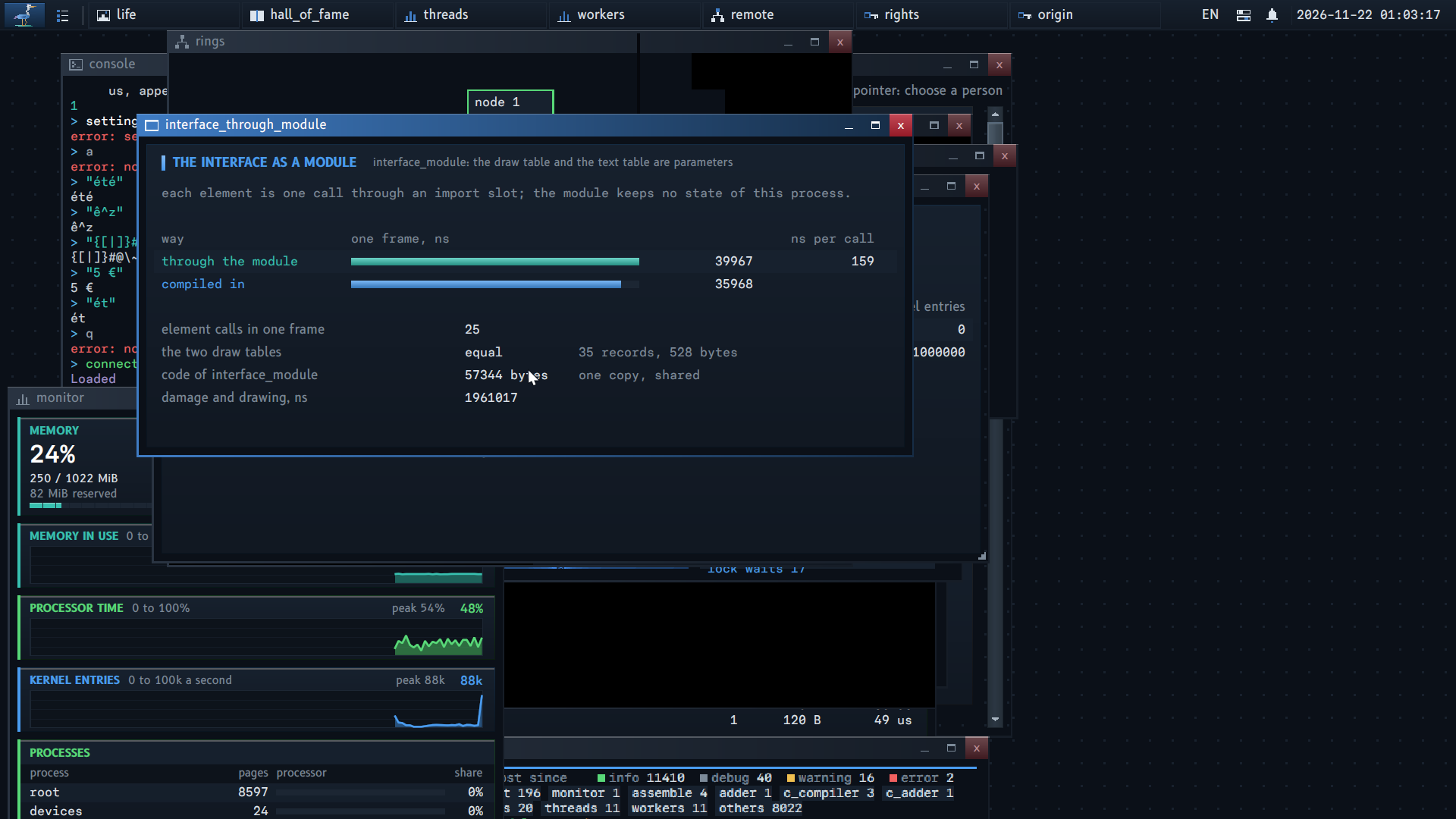
One module in each role: the file of tally runs as a process, as a service, as a library in the console and as a sandboxed process.Guide: Module contractA service serves its own exports while it runs: the console draws in the window of paint with isolated calls.Guide: Module contractThe replacement of an import: agenda imports calendar, which has a fault, and the loader gives calendar_fixed in its place.Guide: Module contractThe console sets a replacement through the root service, and process_modules() gives the replacements that the loader applied.Guide: Module contractThe information of the modules: the manual shows the table of all the modules, with who imports each one and the processes that run it.Guide: Module contractThe page of one module in the manual: its file, its exports, who imports it, the processes that run it and its documentation.Guide: Module contractThe manual shows the documentation that each module carries in its file.Guide: Module contractThe manual with the focus on a link of a page: Tab moves the focus, Enter opens the link, and Backspace goes back.Guide: Module contractThe manual on a procedure of a support package that no module describes: its file, its line of Odin and its comment.Guide: Module contractThe manual on the module sample: the exports that take and give tables, each with its signature and its text.Guide: Module contractThe interface package as a module: the same draw table as the package compiled in, and the time of one frame in each way.Guide: The interface of the processes
Memory, threads and time
The address space of a process, its threads on several processors, the scheduling, and the paths that enter the kernel seldom. 16 pictures.
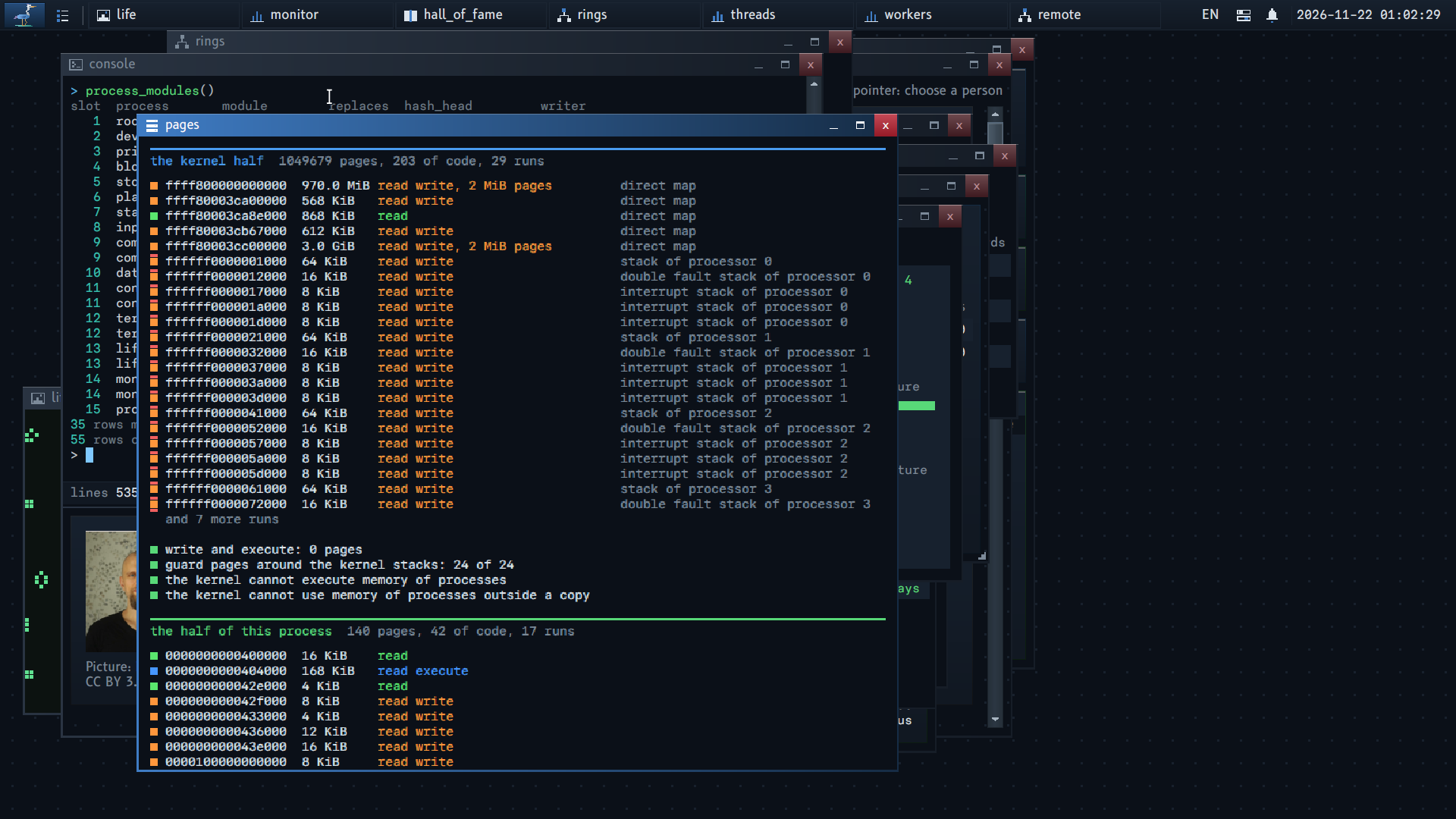
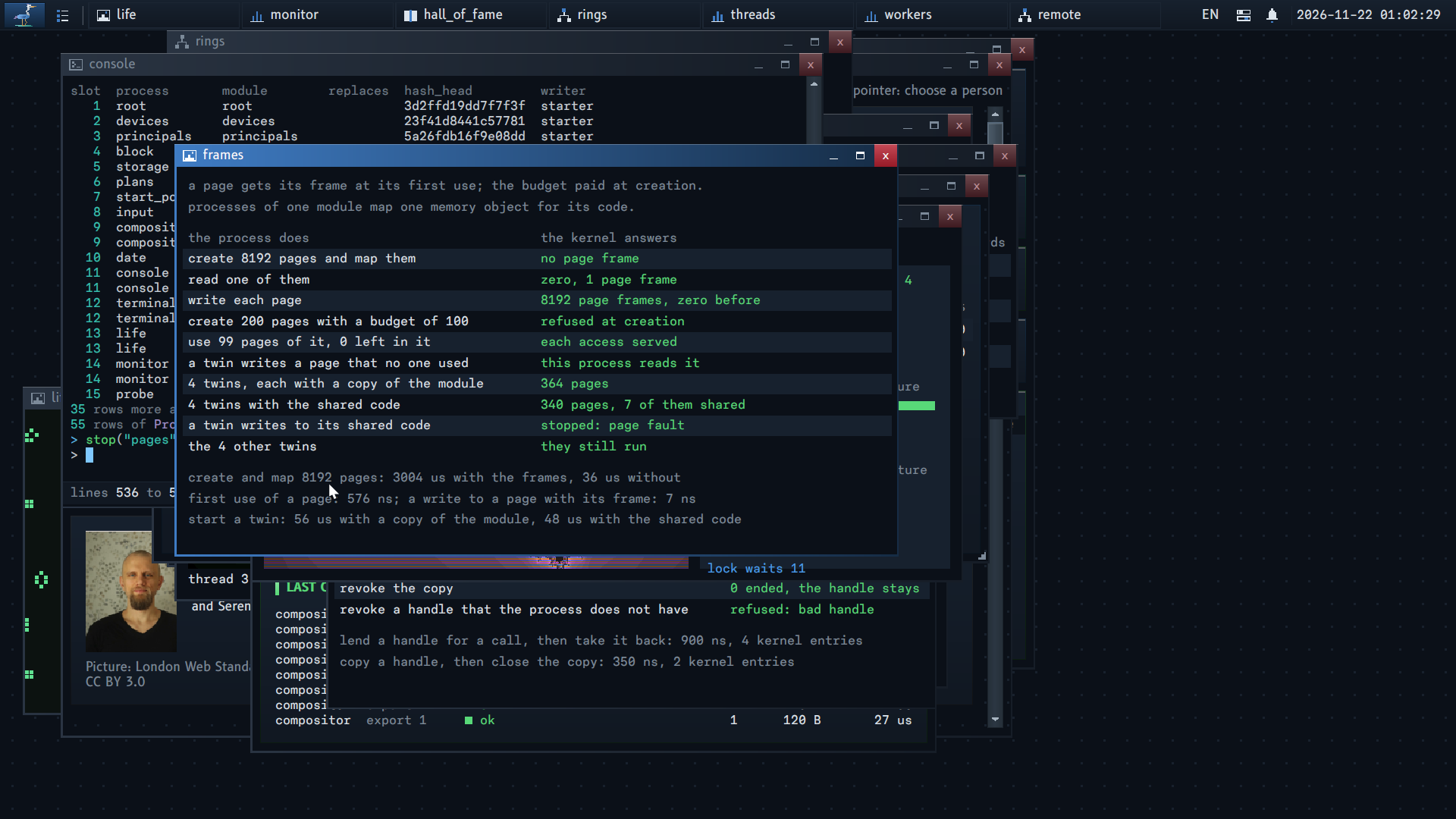
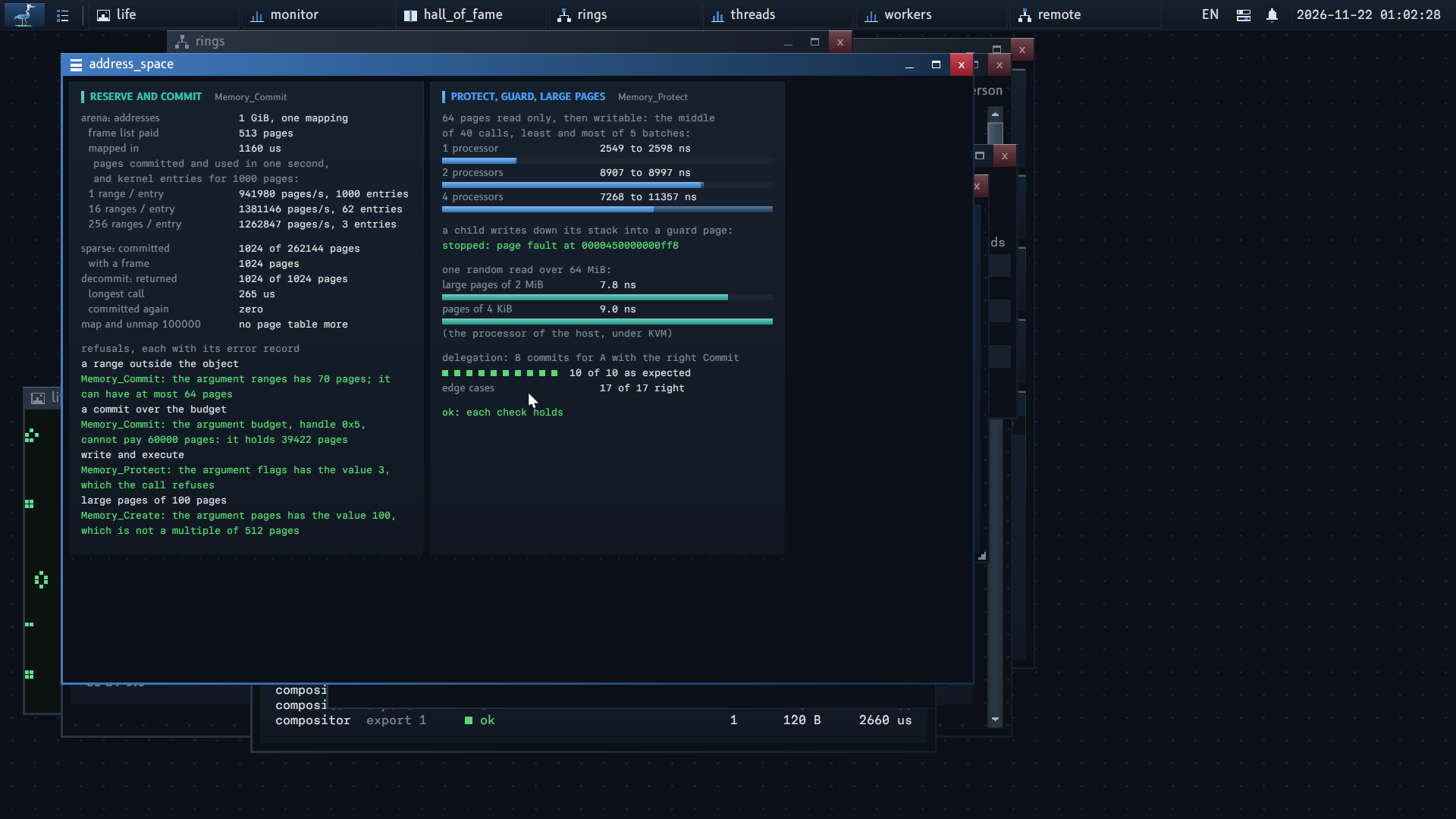
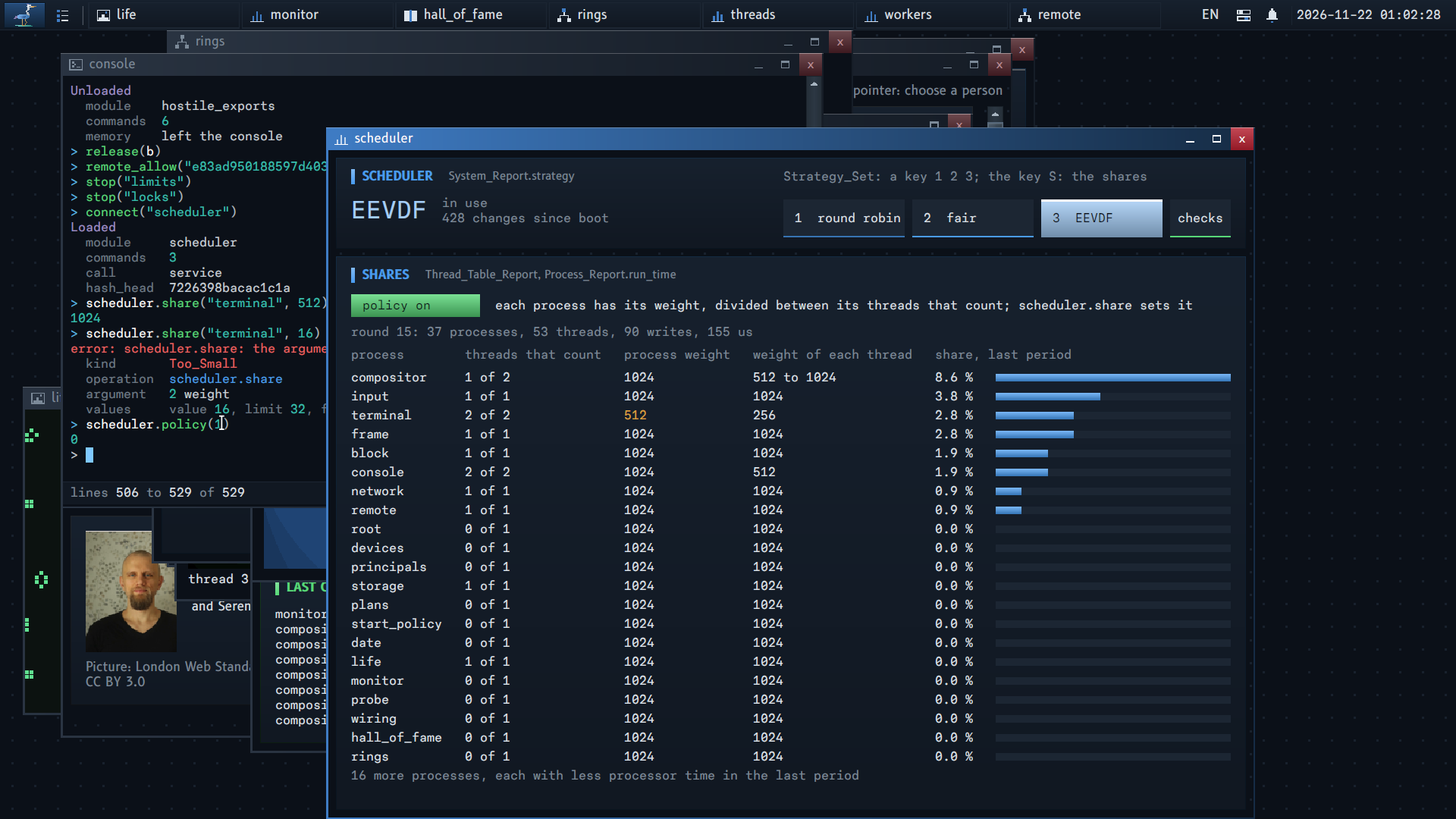
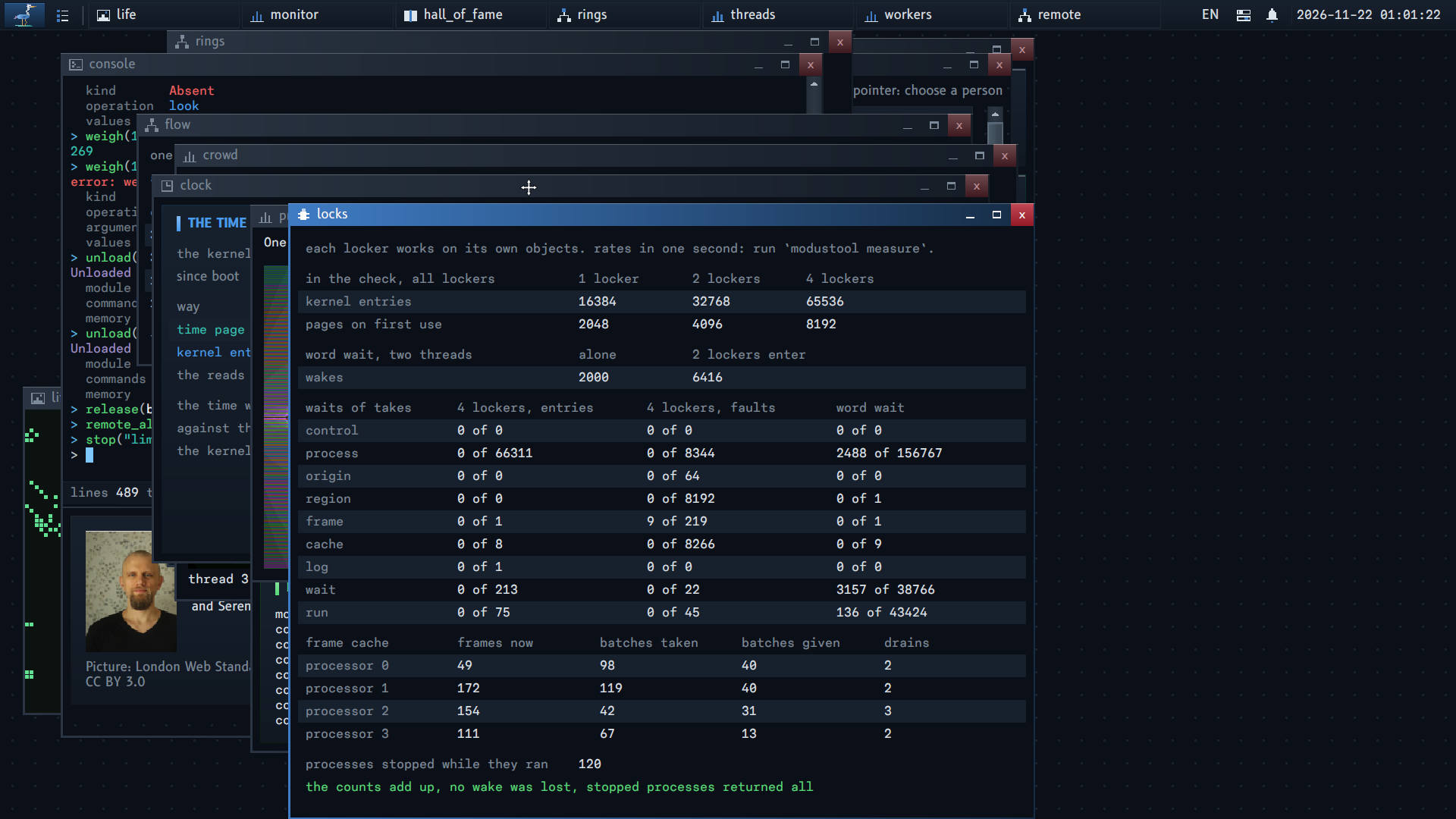
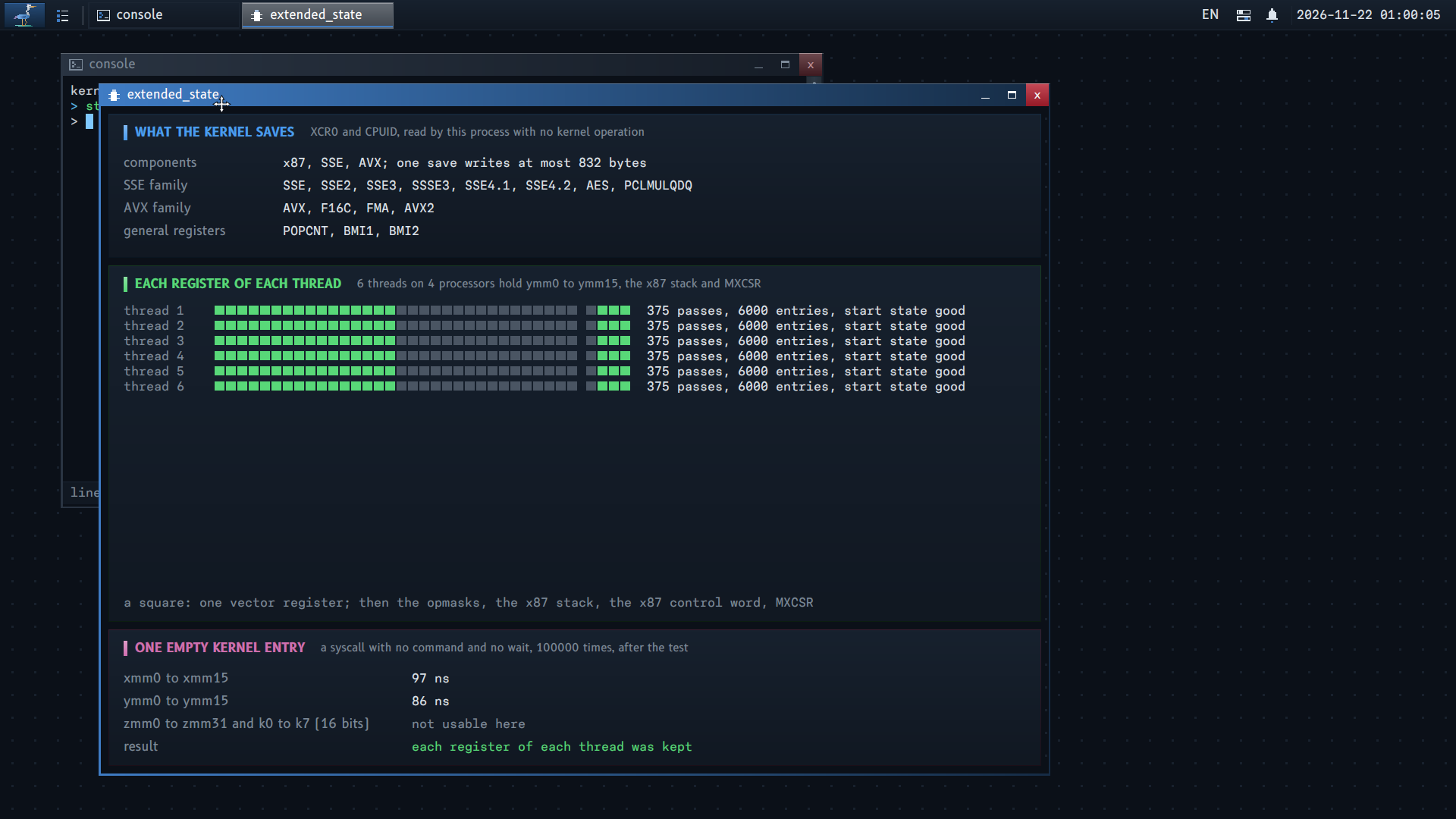
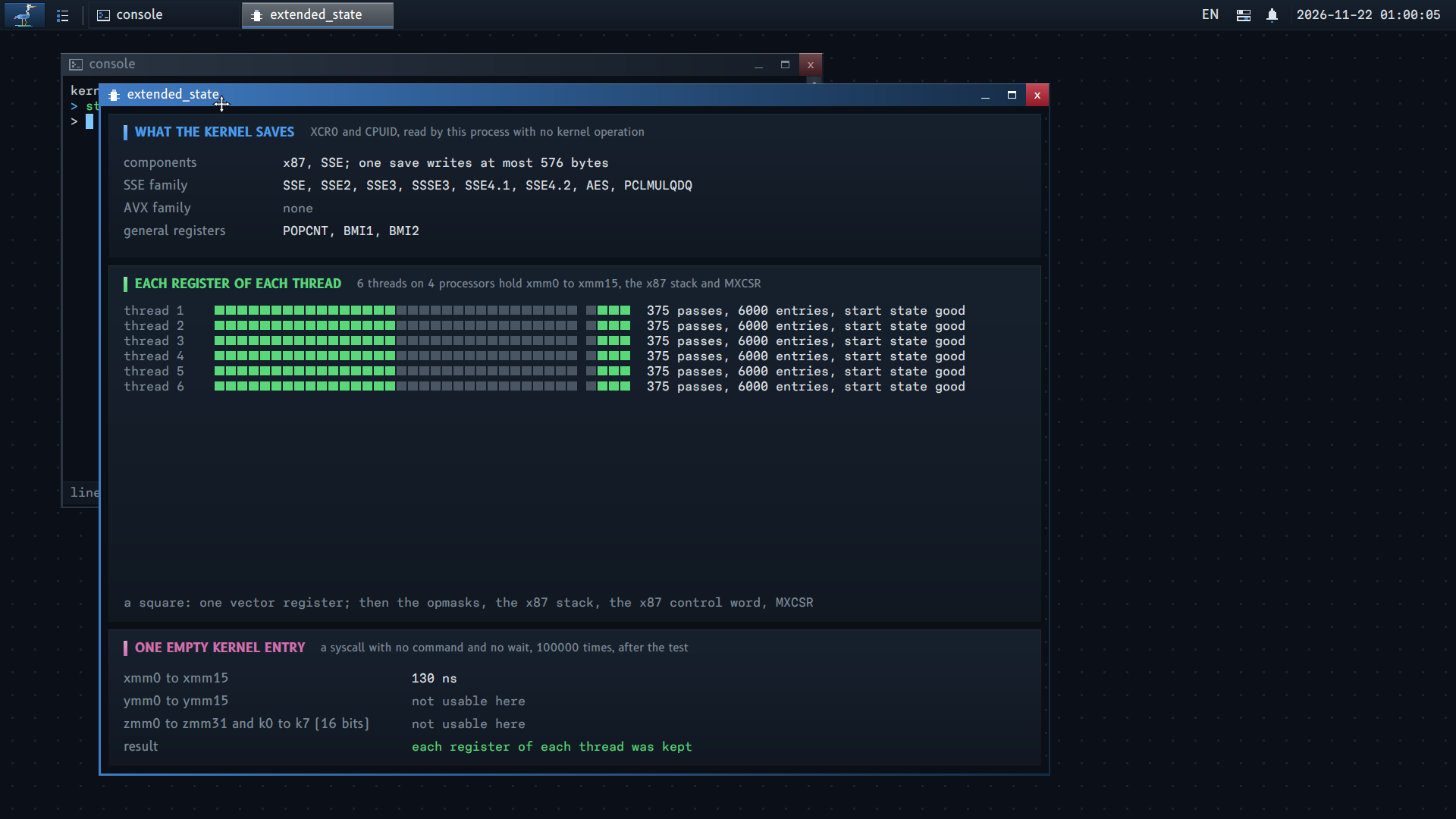
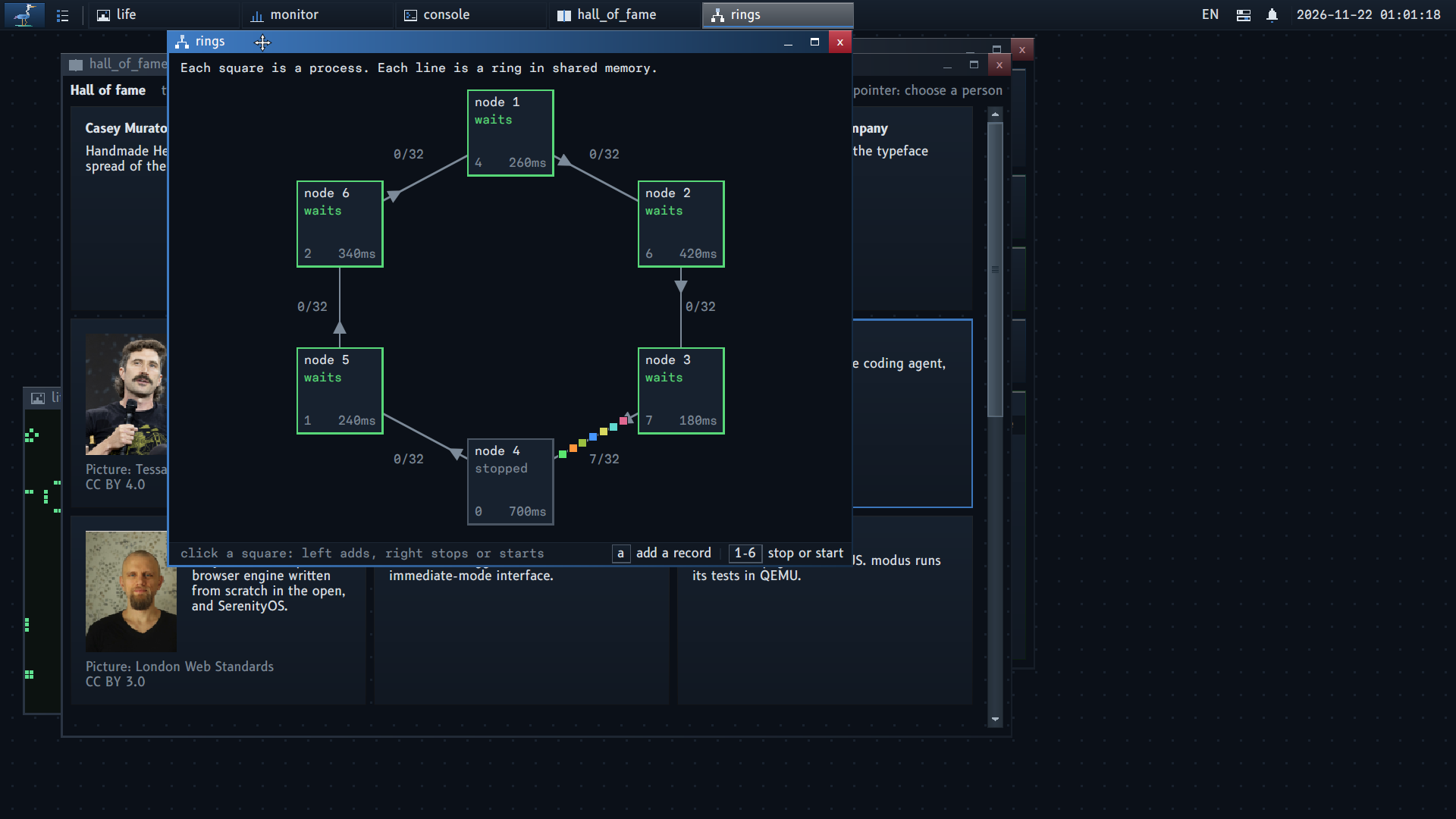
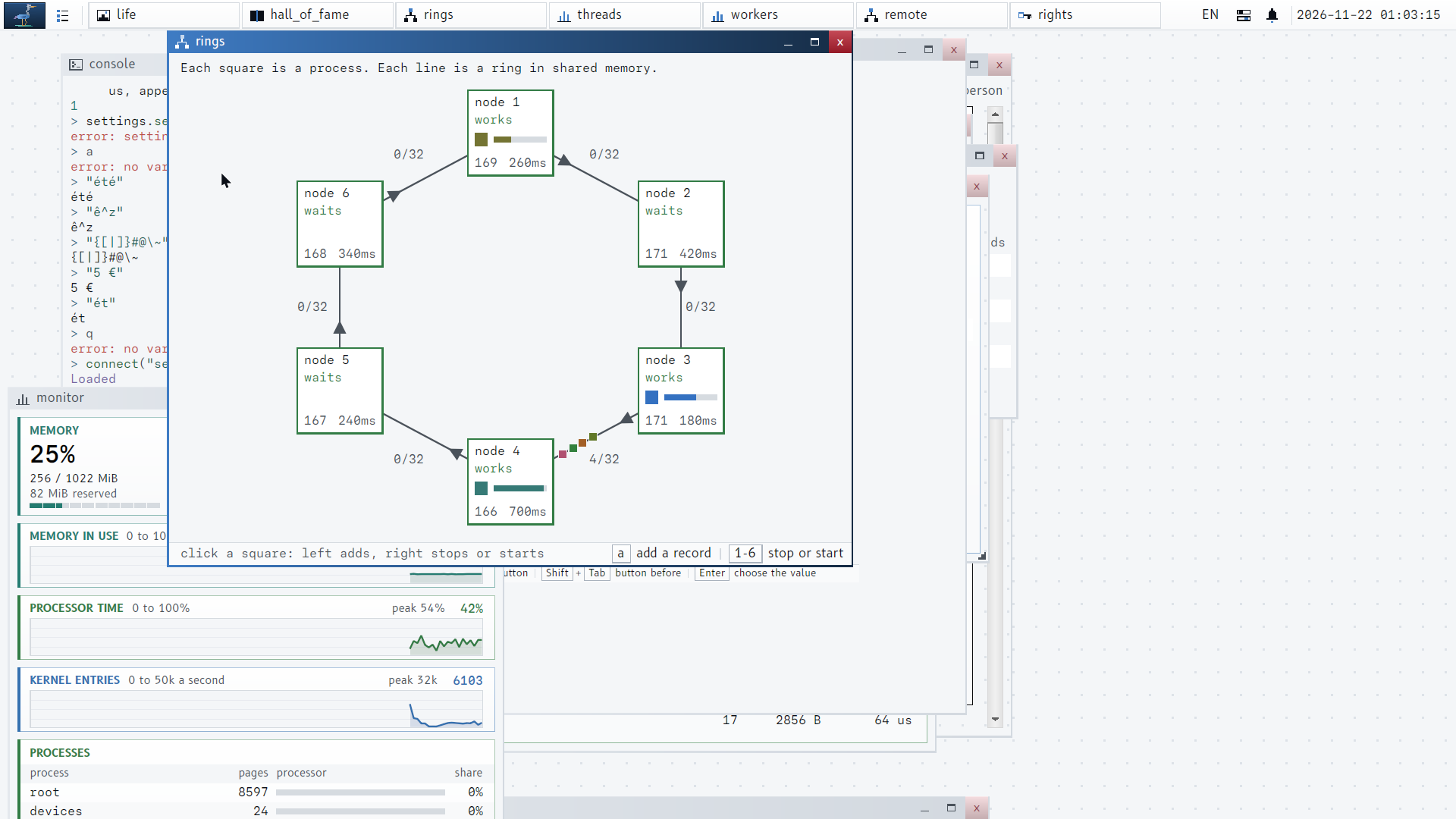
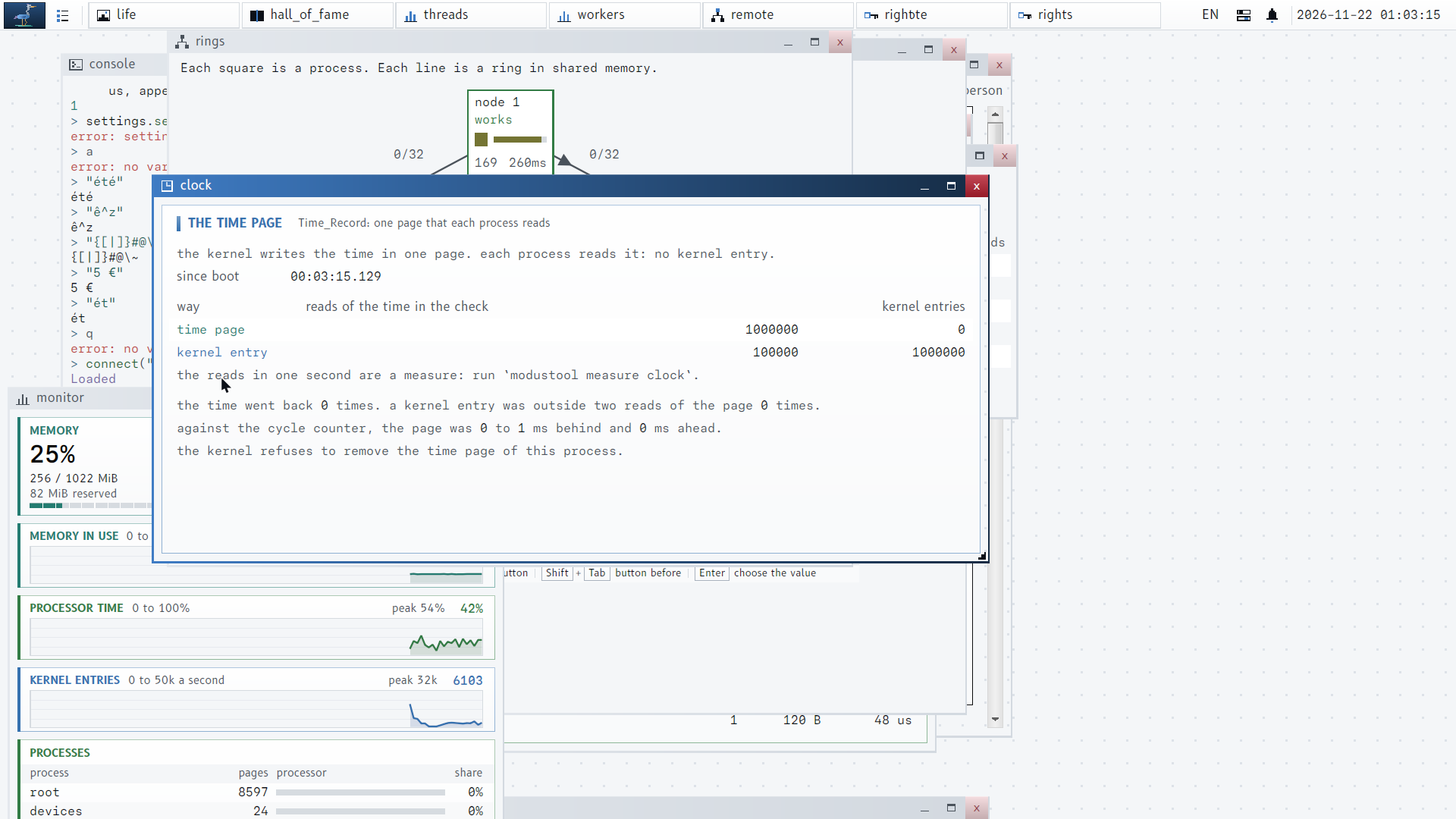
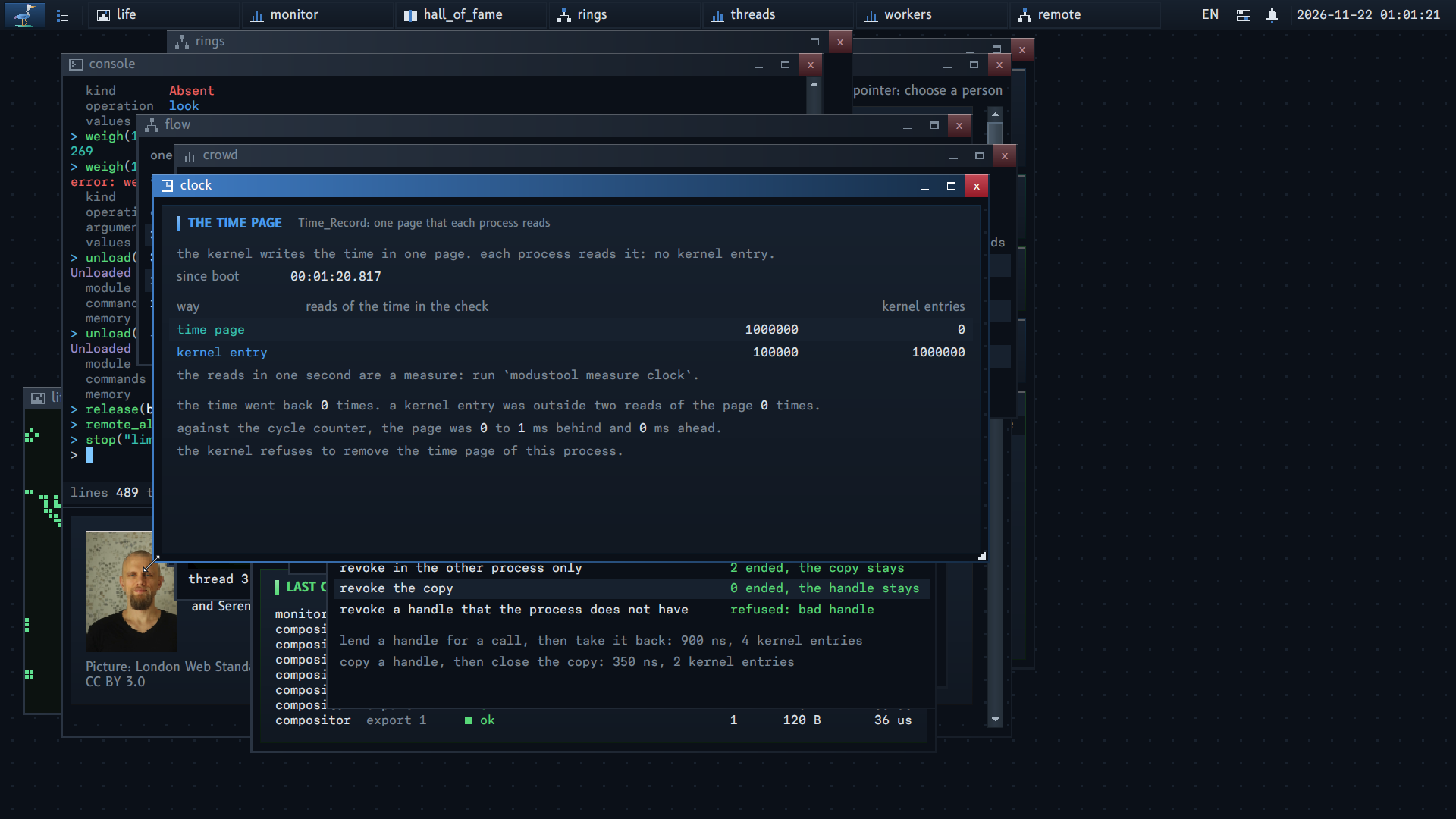
The page tables as the kernel reads them: the direct map, the kernel stacks between guard pages, the kernel module, the half of a process.Guide: ArchitecturePages on first use and shared code: ten cases with the answer of the kernel, and the measures.Guide: ArchitectureThe address space of a process: reserve and commit, a sparse object, guard pages and large pages, each refusal with its error record.Guide: ArchitectureOne process, five threads: each square is drawn by its own thread.Guide: ArchitectureOne queue of tiles, one lock, four threads: each tile has the tint of the thread that computed it.Guide: ArchitectureFour processors run the threads of one process at the same time: the same picture with 1, 2 and 4 threads.Guide: ArchitectureThe scheduling strategies: round robin, fair and EEVDF side by side, with the wakes, the delay of a wake and the shares of spinners.Guide: Scheduling strategiesA share of the processors for each process: the threads that count, the process weight, the weight of each thread, and the share of the last period.Guide: Scheduling strategiesThe locks of the kernel: kernel entries of 1, 2 and 4 processes, two threads that wake each other, and the waits of each lock.Guide: ArchitectureThe extended state of each thread: more threads than processors hold every vector register across kernel entries, one square for each.Guide: Vector forms: SSE2The extended state on a processor with no AVX: the kernel saves x87 and SSE only, and each thread keeps xmm0 to xmm15.Guide: Vector forms: SSE2The time is a page that each process reads: the reads of one second from the page and with a kernel entry.Guide: ArchitectureOne ring between two threads: the records of one second and the kernel entries that they cost, for two capacities and two ways to wait.Guide: ArchitectureOne queue for several writers and several readers, with no lock: the records of one second, against a queue with a lock.Guide: ArchitectureSix processes pass records through six rings.Guide: ArchitectureA stopped process takes no record: the records wait in the ring.Guide: Architecture
The developer tools
The tool that inspects a process that runs or that stopped, and the call of an export from the host. 7 pictures.
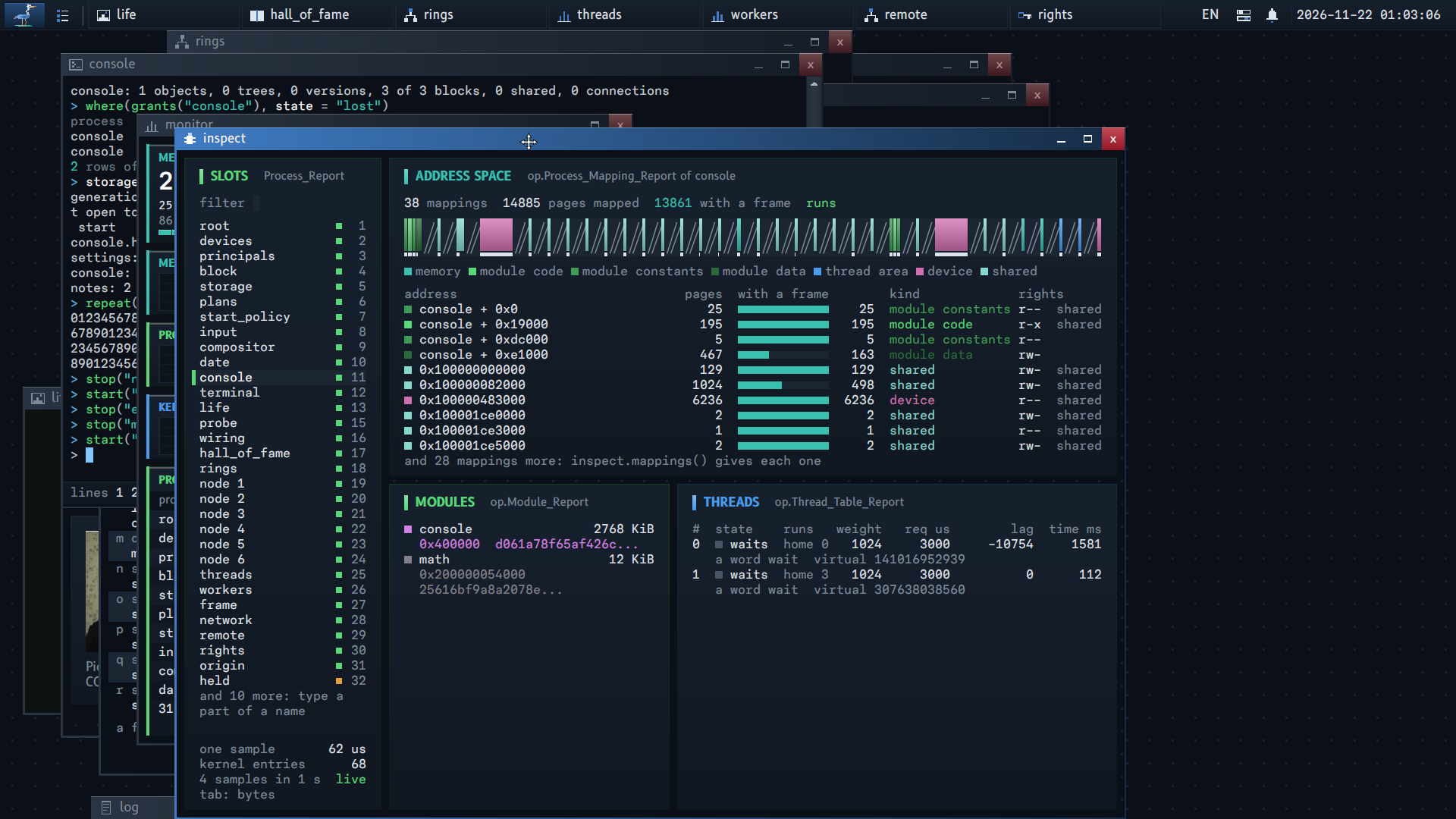
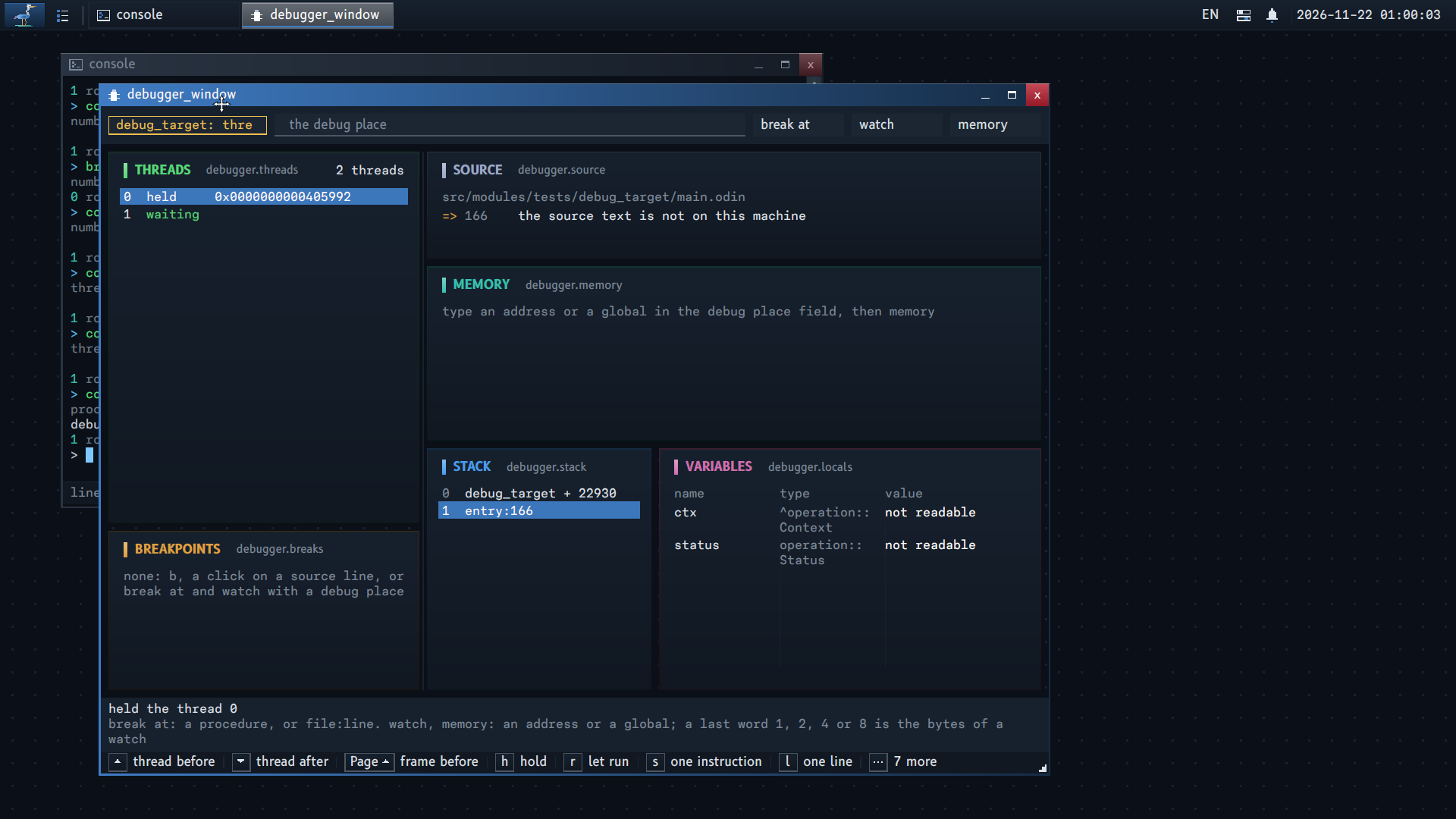
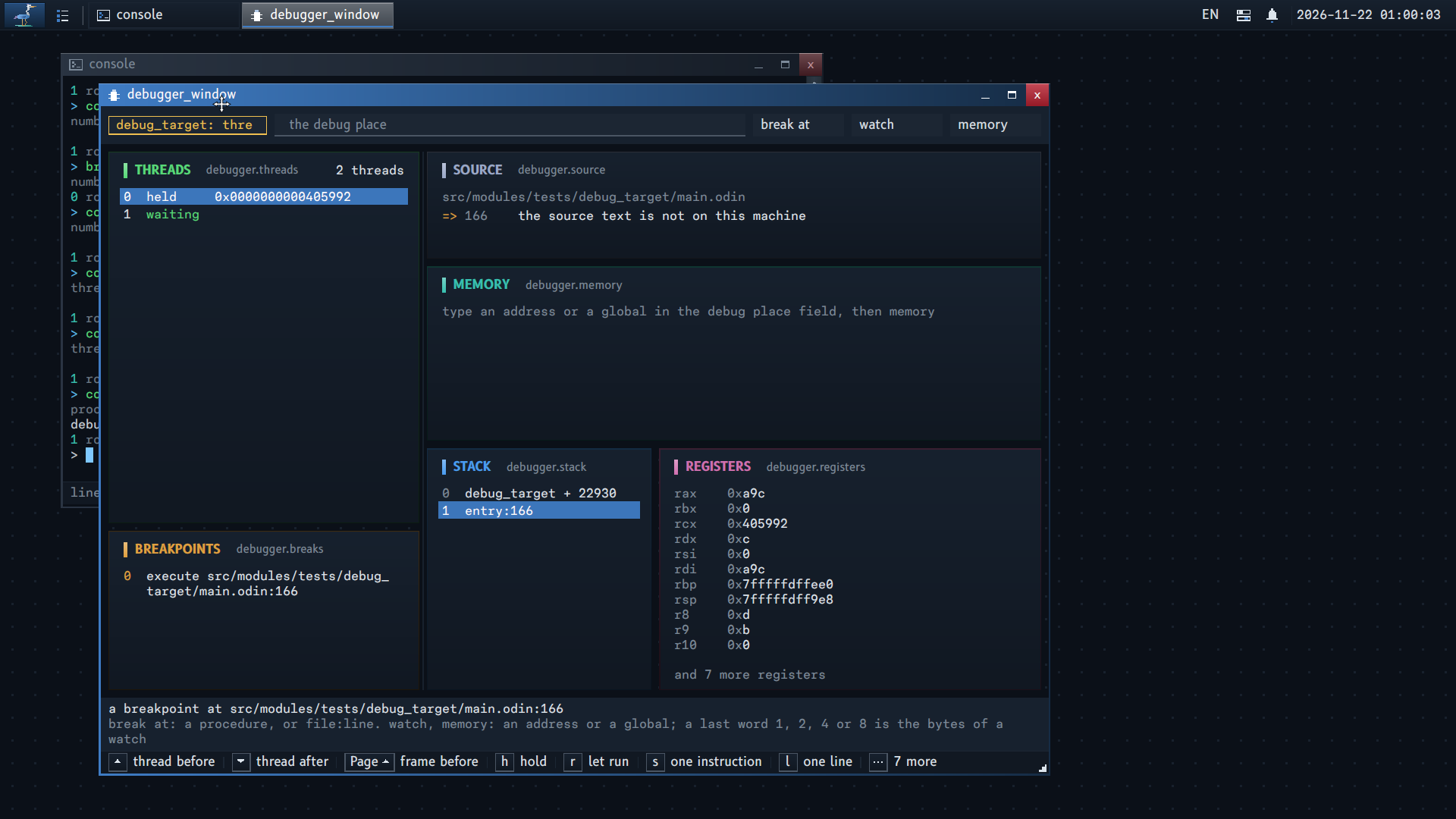
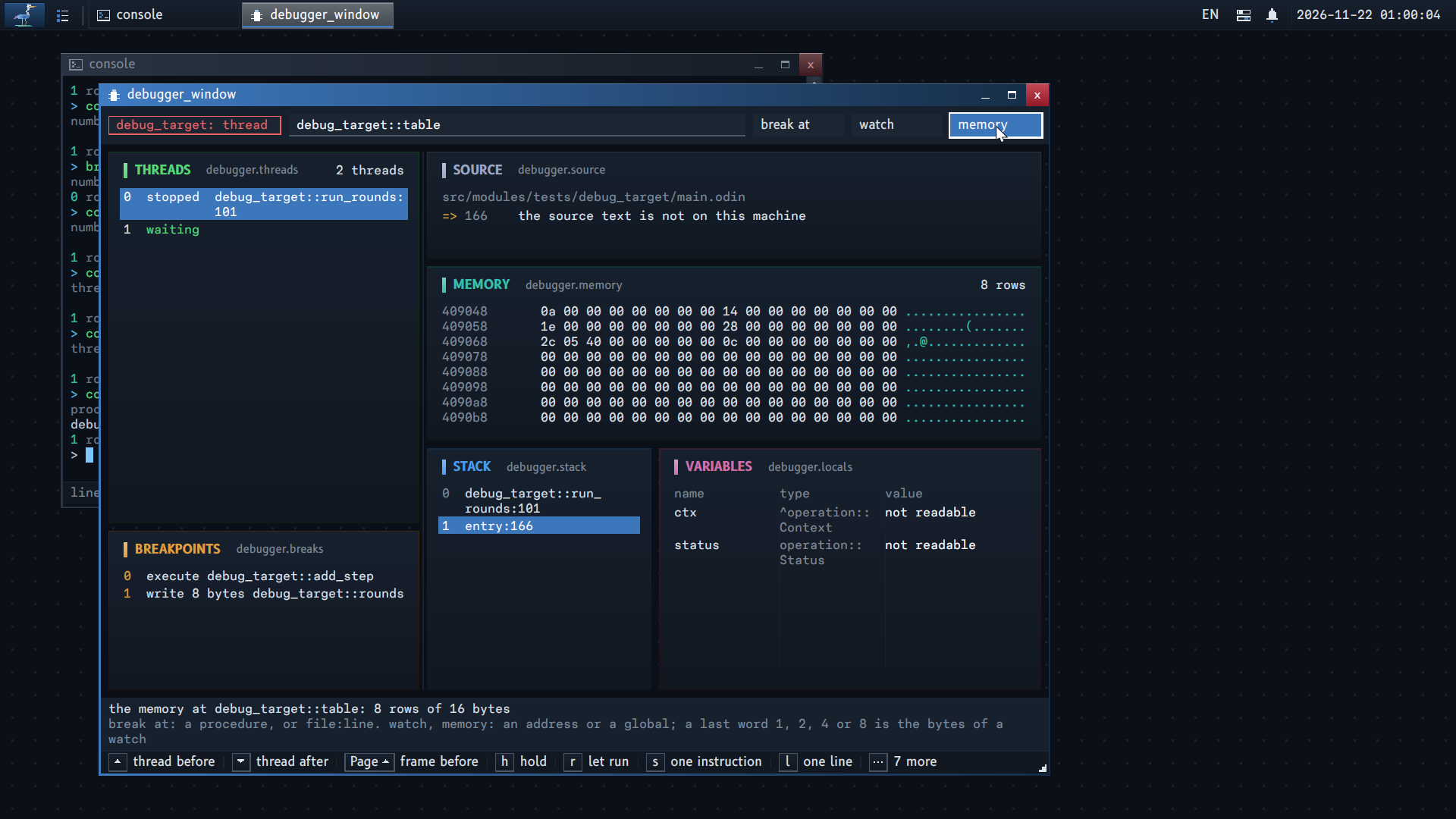
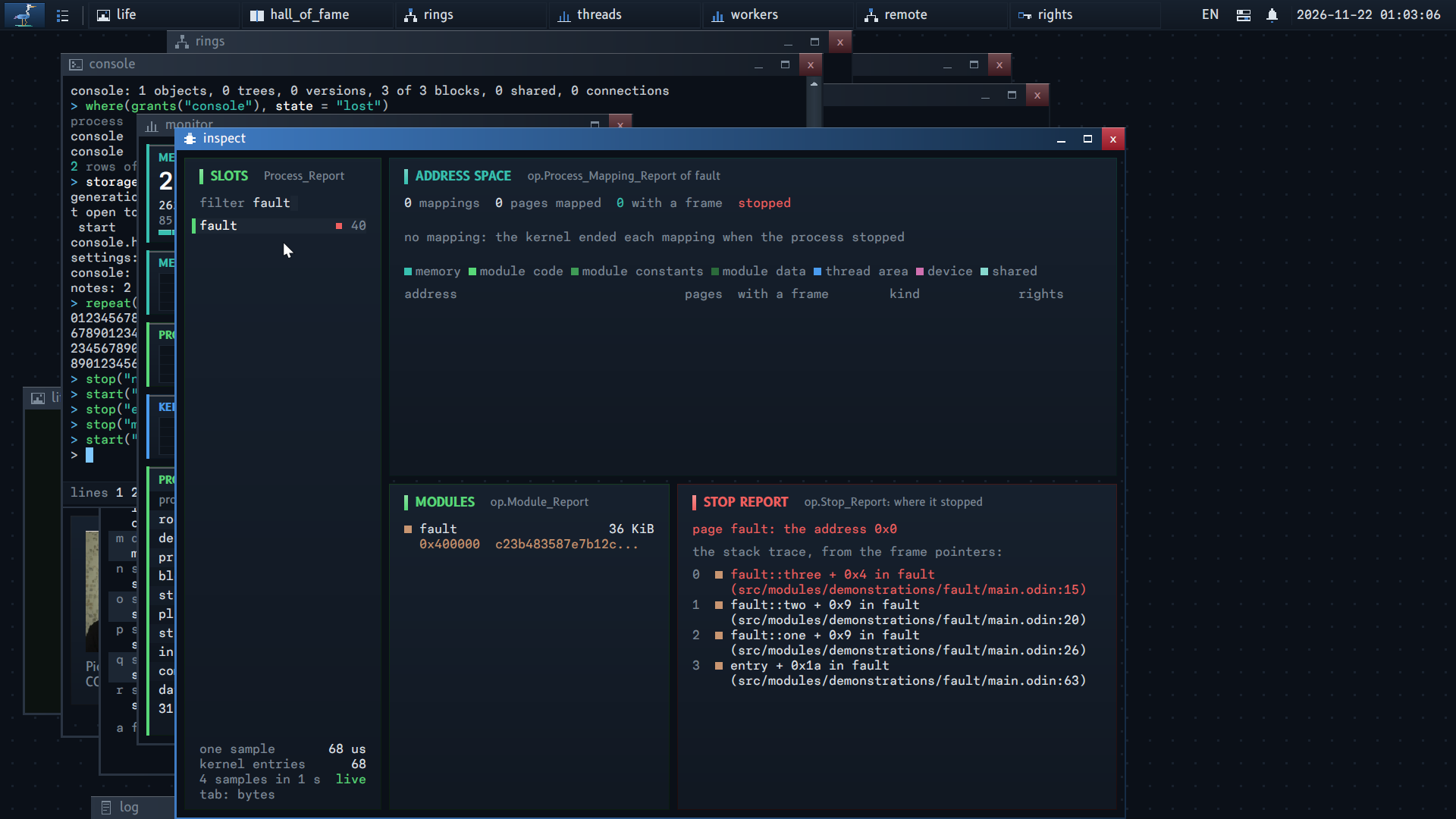
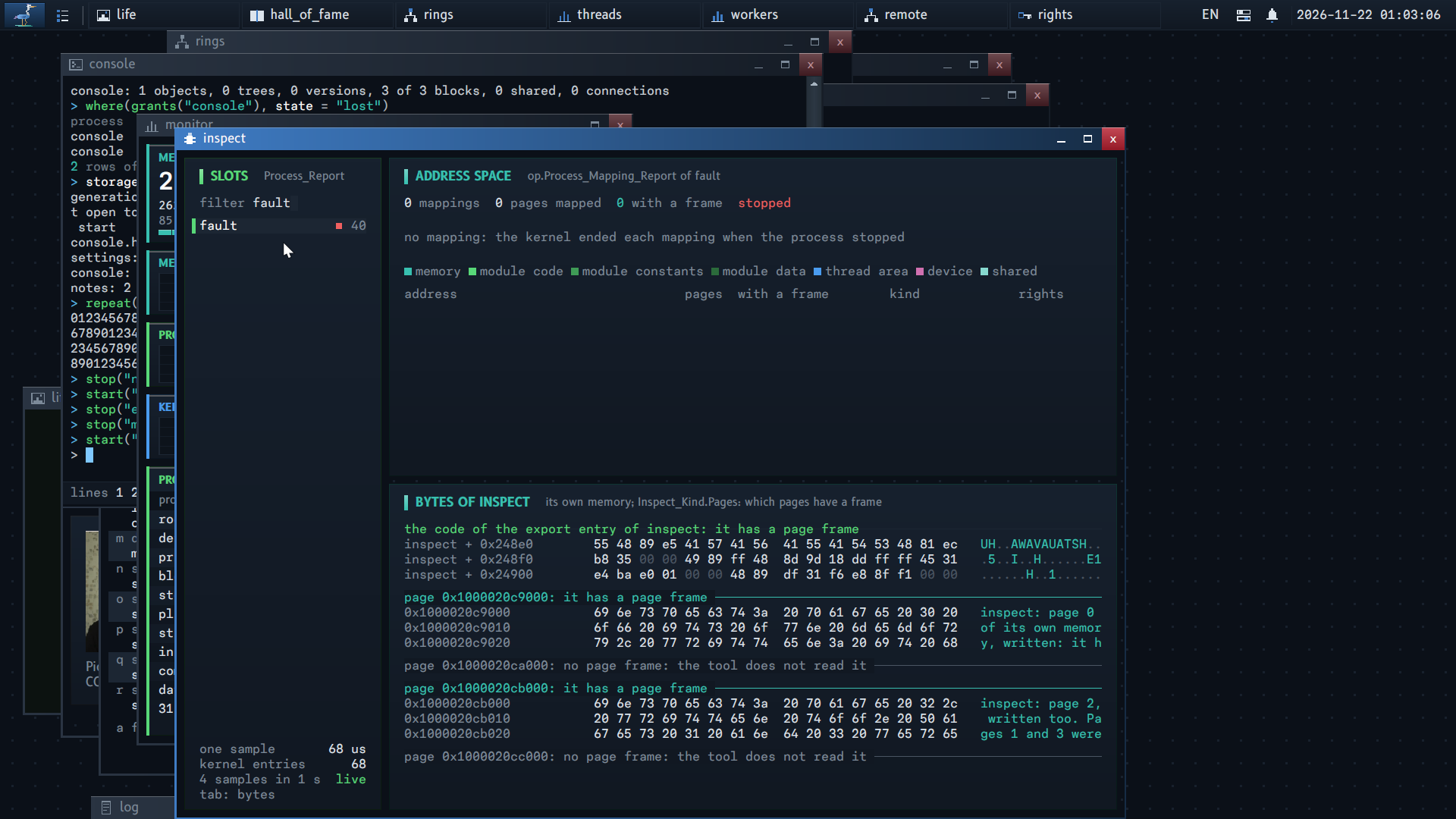
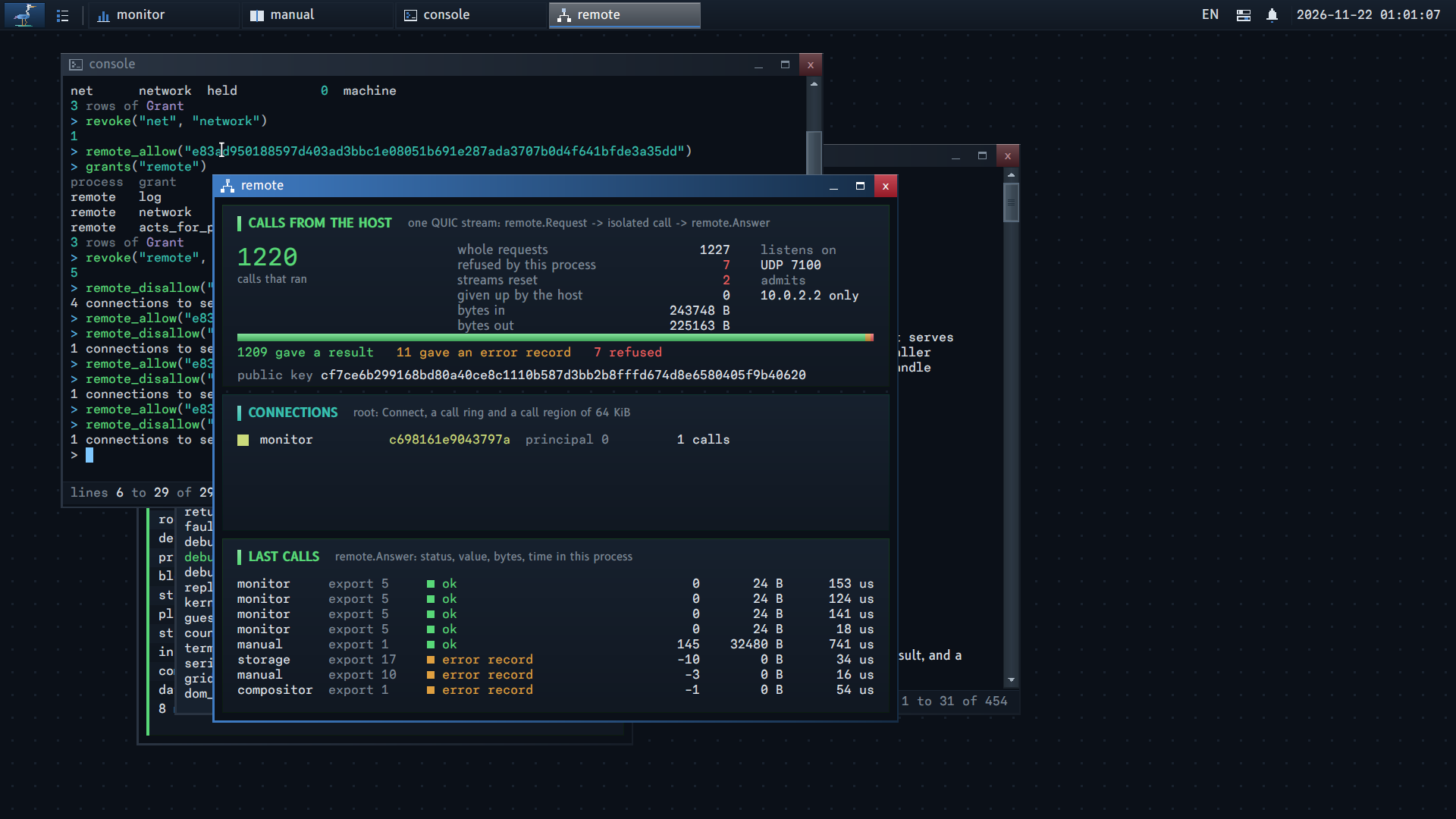
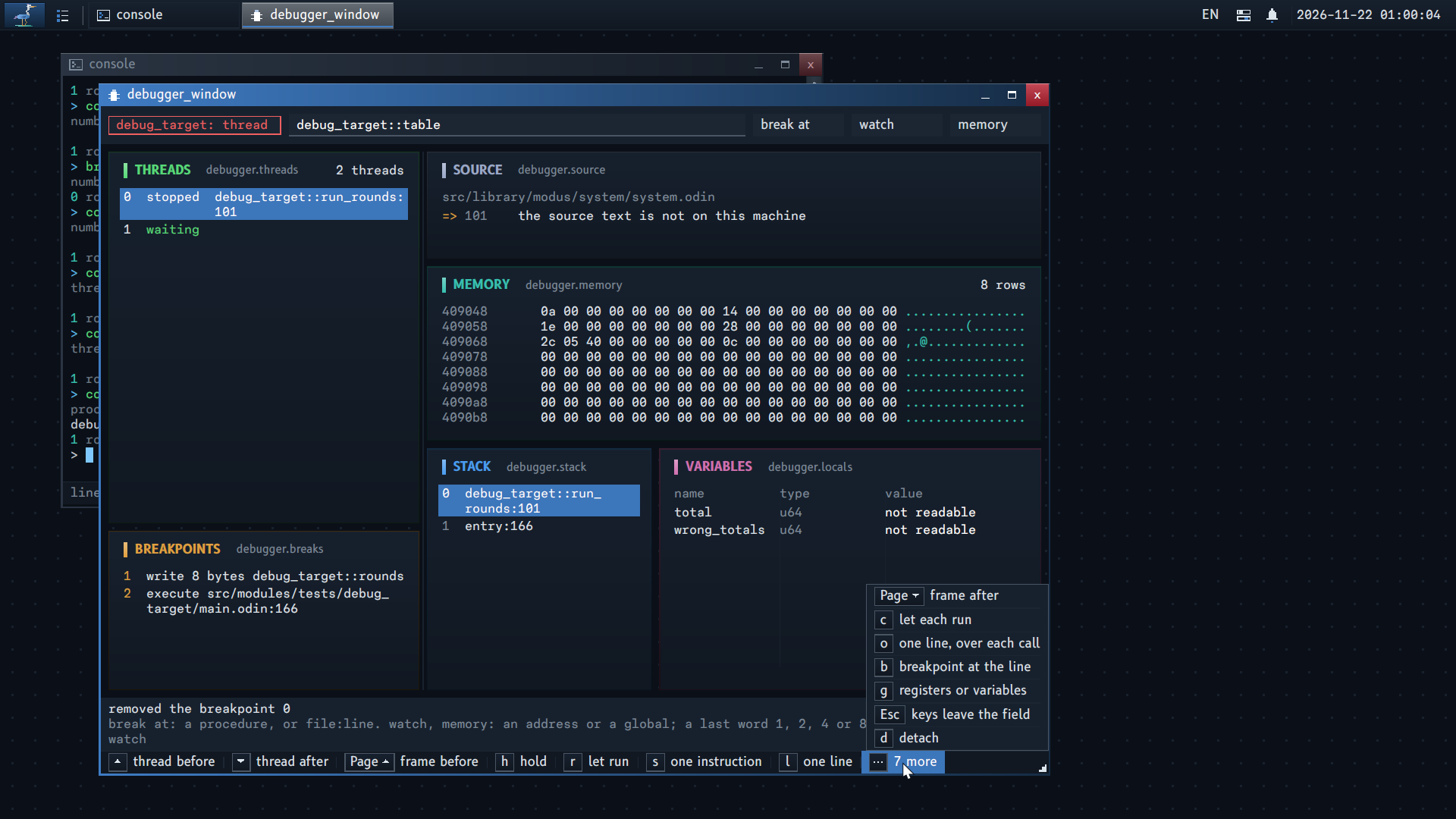
A developer tool: the address space of the console as a band scaled by pages, its mappings, its modules and its threads.Guide: Developer toolsThe window of the debugger: the threads of a process, the stack of a held thread, and the variables and the source line of the frame of its caller.Guide: Developer toolsThe window of the debugger with a breakpoint at the line of the chosen frame, and the registers of the held thread in the place of its variables.Guide: Developer toolsThe window of the debugger with a breakpoint and a watch that the developer typed in the debug place field, and the memory view of a global of the process.Guide: Developer toolsThe developer tool on a process that stopped on a fault: each frame of the stack trace with its procedure and its source line.Guide: Developer toolsThe bytes of a process in the developer tool: it reads only the pages that have a page frame.Guide: Developer toolsA call from the host: modustool call reaches the process remote on one QUIC stream, which makes the isolated call and writes the result back.Guide: Developer tools
The interface and the fonts
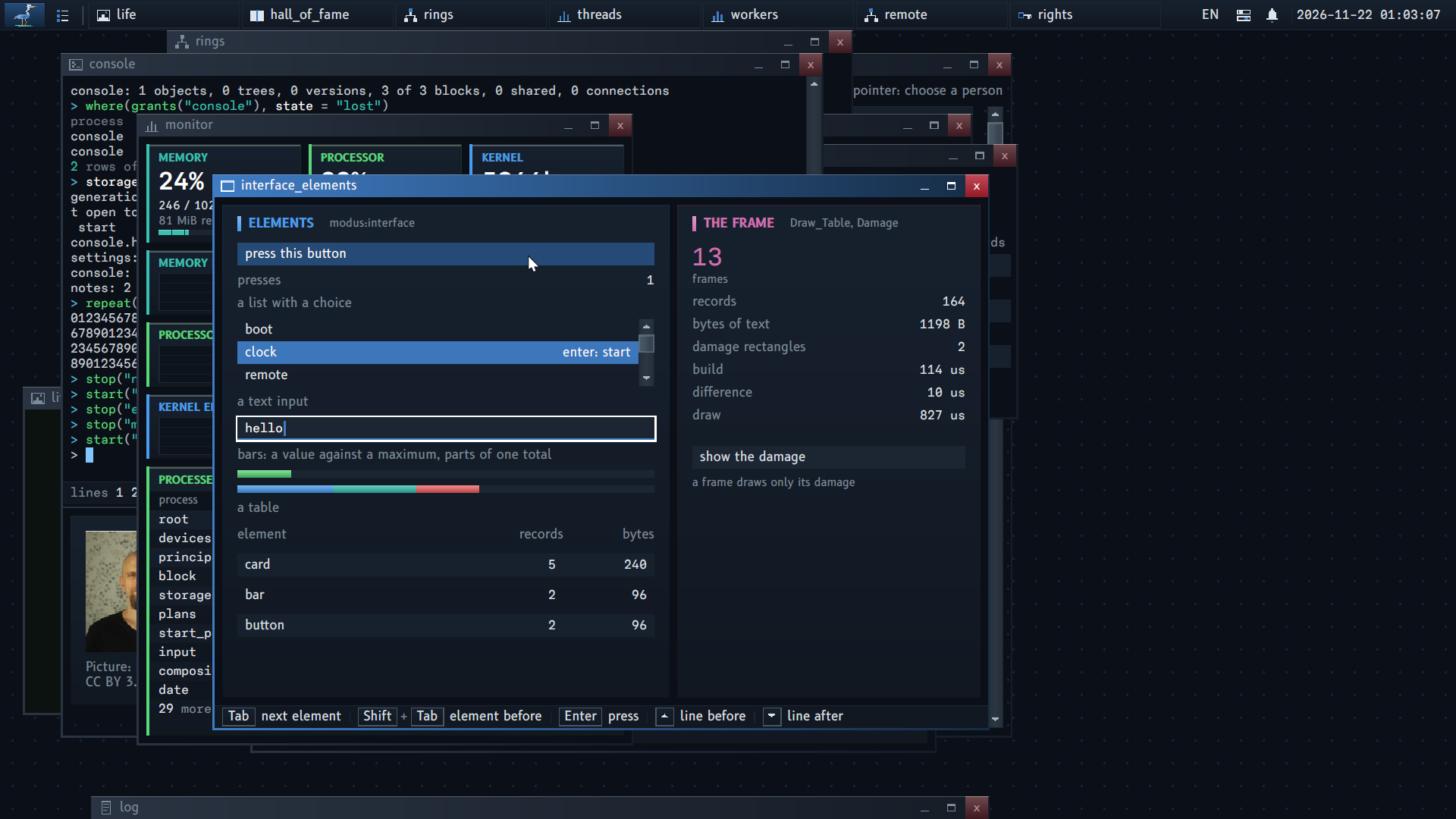
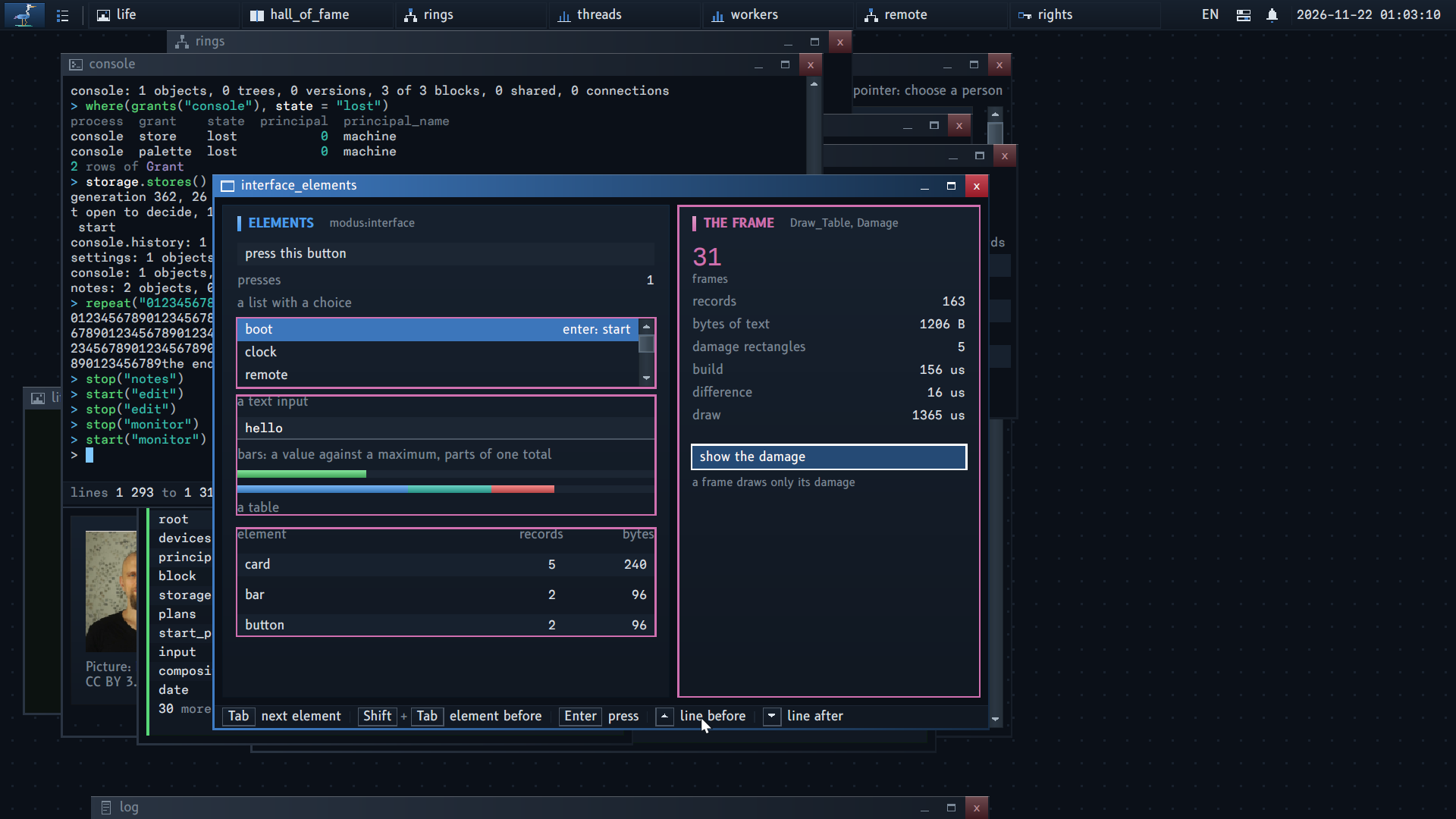
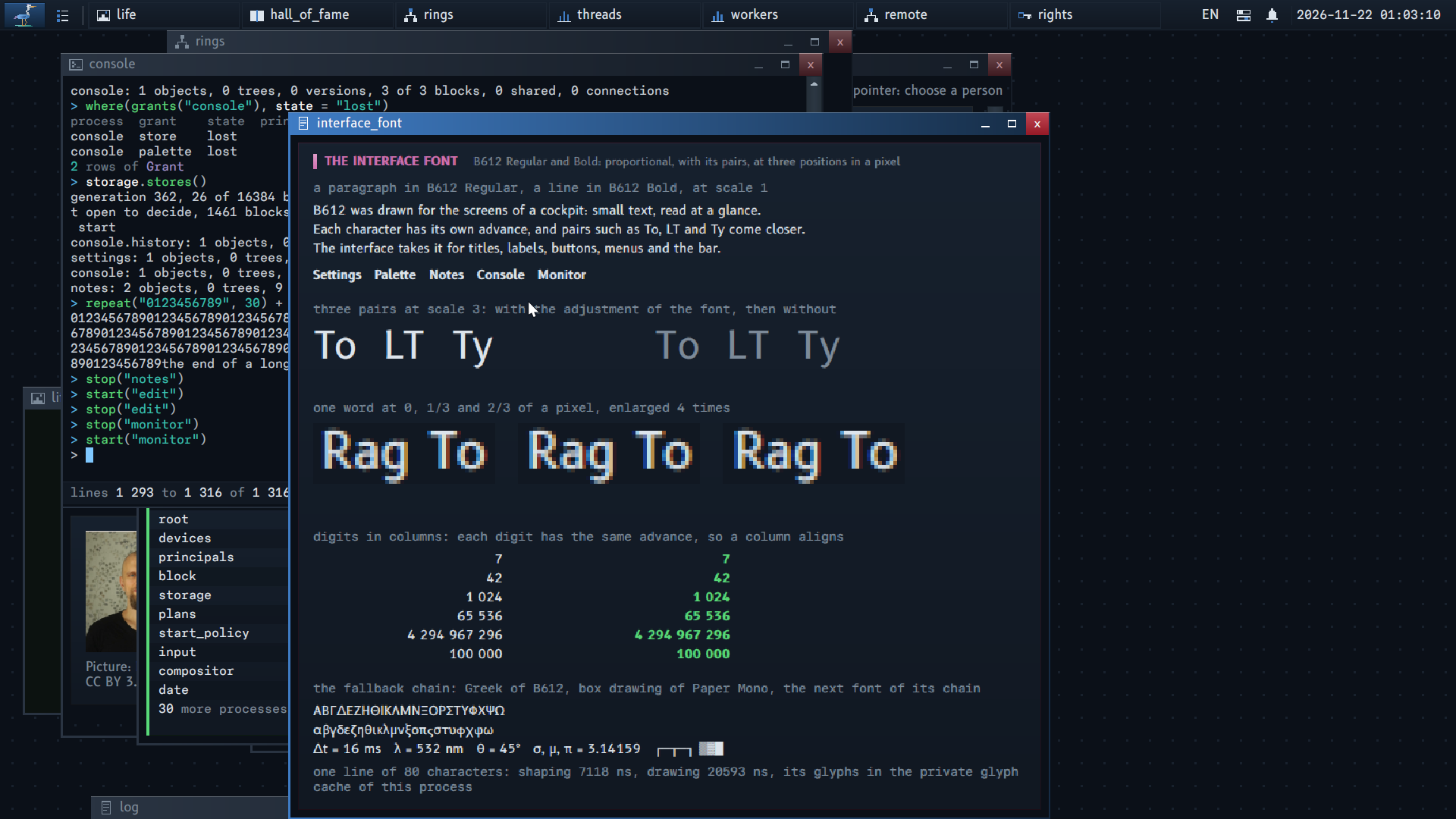
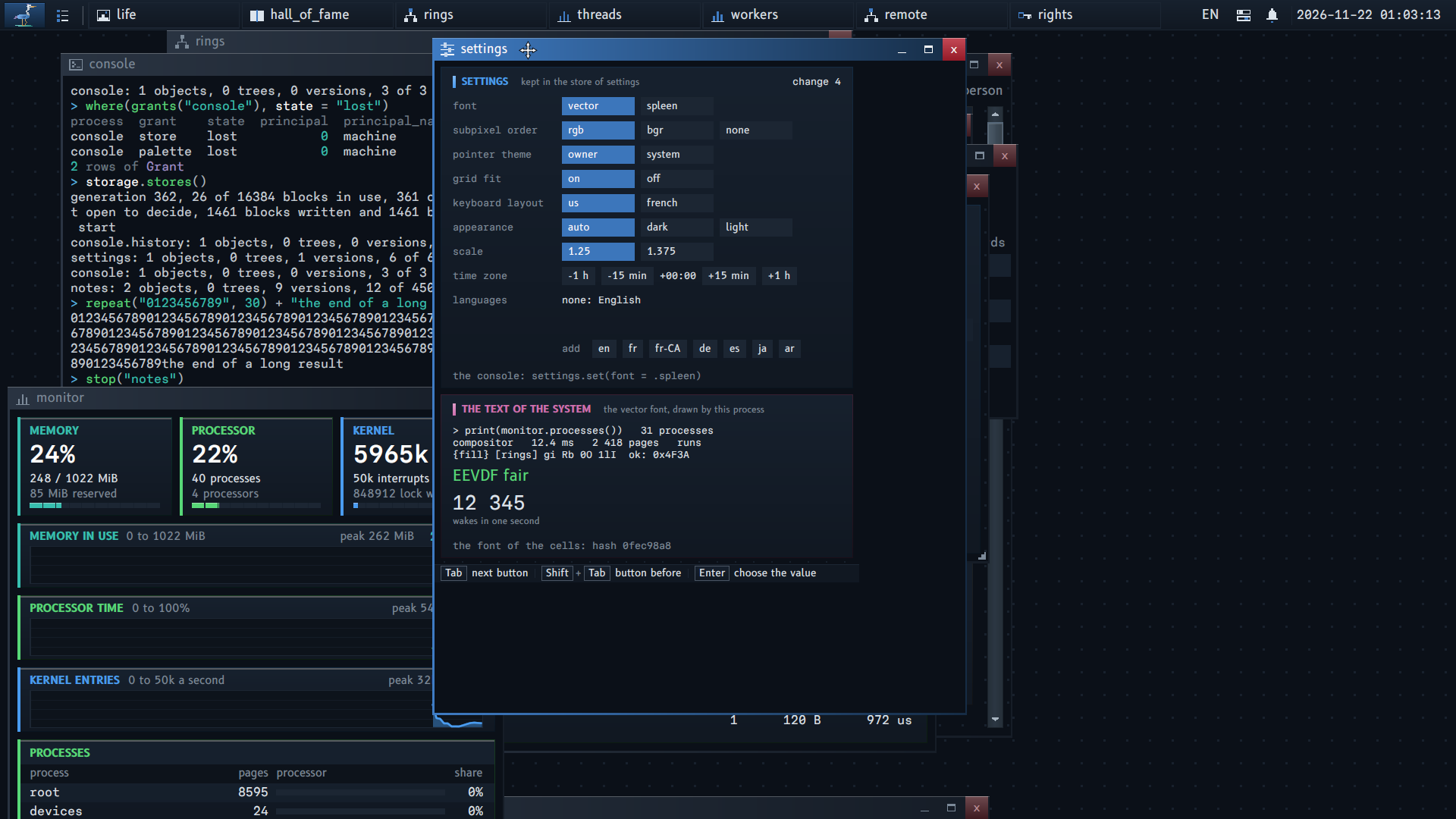
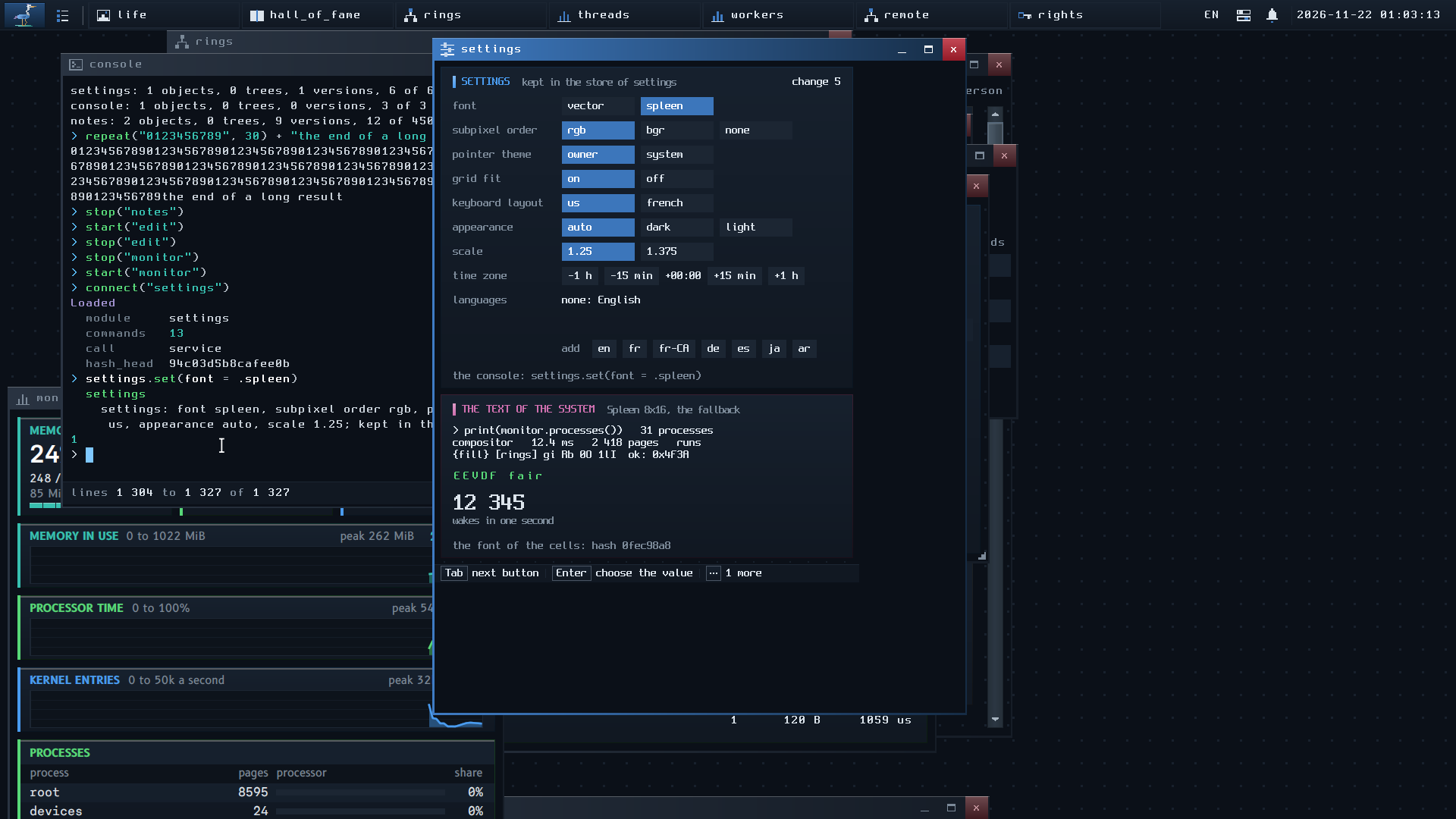
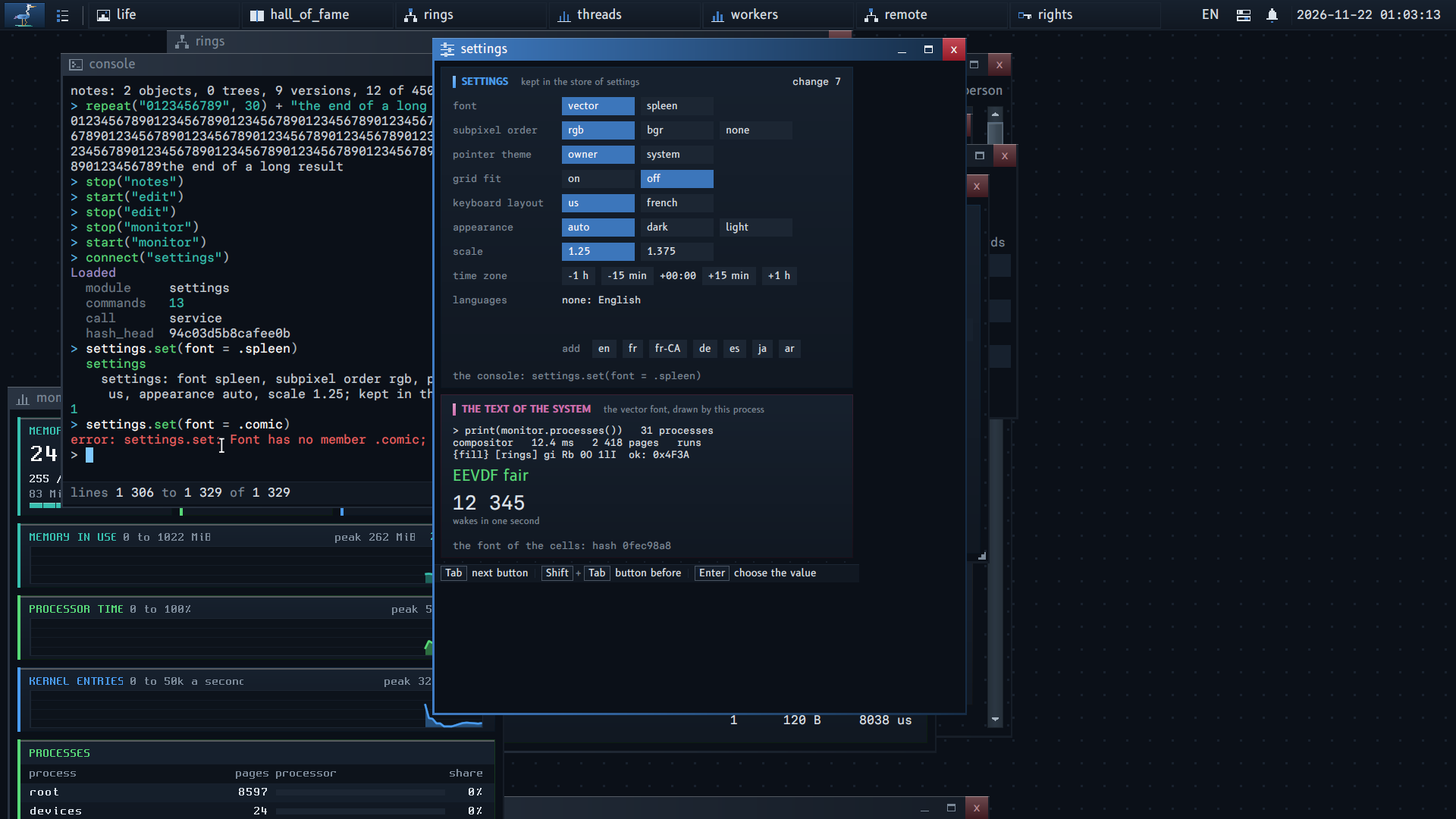
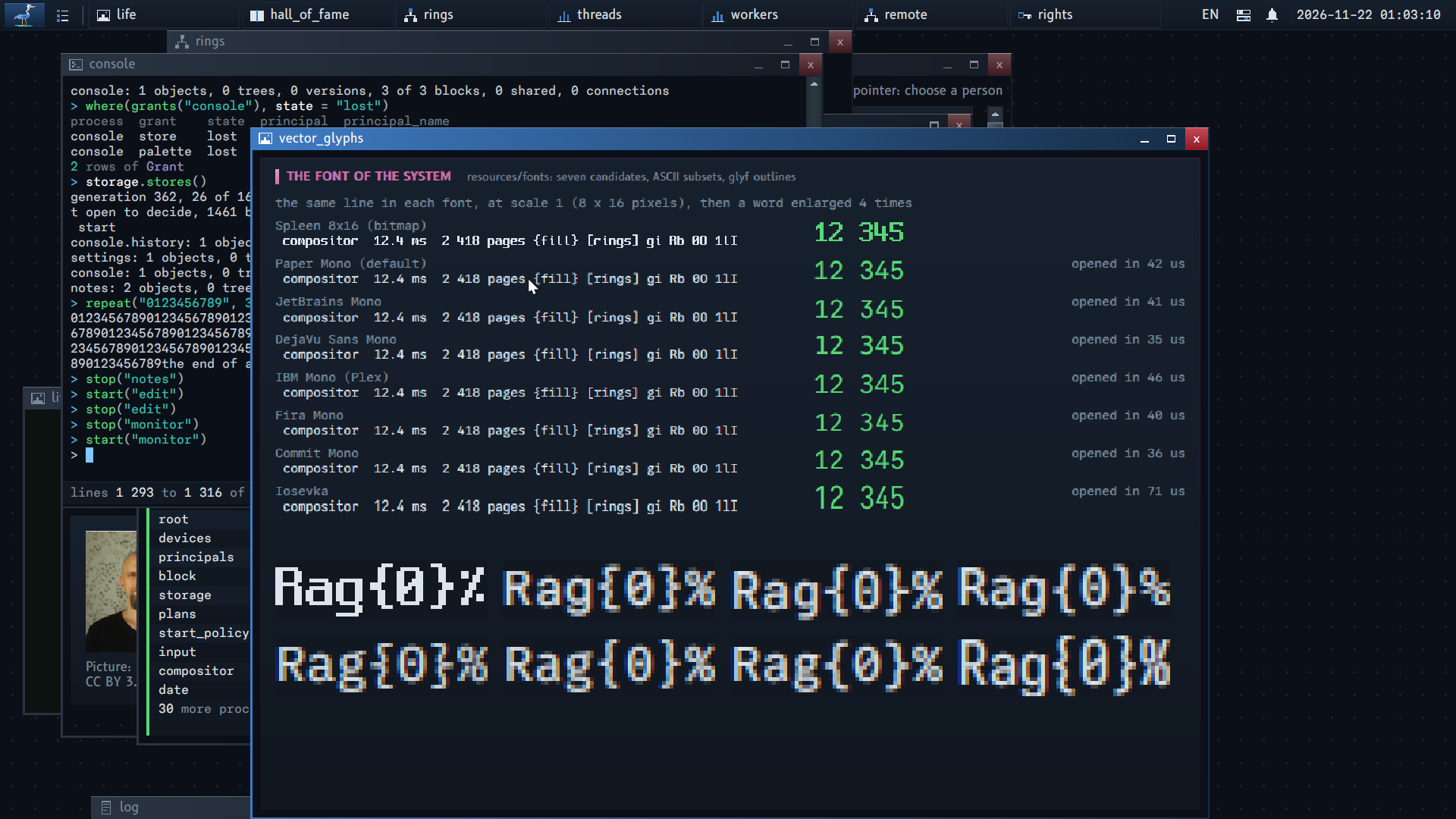
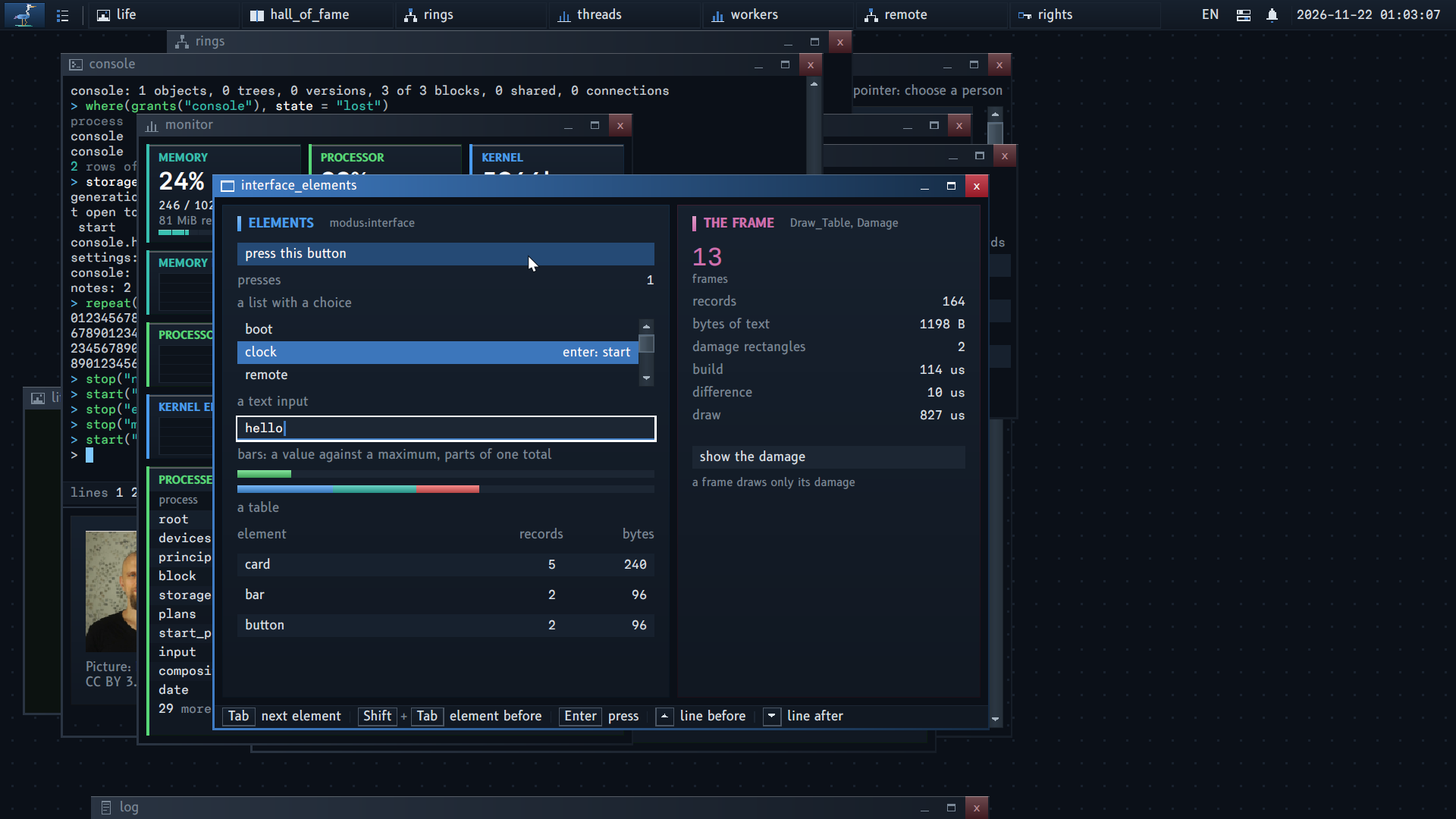
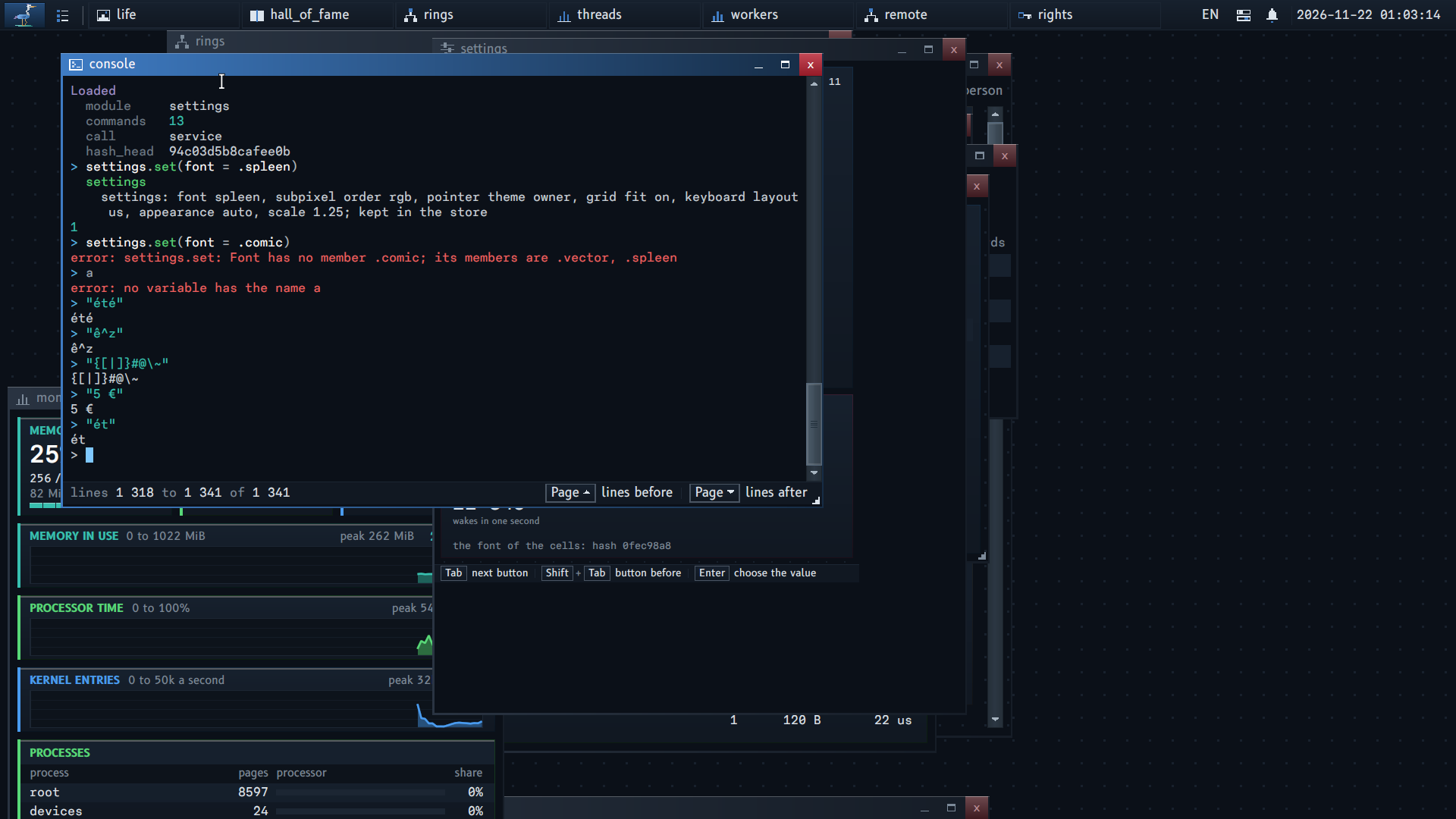
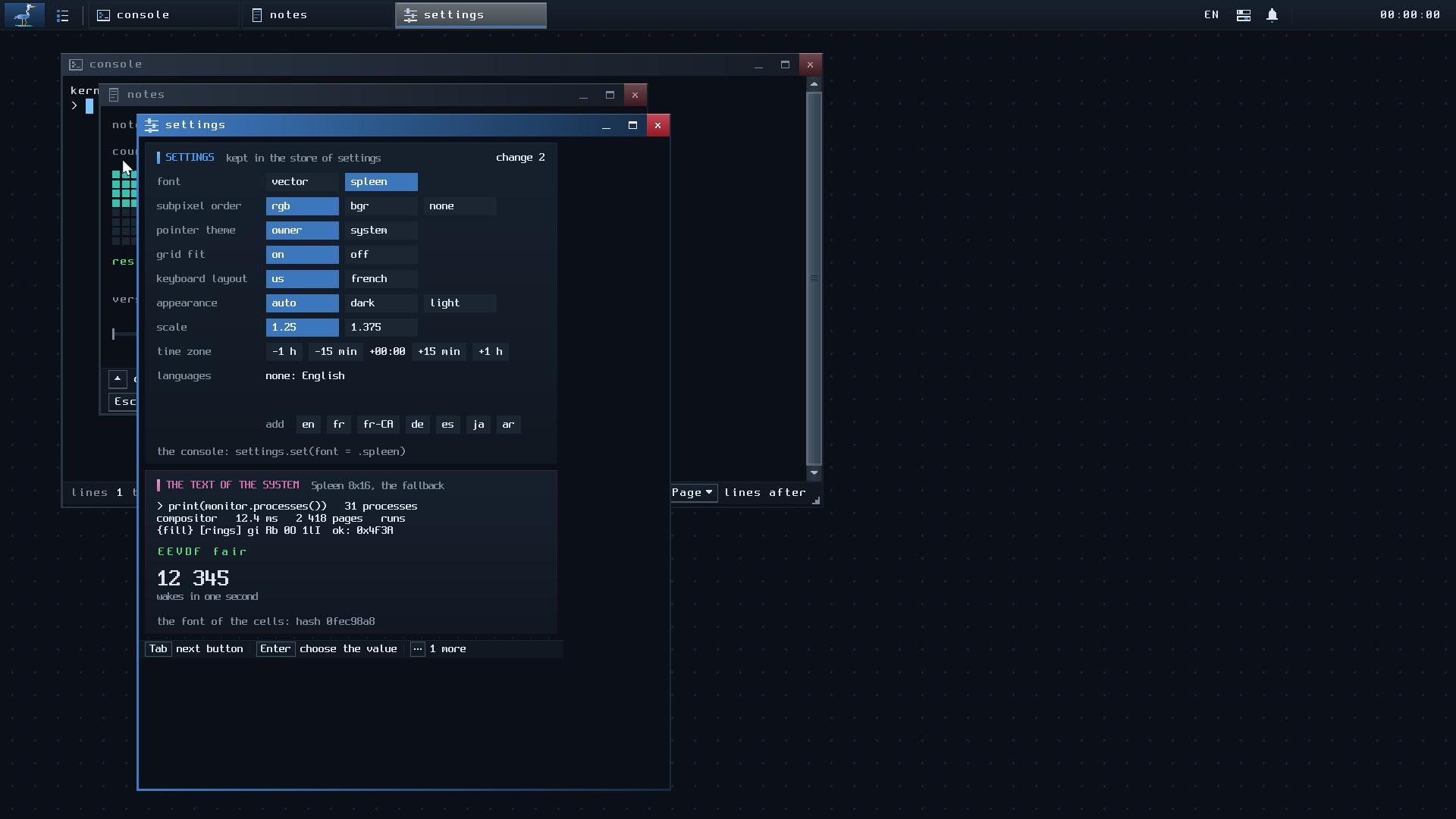
The elements of the interface package, the two fonts of the system, and the settings that change them while the processes run. 21 pictures.
The network service and its endpoints, TCP and QUIC in processes, the cryptography module and the seed of the system. 10 pictures.
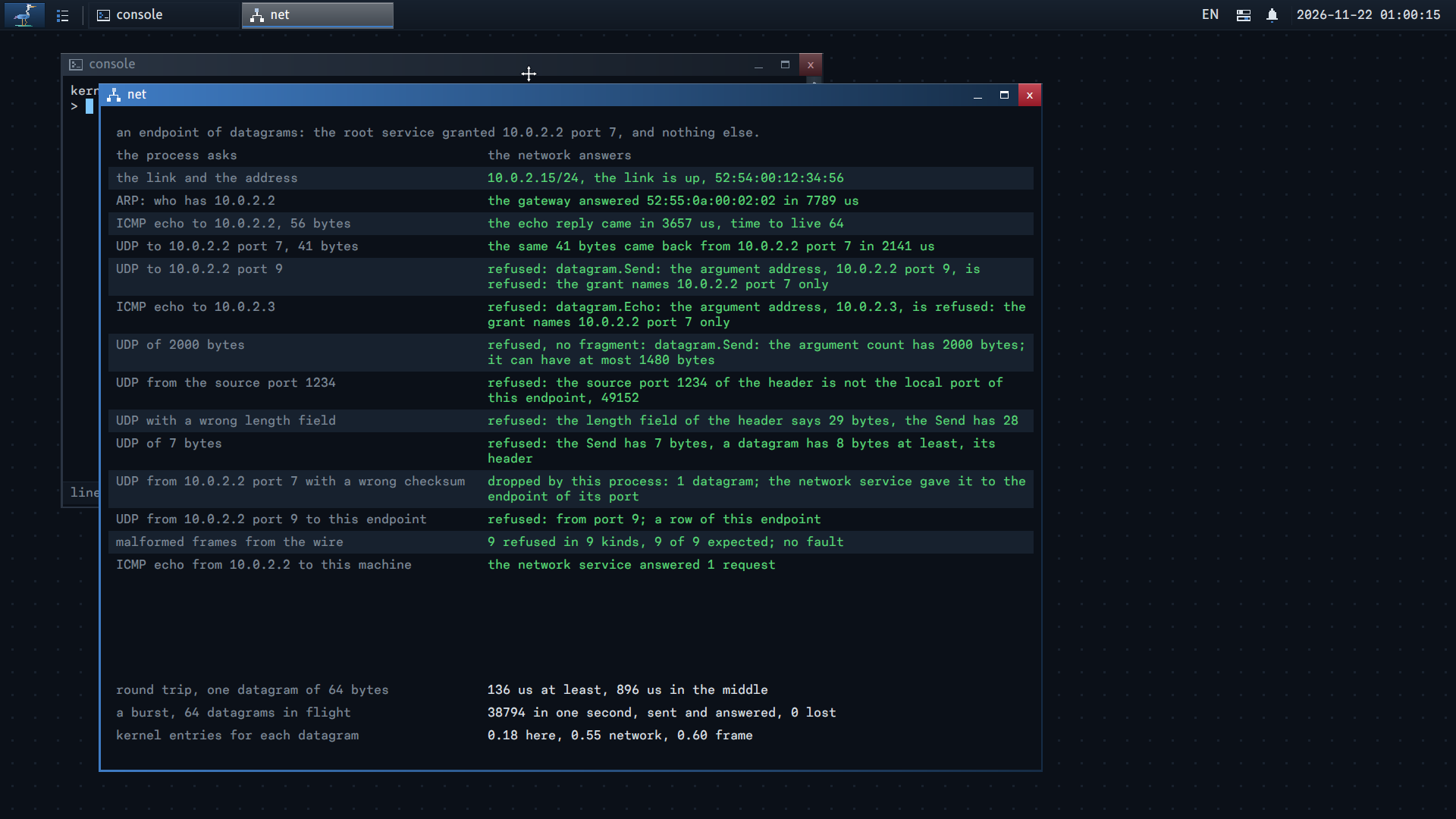
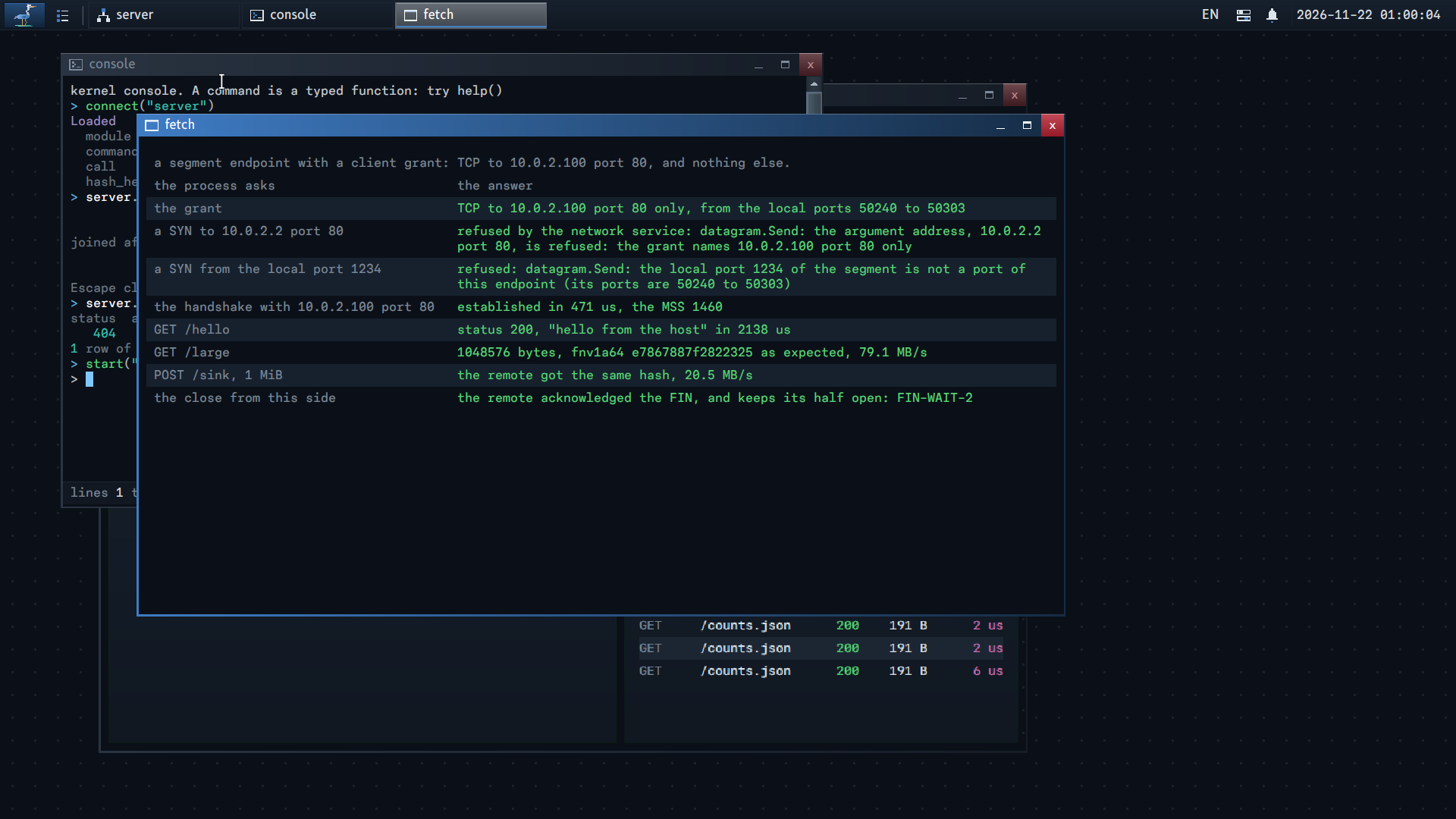
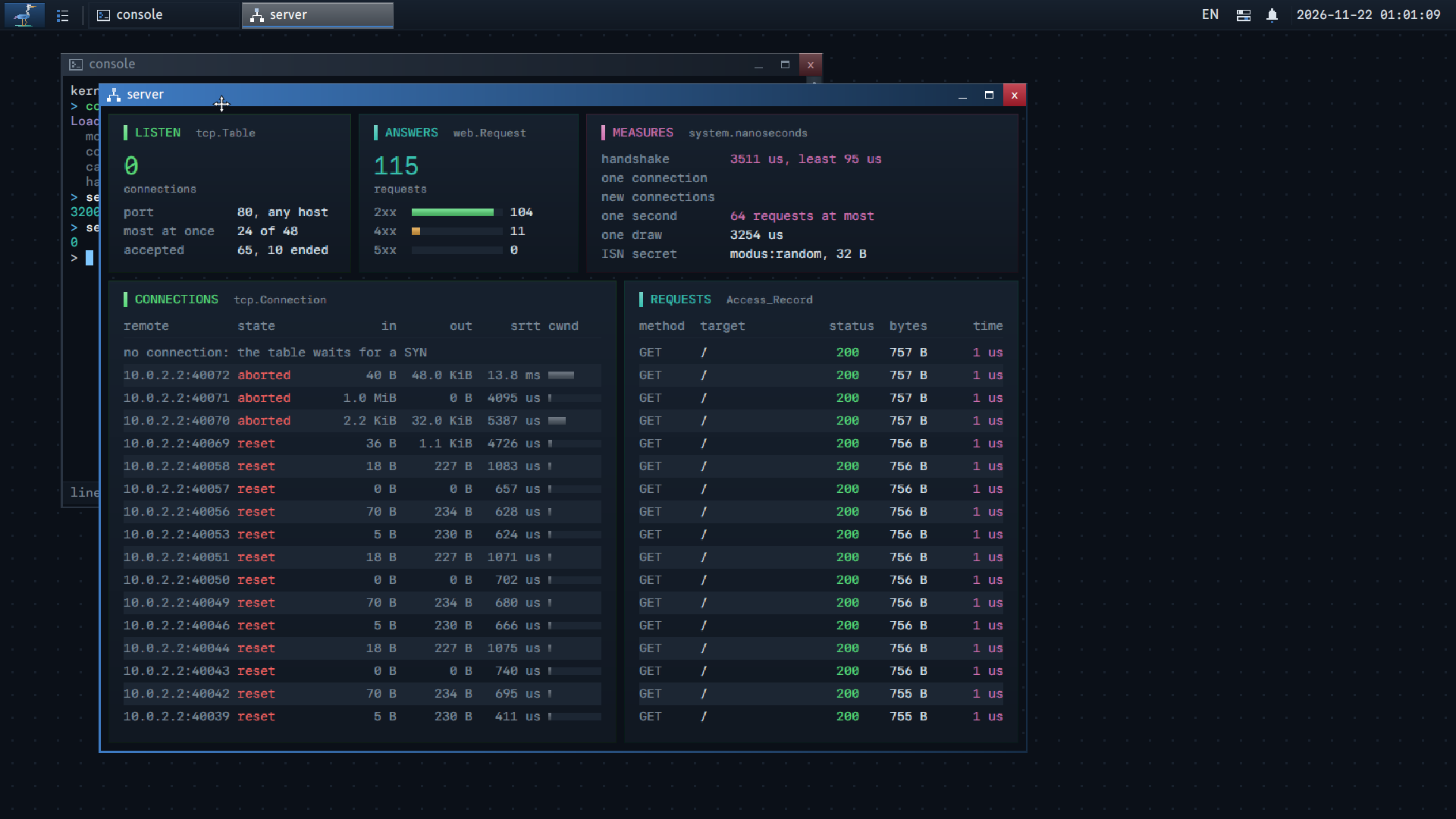
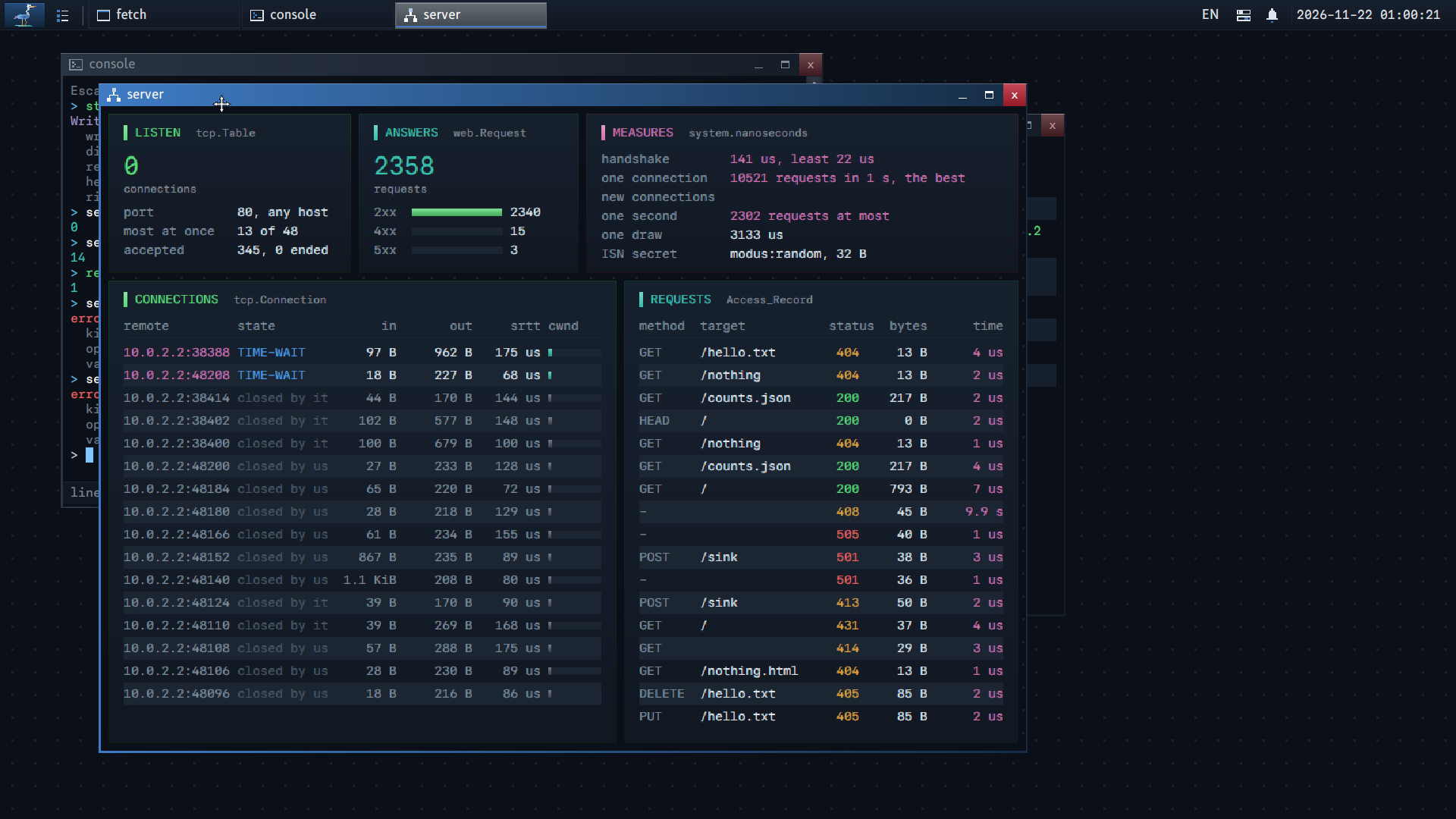
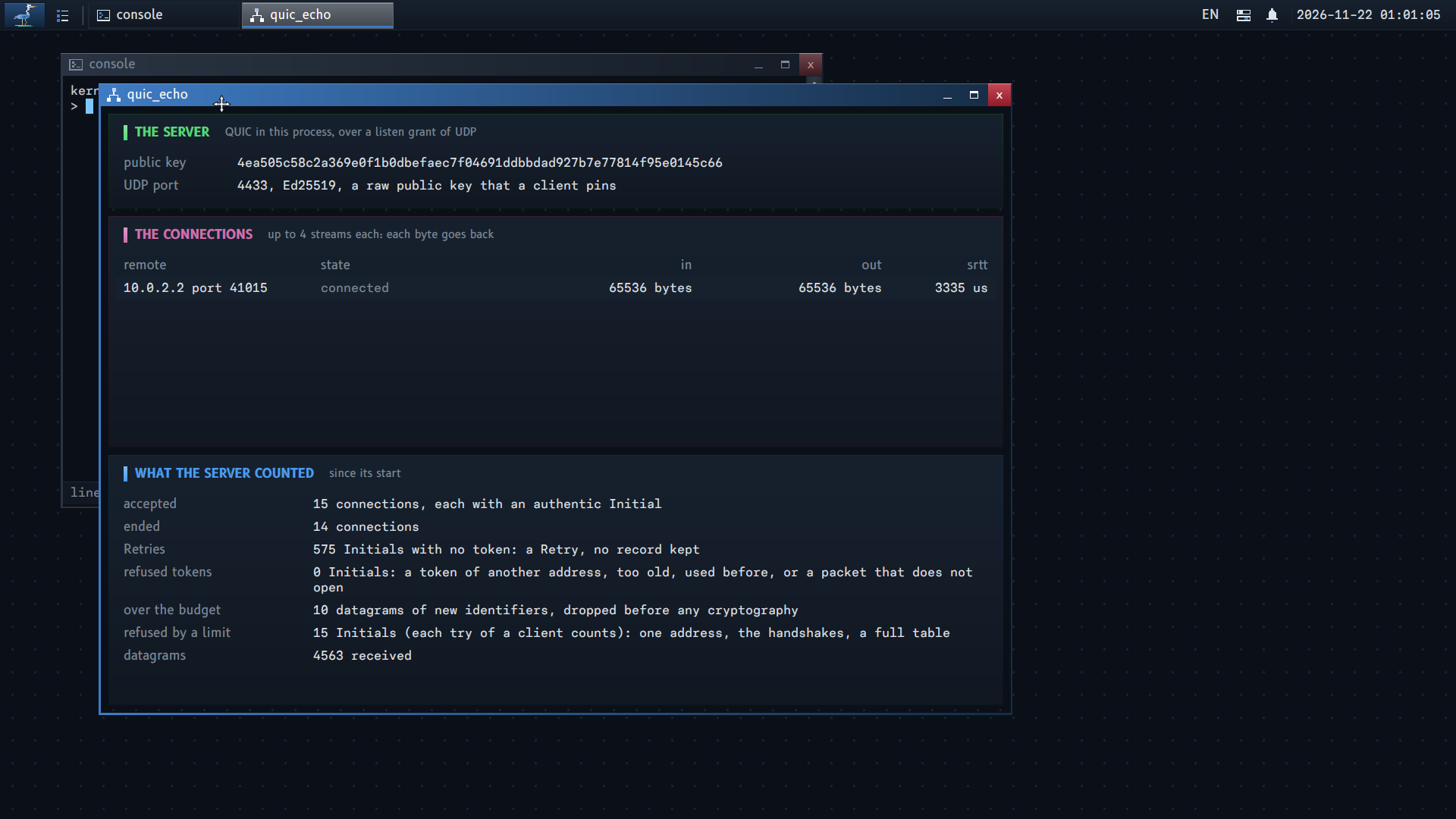
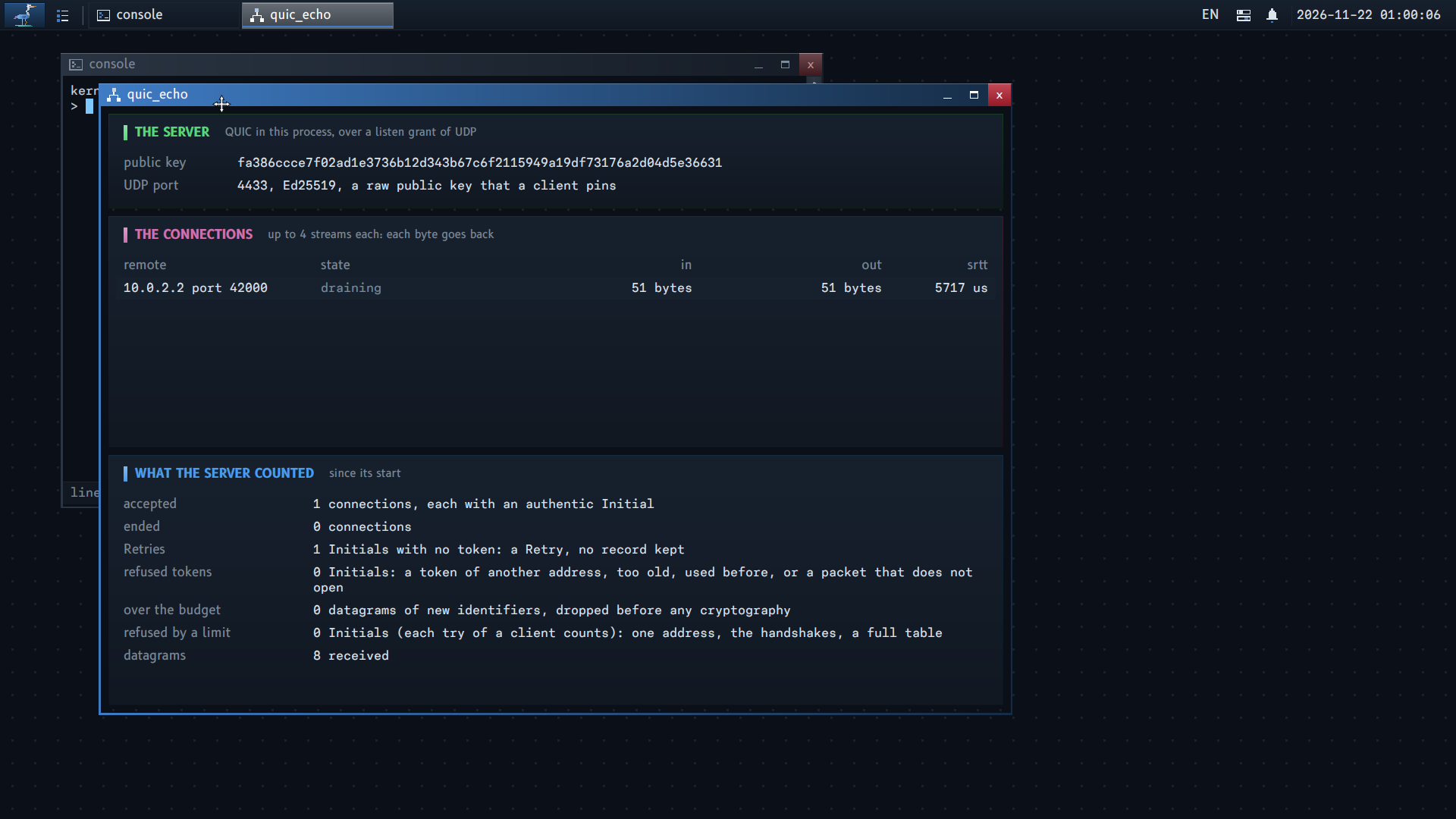
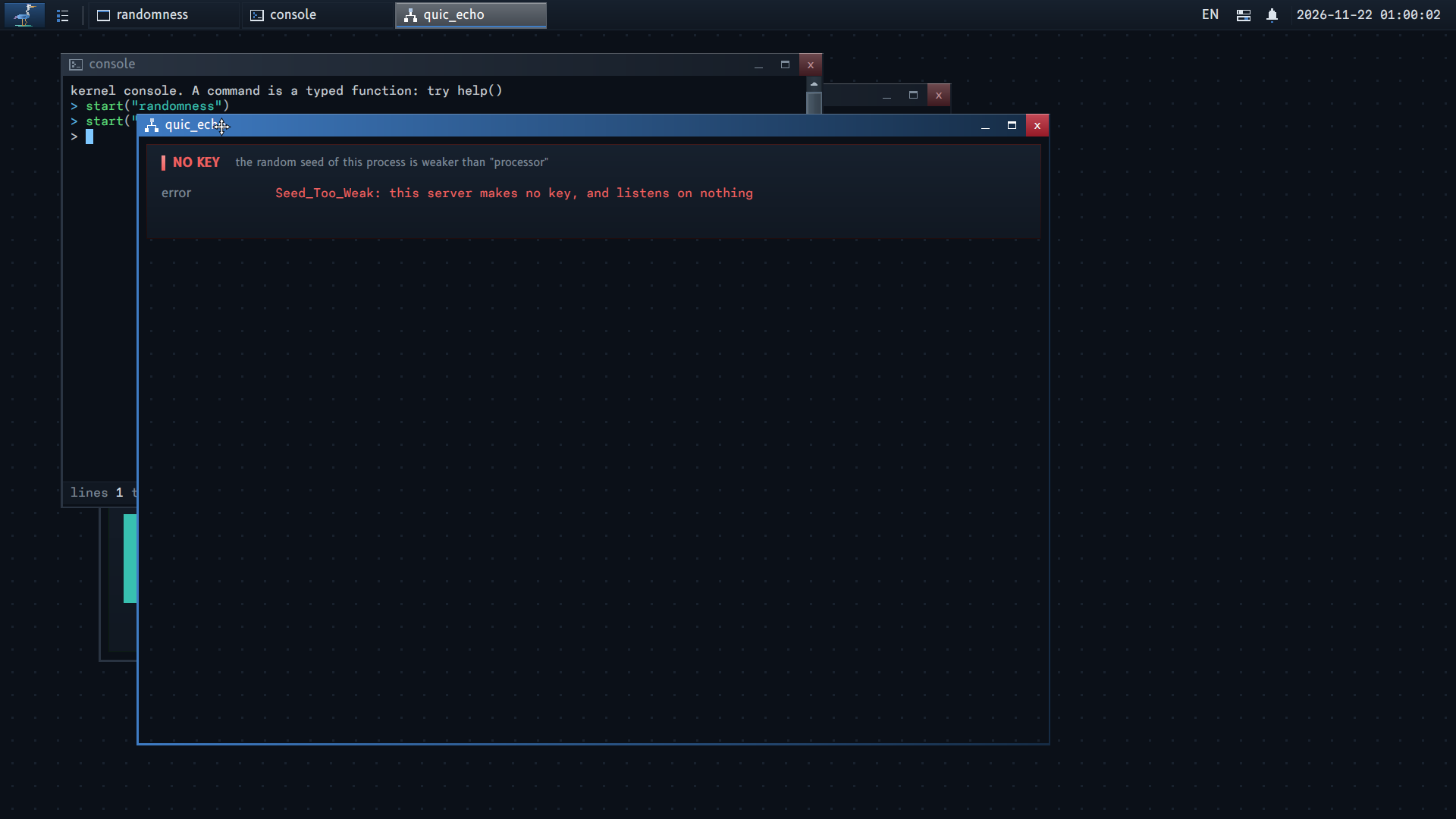
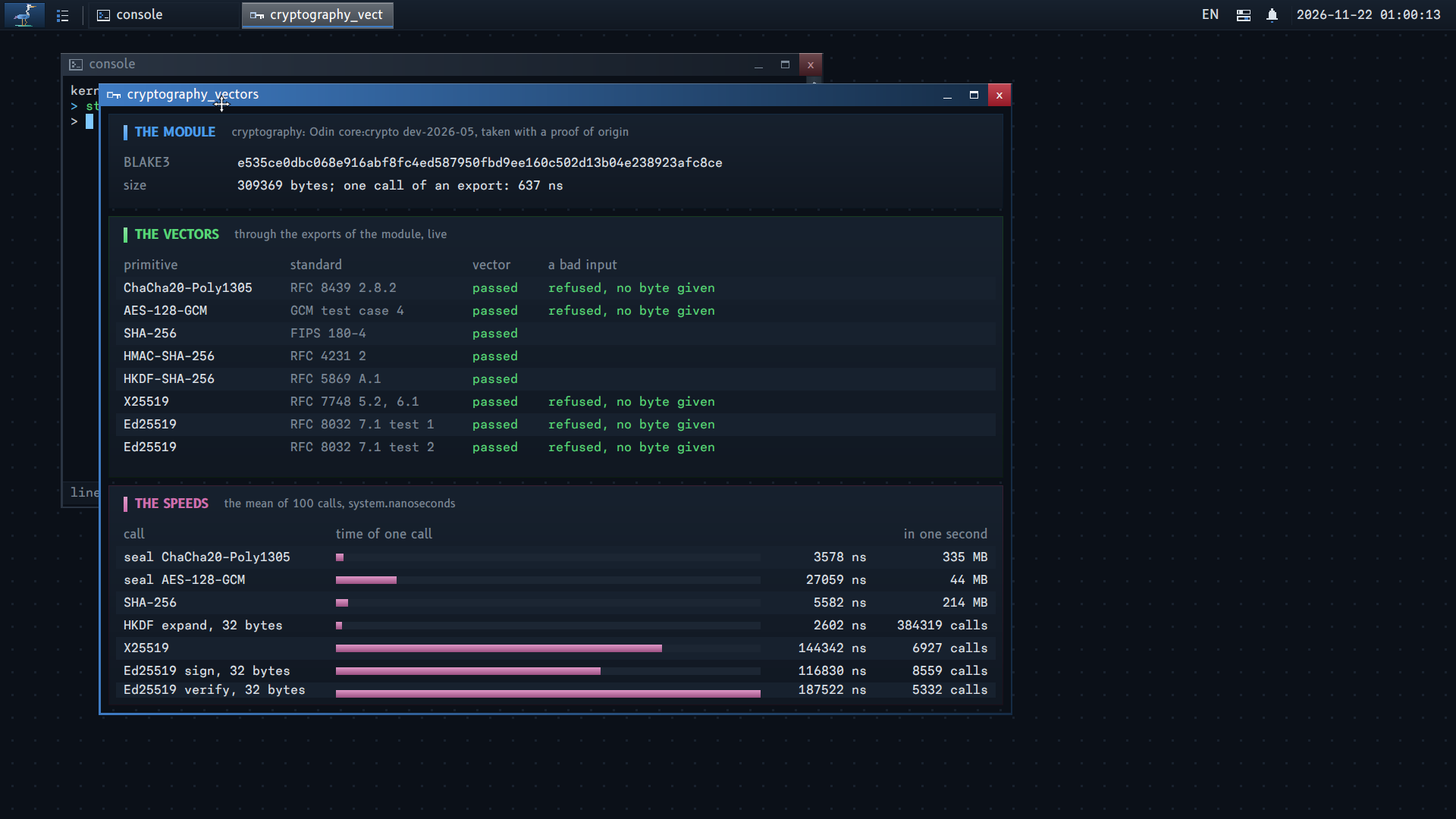
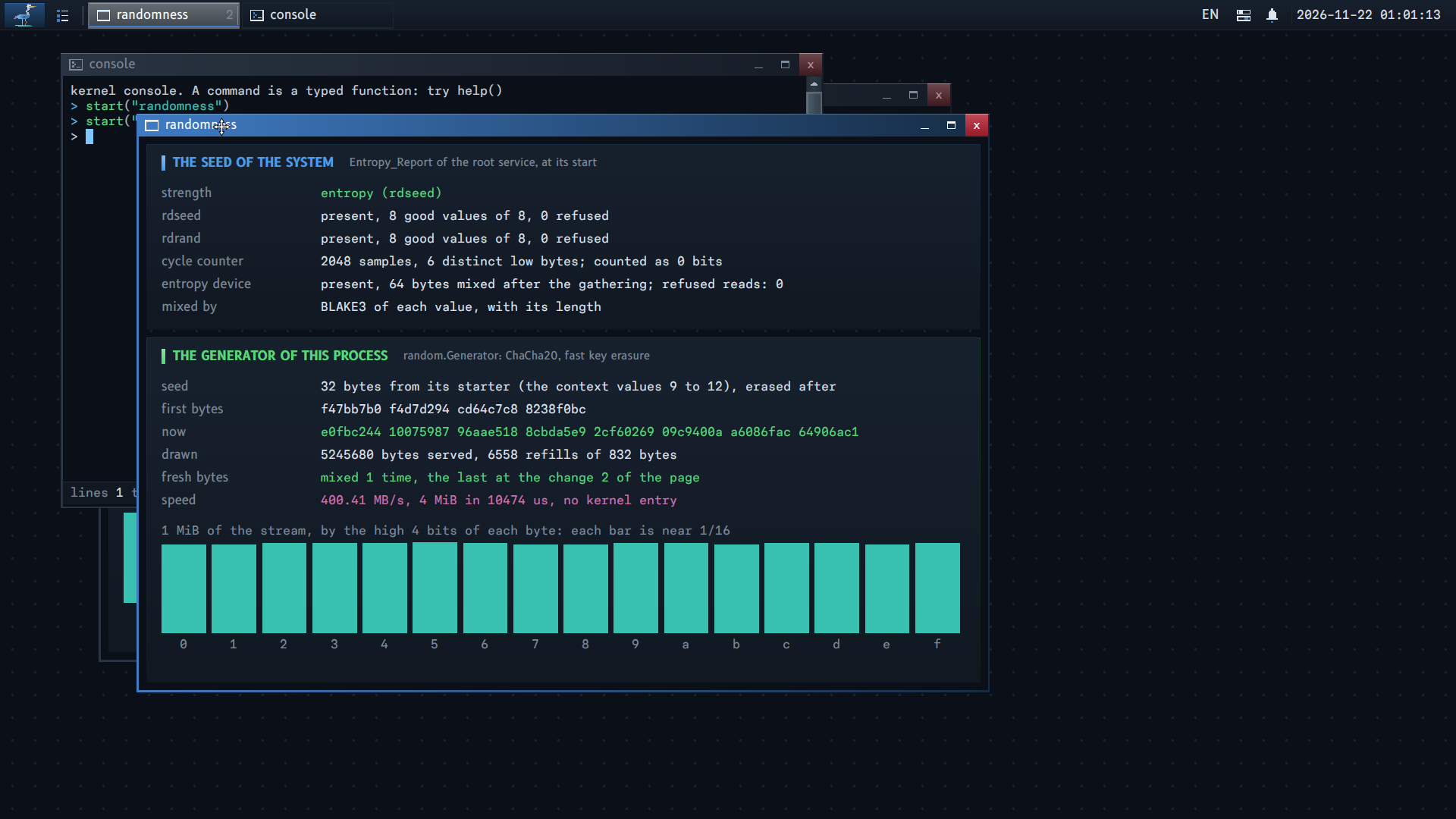
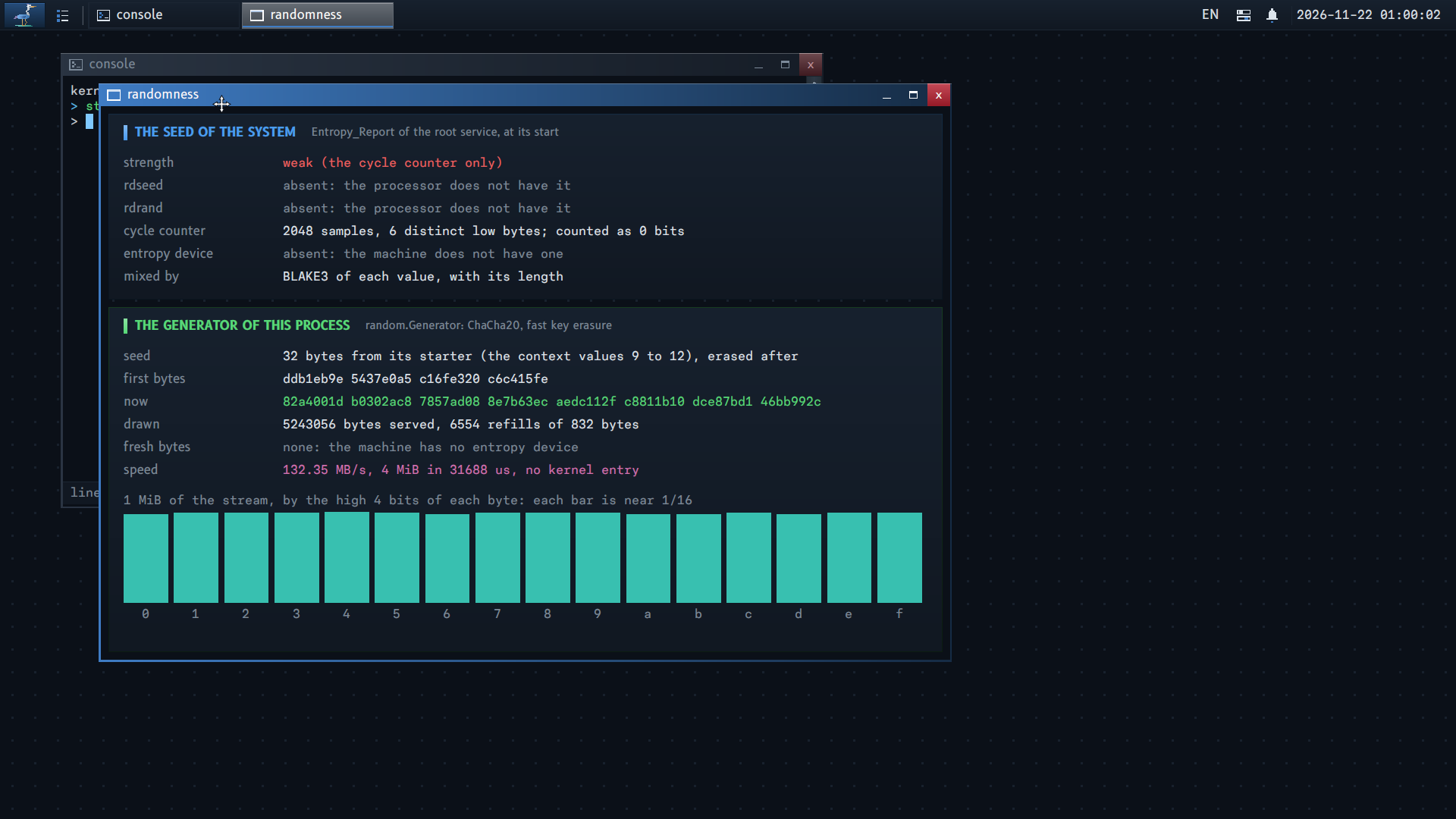
The network: a virtio network device in a process, a network service with ARP, IPv4, ICMP echo and UDP, and an endpoint with a grant of one remote.Guide: The network: TCP as a library in the processThe process fetch: a TCP client with a grant of one remote, the refusals of the network service, and 1 MiB received and sent.Guide: The network: TCP as a library in the processTCP in the process: server holds a listen grant on the port 80 and serves one table of connections from one thread.Guide: The network: TCP as a library in the processA simple HTTP/1.1 server: keep-alive, pipelining, HEAD and each refusal status, with the connections and the last requests, live.Guide: The network: TCP as a library in the processThe process quic_echo: a QUIC server on the UDP port 4433 that writes back each stream, with the public key that a client pins.Guide: QUICThe process quic_echo after the QUIC client of OpenSSL: one connection accepted after a Retry, 51 bytes in and 51 bytes out.Guide: QUICThe process quic_echo with a weak random seed: it makes no key and listens on nothing.Guide: QUICThe process cryptography_vectors: each primitive against its published test vectors.Guide: CryptographyThe process randomness: the entropy report of the system and the speed of a draw.Guide: RandomnessThe process randomness on a machine with no rdseed and no rdrand: the seed of the system is weak, and the report says so.Guide: Randomness
The storage
The block service, the storage service with its stores and its versions, and a process that keeps its data across a restart. 9 pictures.
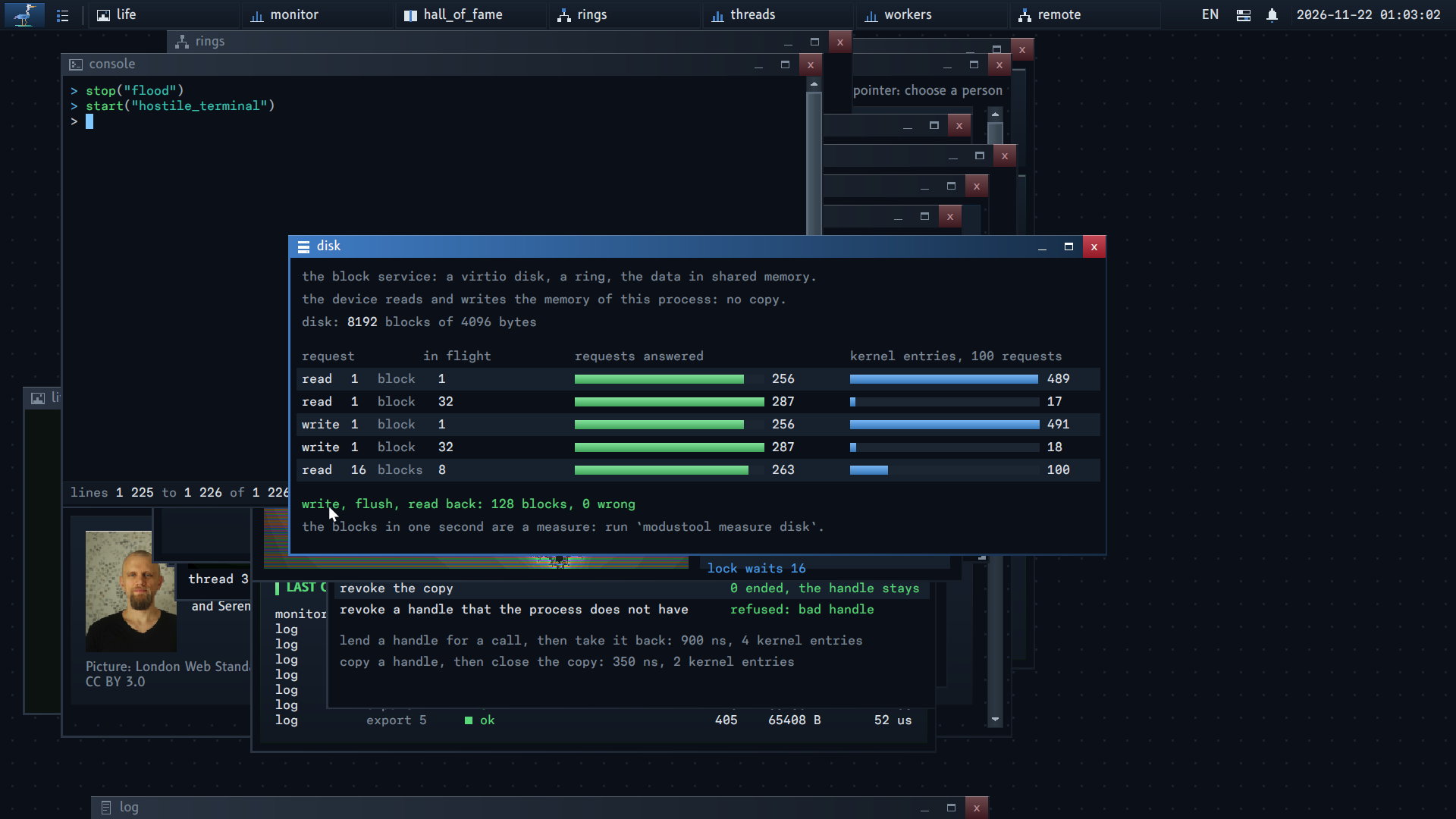
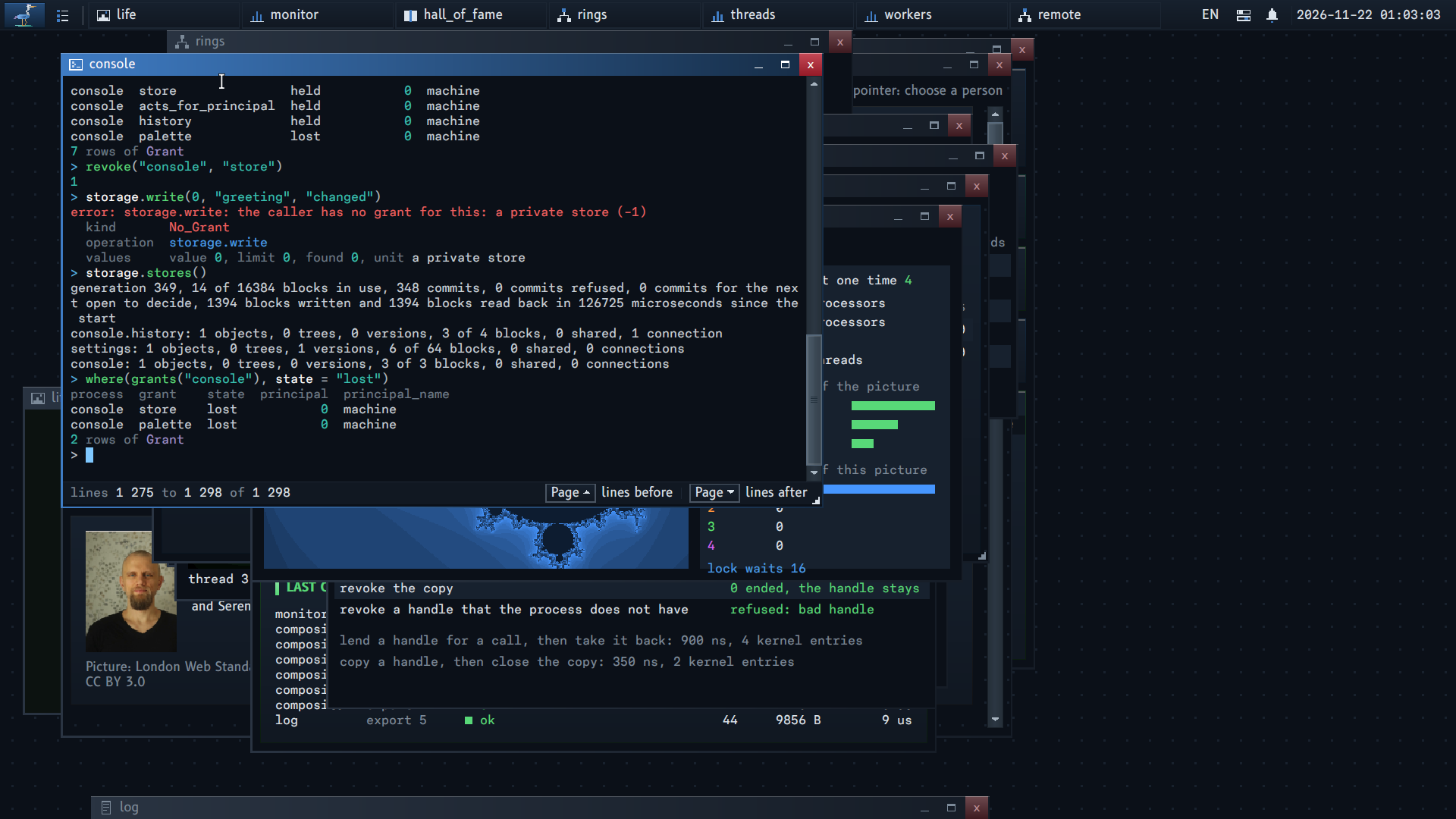
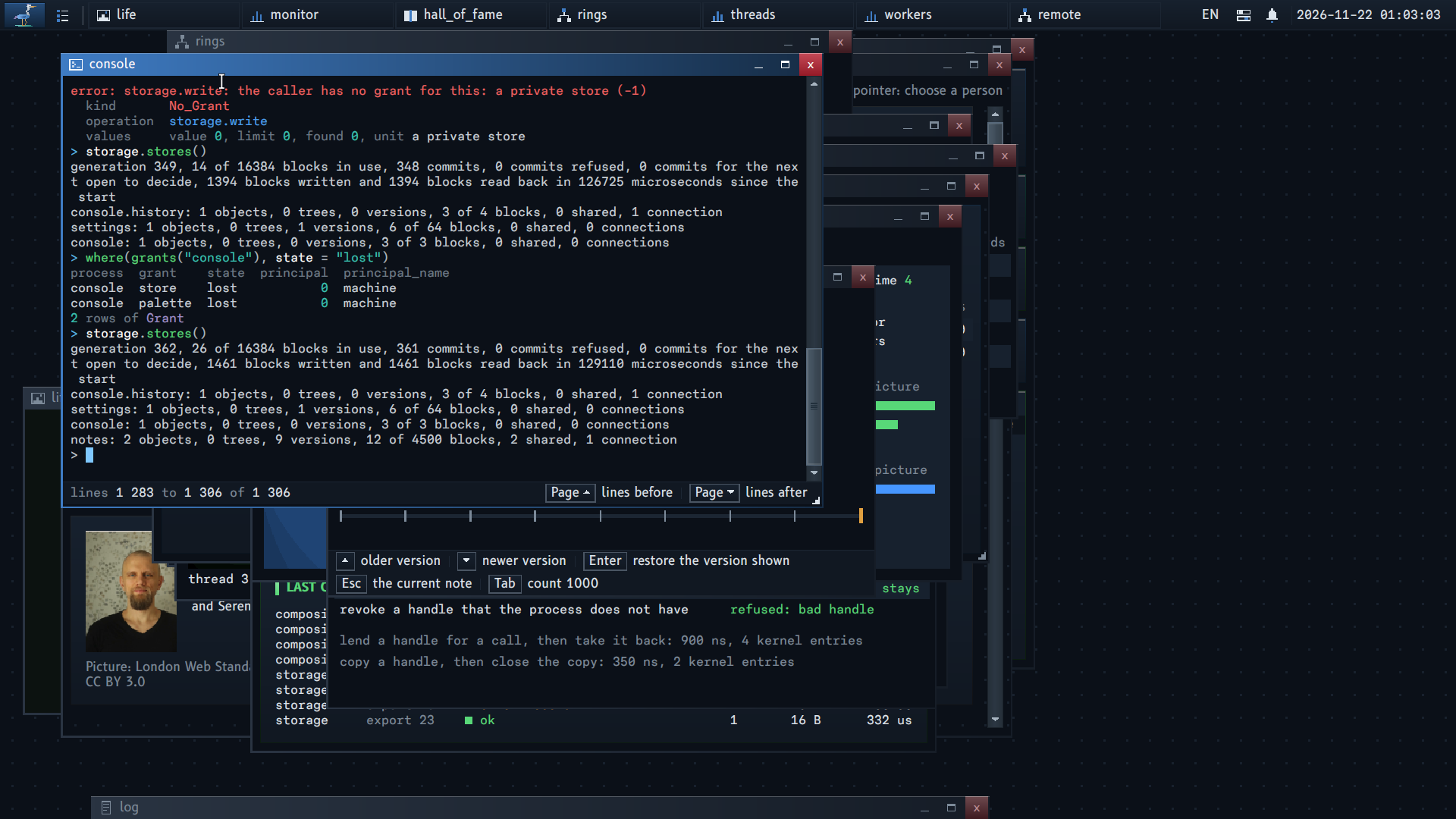
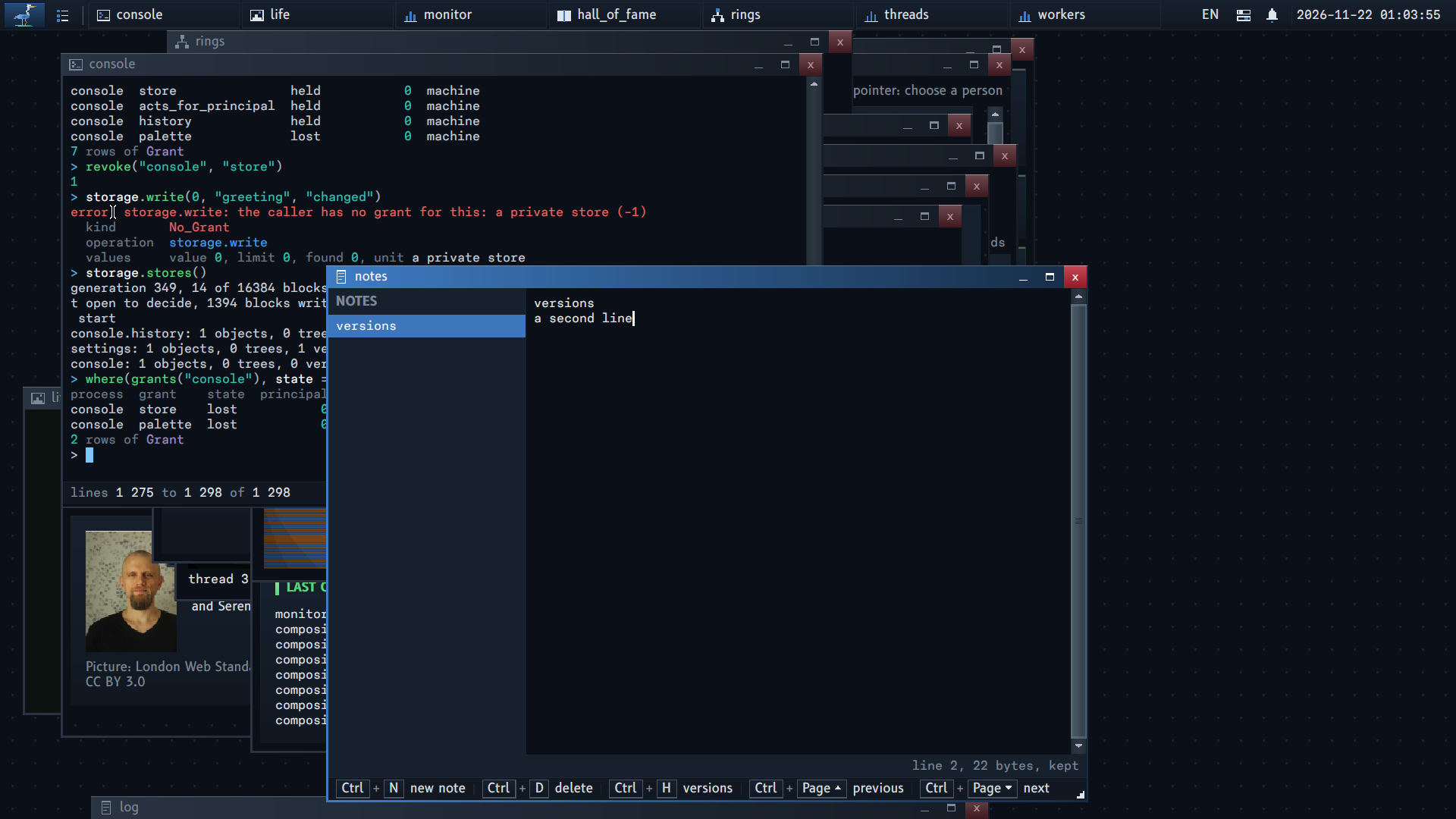
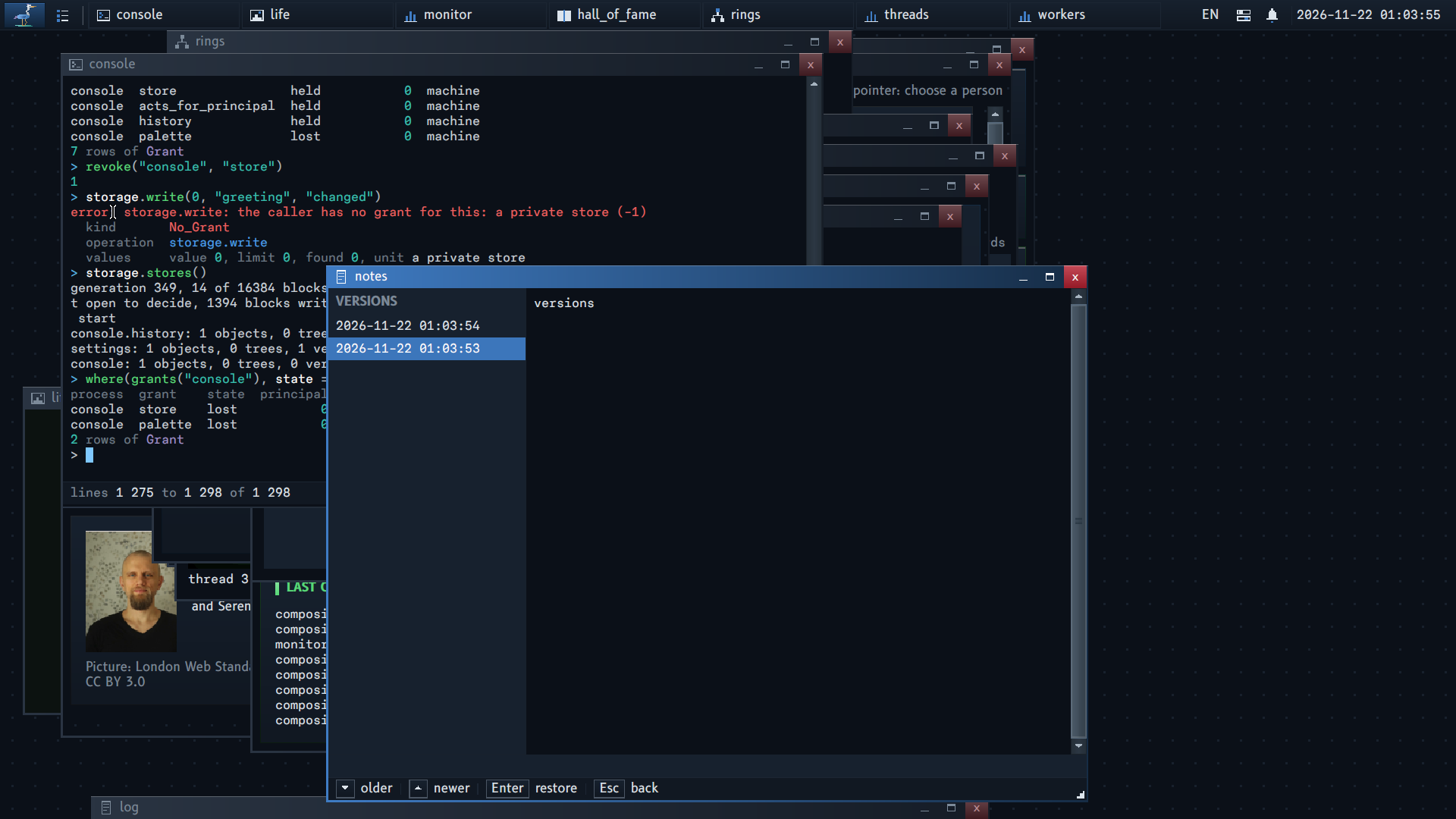
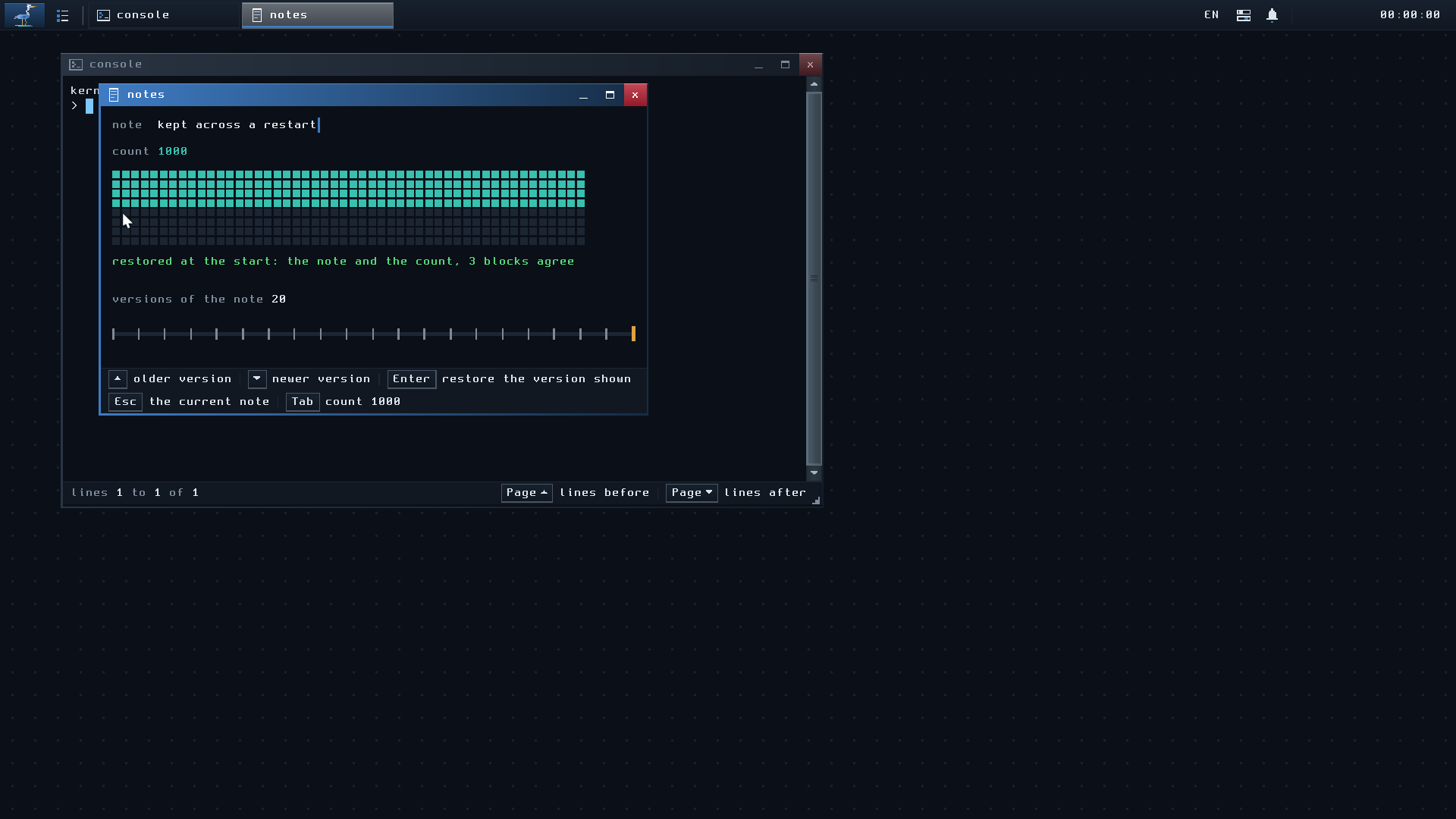
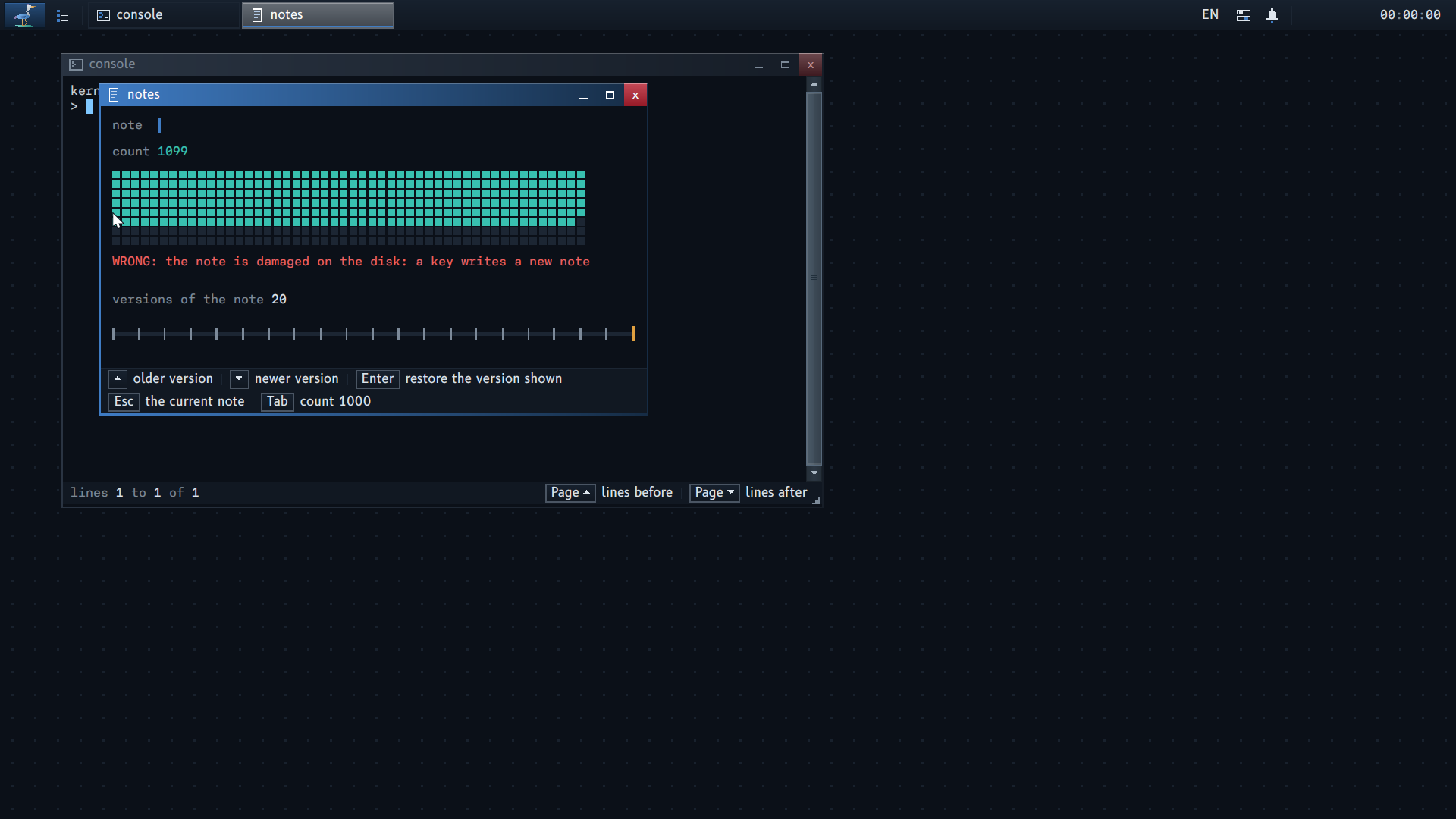
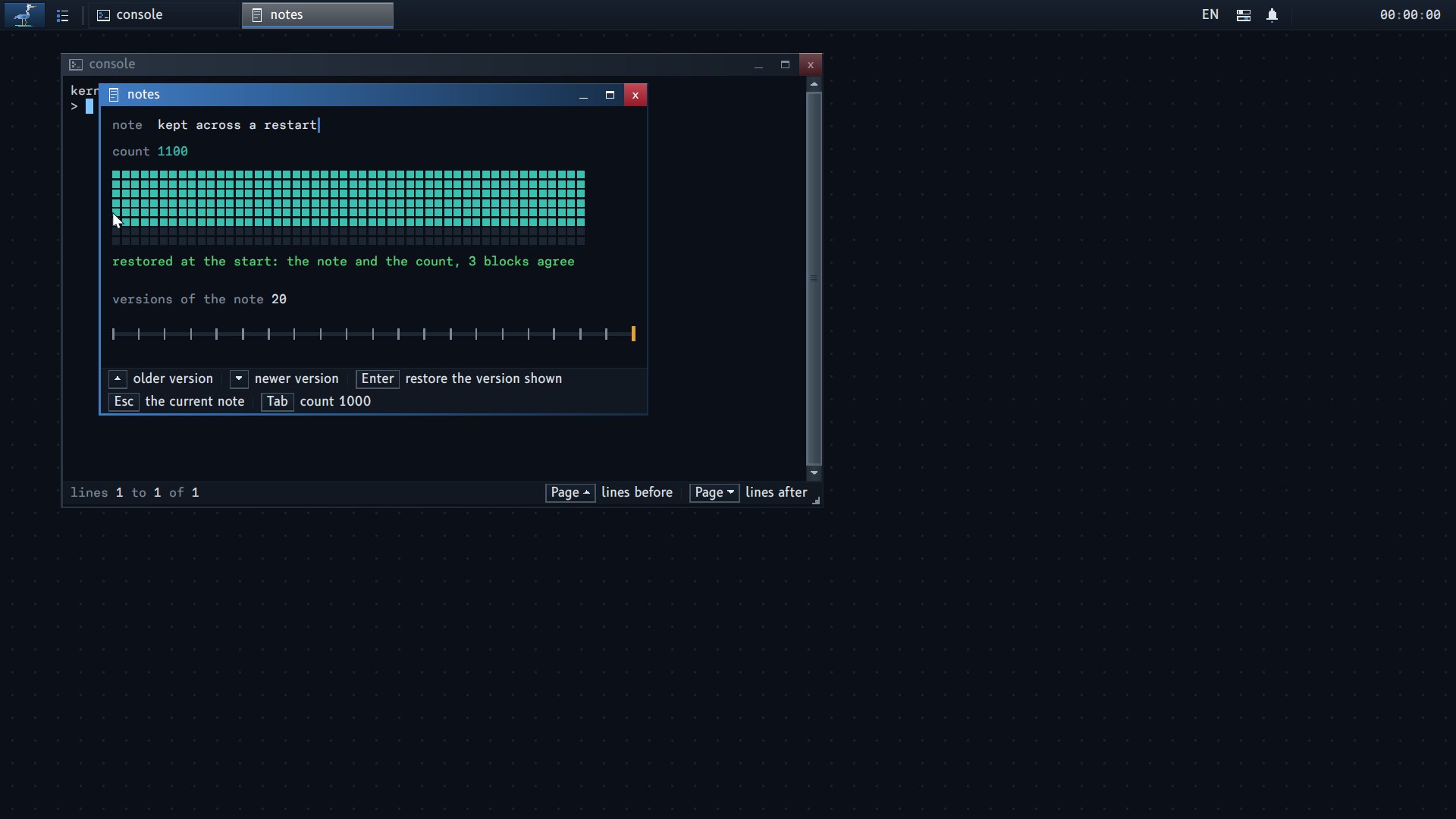
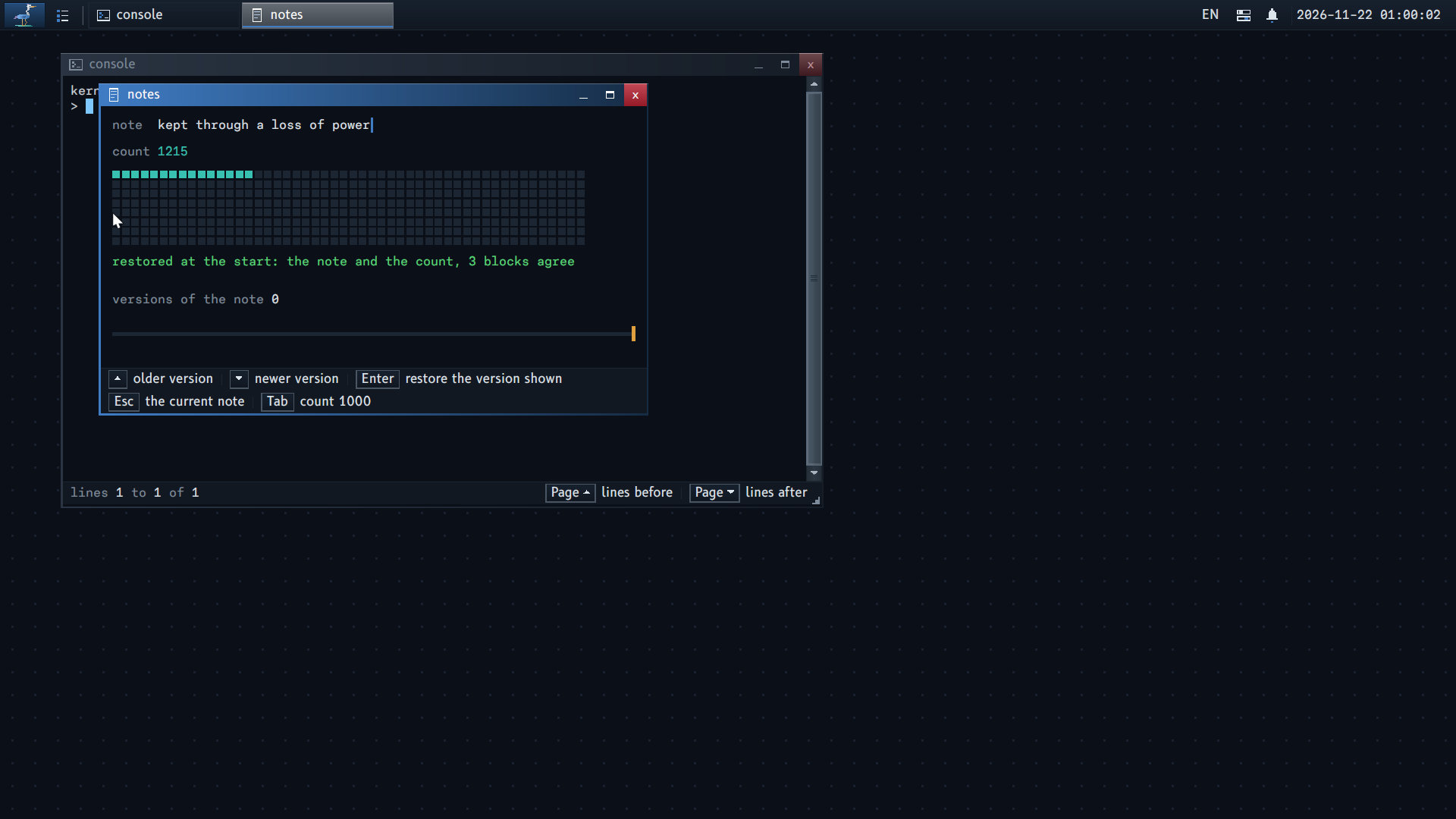
The block service: a virtio disk in a process, a ring, and the data in the memory of the client.Guide: StorageThe storage service: the private store of the console, its limit of blocks, the stores that the principal sees, and a grant that the principal revokes.Guide: StorageThe versions of an object: each commit keeps the state before it.Guide: StorageThe notes of a principal: the list of the notes by their first lines, and the text wrapped at the width of the window, kept with no save action.Guide: The design rulesThe versions of a note: the pane lists them by the date of their commits, the text shows the one chosen, and Enter restores it in a new commit.Guide: The design rulesA persistent process after a restart of the machine: the test process persistence_check finds its note and its count of 1000 commits in its private store.Guide: StorageA block of the note changed on the disk outside the storage service: the service serves the count, and persistence_check says that the note is damaged.Guide: StorageThe test process persistence_check after a stop in the middle of 1000 commits: the note and the count are restored, and the three blocks of the count agree.Guide: StorageAfter a loss of power during the write of a root: the storage service takes the root before it, and persistence_check finds its note and its count.Guide: Storage
The boot and the trusted boot
The boot display with the stages of the start, the rescue start policy, and the starts that the trusted boot refuses. 8 pictures.
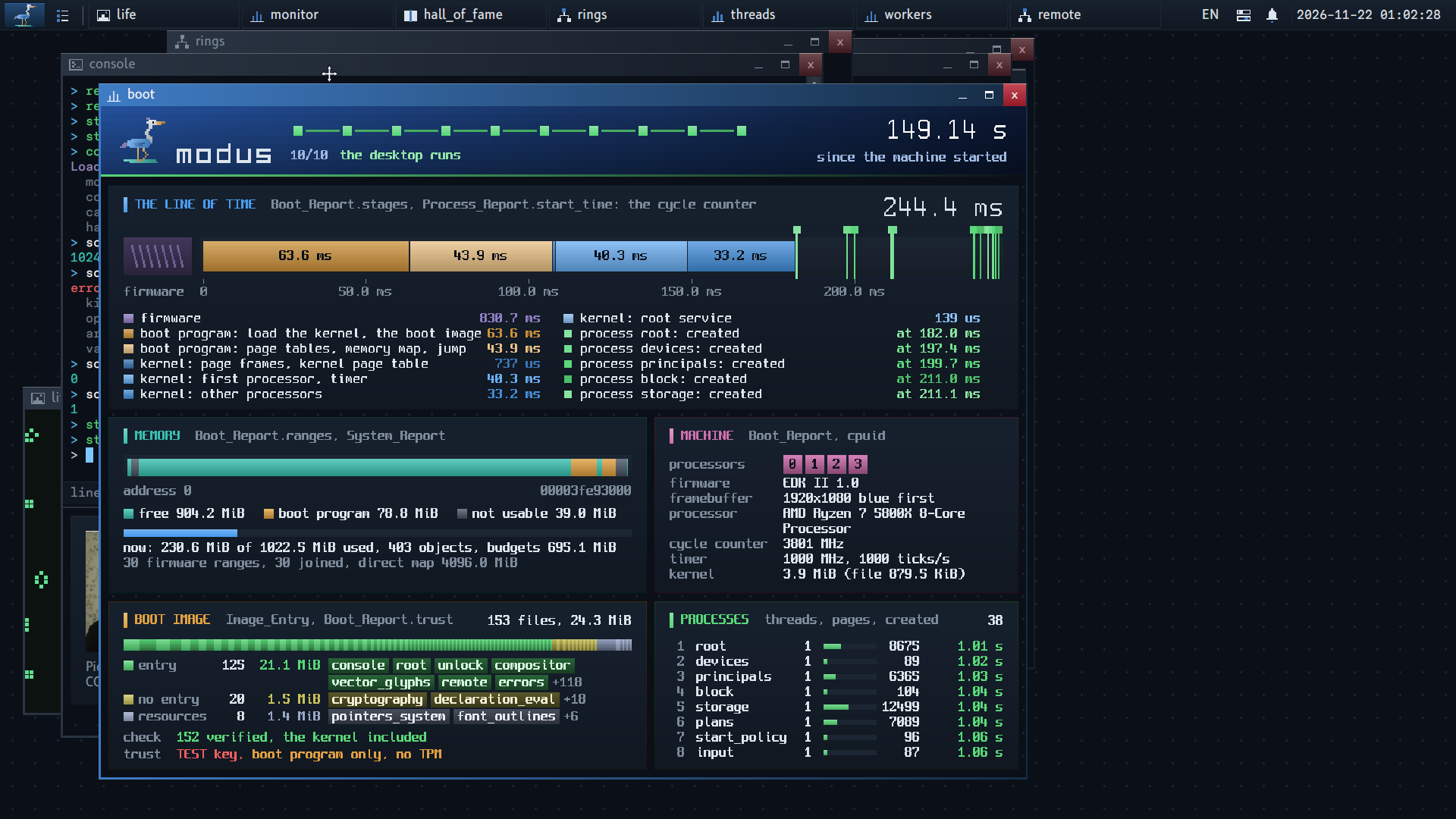
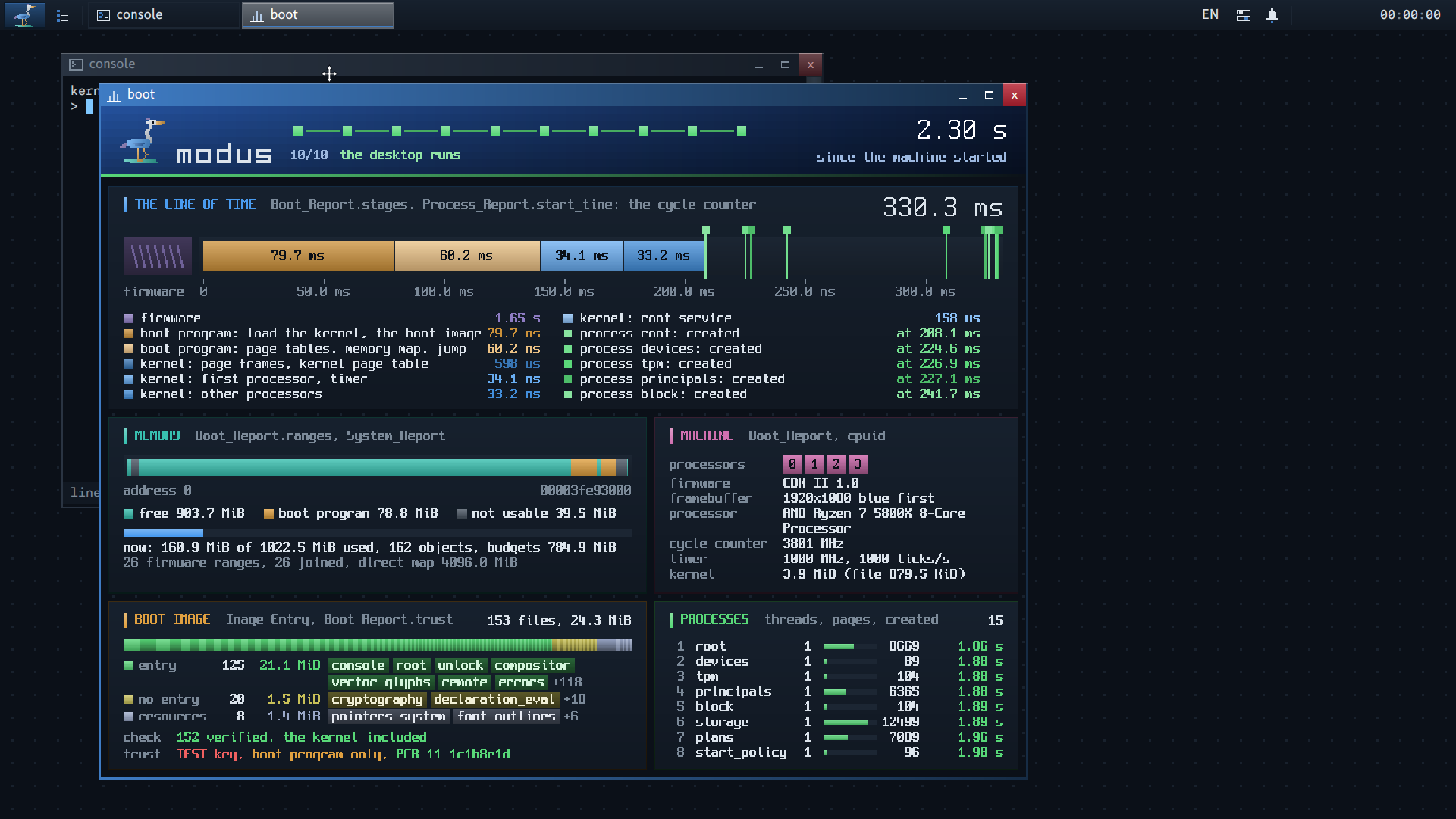
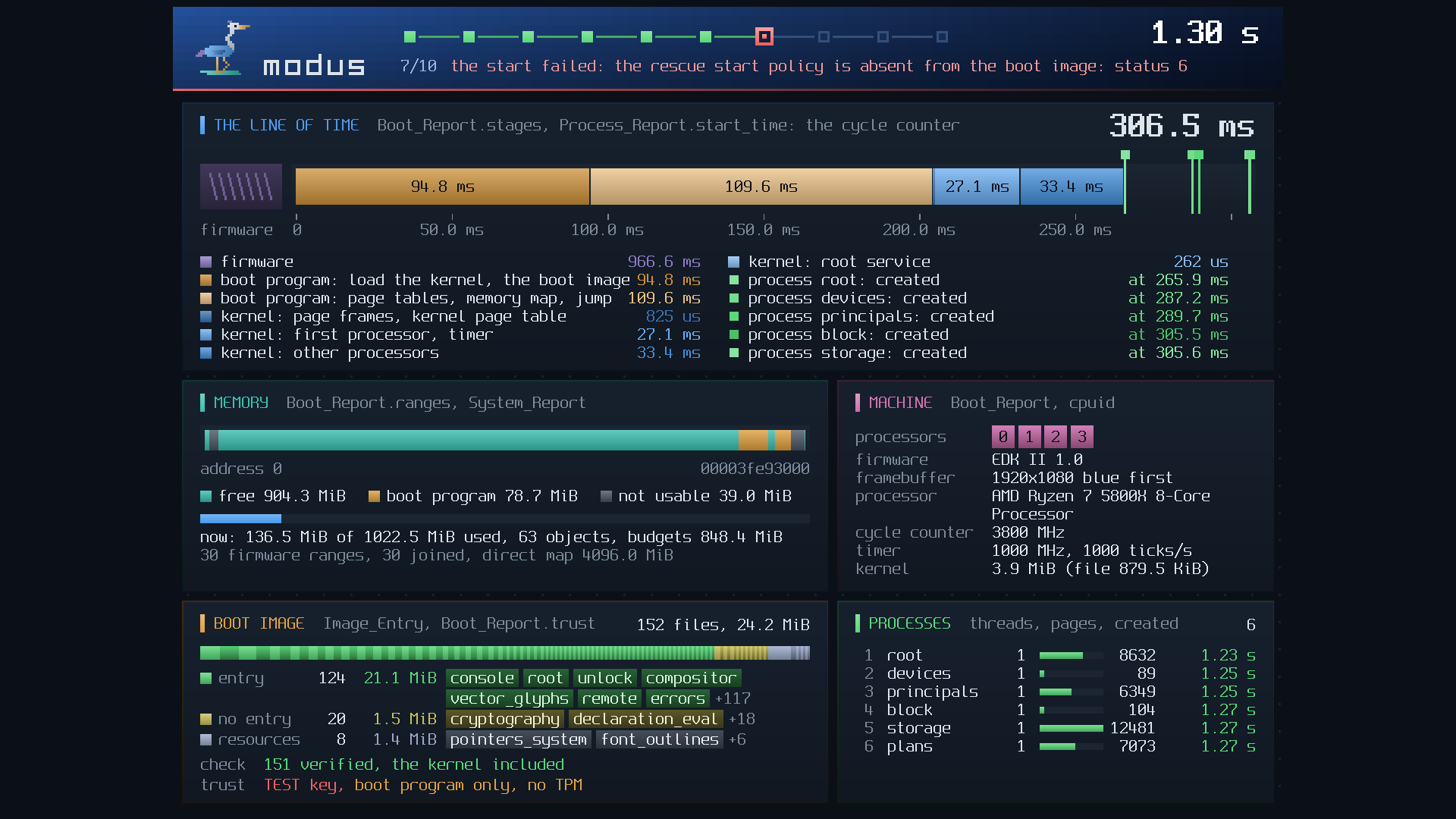
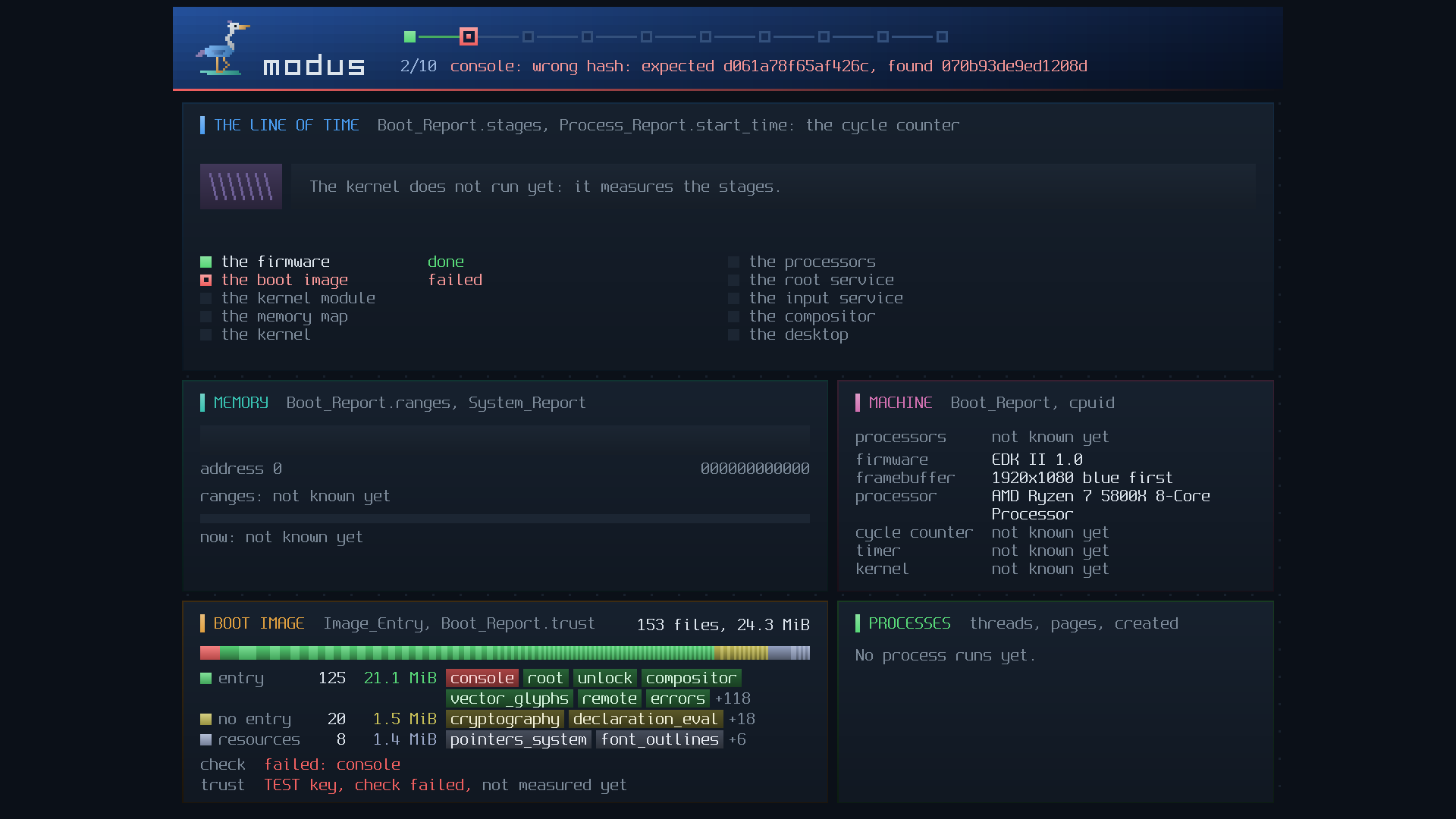
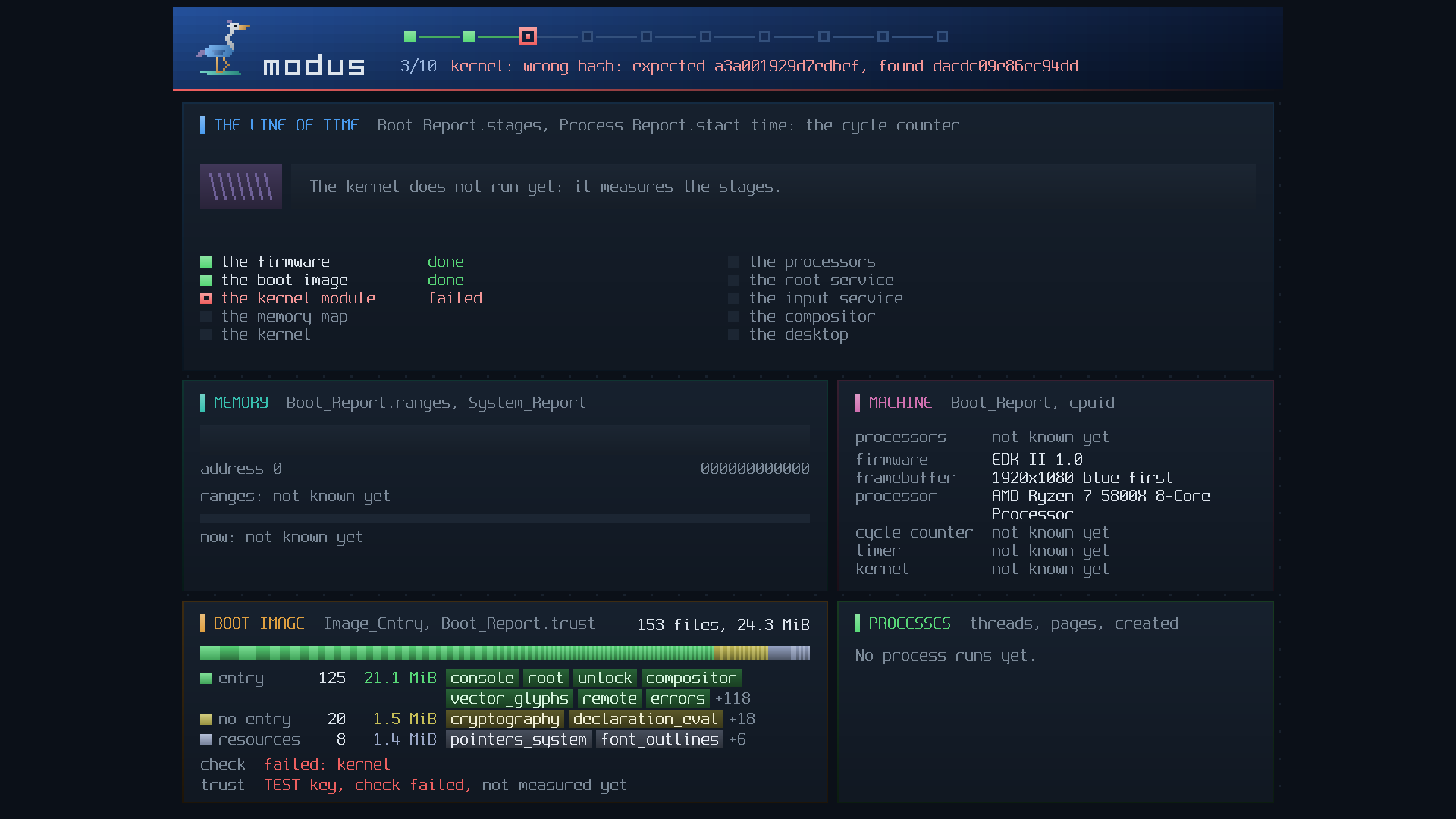
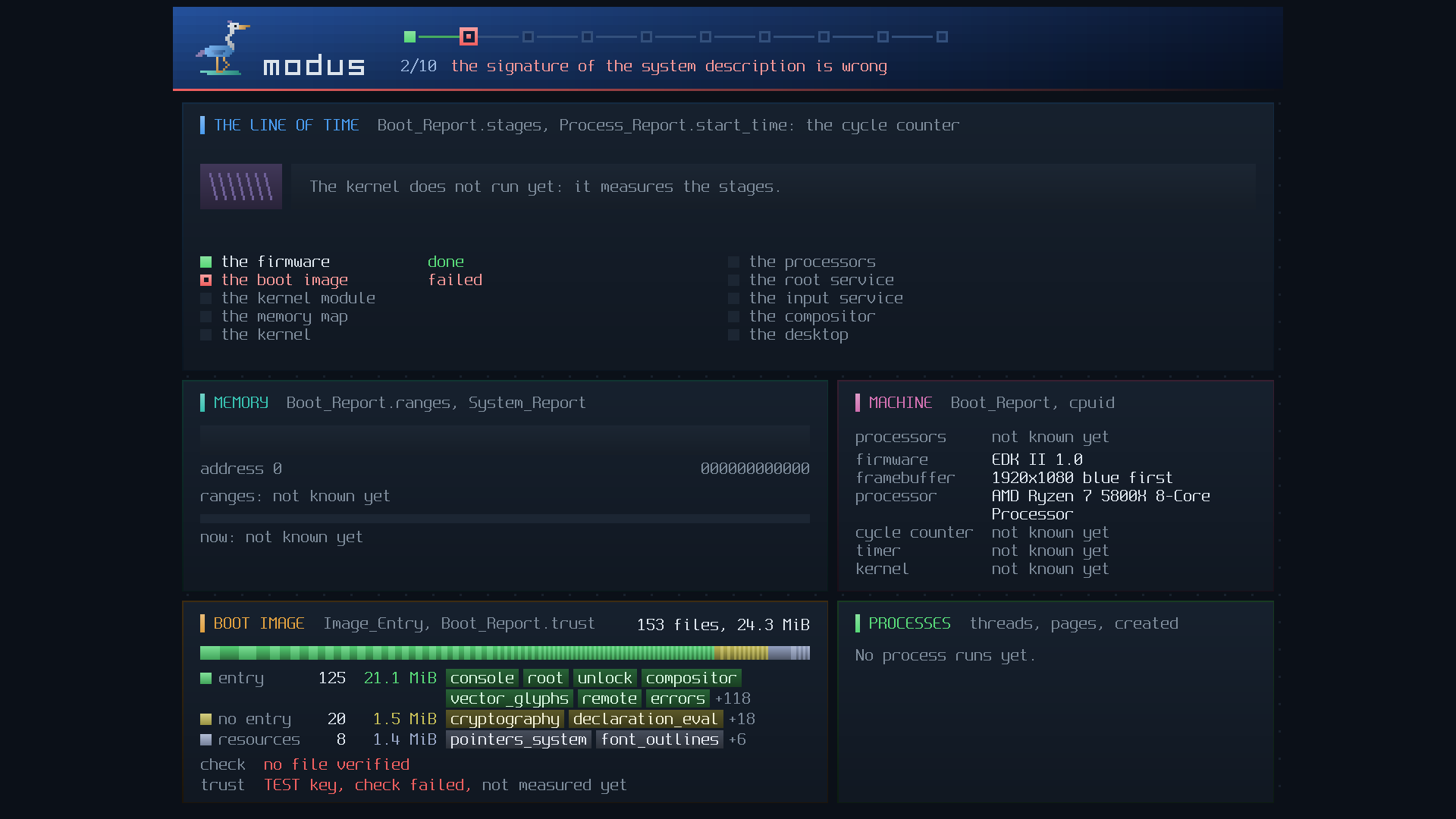
The boot display: the stages of the start on a line of time, the memory, the machine, the boot image, the processes.Guide: The design rulesA measured start: the card of the boot image names the test key and the value of the PCR 11 of the TPM.Guide: Trusted bootA start with Secure Boot: the firmware verified the boot program, then the boot program verified the system.Guide: Trusted bootThe rescue after the key R: the console lists its twelve processes, and monitor, started on demand, shows their pages and their share of the processor.Guide: Trusted bootA start that fails: the boot display stays, with the failure.Guide: Trusted bootA start that fails: the boot display names the changed file and its two hashes.Guide: Trusted bootA start that fails at the kernel module: its hash is not the hash that the system description expects.Guide: Trusted bootA start that fails at the boot image: the signature of the system description is wrong, and no file is verified.Guide: Trusted boot