What a reader can now see or use in modus, newest first: 193 entries. Each entry is one file of news/, written in the step that made the thing, and never moved or merged. The technical list of the changes of each release is on the page Releases.
Each entry has a kind, which its color shows: Shown, a new thing runs in the system; Measured, a number about a thing that exists, with its conditions; Decided, a choice that a reader sees, as a name, a mark or a font; Fixed, a thing that failed now works. An entry links to its release and to the guide that explains the thing.
The kinds: Shown a reader can now see or use a new thing; Measured a number about a thing that exists, with its conditions; Decided a choice of design that a reader sees; Fixed a thing that a reader saw fail now works.
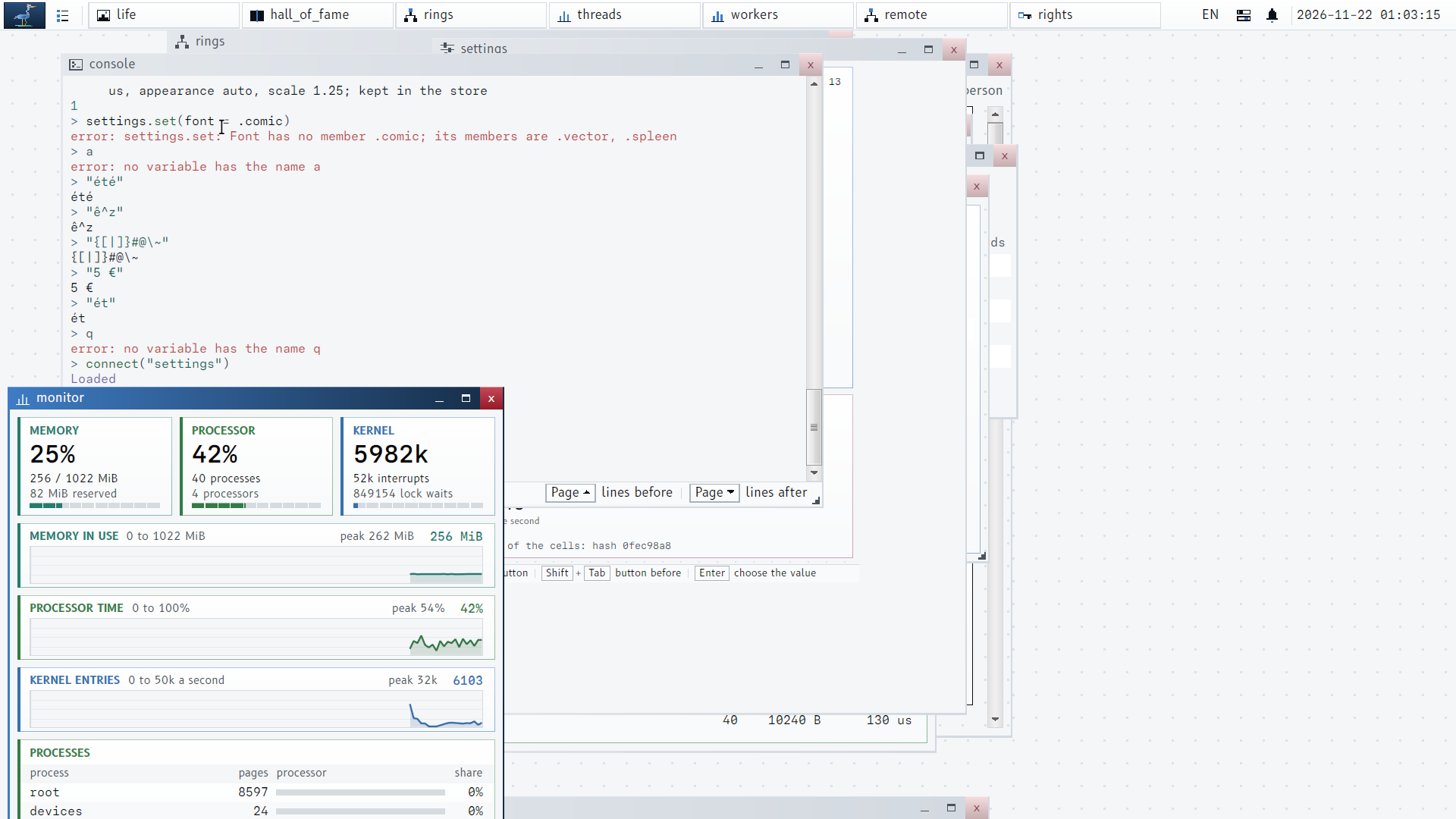
The principal sets the scale of the desktop to each eighth from 1 to 2: the track of the window of settings has nine stops, from 100 % to 200 %, and each stop changes the whole desktop at once.
At 1 a logical pixel is a pixel of the screen, 1920 x 1080. At 2 the logical screen is 960 x 540: a window taller than the work area keeps its title on the screen, and the principal moves it to see the rest.
The budget of each window counts its pictures at 2, so each window pays its surface at each scale. A window whose budget still cannot pay a scale shows its frame only until another scale, and the window of settings says how many do.
The tileAppearance of the Control Center now sets the next appearance: auto, dark, light.
The software processor of a page keeps decoded blocks
Measured - in the next release
A browser machineruns the x86-64 code of the processes on its software processor. It now keeps each run of instructions that it decoded as a decoded block, and runs it again with no fetch through the page tables and no decode of its prefixes. At each entry it compares the bytes of the block with the memory, so a block never runs code that a write changed.
In Node, with the same boot images, the processor time to the prompt of the console image fell from 4.6 s to 3.4 s, and to the first frame of the desktop image from 10.5 to 11.5 s to 8.6 s, over two runs each. The emulated vector forms are now about 40 % of the start of the console.
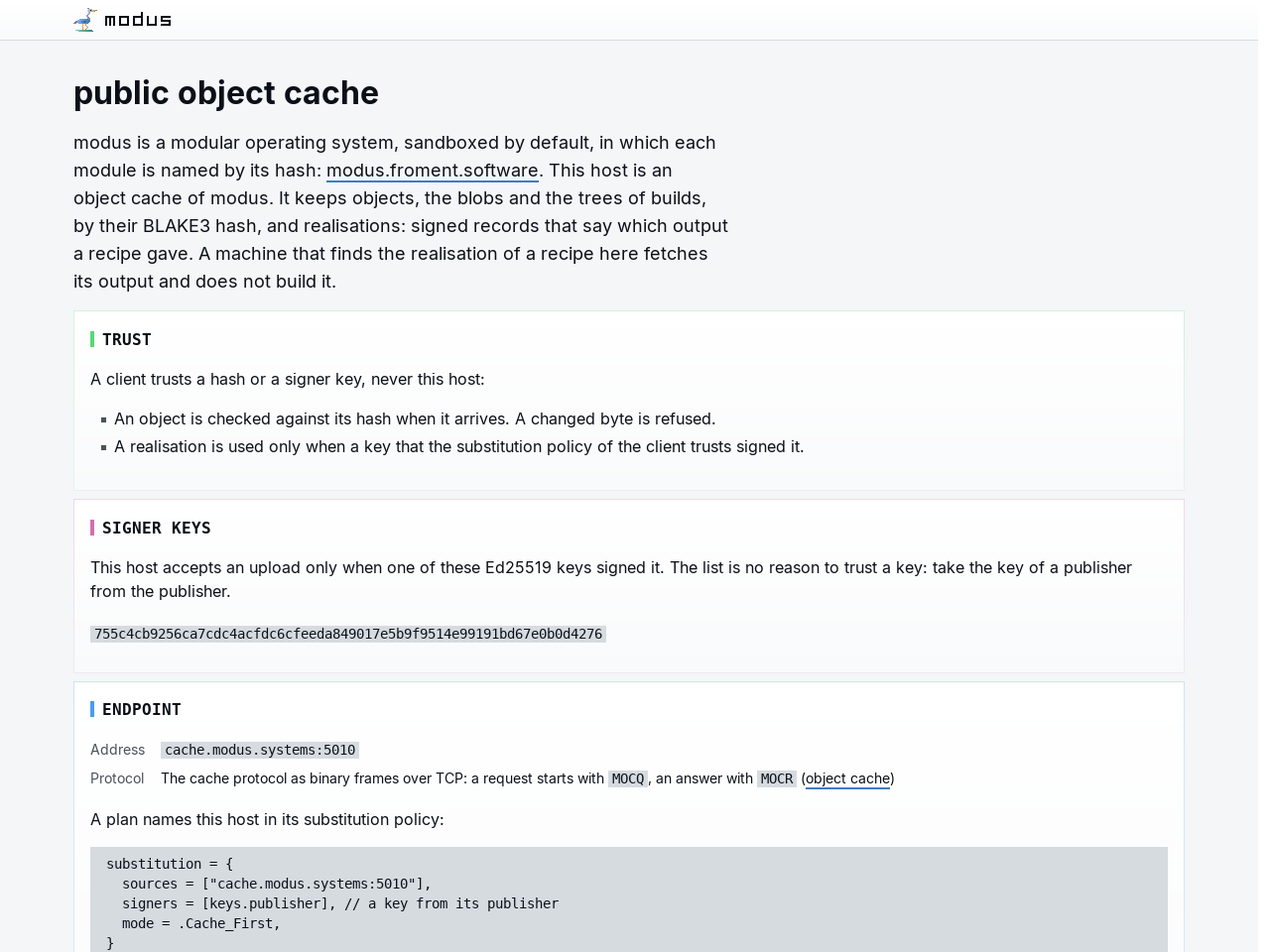
An object cache of modus now has a page. modustool cache-serve --status-listen serves it beside the cache protocol, in the look of the site, with status.json for a monitor.
The page says what the host keeps: objects by their BLAKE3 hash, and signed realisations of recipes. It says that a client trusts a hash or a signer key, never the host. It lists the signer keys that the host accepts, the endpoint and its protocol, the counts of the store, the free space of the disk and the last 10 realisations.
The server counts the store once at its start, then at each write, so a view of the page reads no file.
A recipe takes these two values as its inputs. A bare hash names no kind, so a recipe refuses it, and the evaluation says why.
The evaluation and the service recipes read a recipe with one conversion. So the hash of the recipe of a project is the hash under which recipes registers it.
The pointer of the host, and windows that fill the screen
Fixed - in the next release - the guide Architecture
The machine of modustool run has a virtio tablet, and the root service now gives it to the input service: the pointer of the system is where the pointer of the host is, and the window of QEMU no longer holds the pointer of the host.
The maximize button, a double press on a title bar and Control+Shift+Up give a window the screen less the bar, and ask its process for that size. While a window is maximized, its button shows two windows, the restore: a second press, or a drag of its title, gives back its place and its size.
Each corner of a window resizes it on the diagonal, the grip at the bottom right too.
A terminal has at most 192 columns and 54 rows: a maximized terminal on a screen of 1920 x 1080 fills its window.
Control+Shift+F7 moves the window in front with the arrow keys, 16 pixels at each key or 1 with Shift. Control+Shift+F8 resizes it the same way: an outline shows the new size, and Enter asks its process for it. Escape gives back the old place and the old size. The palette offers both as "move window" and "resize window".
Control+Shift+F10 gives the bar the focus of the keys. Left and Right go from the heron button to the button of the windows and to each window plate. Down opens a menu, Up and Down walk its lines, Enter starts the module or brings the window to the front, and Escape returns to the window.
The thing with the focus has an outline of 2 pixels in the strong text, outside it: a button, a field or a list of a window, an item of the bar, a window that the arrows hold. A host test computes its contrast on each surface: 7.3 to 1 at the least, in the dark and the light appearance and in both high contrast sets.
chibicc, the C compiler of modus, now compiles its own 14 C sources, and the assembler of modus makes one module of their texts.
modustool c-self-host builds chibicc with clang, which compiles the sources into stage 1. Stage 1 compiles the same sources again into stage 2. Stage 1 gives the same text as the build of clang for each source, and the two modules have one BLAKE3 hash: 354 972 bytes, on the host, in one run.
The assembler takes a program of several sources as one text: each source is a unit, and global joins the units.
The browser reads tables and keeps each origin apart
Shown - in the next release
The browser window now parses a page after the insertion modes of the WHATWG. Misnested tags such as <b><i>text</b>more</i> give the tree that other browsers give, a table with no row group or a stray text is repaired, and a page of 2000 nested elements stops at its bounds of 512 nodes and 64 open elements.
The CSS of a page can now use descendant and child selectors, borders, text-align and tables, with the specificity of the standard.
An address of HTTP or HTTPS now shows the request that the worker of its origin writes, with the cookies of that origin only. The window still has no network grant. The storage, the cookies, the form values and the style sheet of each origin cross a border of messages, and a request for the state of another origin is refused with no byte of it.
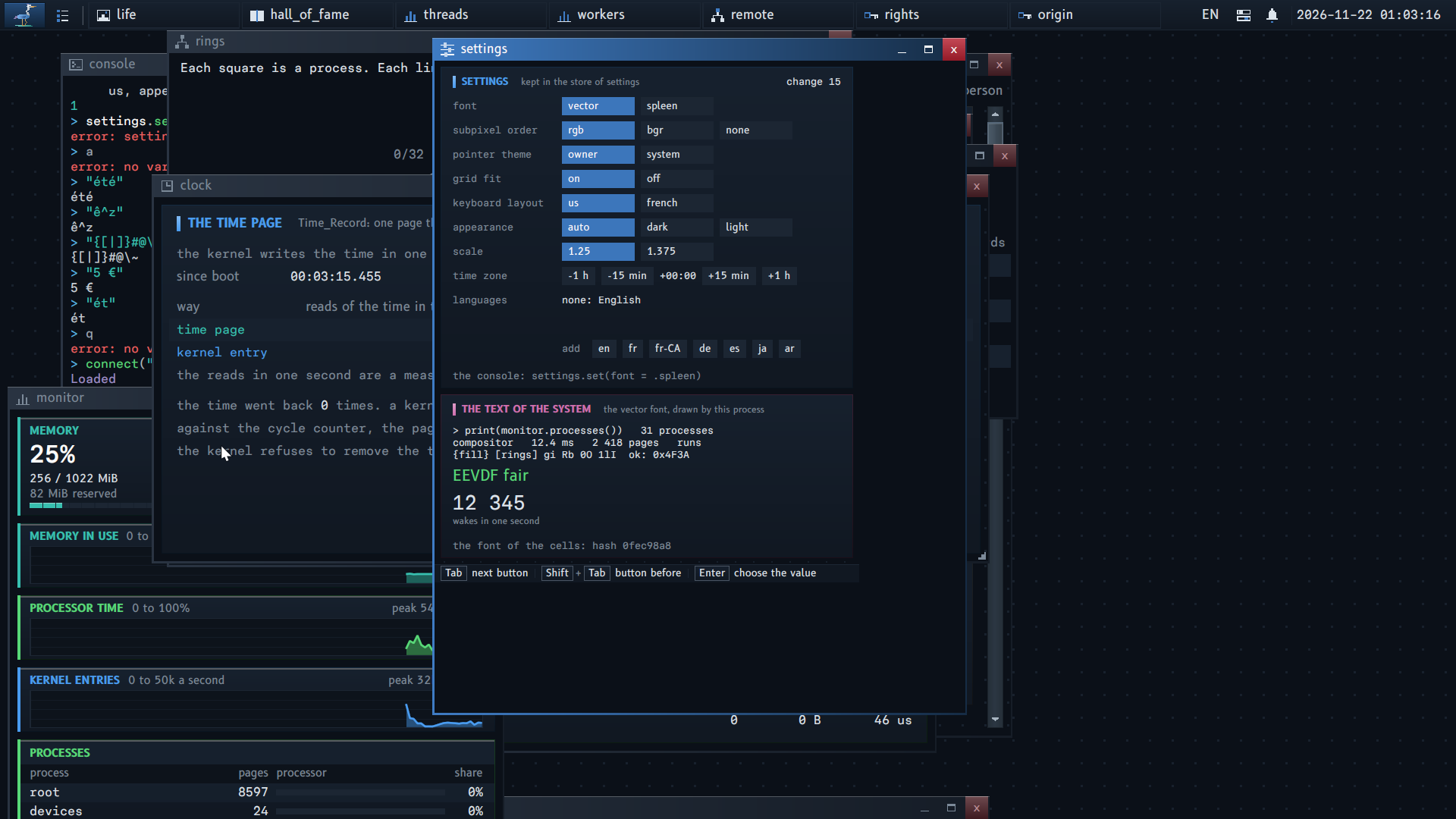
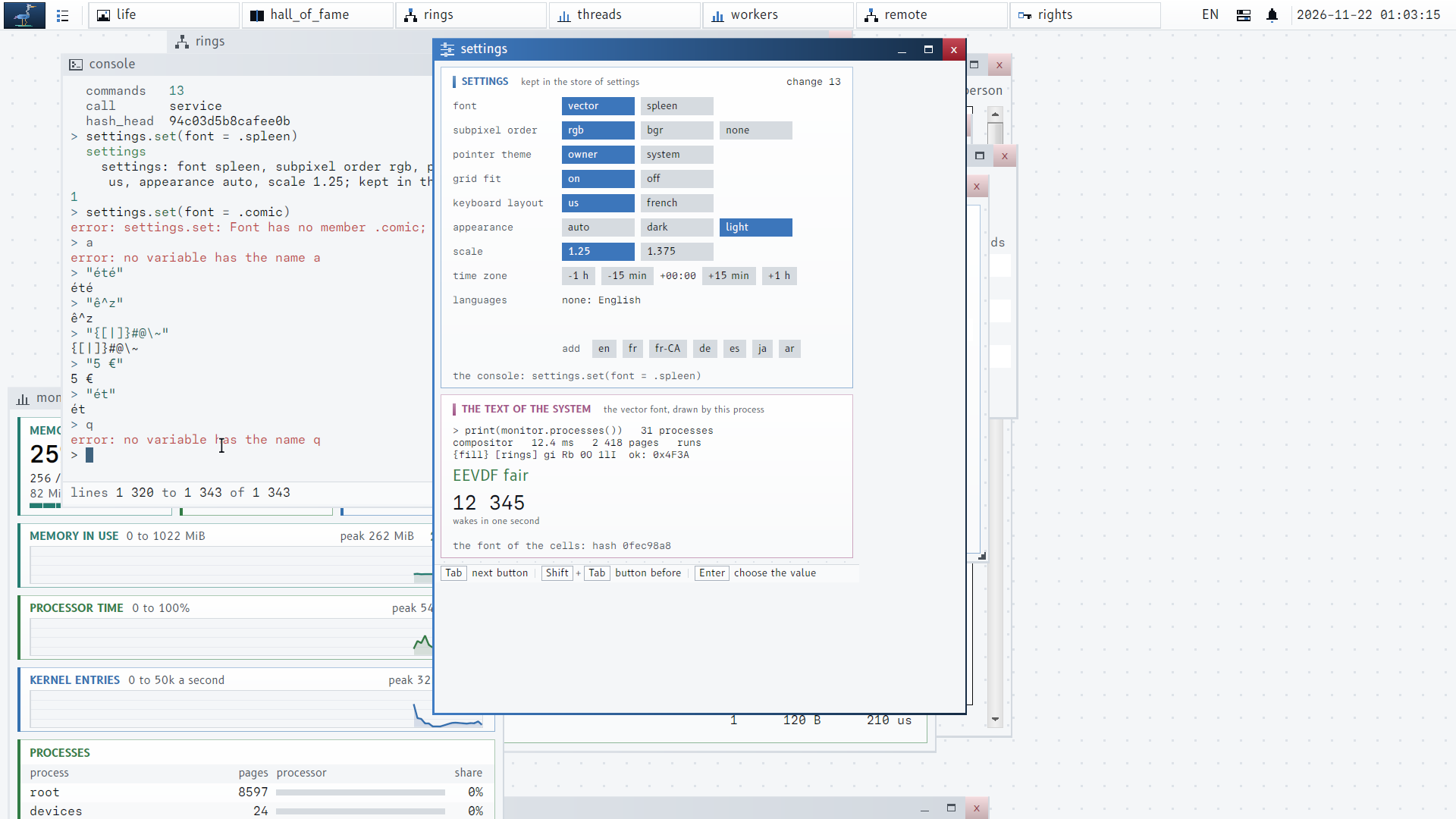
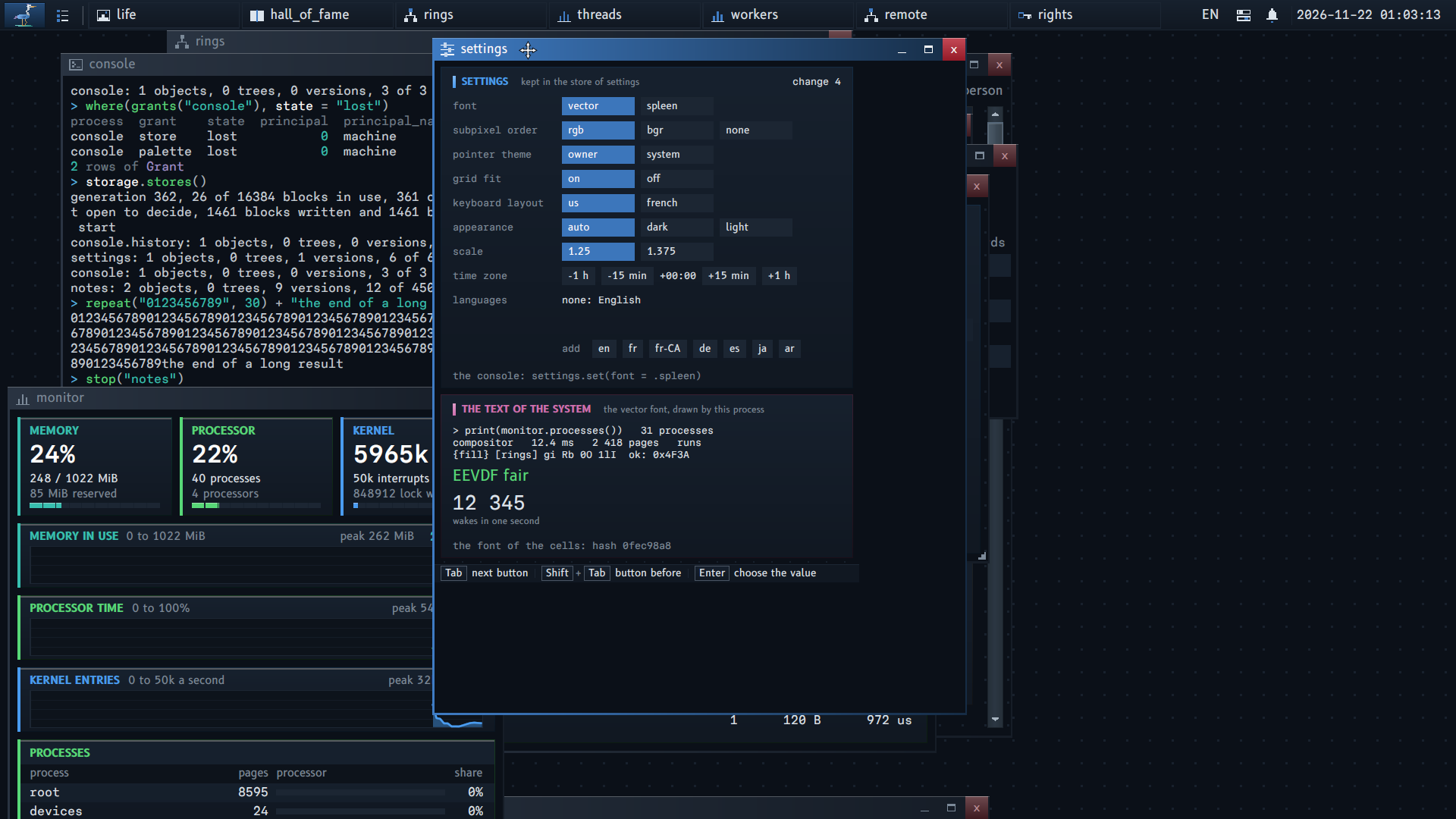
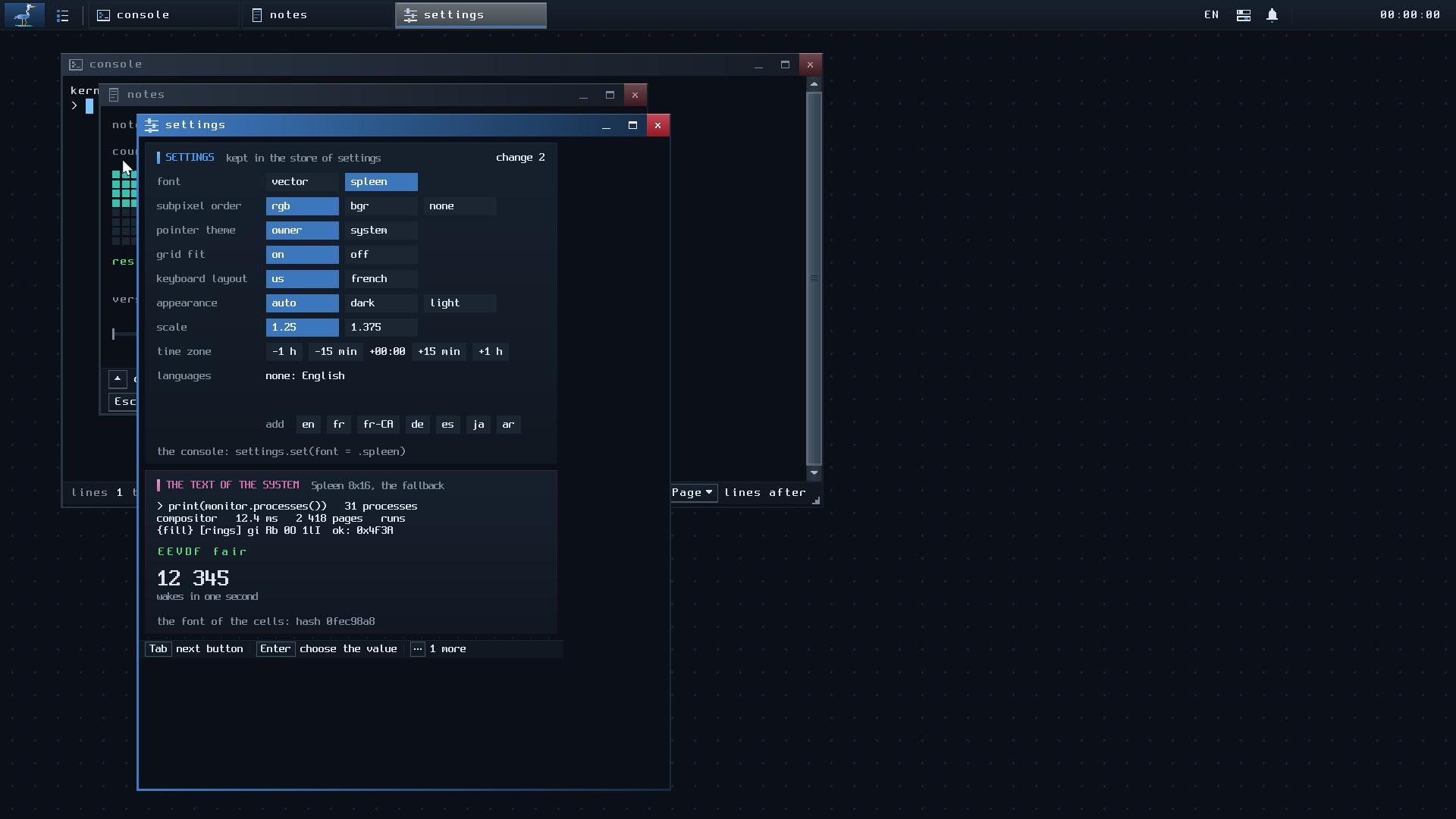
The window of settings shows four sections: Display, Pointer, Keyboard, and Region and language. Each setting has one line that says what it does, and the value in force is the marked button.
The scale is a track of seven stops, from 125 % to 200 %. The stops from 150 % are dim: they wait for windows that fit a smaller logical screen. A press on a stop changes the scale of the whole desktop at once.
The time zone is a list of the 38 offsets that the earth uses, each with places that keep it as their standard time. The languages are a list of names in their order, with Up and Remove.
The window resizes from 400 x 320 to 1024 x 800 logical pixels. Its sections take one column, or two from a width of 720, and a scroll bar moves them when they do not fit.
A press now reaches the element under the pointer at each scale: the window drew its frame with no scale, and at 1.25 a press on one button chose another.
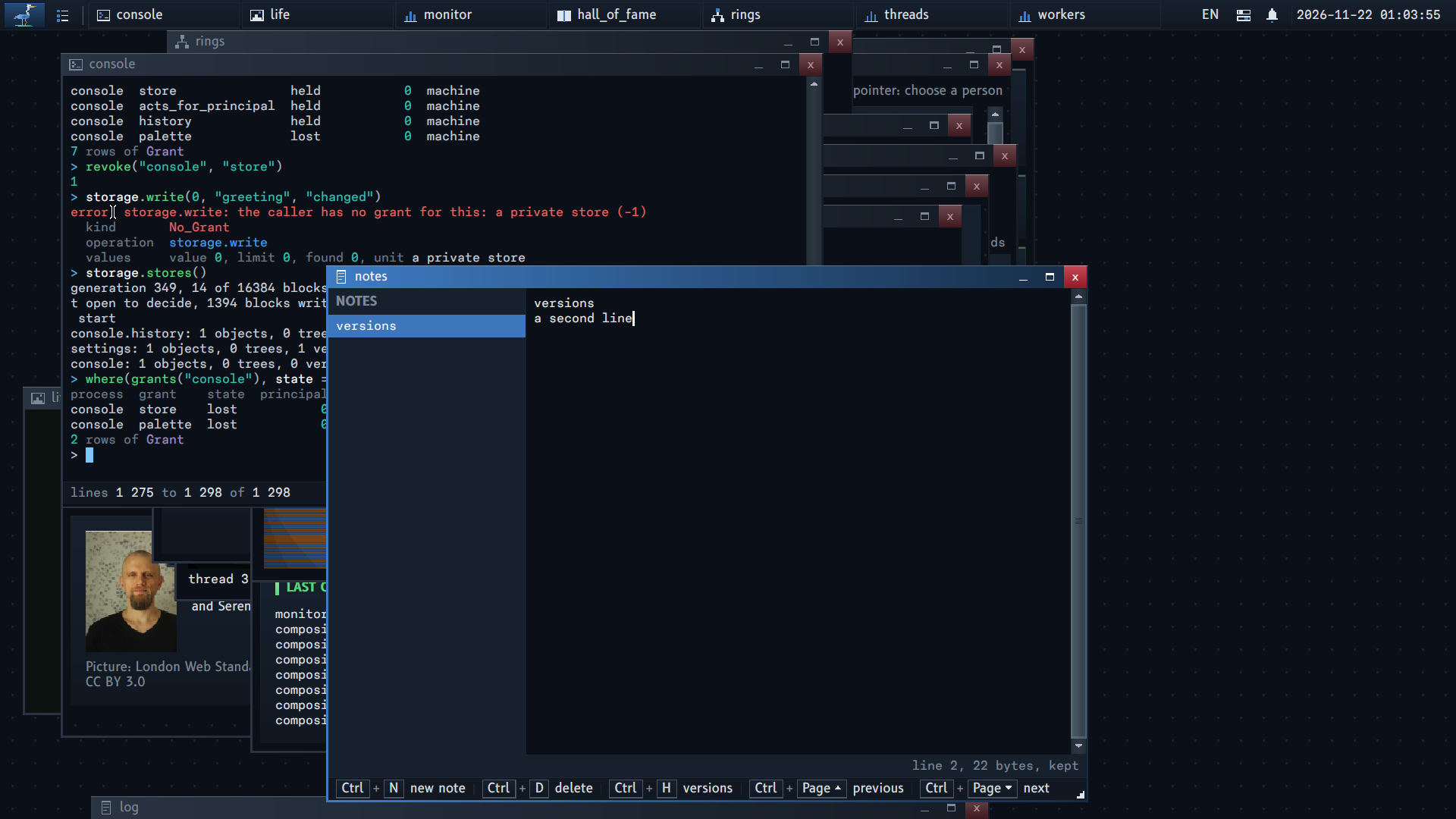
The program notes keeps the notes of a principal. The list at the left names each note by its first line. The text has the keys of the editor, the selection and the clipboard, and wraps by word at the width of the window.
There is no save action. A change is one commit when the keys pause for one second, or when another note is shown. A sentence is one version, not one version for each key.
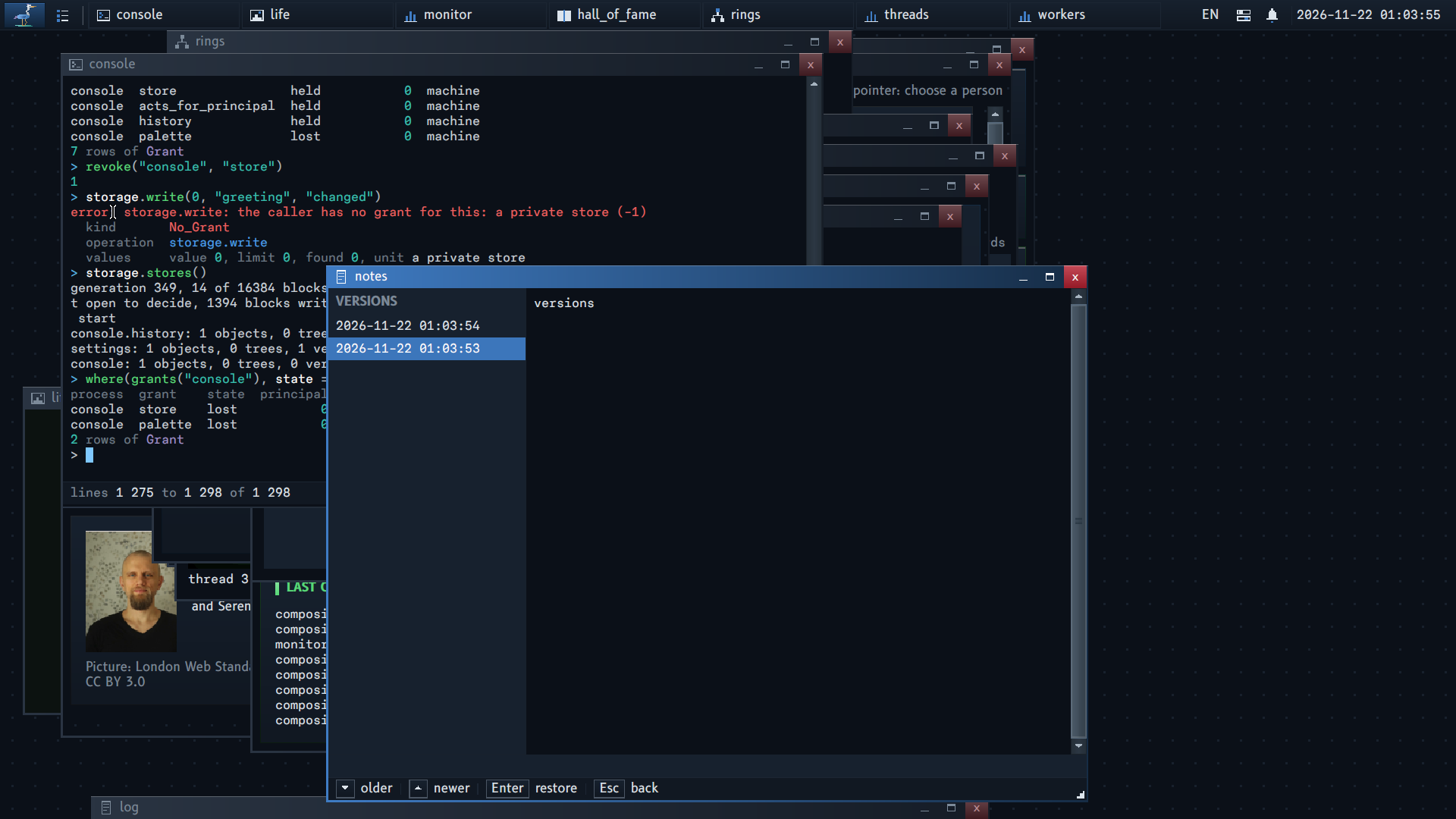
Ctrl+H lists the versions of a note by the date of each commit. Down shows an older one, and Enter makes it the note again in a new commit: the note before it stays a version.
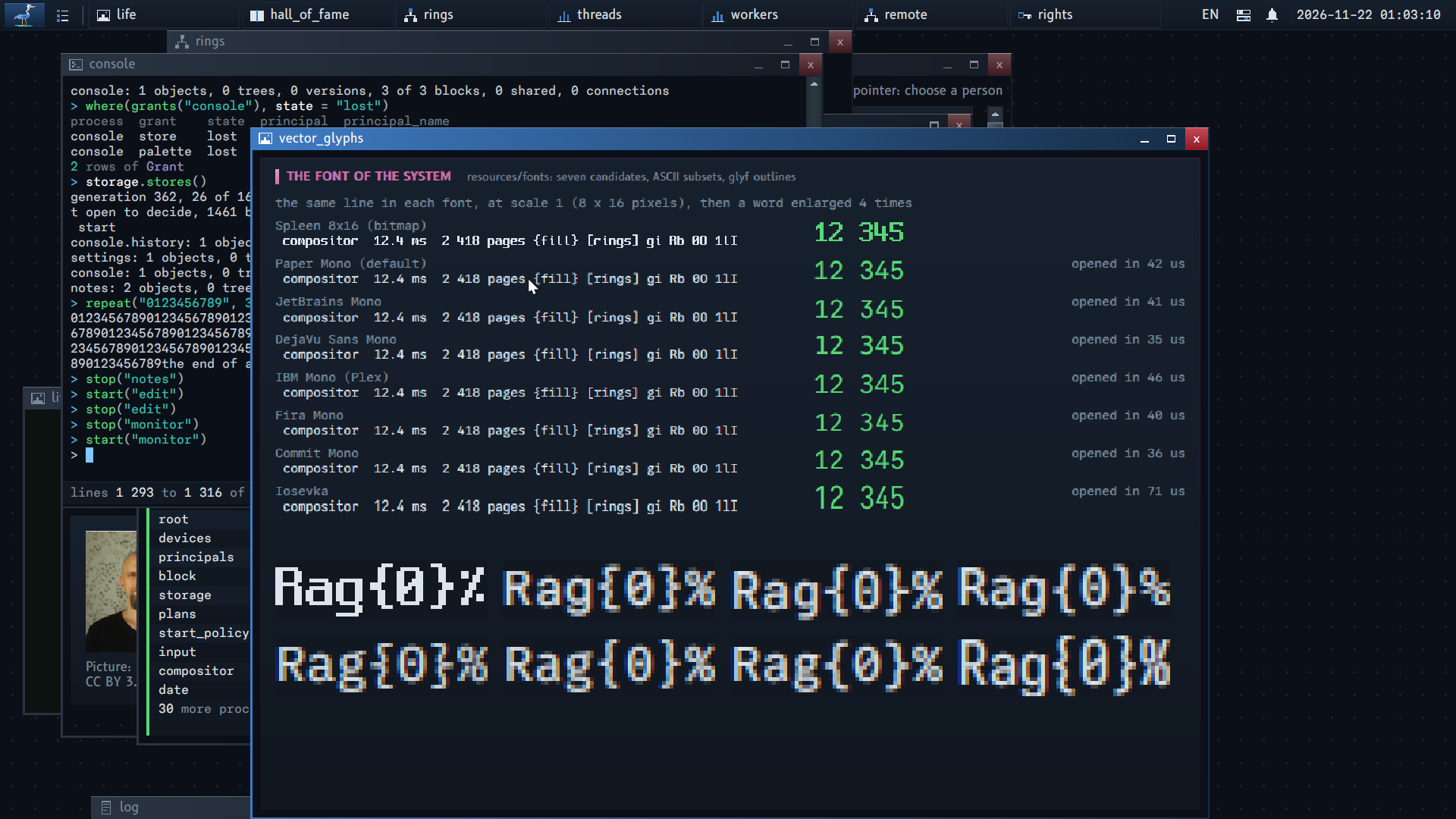
Each window and each cell of a terminal now draws every Greek letter, the 96 basic Cyrillic letters (U+0400 to U+045F) and the 128 letters of Latin Extended-A (U+0100 to U+017F). So a principal writes Greek, Russian, Polish or Czech in a label, a title or the console.
The letters come from Noto Sans, the last font of each fallback chain. A letter that B612 or Paper Mono has keeps its glyph; Noto Sans gives only the others, such as Π, ρ, Ж and Ł. The process draws each one itself, at its first use, as it draws each other glyph past the 192 characters.
The subset of Noto Sans holds 465 characters in 87 172 bytes of the boot image.
The assembler of modus now takes the scalar SSE2 instructions that chibicc writes for float and double, the atomic xchg and lock cmpxchg, and the numeric local labels1:, 1f and 1b. Each new form gives the bytes that llvm-mc gives for the same line.
A global table of functions or of strings is now a quad of each address. The module records a rebase there, and the loader adds the base of the load.
So compile and assembleturn C with float, double, alloca, the atomic builtins and calls through a table of functions into a module that runs. A floating constant such as 1.5 and long double are still refused, with their line and their column.
compile now takes floating constants in C: 3.141592653589793, .5, 2.5E+10, 1e-6, the hexadecimal 0x1.8p+1, and 1.5f for a float.
The strtold of the thin libc gives each constant the nearest double, with integer arithmetic only. A host test compares its bits, its end and its errno with the strtod of glibc for 1 874 412 texts, with no difference.
compile and assemble also take a source of up to 256 KiB, in place of 64 KiB.
Alt+Tab opens a card of the windows in the middle of the screen, the one used last first, and chooses the window used before the one in front. Each Tab chooses the next one, and Alt+Shift+Tab goes backward. The release of Alt brings the chosen window to the front. Escape closes the card, and no key reaches a window while it is open.
The plates of the bar now keep the order in which the windows opened. A press on the plate of the window in front minimizes it; a press on another plate brings its window to the front. The right button on a plate opens the menu of its window.
start("browser") opens a window with back, forward, an address field and the document origin of the page. Its four pages, modus://welcome, modus://properties, modus://guide and modus://forms, are HTML and CSS. The contract package html_css parses each page into at most 512 nodes, applies its style rules, lays out block, inline and flex boxes, and paints them into the draw table of the window.
A press on a link loads its page, and back and forward keep the scroll of each page. The form sends its fields in the query of its action, and the answer shows them. The origin modus://forms keeps the last query; a page of modus://welcome asks for it and is refused.
The window has no grant but its window. An address of HTTP or HTTPS shows a page that says so: each origin will get its own process with its own network grant.
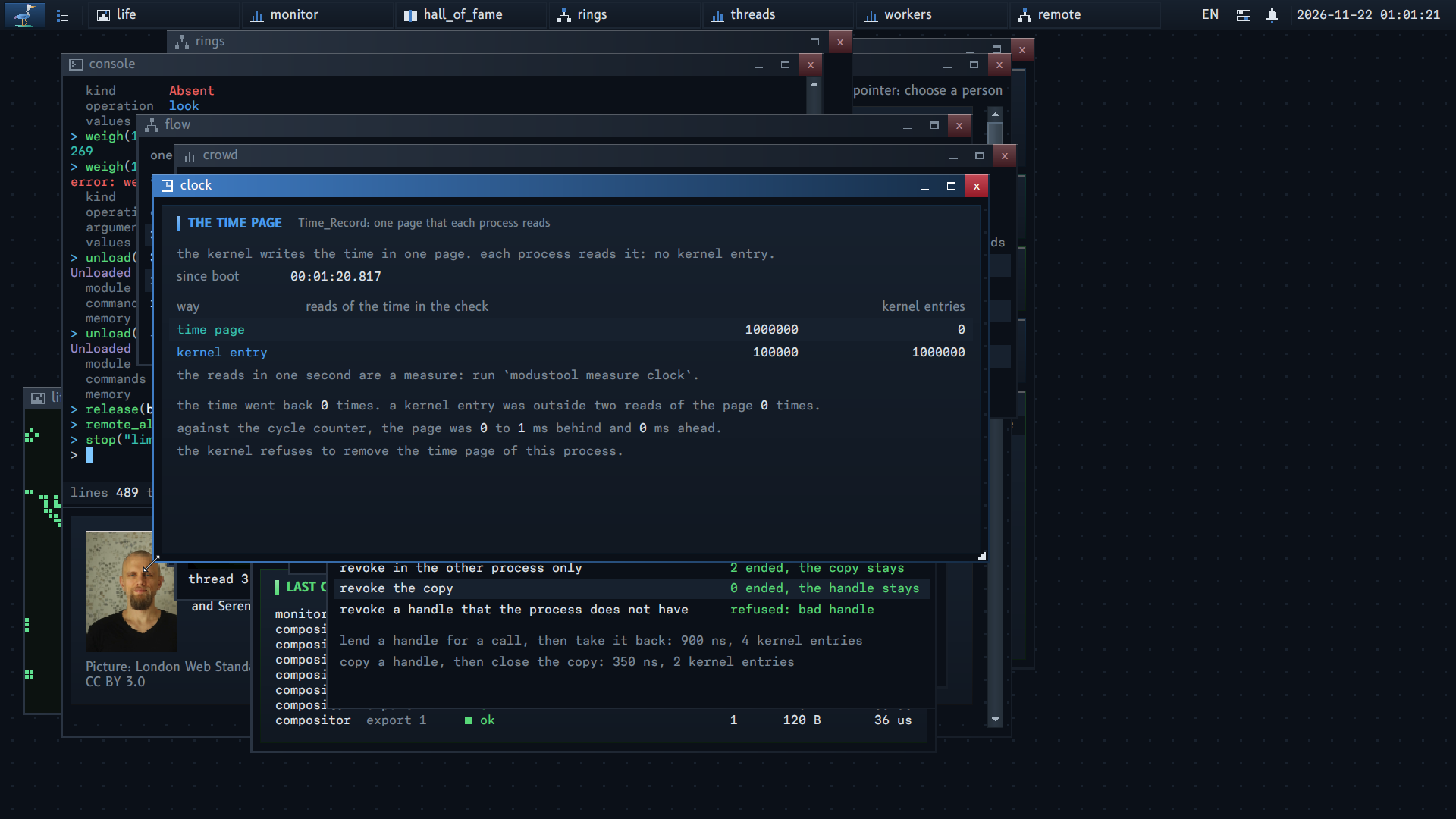
The window clock is a clock now. Its first section shows the local time in large digits, the date with the time zone of the settings, and the calendar of the month, with today in blue; Page Up and Page Down change the month. The second section is a stopwatch with laps, the third a countdown timer from 1 second to 99 hours. At the end of the timer the window shows 00:00 in the warning color, and the process asks the compositor for a desktop notification. The checks and the measures of the time page, which the window showed before, are the demonstration time_page.
paint is a paint program now: a brush, an eraser, a line, a rectangle, an ellipse and a fill, eight sizes from 1 to 34 pixels, 16 colors and any other color by its red, green and blue. Ctrl+Z undoes a change and Ctrl+Shift+Z does it again, up to 64 changes. There is no save: the private store keeps the open picture after each pause of a second, as the changed rows, and Ctrl+O lists, opens, names and deletes the pictures. The window is resizable, and a smaller window keeps the part of the picture that it does not show. The status line says the tool, the size, the color and the place of the pointer.
A line of the console now writes a function: (x) => x *2. A let names it, and a call by that name runs it: let double = (x) => x * 2 in area({x = 0, y = 0, width = double(3), height = 4}) gives 24.
A list is [1,2,3], and map([1,2,3], (x) => x *2) gives [2,4,6]. With the pipe operator: [1,2] |>map((w) =>area({x =0, y =0, width = w, height =5})) gives [5,10].
A line can end with a comment: map([1, 2, 3], (x) => x * 2) // doubles runs the call, and the console draws the comment in its own color.
A function stays in its line. No module takes one and no variable keeps one, because its body reads the values of the line around it. Lex has no condition yet, so a function that calls itself never ends: the line stops when the evaluator has taken 512 KiB of stack, and says so.
The start list wires a stream between two of its rows
Shown - in the next release - the guide Architecture
The list that starts the machine now joins processes as well as starting them. Besides its start rows, it holds wiring rows: each joins a record output of one row to a record input of an earlier row. The start policy gives the wiring with the start of the writer, so the ring exists before the writer runs, and the reader reads every record from the first one.
The default list wires a demonstration pair at each start: wired_writer writes 16 numbers and their squares, and wired_reader reads them from the serial 0, in order, then the end. The build checks each row against the module files of its two rows: a stream that the writer does not declare, two records that differ, and a reader that starts after its writer are refused before an image is written.
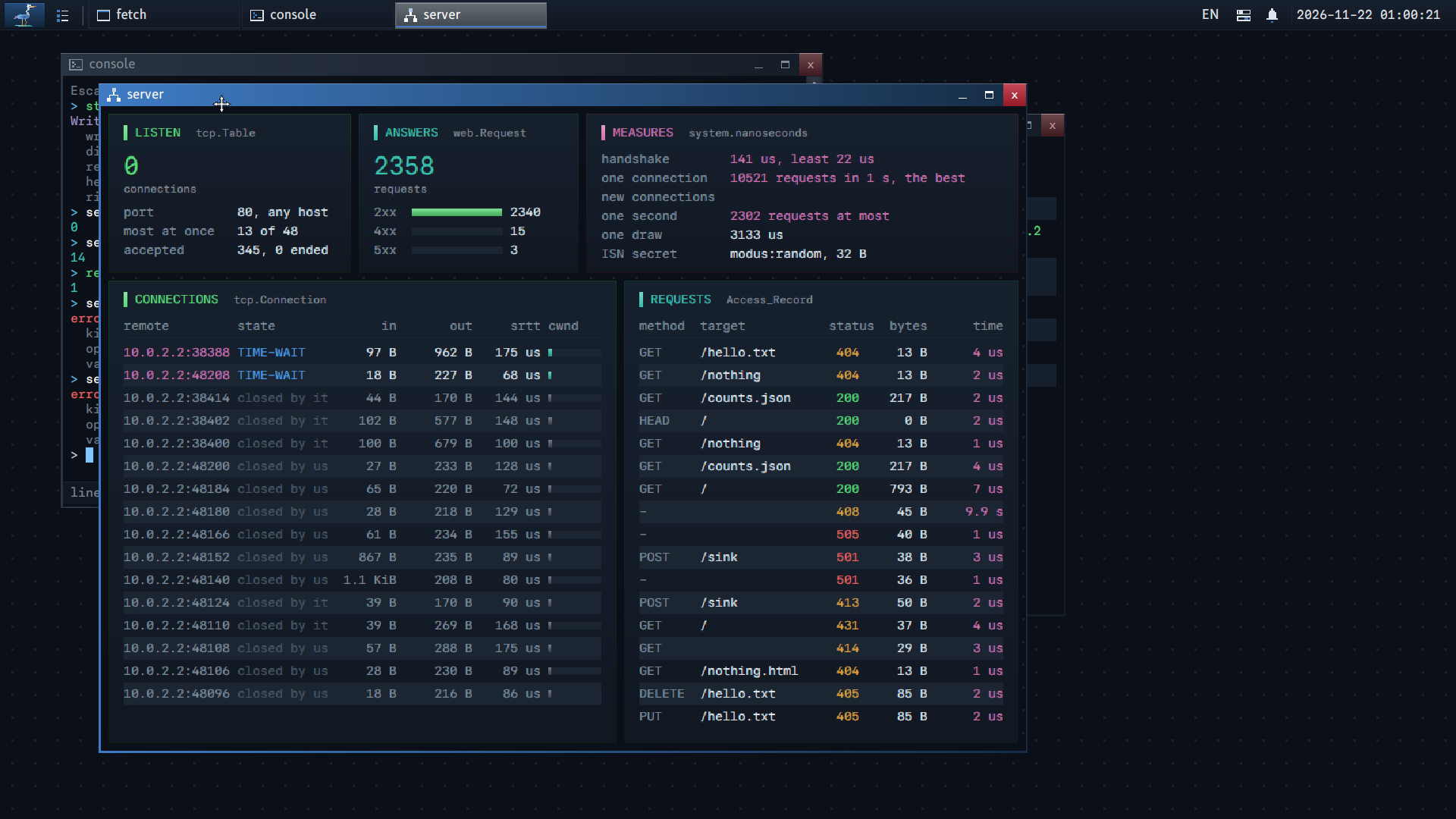
server, the web server of the system, now gives the record of each request that it answers to a reader, in place of a line of its log. The console reads them by name: after connect("server"), server.requests|>where(status =404) |> first(5) gives the next five requests that found no page, each with its status, its size, its time, its method, its target and its host.
The log kept at most 100 of these lines in each second, and dropped the rest. A reader of server.requests loses none in silence: its first row says how many requests came before it joined, and a reader too slow for the server gets a row that says how many records it missed.
A reader chooses how it slows the server. A reader for an audit holds the server until it has read; any other reader never holds it. With one reader of each kind and one fast reader on one server, a test checks the counts exactly: the reader that holds lost nothing and held the server twice, the other missed one whole ring of 32 records and was told so, and the fast reader got all 80 records in order.
The log of the kernel keeps a fixed count of records for each process in each second, and drops the rest: it is for diagnostics. A starter that must keep every line of a child, for an audit, now wires the record output log of that child when it starts it. Each record also goes to the ring of that reader, and the child waits when the ring is full, so the reader loses none. In the test, the kernel log keeps none of the 602 log calls of a child whose budget is zero, and its starter reads all 605 records in order.
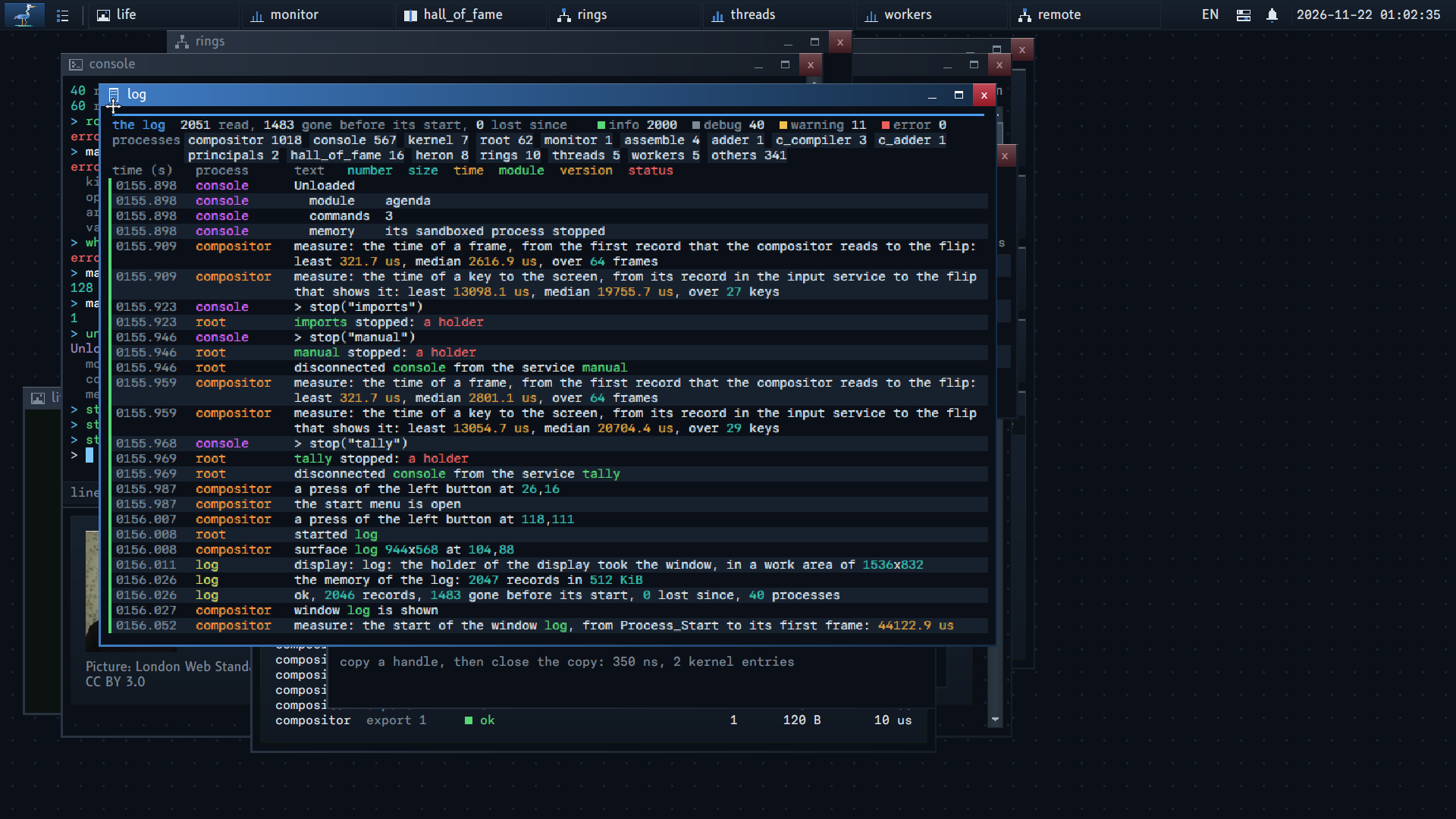
The log service gives a second stream, log.follow: each record of the whole log as it comes, to a reader that acts for the principal. The service never waits for a slow follower. If the kernel writes over records before the service passes them on, the follower reads one row that says how many it missed.
modus is an operating system with a small kernel, in which each program is a module named by the hash of its file.
Until now the build tool wrote each module file on another machine. The module assemble now writes one in modus. It reads x86-64 assembly, in the syntax that C compilers emit, and a line export add(a: Integer, b: Integer) -> Integer that gives the types of an export. A text that it does not take whole is refused, with its line and its column.
In the console, assemble("…", f) writes the file into a memory object, and isolate_memory("adder", f, n) runs that module in a sandboxed process with no handle of the console. add(2,3) then gives 5.
The assembler is the first native stage of the bootstrap: the stage after it, a C compiler, emits the assembly that it reads.
modus is an operating system with a small kernel, in which each program keeps its state in a private store with versions, and has no save action.
start("edit") opens the editor of a text. It has no modes: a character goes in at the caret, Shift with an arrow selects, and the pointer places the caret and selects with a drag. A line longer than the window goes on more rows, and a gutter numbers the lines.
The editor writes the text to its store after each word, each line end, and each move to another line. Each write is a version of the object. Ctrl+Z restores the version before from the store, so it also works after a restart of the machine, and Ctrl+Y goes forward again.
A text holds at most 32768 bytes. Copy and paste, the search and the edit of another text come next.
modus is an operating system with a small kernel, in which each window is a process that describes its frame as a table of draw records.
Until now the desktop of the screen of 1920 × 1080 drew one pixel of the screen for each pixel of a layout, so its text was small. It now draws at a scale of 1.25 by default: the windows, the bar, the menus, the palette, the text and the pointer are a quarter larger, on a layout of 1536 × 864. The row scale of the settings window sets 1.375.
A process still places in logical pixels and never computes a pixel of the screen. The drawing module turns each place into the screen, with each edge rounded to the nearest pixel, so two boxes that share an edge meet with no gap. In a window built from the elements of the interface, each glyph is drawn at its size on the screen, not stretched. A few windows still draw their pixels by hand, as the log: they show a picture of their layout, whose text is less sharp until they move to the elements.
The scales from 1.5 to 2 come when every window fits their smaller layout.
A line of the console now writes a record by its fields, in any order: area({x =0, y =0, width =11, height =3}) gives 33. The record has no type of its own: the parameter of area gives it, so a field with a wrong name, such as widht, is refused with the fields of the record before the call runs.
A call gives a parameter by its name: grow(r, by =2). r with {width = 10} is the record r with one field changed. let s = {x = 0, y = 0, width = 6, height = 7} in area(s) + area(s) names a value for one line and computes it once.
After |>, the placeholder_ puts the value on the left in another place of the call: 3|>grow(r, _) is grow(r,3).
These are the forms of Lex, the language of the console, that the declarations of a system will use.
A process that writes records while it works declares a record output: a stream of records of one type, which the root service gives to a reader through a ring that loses no record. The console now reads one by its name: output_counter.counts is a value of the kind Stream, whose fields the console knows from the module file of the process.
output_counter.counts|>where(status =404) |> first(3) reads records until three of them pass the condition, then closes the record stream and draws a table. A record stream at the end of a line draws each row as it comes, in columns as wide as their fields can be, and Escape ends it at once.
No text crosses between the two processes: the console checks each record against its record description, and a name that the process does not declare fails the line before anything is wired.
merge joins several streams of records into one, and filter keeps the records of a stream that pass one condition. Neither declares a record of its own: the first stream wired to it fixes its record, and the system refuses a later stream of another record before any record moves.
An export of a module can now take a value of a closed set: an enum, whose members the module file names.
The console completes the members after a dot and refuses a name that the enum does not have, before the call: settings.set(keyboard_layout = .french).
The palette reads the same description. It shows one row of buttons for each such parameter, and marks the member in use, which it asks of the getter that the parameter names.
The settings are the first user: one optional argument for each setting, and one getter for each, settings.font().
modus is an operating system with a small kernel, in which each program draws its window into memory of its own, and the compositor shows it.
The elements of a window now take the text sizes of the design rules. The caption of a card is at 14 pixels, on the baseline of its title. The one number of a card is at 32 pixels, and what it counts is a caption under it. Each page of the manual has its title at 24 pixels over its text, and the title stays when the text moves. The result of the palette stays at 48 pixels, and each other text at 16.
The card "THE TEXT OF THE SYSTEM" of the window settings shows each size, one under the other. A caption keeps a contrast of 4.5 to 1 on a card in the dark and in the light appearance.
modus is an operating system with a small kernel. A program writes a line of its log as a log fact: a record of fields with no text, which a reader writes as a sentence from the module file of the program.
The serial port writes a fact as bytes: #1a2b3c4d:fa0adf 0cm1a23h1a2b. The first part names the module by the first 4 bytes of its hash, the second the fact type by the first 3 bytes of its key. A value byte is two hexadecimal digits, and a run of zero bytes is one letter, from g for 1 byte to z for 20: m is the 7 zero bytes of the number 12 in a field of 8 bytes.
The form before wrote the whole key and each zero byte, and took 1.9 times the bytes of the same lines as text. On the facts of three machines of one full check, the new form takes 0.94 to 0.98 times those bytes. A byte costs about 22 µs on the serial port under KVM, so a flood loses fewer lines.
modus is an operating system with a small kernel, in which each program is a module named by the hash of its file.
The module c_compiler is chibicc, a C11 compiler of about 9 000 lines, ported. It runs in a sandboxed process of the console, reads no file and no clock, and writes its assembly into a memory object. Each C function that is not static becomes an export, with its types.
In the console, compile("int add(int a, int b) { return a + b; }", t) writes the text, assemble turns it into a module file, isolate_memory runs that module, and add(2,3) gives 5.
The source of chibicc is not in the repository: the build fetches it at one commit and applies four small patches. The assembler takes only a part of what chibicc emits today: each other instruction is refused with its line and its column.
Shown - in the next release - the guide Architecture
modus is an operating system with a small kernel, in which programs call each other's functions with typed values, and no text goes between processes.
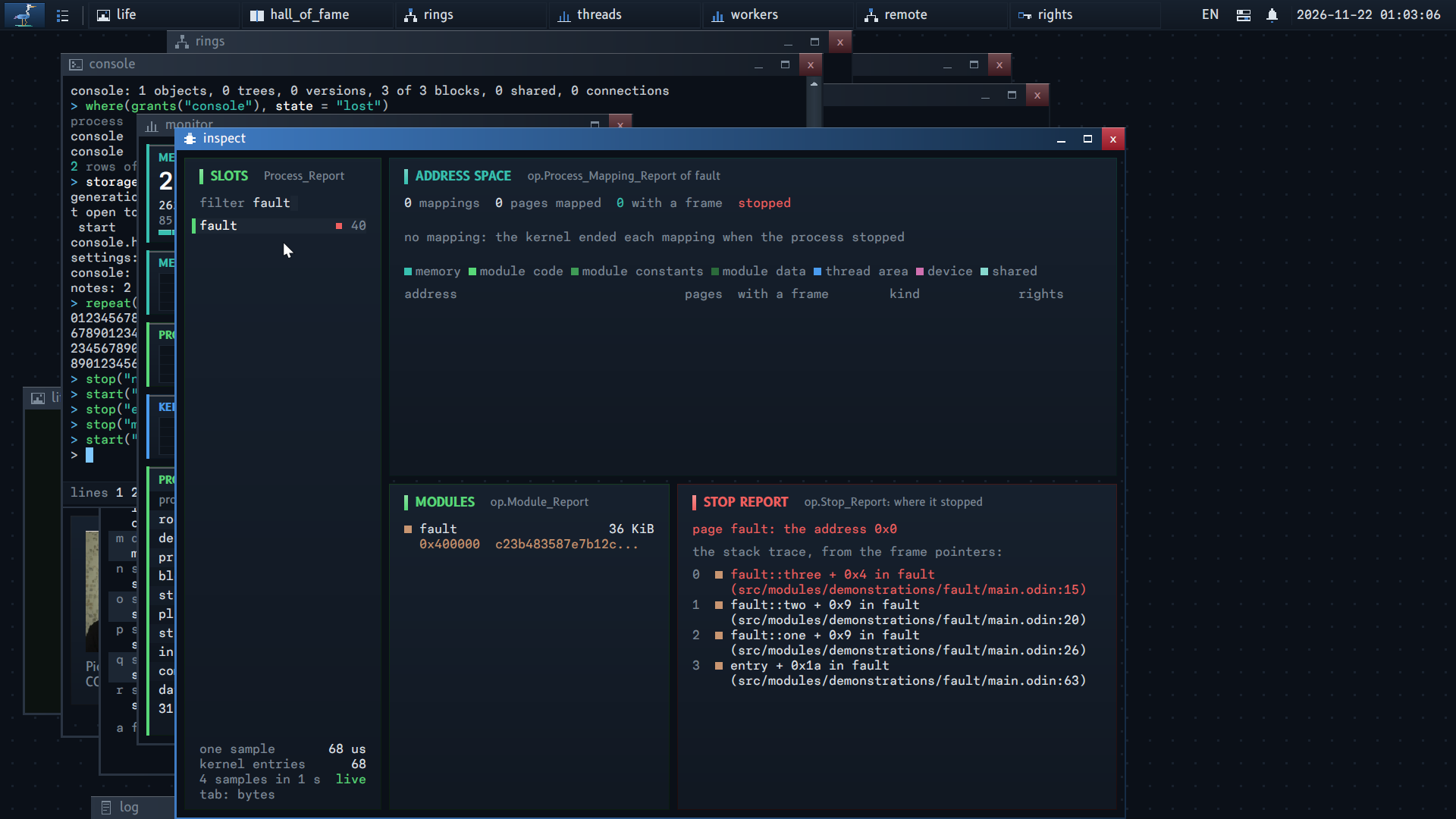
The kernel records why each process stopped: the process itself, a holder of its process handle, a fault, the end of its last thread, or the close of its last handle. No other process can forge this stop cause. The kernel decides it from the target of the stop, not from a number that the caller gives. The console says "the process calendar stopped: a fault, page fault", the root service writes "root: net stopped: a holder" when a window is closed, and monitor.processes() has the column cause. The demonstrations give their results through memory that they share with their parent, not in their stop.
Shown - in the next release - the guide Architecture
modus is an operating system with a small kernel, in which programs call each other's functions with typed values, and no text goes between processes.
A process that stops itself now says what its work gave: done, failed, refused, or stopped on request. The kernel takes that word only from the process itself: a holder that stops another process cannot say it in its place, so a parent that reads "done" knows that the child said so. monitor.processes() has the column outcome, and where(monitor.processes(), outcome = "refused") lists the processes that refused their context or their input. The root service writes "root: settings stopped: itself, done", and the start policy no longer starts a row again after a finished work or a refused input. The open stop code, a number that each reader decoded, is gone.
modus is an operating system with a small kernel, in which programs call each other's functions with typed values, and no text goes between processes.
Two designs are decided. A log fact is a record type that a process writes to the log in place of a formatted line: a reader filters the log by field, as in log.records(0) |> facts(storage.Bad_Block) |>where(block =12), and a test waits for a fact and its fields. A record output is a stream of typed records that a module writes and another module reads, through a ring that loses no record; a starter wires the record outputs of a program it starts, its log included, for example to an append-only audit space.
A twenty-second property joins the list: each need has one general mechanism, and each frequent task is one expression that says what it does, with no trick and no hidden encoding.
modus is an operating system with a small kernel, in which programs call each other's functions with typed values, and no text goes between processes.
The service remote_display sends the screen of the machine to a viewer on another machine over QUIC. It sends only the rectangles that changed, as screen pieces that a lossless coder in the manner of QOI codes, and the next viewer frame goes only after the viewer took the last one. The compositor copies its damage into memory that the service gives, and never waits for it.
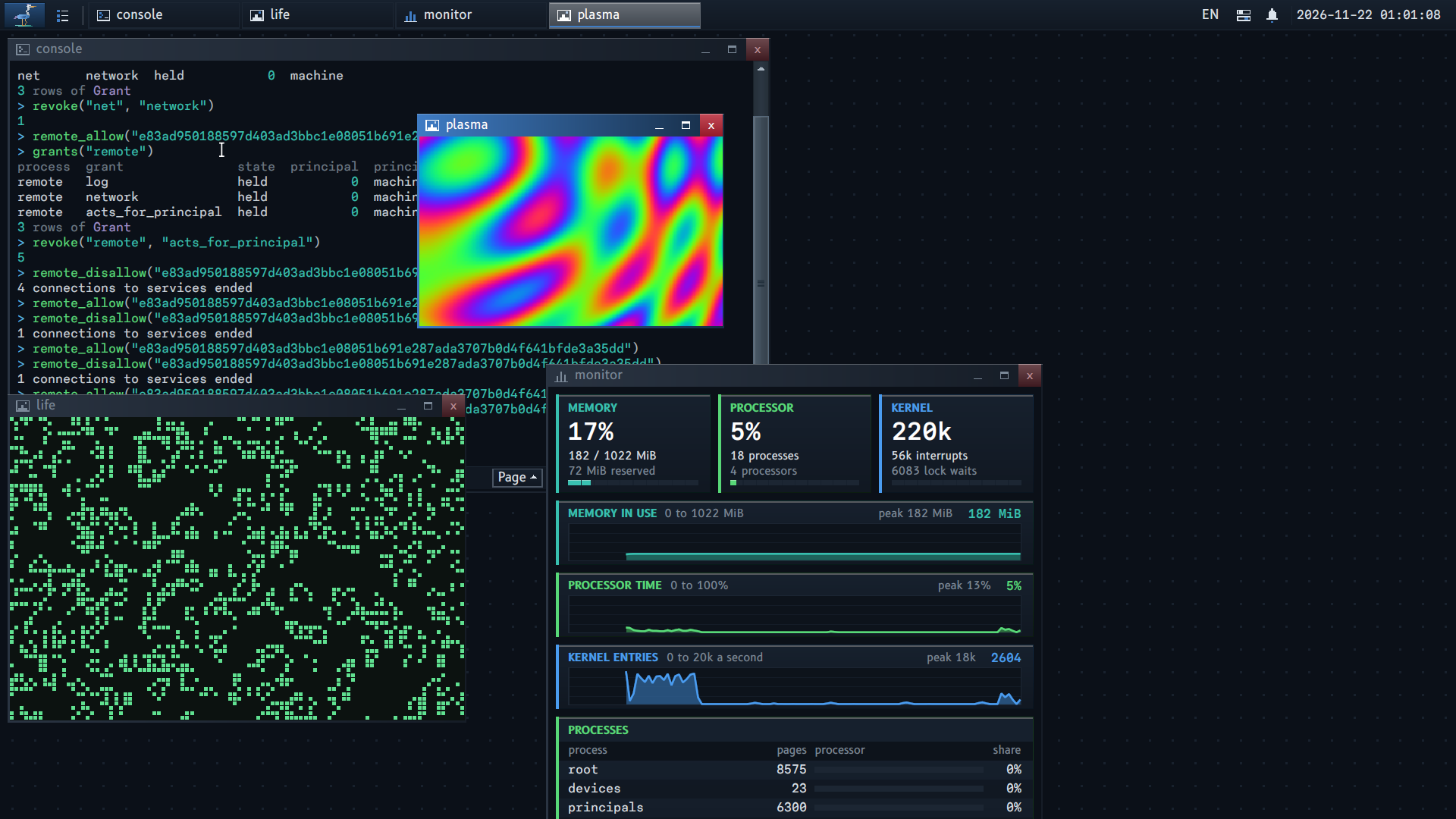
A principal allows the key of a viewer in the console, with remote_display_allow(key, "view") for the screen, or "view_and_input" to type too. While a viewer is connected, the bar shows the mark viewer with the start of its key, which the service cannot hide. remote_disallow(key) ends the session at once.
The machine test uses the tool as the viewer: the screen that it rebuilds from the screen pieces is the picture of QEMU of the same moment, pixel for pixel outside the pointer.
modus is an operating system with a small kernel, in which programs call each other's functions with typed values, and no text goes between processes.
A log record no longer carries a free name that its writer chooses to group it. The window of the log shows a card for each process with the count of its records, and the console groups the records of a line by process. A line of a process on the serial port starts with the name of the process in brackets. The text of one record grew from 152 to 168 bytes. This is the first step of log facts: the next steps give each record that matters a type, which a reader filters by field.
modus is an operating system with a small kernel, in which programs call each other's functions with typed values, and no text goes between processes.
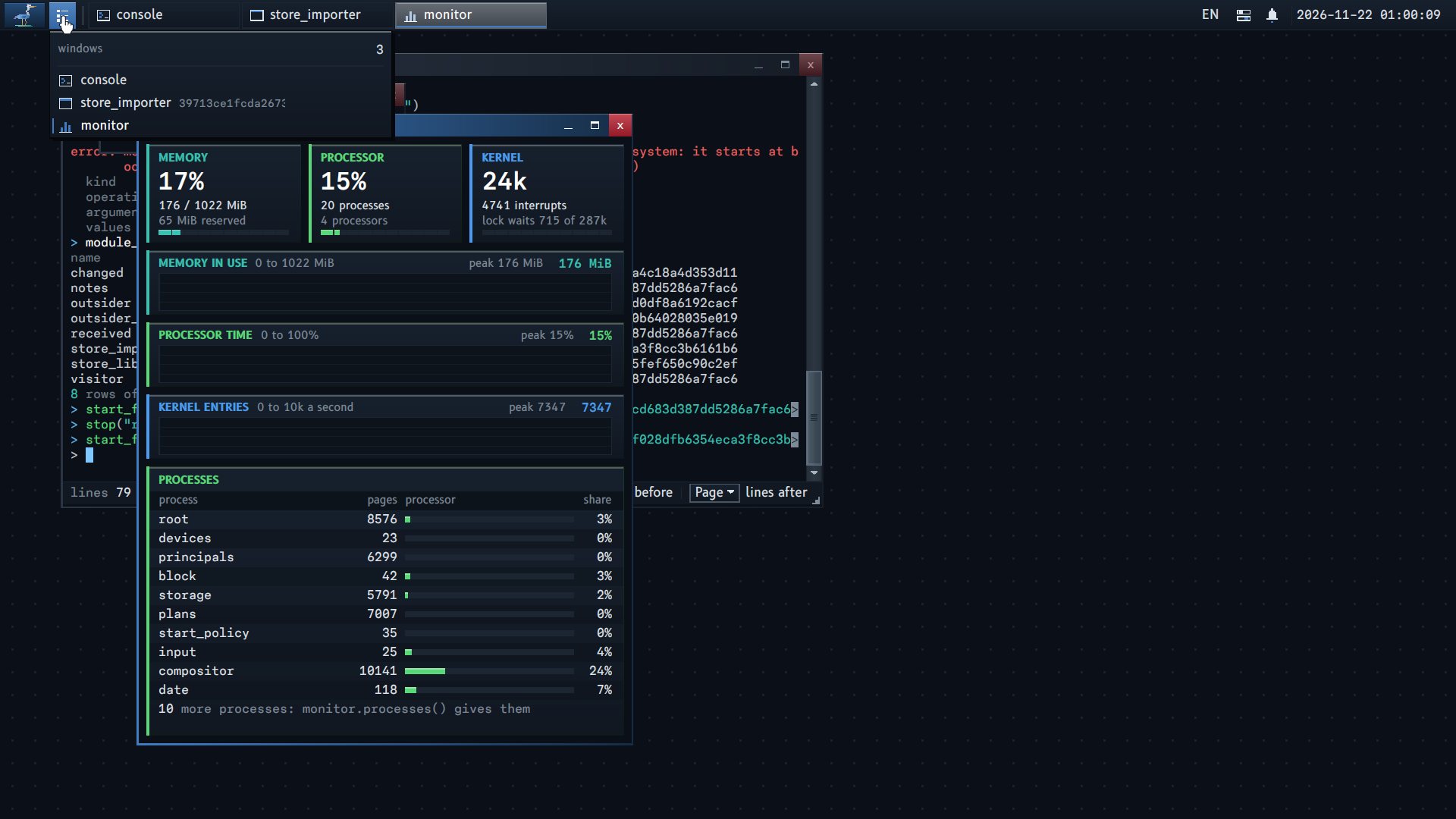
The window of monitor now draws three graphs of the last minute: the memory in use, the processor time of all the processes, and the kernel entries in one second. Each graph is a curve of the last 120 samples, one each 500 ms, over the grid of points of the desktop. The monitor computes the points of a curve once for each sample, not in each frame. The bar of the memory and the bar of each process take the color of what they measure, the warning color from 60 %, and an orange from 85 %. The number beside each bar says the same value.
modus is an operating system with a small kernel, in which programs call each other's functions with typed values, and no text goes between processes.
A log fact is a record of typed values in the log, with no text. The console, under a line, and the window of the log now write its sentence from the module file that the fact names, each value in the color of its kind. A fact whose module the boot image does not hold shows its bytes in hexadecimal.
In the console, log.records(0) |> facts(log_reader.Fact_Probe) gives the fields of one fact type as the columns of a table. where takes a condition on a field: log.records(0) |>where(level = Warning). The console checks the fact name, the field and the member of the level before any call, and completes them.
modus is an operating system with a small kernel, in which each program draws its window into memory of its own, and the compositor shows it.
The width of a text no longer comes from tables that the build wrote for three sizes. Each program reads the advance of each character and the adjustment of each pair from the font file, at the size that its layout asks for. At the three sizes of today the numbers are the same, so no text on the screen moves.
A program that does not compile the text code in calls the library moduletext_rendering with the font files as bytes, a face and a size. It places the glyphs of a text, measures many texts in one call, and breaks a text into the lines of a box.
modus is an operating system with a small kernel, in which each program draws its window into memory of its own, and the compositor shows it.
The boot image no longer holds glyphs drawn at build time. It held five glyph caches of its two fonts, more than 1.3 MB, at three sizes of text only. Now it holds the font files, about 195 KB, and each window draws each glyph of its text from them once, into its own private glyph cache, with the same pixels. The root service no longer checks the hash of five caches at each start.
A text of the interface font at twice and three times its size now stands at the nearest third of a pixel, as at its first size. Each program that draws text states the pages of its glyphs in its budget: 354 pages for each copy of the text rendering that draws.
modus is an operating system with a small kernel, in which each program draws its window into memory of its own, and the compositor shows it.
The font service is gone. It was a process of the system that drew the Greek letters and the box-drawing characters into a shared cache at each start, then stopped. Each start of the machine now has one process fewer, and the root service no longer pays 1 073 pages for that cache.
Each window draws these characters itself, into its own private glyph cache, with the same pixels. The log of the compositor names, once at each start, the characters of each script that no font of the system has. The terminal writes one line for each font of its fallback chain from which it drew a cell.
modus is an operating system with a small kernel, in which each program draws its window into memory of its own, and the compositor shows it.
The principal can now drag an edge or a corner of a window whose program declared it resizable. The pointer takes the resize shape over the edge, and an outline shows the new frame during the drag. At the release the program makes a surface of the new size, paid by its own budget, and draws its next frame in it. Until that frame, the window keeps its old size and picture, so the screen never shows a size that the program did not draw, and the compositor never waits for a slow program.
The window of clock is the first resizable window: its table takes the width that it gains.
modus is an operating system with a small kernel: a program asks for each of its 35 kernel operations with a command record.
A test machine now runs operation sequences: lists of commands that the tool writes into the memory of the machine. A new program with a new budget runs each sequence on the kernel that ships, and the tool checks each answer. A refusal must have a status that the reference of its operation lists, an error detail for each argument that the form of the operation refuses, and no change of the budget. After the program stops, its budget must hold what it held before.
The test partoperation_sequences runs a sequence for each operation and a few cases that must succeed. modustool fuzz replay operations <file> runs one sequence. This machine is the first part of the fuzzing of the kernel operations.
modus is an operating system with a small kernel: a program asks for each of its 35 kernel operations with a command record.
modustool fuzz operations <executions> now writes generated operation sequences into a test machine of the kernel that ships, and checks each answer. A stop of the machine, a sequence that does not end, or an answer that breaks an oracle is a fault of the kernel. The tool keeps each fault one time, minimizes it on new machines to the fewest sequences and steps that still give it, and boots a new machine to go on.
The desktop starts on a machine with no PS/2 controller
Fixed - in the next release - the guide Architecture
modus is an operating system with a small kernel, in which the code of each device runs as a process.
On a machine with no PS/2 controller, the input service used to read the status port for ever on one processor. Now it reads a status of all ones as no controller, writes one line and stops, and the desktop comes up with no keyboard and no mouse.
modus is an operating system with a small kernel, in which each program draws its window into memory of its own, and the compositor shows it.
The test machines now show the reference screen of the system, 1920 by 1080 pixels, in place of 1024 by 768. Each picture of the gallery is a picture of that screen. The compositor shows each frame whole: it writes the frame into one of two screen pages in the video memory, then makes the display show that page. Two pages of 1920 by 1080 take 16 588 800 of the 16 777 216 bytes of the virtual display.
The windows keep their sizes for now, so they take a smaller part of the screen. Next, a scale factor from 1.25 to 2 draws them, their text and the pointer larger, on the same screen.
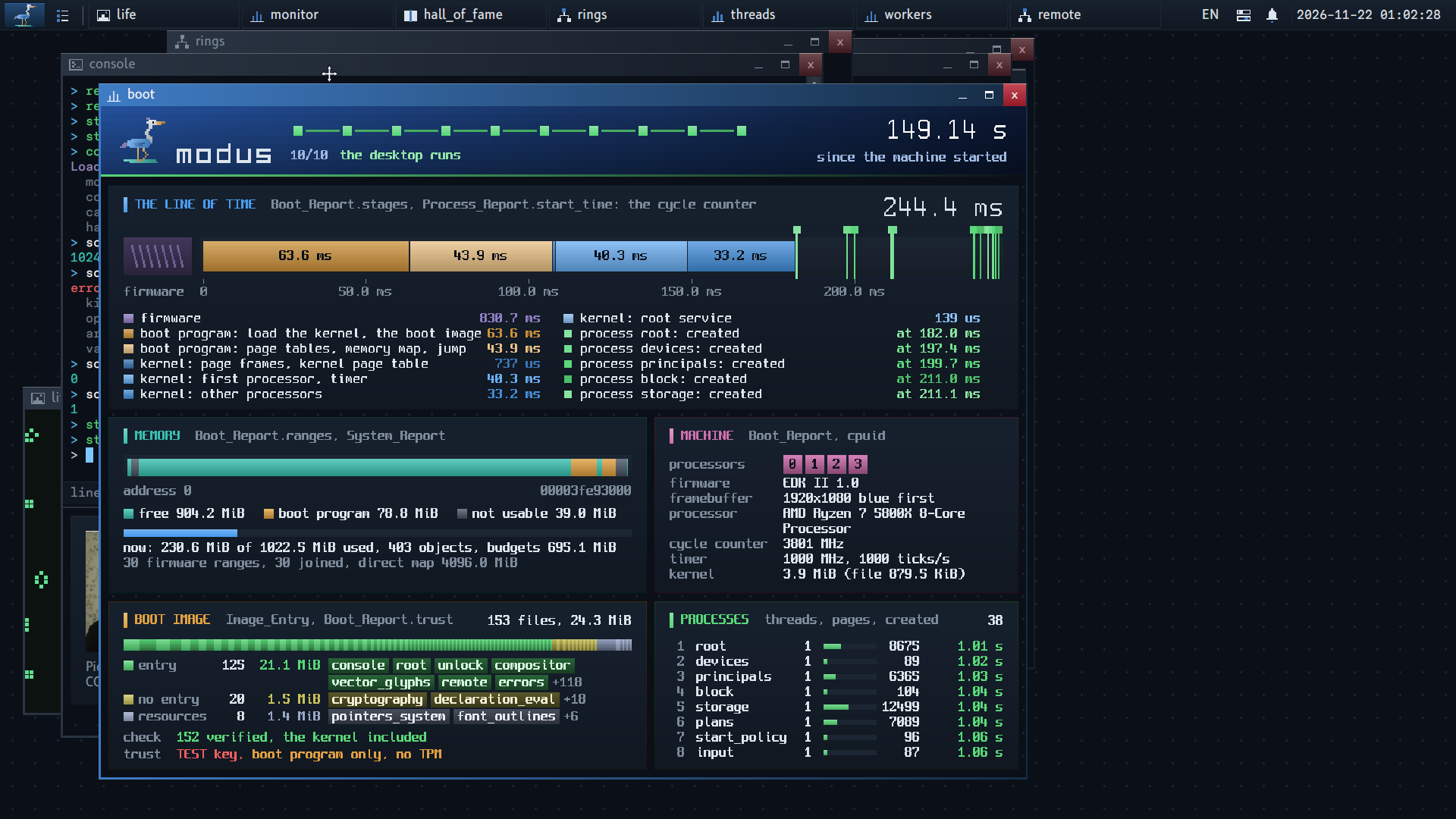
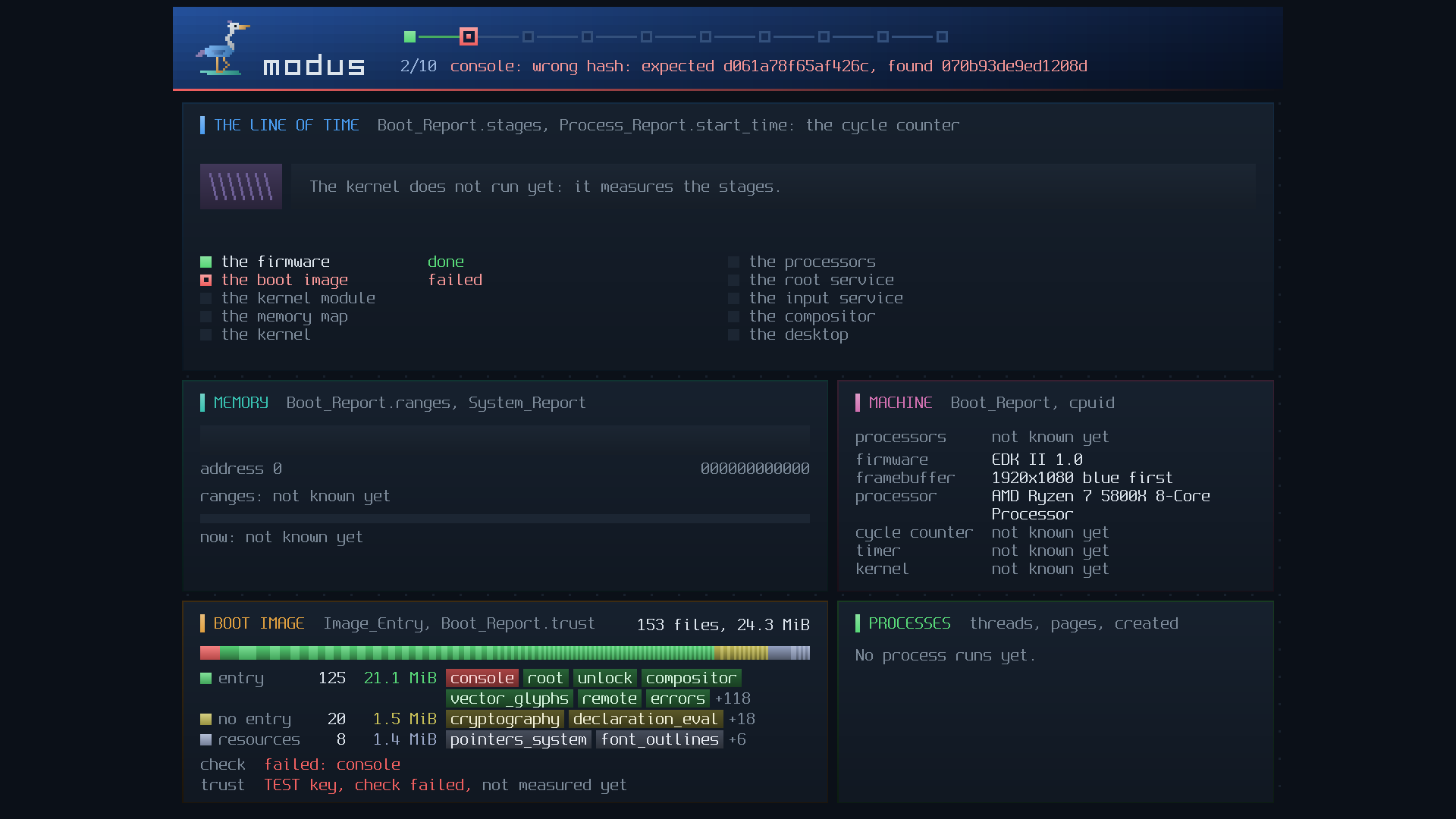
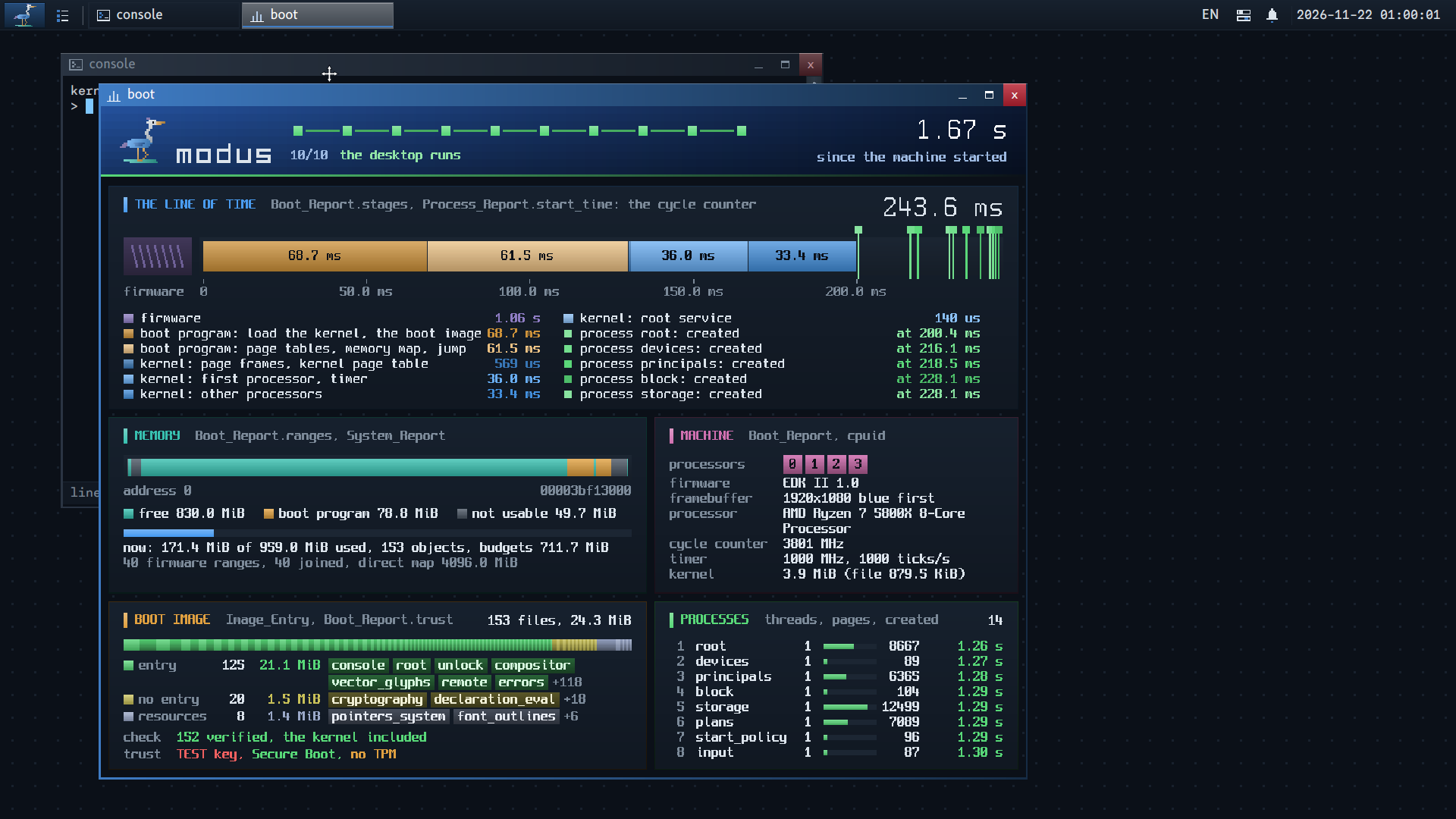
modus is an operating system with a small kernel. While the machine starts, it shows the boot display: the stages of the start with their times, the memory, the machine, the files of the boot image and the first processes.
The boot display was 976 by 708 pixels, half of a screen of 1920 by 1080. Its font is Spleen, a bitmap font drawn for several sizes. It now takes the largest of the scales 1, 1.5, 2 and 4 at which it fits the screen with a margin of 8 pixels: each of them is a size of Spleen, so each letter fills its cell. On a screen of 1920 by 1080 the scale is 1.5, the text is Spleen 12 by 24, and the display is 1464 by 1062 pixels in the middle of the screen. It keeps its proportions: it is never stretched across. Each card, bar, gap and text is drawn again at that scale, not enlarged from a picture.
A program holds data with no known bound in an arena
Shown - in the next release - the guide Architecture
modus is an operating system with a small kernel, in which a budget pays for each page that a program uses.
A program can now hold data whose size it cannot know before it reads it, such as the tree of a document, in an arena. An arena reserves a range of addresses once and commits its pages as it grows. When the budget cannot pay the next pages, the push gives back the status No_Budget: the program reads it and keeps running. An arena never moves, and its end gives every page back to the budget at once.
The test program arena grows an arena one page at a time until its budget refuses, then checks that a reset takes the same pages again with no commit, and that its budget comes back whole after the end.
modus is an operating system with a small kernel, in which a program sees nothing that no one handed to it, the clipboard included.
The principal can now copy the text of a field with Control+C and paste it with Control+V into a field of another window, or into the line of the console. The compositor takes both keys: no program sees them, and no program can send them. A program reads the clipboard only at a paste of the principal, through a handle that the compositor lends for that paste and then revokes. The reader copies the text first, then checks it, so a paste never carries an Enter into the console.
A start policy from the disk, measured into PCR 12
Shown - in the next release - the guide Principals
The machine can now start with a start policy that a third party publishes, in place of the one of the boot image. On a machine whose machine key the TPM seals with no passphrase, start_policy_choose("tiny", hash) in the console of principal 0 chooses a module of the store module_files by its hash. At the next start, the root service reads the choice before any start policy runs, checks the hash of the bytes, and starts the module with the start grantStart_Policy only: it can start and stop processes of the machine, and nothing more.
Each start policy is now measured into PCR 12 before it runs, the default one and the rescue too, and the log gives the value of PCR 12. A remote party can then see which start policy ran. The seal of the machine key still reads PCR 7 and PCR 11 only, so a new choice opens the machine key as before.
Shown - in the next release - the guide Architecture
The root service of modus no longer holds the order of the start. It starts one process, the start policy, which reads the start list of the boot image in its order and says when the machine is usable. When the console does not start, the start policy stops before that point, and the root service starts the rescue start policy: the input, the compositor, the console and remote. The machine then shows its console in place of a failure on the boot display. Hold the key R while the machine starts, or choose the entry "modus (rescue)" in the boot menu of the firmware, to start the rescue at that start. The boot program writes that entry at the end of the boot order when it is absent. Each list is a resource of the signed boot image, and the build refuses a list that names no module of its image.
Fixed - in the next release - the guide Trusted boot
When the boot program cannot start the kernel, for memory, for the memory map of the firmware or for a kernel module that it cannot load, the boot display shows the reason in red and stays. Before, the boot program wrote one line on the console of the firmware and powered the machine off at once, so the line was gone before anyone read it. The boot program turns the watchdog of the firmware off, as for a failed check of trust, so the machine waits until it is stopped by hand.
modus is an operating system with a small kernel, in which the code that drives a device is an ordinary program with the handles of that device only.
A program can now play sound. It writes its samples in memory of its own and sends records to the sound service, each with the time of its first sample by the clock of the system. The service plays each record at that time, and silence between the records. A record that comes too late plays nothing: the program gets a refusal with the earliest time that it could take.
The program tone plays a tone of 440 Hz half a second after the start of its stream. The test machine writes its sound output to a file, and the test finds the tone there at the sample of its time.
modus is an operating system with a small kernel, in which each running piece of code holds only the handles that it was given.
The system had one word for two things: "program" named the file of code and that code as it runs. Now a module is the file, named by the hash of its bytes, and a process is a module that runs: the realisation of that module in time, from its start to its stop, with its own address space, its handles and its threads. The word is general: a chemical process runs in time too, and Unix took the word from common speech, as this system does. A process here has no parent that it inherits from, no fork, no global number and no environment: it has only the handles that its starter gave it. The kernel operations, the contract, the guides, the glossary and the lines of the log follow the two words. The menu of the bar that lists the modules to start is now start.
modus is an operating system with a small kernel, in which each program draws its window into memory of its own, and the compositor shows it.
The standard of quality of its desktop is 120 Hz at 1920 × 1080: a frame in less than 8.3 ms. The program processor_frame now measures, on the test machine and with no GPU, what such a frame costs on one processor, with the code of the system: a clear and a present take 269 us, a full frame of the compositor with four windows 954 us, a frame in its damage 86 us, and a draw table of 339 records that fills the screen, with text in two fonts, pictures and alpha, 2043 us (the medians of 21 frames). The heaviest part takes a quarter of a frame at 120 Hz, so a machine with no GPU keeps the resolution and the rate of the standard, and leaves out only the blur, which no measure gives yet.
modus is an operating system in which a program reaches only what its starter gave it. The root service starts each program of the system with the grants of its role.
The role of each program is now one row of one table: its grants, the services that it can connect to, the size of its private store and of its terminal, and the reason of each. The page of the grants on the site shows each row, a program with no grant too, and the page of each program shows its grants and its other terms.
The build of the system stops when a program has no row, so a new program never starts with a role that nobody wrote. Each program that the root service starts gets each handle and each value of its context through one check, and a start that would write one place twice does not run.
Fixed - in the next release - the guide Architecture
modus is an operating system whose site publishes its guides. The guide of the architecture holds five diagrams in the text form of mermaid: the layers of the system, the order of construction, and three flows in time. The site showed each one as its text.
Now the tool draws each diagram as a picture in the page when it builds the site, with no script. The boxes, the lines and the labels take the colors of the site, so a diagram follows the light and the dark form. The tool measures each label with the font of the diagrams, so a long label wraps onto more lines and no text passes its box. The text of each diagram stays under its picture, for a screen reader and for the search. A diagram that the tool cannot draw stops the build of the site, with its file and its line.
modus is an operating system whose programs talk through records in shared memory. A record holds its choices as numbers: the command of a ring, the mode of a child, the tone of a line of text.
Until now, some programs read a number that named no choice as a choice: an unknown role became the parent, an unknown command was ignored with no word. Now each program reads such a number at one place, which refuses it. A service answers with an error record that names the number, a program that a starter gave a wrong mode writes a line and stops, and the compositor and the terminal count the records of a window that they refuse and write the count on the log.
The tables of the modules that inspect.modules(), manual.running() and program_modules() give no longer write "unknown" as the writer of a module record: a writer that names nothing leaves the field empty, with a line of the log.
The TPM service sets a lockout value that nobody keeps
Shown - in the next release - the guide Principals
The TPM counts the wrong passphrases of a named principal, but a TPM with an empty lockout authorization value lets any system on the machine reset that count. With such a TPM, an attacker with the machine starts another system, resets the count, and guesses passphrases with no limit of the TPM.
Now the TPM service of modus reads the bit lockoutAuthSet before the first use of a passphrase in a run. A start that uses no passphrase with the TPM changes nothing. When the bit is clear, the service sets 32 random bytes as the lockout value, then erases them. No program, file or store keeps the value, so no system can reset the count or change its limits, this one included. The service also writes the count limits of the TPM on the log: on the test machines, a lockout after 3 wrong passphrases, then one forgiven each 1000 seconds.
In the test, a new TPM takes TPM2_DictionaryAttackLockReset with the empty value from the host. The TPM of the test machines refuses it with TPM_RC_AUTH_FAIL. A principal who reaches the lockout waits, or types the recovery key.
Shown - in the next release - the guide Trusted boot
modus is an operating system whose boot program checks a signed list of the hashes of the whole system before the kernel starts. Until now, each list that the key of the publisher signed stayed valid, an older one with a known flaw too.
The TPM now keeps floors that only rise. Each system description carries a security version, and each boot program a key number. Before it measures a newer system, its boot program raises the floors to its numbers; after the measure, no kernel and no program can raise them. From then on, the boot program of an older system, or of a revoked signing key, stops before the kernel starts, and the screen names the floor.
The publisher raises the security version only for a flaw that an older system would bring back, so a principal can still go back to the release before for any other fault. Six machines of modustool test trusted_boot with a software TPM show both refusals, and the repair of an index that another system planted.
Shown - in the next release - the guide Principals
The machine passphrase of modus guards the machine key, which signs the disk grants of the machine. Its record held the key under Argon2id of the passphrase alone. With a copy of the disk, an attacker could try passphrases with no limit, and a changed system could open the key with the right passphrase.
Now, on a machine with a TPM and Secure Boot on, machine_passphrase() gives the record the form of the keys of a named principal. The TPM seals a secret to the measure of the system and to a value that the passphrase gives. The TPM counts each wrong machine passphrase, and on another system it refuses even the right one. The window of unlock shows a recovery key one time. That key opens the machine key when the TPM refuses, and the window then asks for a new machine passphrase.
In the test, a wrong machine passphrase is refused and counted on the system of the seal, and the right one opens the key. On another system, the right passphrase opens nothing, and the recovery key opens the key.
The readers of modus that take bytes from the network or from a disk now get inputs that nobody wrote by hand. modustool fuzz runs the real code of the system on the host: the module file, the debug object, the storage format, QUIC and TLS, TCP and the head of an HTTP request.
LLVM adds an edge counter to the packages under test. The tool keeps each input that reaches new code, and makes the next inputs from it. Each input sits against a page with no access, so that a read one byte past it stops the run.
A fault is minimized to its smallest input and printed as the bytes of a host test. After its fix, the input joins the corpus of its target in the repository, and each modustool check runs it again with a fixed count of new inputs.
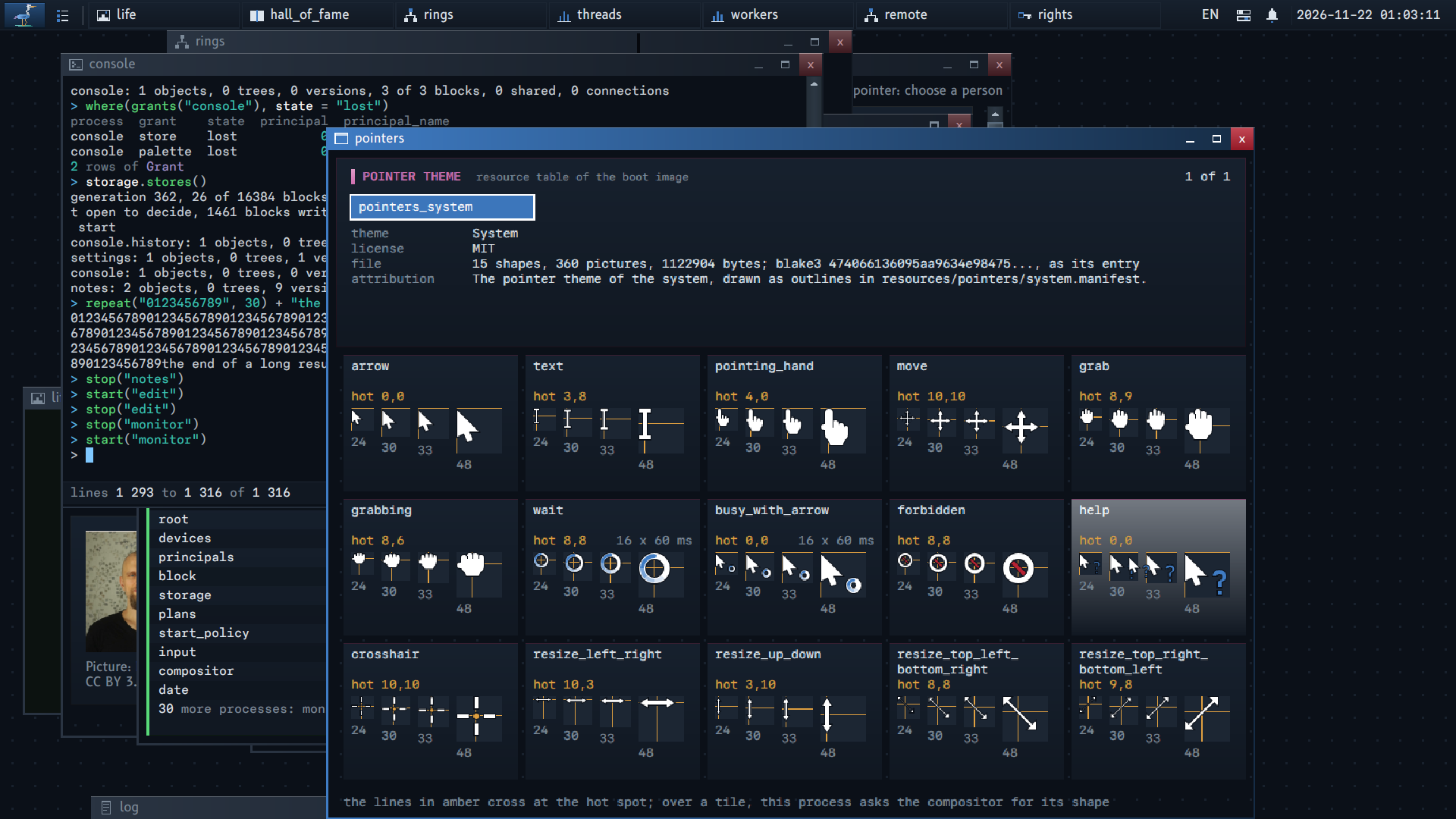
The pointer theme of the system is the pointer of each release image. Its 15 shapes were grids of squares of 2 pixels, with a staircase on each slanted side. They are now outlines in a text file of the repository, which the build draws at 24 and 48 pixels with the rasterizer of the fonts. The edge is 1 pixel at both sizes, so the larger pointer is finer, not heavier. Each shape has a dark form, white in a dark edge, for a dark desktop, and a light form, dark in a white edge, for a light desktop. A few parts have an accent color: the arc that turns in wait and the question mark of help in the blue of the focus, the slash of forbidden in red, the dot of crosshair in amber. The program pointers shows both forms of each shape.
Shown - in the next release - the guide Architecture
modus is an operating system in which one program, the compositor, puts the windows of all the programs on the screen. Until now it copied the changed parts of each frame into the memory that the display showed, so the display could show the top of a new frame over the bottom of the frame before.
The video memory of the display of the test machine holds two screens. The compositor now writes each frame into the screen that the display does not show, then one write of a display register makes the display show it, in one step. A window that changes many times a second then never shows a cut between two of its frames.
The compositor counts the frames that it wrote into the screen that the display showed. The main machine test requires that count to be 0.
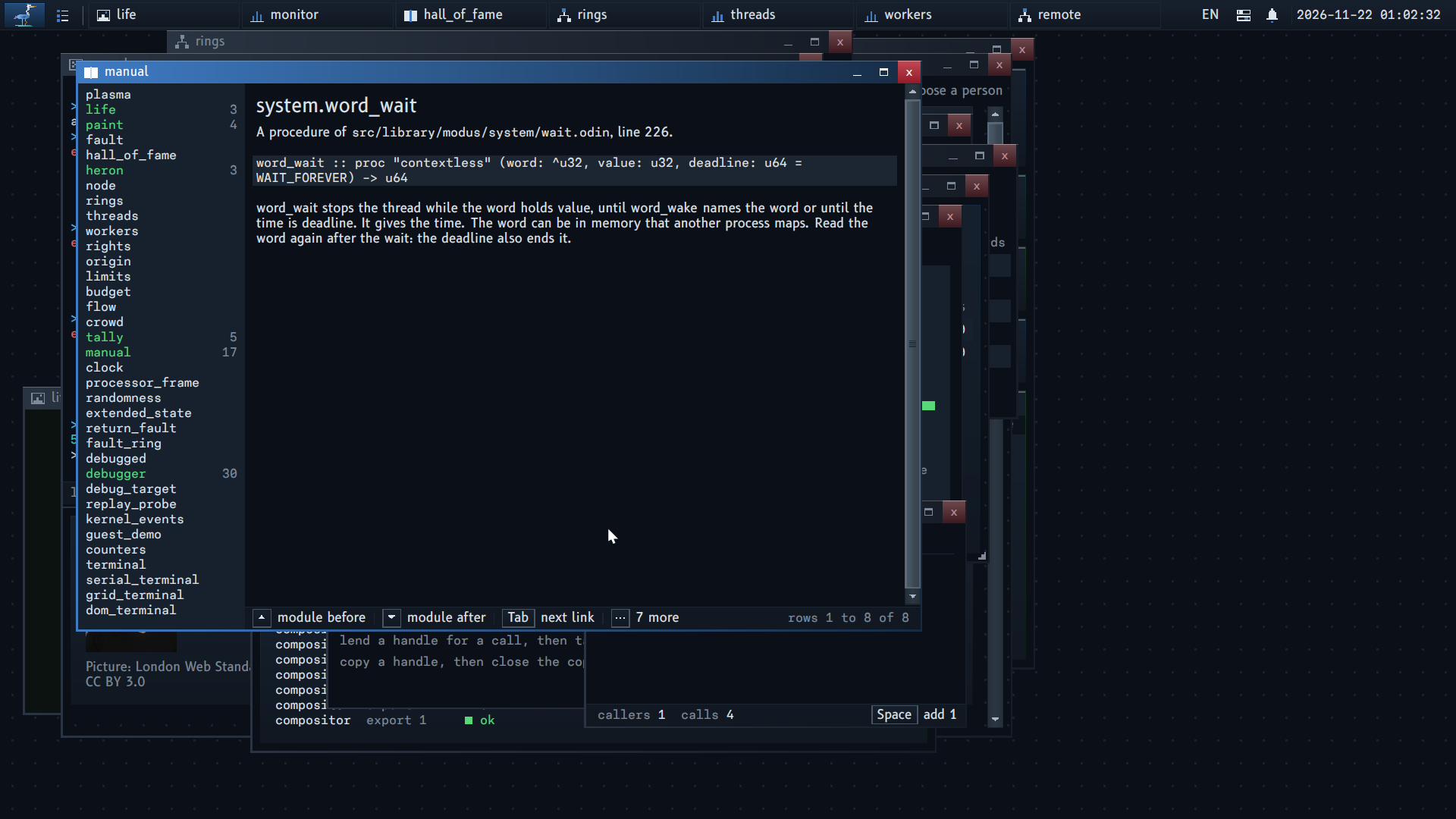
The documentation of a module can link a procedure of a support package, such as system.word_wait. No module file describes such a procedure, and the program manual reads only the boot image. Now the build writes a page for each such link into the boot image, from the source: the file and the line, the one line of Odin, and the comment above the declaration. The link in the manual has a line under it and opens that page. A link to a module, an export or a record that a module describes still opens the page of the module. The picture shows the page of system.word_wait, which the machine test opens with Tab and Enter from the page of the module manual.
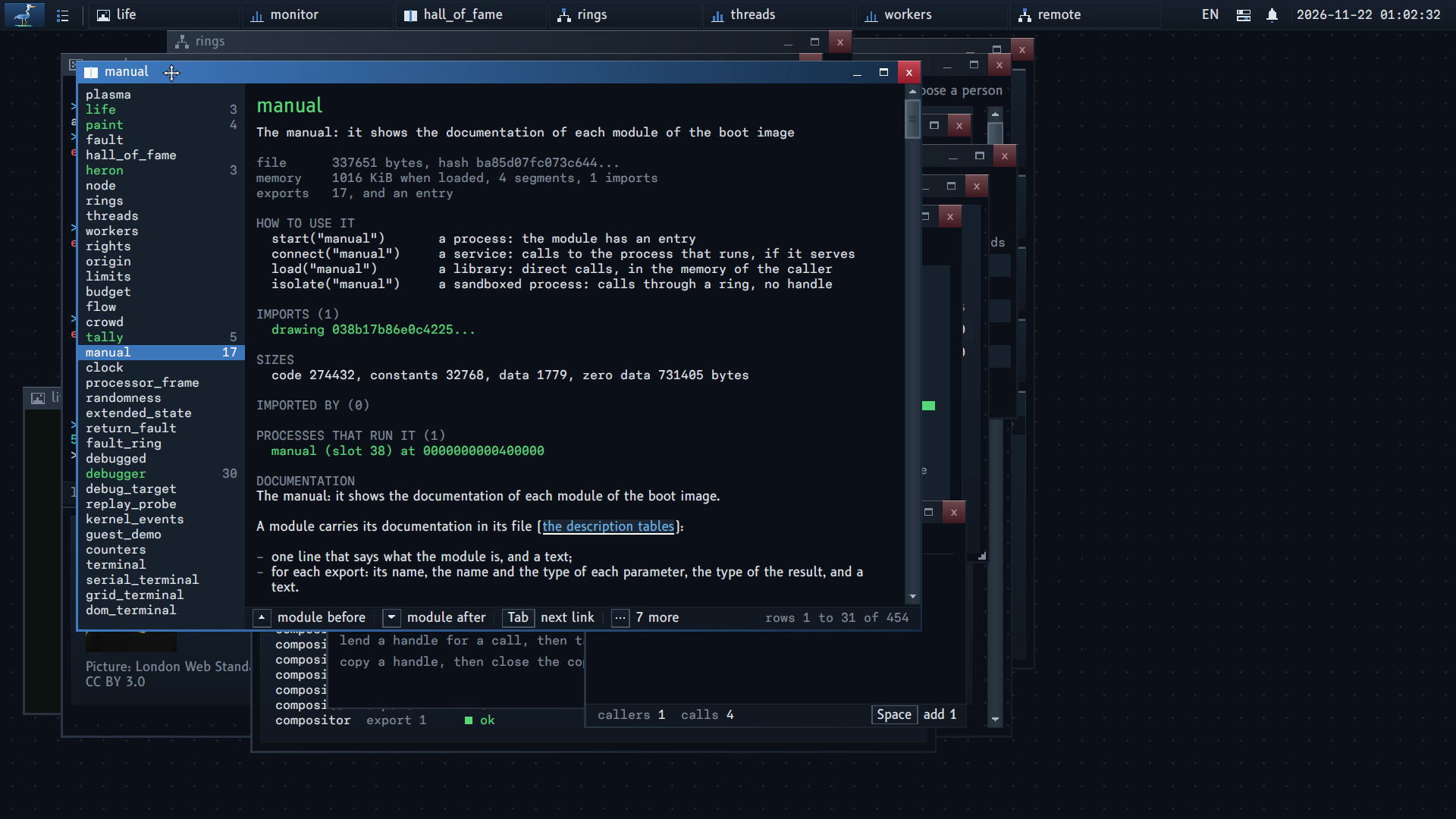
The documentation of a module links terms of the glossary and headings of the guides. The program manual now opens them. The boot image carries the page of each term and each heading that a module links, with the headings under it. Tab moves the focus from link to link, and Enter opens the link with the focus. Backspace goes back to the page before, at the row where it was. A link to another host shows its address and does not open: the system has no browser. The picture shows the page of the module manual with the focus on the link "the description tables". The machine test opens that link with a press, opens the link of a term with Tab and Enter, and goes back each time.
modus is an operating system in which a program sees no other program. A program reads its own log records back, from a ring that only its own records fill.
Two facts of the log still told it how much the other programs wrote. The kernel refused a record when a budget above the program was full, and a Log waited for the lines of the others on the serial port.
Now the log records of each second are an amount of a budget, as its pages: a starter gives each child a part of its own, and each budget counts only its own records. A refusal says only that the program wrote its own amount. Log writes the records in memory only; the tick of the first processor writes their lines on the serial port after it, in their order.
The program log_reader checks it: its storm child takes 900 of its 1000 log records of each second, and gives them back at its stop.
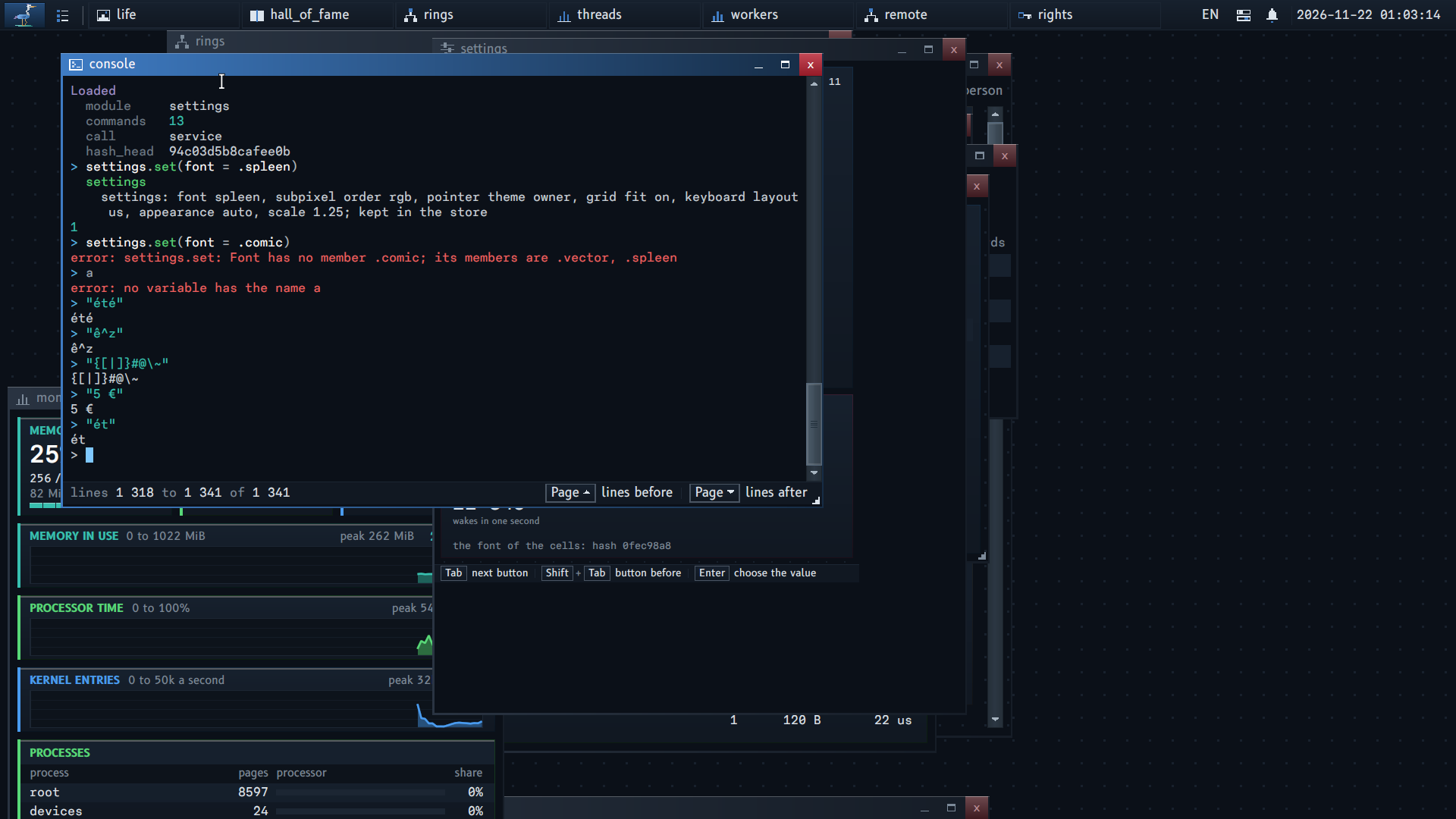
With the setting keyboard_layout on french, AltGr with e types €, as on each AZERTY keyboard. The console prints 5 €. Each font of the system draws the sign: Paper Mono, its SemiBold, B612 and Spleen. € is U+20AC, past the Latin-1 Supplement. It is the first character of a short list of added characters: each one is chosen, and each font must draw it.
The desktop has two appearances: dark and light. The setting appearance chooses one: dark, light, or auto, the default, which gives the light appearance from 07:00 to 19:00 and the dark one at night. The system has no time zone yet, so these are the hours of UTC.
Each color of the design rules has a value in each appearance, in one table. The light appearance has the colors of the light page of this site: dark text on a light background, white cards, each concept in a darker shade of its color. The blue of a title bar and the red of a close button are the same in both.
A change draws each window once: the background, the bar, the windows, the palette, the console and its results. The boot display stays dark. In the console, settings.set("appearance","light") changes it at once, and the log says why the appearance in force is what it is.
Each processor of modus runs the kernel on a stack of 16 pages, with a guard page under it. A chain of calls that is deeper stops the machine at that page.
Each build now reads the frame of each procedure of the kernel, which LLVM writes, and the calls of the linked kernel. It prints the deepest chain of calls on that stack, procedure by procedure, with the bytes that stay free. The chain counts the two frames of execute of a command with a table of error details, and one interrupt that comes while the kernel waits idle.
The build fails when less than 4 of the 16 pages stay free. A call that the tool cannot follow, or a recursion with no stated bound, also stops the build, with the name of the procedure.
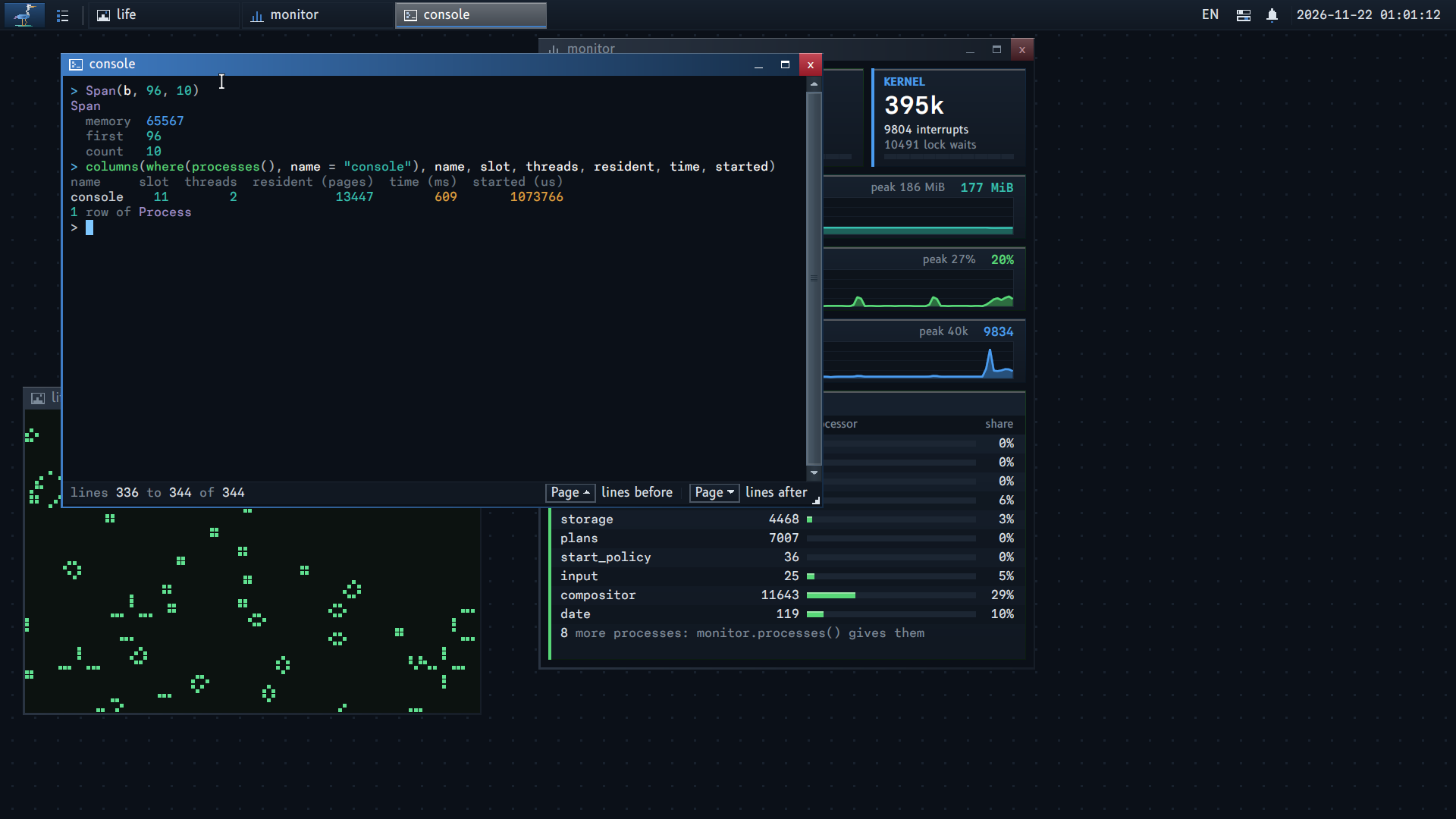
A table of the console now shows each field in the color of its value kind, as the log and the site do. A time is in the color of the boot program. A size and a number are in the color of memory. The unit of a size or a time is in the head of its column, one time: resident (pages), time (ms). A record writes the unit after each value: the field used of memory() shows 1204 pages. The description of the record states the kind: a field of the type value_kinds.Time_In_Milliseconds in the source of a module is a time in milliseconds, and a text is never classified by its look. columns and join keep the kind of each field. The picture shows a record with a handle, then columns(where(programs(), "name", "console"), "name slot threads resident time started"): a text, two numbers, a size and two times.
The guide of the module contract now draws each record of a module file byte by byte, as the header diagrams of the RFCs do. A row is 8 bytes. Each field is a rectangle over its bytes, with its name and its size; its type and its comment show under the pointer. The diagrams cover the header, the table directory and one record of each table: 12 layouts. The offsets and the sizes come from the compiler that builds the tool, so a diagram cannot differ from the code. The same layouts are in the Markdown of the guide as text, and the check of the repository fails when that text differs from the code.
The system has a time zone. The setting time_zone is an offset from UTC, from -12:00 to +14:00 by quarters of an hour: settings.set("time_zone","+08:00") in the console, or the row "time zone" of the window of settings, with four buttons that move it by an hour or by 15 minutes. The default is +00:00, UTC.
The bar then shows the local date and time. The setting appearanceauto turns light at 07:00 and dark at 19:00 of the local time, and no longer of UTC. A change of the zone takes effect at once, and the log says the zone that the date service now gives.
The zone is a fixed offset: it has no summer time. A principal in a zone with summer time changes it twice a year, for example +01:00 in winter and +02:00 in summer in Paris. The date that the system keeps, in the store and on the network, stays in UTC.
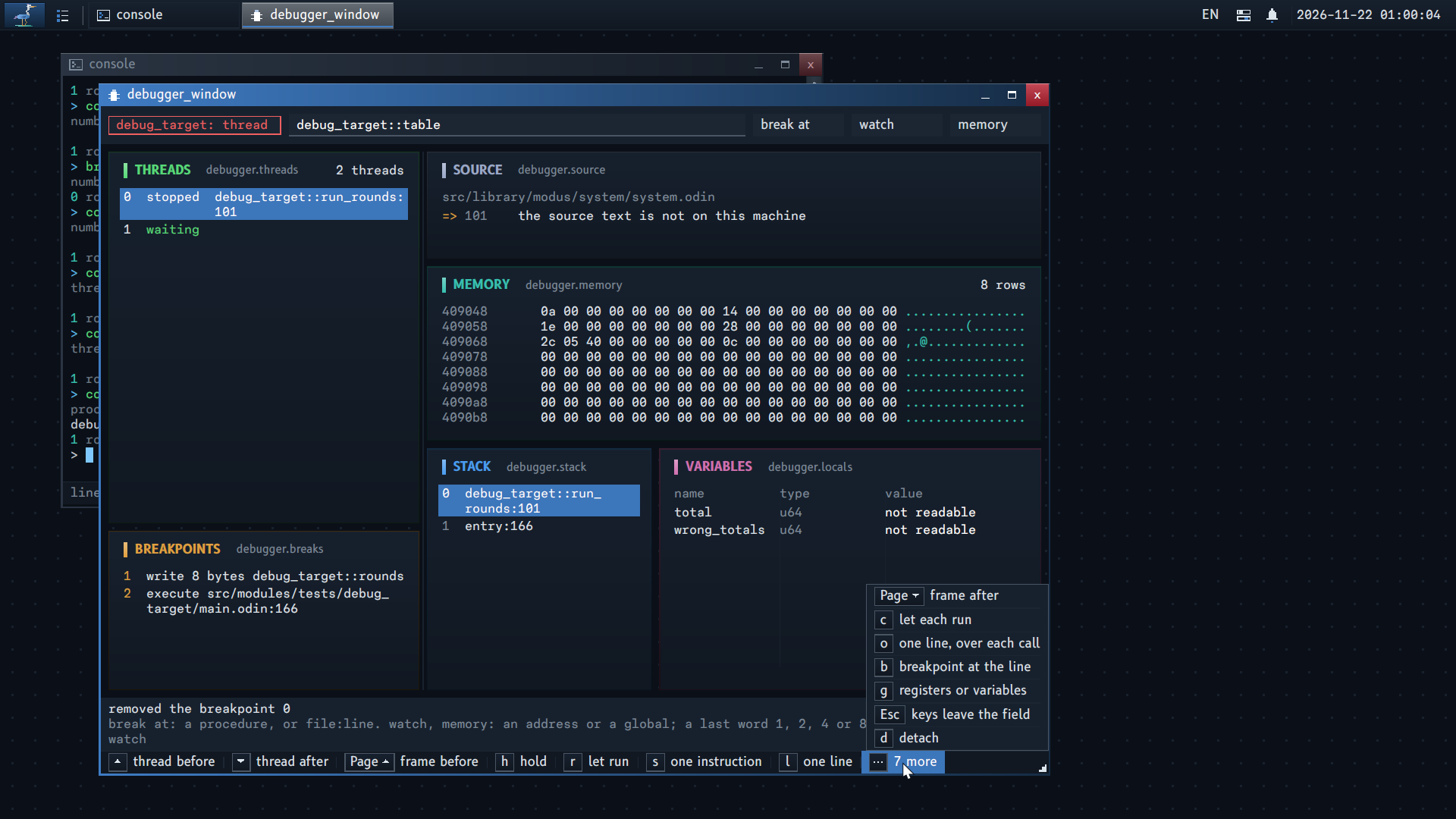
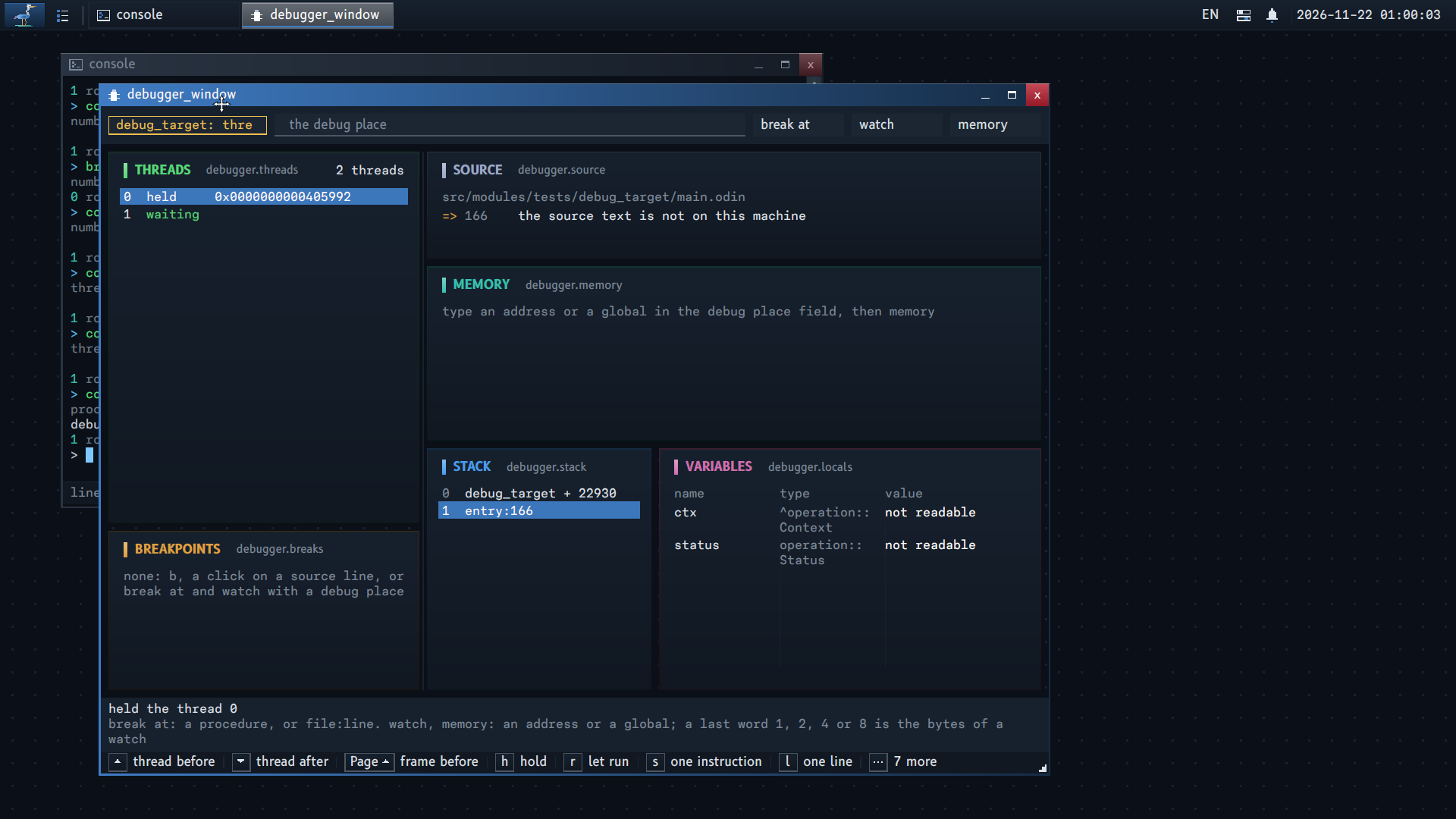
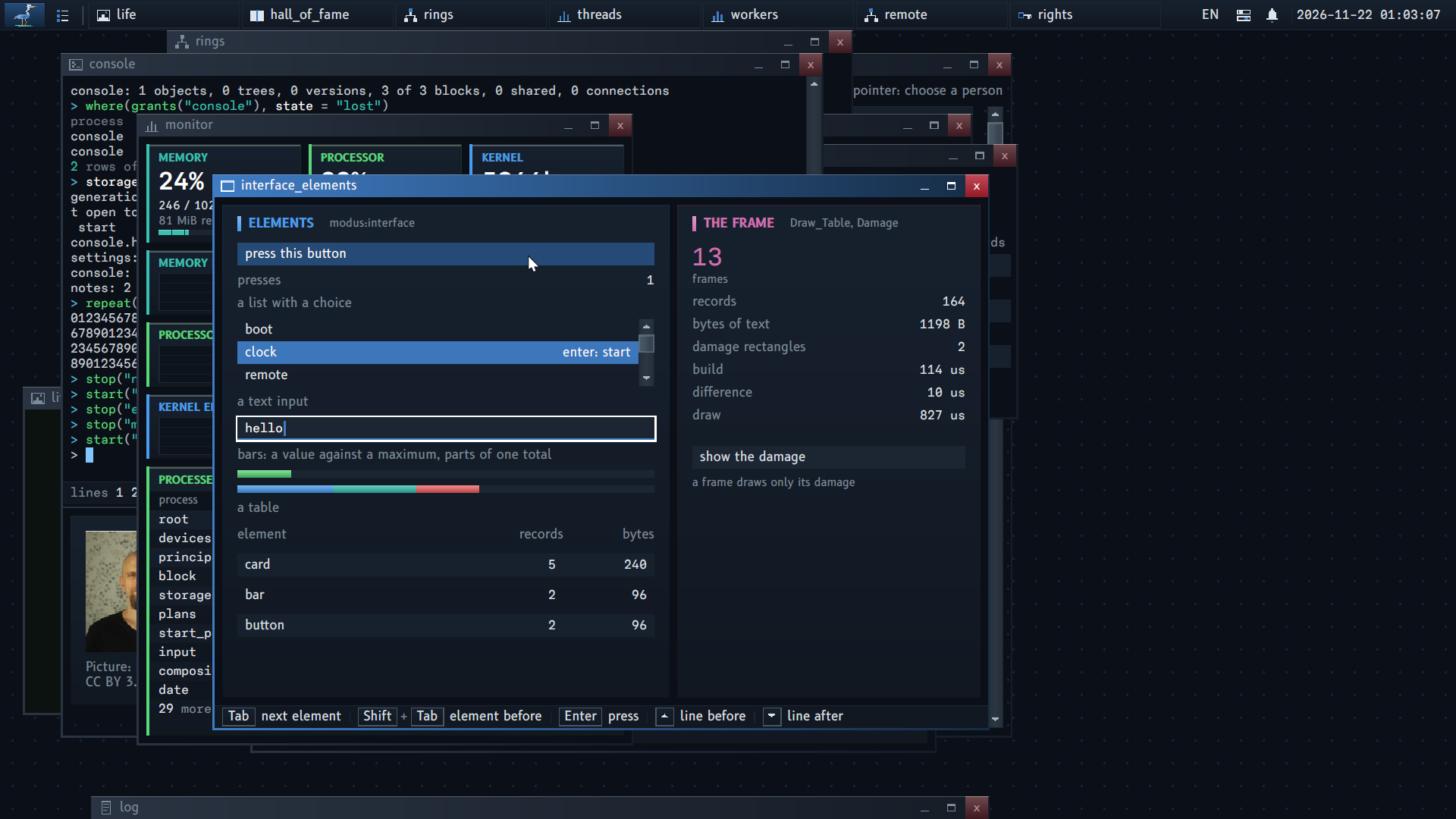
A window that the keyboard drives names its keys in an action bar at its bottom. Each item is a key combination drawn as keycaps, then the name of the action. A press on an item runs the action, as its key does. When the items do not fit, the items of lowest priority go into a list behind a button more. The list opens upward, inside the window, and Up, Down, Enter and Escape move in it. The picture shows the debugger window with its list open: detach has the lowest priority, so it is in the list. The machine test opens the list and detaches with a press on that row. The window interface_elements shows all its items in one row (action_bar.png). Before, each window wrote its keys as one line of dim text, and the pointer could do nothing with it. Ten windows use the bar: manual, the terminal, settings, notes, the debugger window, unlock, interface_elements, tally, rings and paint.
The devices behind an older PCI bridge work with the IOMMU on
Shown - in the next release - the guide Architecture
An older bridge of PCI makes the requests of each device behind it with one requester, so the IOMMU cannot tell those devices apart. Until now the kernel refused each of their accesses. Now they have one domain. The kernel makes it only when one service holds the registers of each device behind the bridge, and ends it when that service lets one of them go. The root service gives them all to one service. The test machine with the IOMMU of AMD has a disk and an entropy device behind such a bridge: the disk reads and writes through the shared domain, and the kernel refuses the domain when the service gives back the registers of the entropy device.
Before, a change of the passphrase or of the recovery key of a named principal left the file from before as a version on the disk. That version opened with the old secret.
Now unlock asks the storage service to erase the versions of the file after each change. The service ends the versions in one commit, writes its root a second time, and then writes zeros over each block that no other state names. A loss of power at any write leaves the versions or none, and no root names a block of zeros.
In the test, the tool reads the file of the principal from the disk before a change. After the change, the disk holds none of its salt and none of its sealed keys.
The erase reaches the blocks that the storage service reads. A flash disk or a snapshot of the host can still keep an old copy.
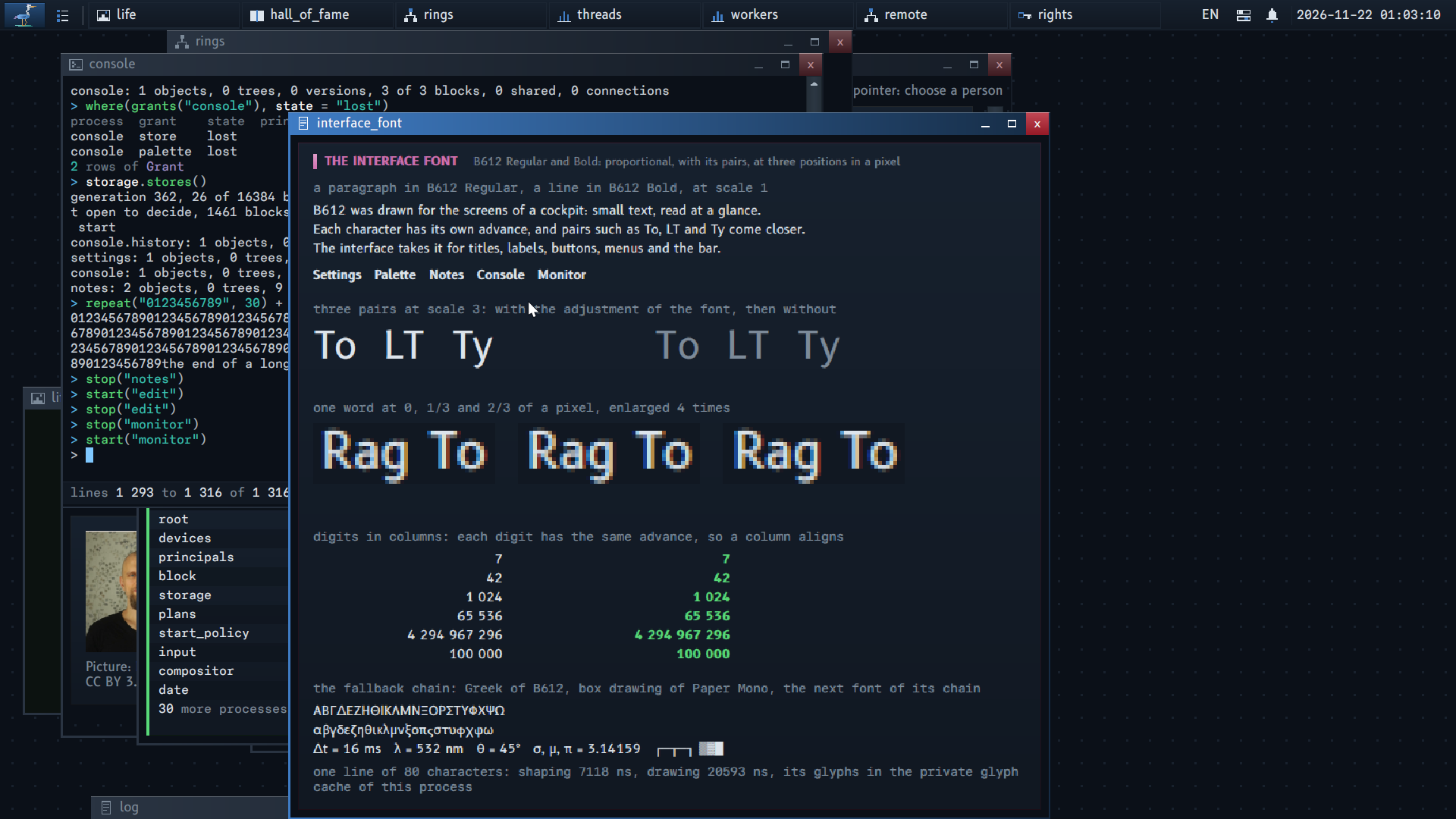
The window interface_font shows two lines of Greek letters in B612. The glyph caches of the boot image do not hold them: they hold 192 characters for each font.
A new program, the font service glyphs, holds the outlines of the 47 Greek letters of B612: the font has no capital pi and no small rho. At its start it draws each of them into one demand cache that each window maps read-only. So the cache is the same whatever the windows draw, and tells no window what another one draws. A window that starts before that work ends draws the letter itself, with the same pixels.
A glyph drawn by the service has the same pixels as a glyph that the build draws from the same font file. A host test compares them word for word.
Shown - in the next release - the guide Randomness
A program gets one random seed at its start, and draws from its own generator. Now the root service also reads the entropy device every 30 seconds, mixes the bytes into its generator, and writes 32 bytes of its stream in a page that only one program reads. The generator of the program mixes them into its key at its next refill, or before it makes a key. A key that a program makes an hour after its start then has bytes from the last 30 seconds. The mix is never done for each draw: the page changes once in 30 seconds, and the same bytes mixed again add nothing. The window of randomness shows the count of the mixes in a new row.
Twenty programs drew some colors of their own, and those colors stayed dark in the light appearance: the bars of monitor, the measures of clock, the levels of the log, the headings of manual, the states of rings. Each window now takes each color from the color tokens, by its meaning, so it changes with the appearance.
A color keeps its meaning in both appearances. A kernel entry is in the kernel blue, a page in the color of memory, an answer that is not the expected one in the color of a failure. Each text keeps a contrast of at least 4.5 to 1, and host tests compute each pair.
Three tokens are new: a warning color, a link color, and eight series colors that tell apart things of one kind, such as the threads of a program or the records of a ring. The boot display stays dark: it draws before any setting is read. The stage of heron stays dark too: it is a picture of the dark mark.
Each window now draws a character past the 192 of its glyph cache itself: its labels, its titles, its menus and its cells. It reads the font files of the system, which the root service maps read-only in each window, and keeps the glyphs that it drew in its own memory. No other window reads that memory, so it tells no window what another draws.
A character takes the first font of the chain of its script that has it. In the console, character(945) shows α in a cell: Paper Mono has no α, so the terminal draws the α of B612, on the baseline of Paper Mono and inside its cell. Π, ρ and the Cyrillic letters are in no font of the system: they draw a box, and the log names them.
The first draw of a glyph costs 3 to 46 µs in each window, on an AMD Ryzen 7 5800X.
The measure record held one run: the last full check, which the next run replaced. Each release now keeps its own copy of the record, so the numbers of a release stay. The page of the measured numbers draws one chart for each measure, such as the kernel entries in one second or the round trip of one UDP datagram: the releases at equal steps, the number from zero, and a list of the number, the commit and the run of each release. Each point is one run on a host that runs other work, and the page says so: a step that is not larger than the spread of two runs says nothing. Of the 89 release tags, one held a measure record, so the first chart appears with the next release that a full check measured.
A call of a service or a module that fails now gives an error record, in every export. Before, some exports gave only -1: manual.show("nothing") printed -1 in the console. Now the console prints error: manual.show: the argument name names none of the modules (-1). A refusal of the kernel inside an export, as the map of a lent handle, names the argument of the export, not an argument of the kernel operation. The tool refuses a new export that gives a negative number with no error record.
The terminal draws the box-drawing characters, the block elements and the five Greek letters of Paper Mono in its cells. In the console, character(9472) + character(955) shows ─λ.
The glyph caches of the boot image hold 192 characters for each font, and these 165 are past them. The font service draws them at its start, beside each glyph cache of the cells: Paper Mono with the grid fit, Paper Mono with no grid fit, and Paper Mono SemiBold. Each glyph stays in its cell, as each glyph of a glyph cache of cells does.
The seed of the system takes bytes from an entropy device
Shown - in the next release - the guide Randomness
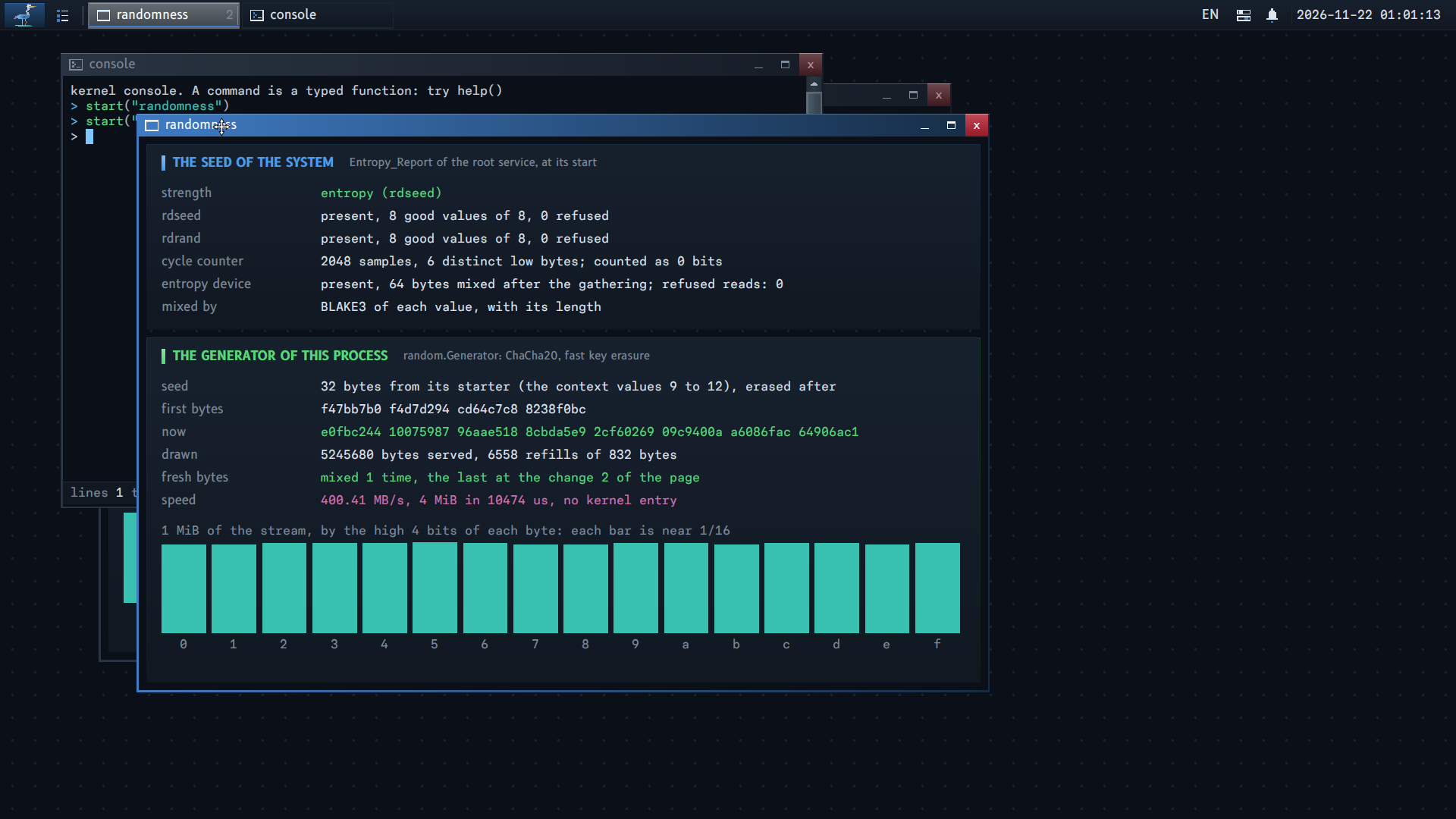
The random seed of modus no longer depends on the processor alone when the machine has the entropy device of virtio. At its start, the root service starts a device service for it, the program entropy, and asks it for two reads of 32 bytes. It does not wait for them: when they come, it mixes them into the generator that gives each program its seed. The bytes add to the bytes of the processor and never replace them, so a device that lies cannot weaken the seed. A read of zeros, of one value, with no byte, or equal to the read before adds nothing and counts as refused. The strength that the system claims does not change. The log says root: the entropy device gave 64 bytes in 2 reads: 64 bytes mixed into the random generator of the system; refused reads: 0, and the window of randomness shows the device. A machine with no such device starts as before, and its log says so.
With the setting keyboard_layout on french, AltGr, the right Alt key, gives the third level of the keys of the row of the digits: #, {, [, |, \, ^, @, ] and }. So the whole console language is typed with that layout. AltGr with the key of 2 is the dead tilde, and with the key of 7 the dead grave accent: ~ then n types ñ, and then Shift a types À. A space after them types the accent alone. AltGr with e` types no euro sign yet, because the fonts do not draw it.
modus is an operating system in which a program sees no other program, only the programs that it started. Its log service gave a program its own records only.
A program that starts programs now also reads what its children wrote. It lends the handle of a child to the log service for one call, and receives the records of that child, and of no other program. The handle is the proof: only the starter received it when it made the child. A grandchild is read only if the child gives its handle. In the machine test, log_reader starts two children and reads the one record of each, two times in a row, with no record of the first run in the second.
The log service gives a program its own records, with their times, levels, channels and value runs. It needs no right to read the whole machine: a connection to the log service is enough. The kernel writes the program slot and the program serial in each record, and the root service writes the two numbers of the caller in the grant of its connection. So a program receives the records of its own run only, and not those of an earlier program in the same slot. The console and remote act for the principal, and still read the whole log. The program log_reader checks it in the machine test: from the number 0, it receives its own record and no row of another program.
Shown - in the next release - the guide Architecture
A thread can now count four events of the processor for its own code: the instructions retired, the cycles, the cache misses and the branch misses. It counts in user mode only, so no work of the kernel and no other thread is in its counts. The kernel keeps the counts of a thread when it leaves a processor. A developer measures with them what a data layout costs in cache misses, and not only in time. The program counters reads the same 2 MiB of memory in order and one page apart, and writes the counts of each order on the log. A count of the misses of a shared cache also shows what other programs do, so the counters are a grant: the right Counters of the machine handle. The kernel programs the counters of Intel and of AMD Zen; on a machine with neither, the commands say Unsupported.
The kernel keeps a module record for each module in a program: its addresses and its hash. The reports of a fault, the manual and the console name the code of a program with these records.
Now the kernel marks each record with its writer: starter when the program that started the program wrote it, program when the program wrote it for itself. A program cannot remove or replace a record of its starter. It cannot unmap the code of that module or map other memory at its addresses either. So a record of the writer starter names the code that really runs at those addresses.
program_modules() in the console, inspect.modules() and manual.running() show the writer in a field writer. In the main machine test, the program imports tries the four changes, and the kernel refuses each one.
A named principal changes its passphrase and its recovery key
Shown - in the next release - the guide Principals
Before, a named principal got a new passphrase only after a recovery, when the TPM refused its keys. Its recovery key never changed.
Now a console of the session asks for a change. passphrase_change() opens the window of unlock, which asks for the current passphrase first; the TPM counts a wrong one. The TPM then seals the keys to the new passphrase. recovery_key_change() shows a new recovery key one time, and writes the file after Enter.
The keys themselves do not change: they are the principal. The store keeps the file from before the change as a version on the same disk, and that version still opens with the old passphrase and the old recovery key. So today a change protects the keys only against a party who knows the old secret and never gets this disk. The erase of the old versions is planned.
In the test, after a change the old passphrase is refused and counted, and the new one opens the session. On another system, the recovery key from before is refused, and the new one opens the keys.
A principal asks for its recovery key with no wrong try
Shown - in the next release - the guide Principals
The TPM counts each wrong passphrase of a named principal, and of the machine, in one count. After three wrong tries on the test TPM, it refuses each try for a time. A principal who lost the passphrase had to type wrong tries until the TPM refused, and each one also counted against the machine passphrase.
Now the window of unlock has the item Ctrl+R "recovery key" at the passphrase of a named principal, as it has at the machine passphrase. Ctrl+R asks for the recovery key at once, and nothing reaches the TPM. Enter with nothing goes back to the passphrase. The recovery key opens the keys. With Secure Boot on, the window then asks for a new passphrase, and the TPM seals the keys to it.
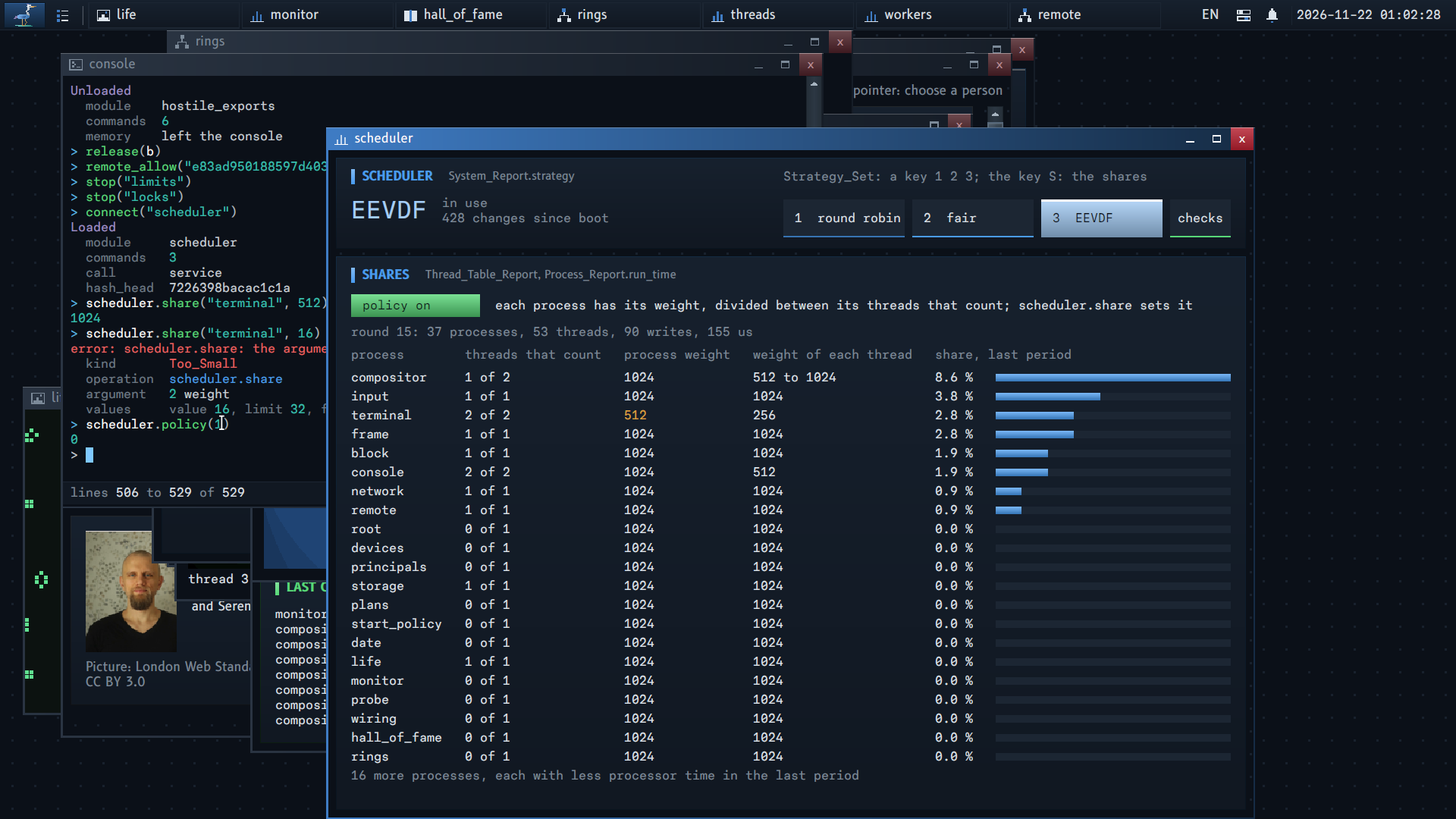
The share policy of the program scheduler gives each program one program weight, whatever its count of threads. A round runs each 100 ms. A program could create threads just after a round that ended before the next one: no round saw them, and each one had the whole program weight. Now each thread and each program have a new-thread weight limit, which only the holder of the machine writes, and a new thread gets the smaller of the two. Each round writes the program weight divided by 32 to each program before it reads its threads. A program has at most 32 threads, so after its first round the threads that no round saw sum to under one program weight, also for a program that knows the moments of the rounds. The machine test starts a program that keeps 6 short threads alive and, after one round, reads 24 of its threads that no round saw: each one has the weight 32. Without the policy, a new thread gets the limit of its creator, as before.
Some calls answered a name that names nothing with an empty text or 0. manual.about("nothing") gave an empty line, as for a module with no documentation. settings.get("colour") gave an empty text. storage.stores() gave the text "no grant to see the stores" to a caller with no grant. next_prime above 2^40 gave 0. Each of these calls now fails with an error record, and the console writes its sentence: "error: manual.about: the argument name names none of the modules (-1)". A program that calls them now tells an empty answer from a failure.
modus is an operating system in which a program sees no other program. A program reads its own log records back through the log service, but until now all records shared one ring of 2047. A program that wrote many records pushed out the records of the others, and a reader that counted its lost records learned how much the others wrote.
The kernel now also keeps the last 64 records of each program in a ring that only that program fills. The budget of the program pays its 4 pages, and they return to the budget when the last handle to the stopped program closes. The log service reads there, with one new kernel operation, Log_Read, a caller's own records and the records of a child whose handle a starter lends. The kernel now has 35 operations.
In the machine test, a child of log_reader writes 2111 records after one record of log_reader and one record of each of its two other children. The whole log no longer holds those three records, but log_reader still reads each one, as the first record of its program, with nothing lost. A reader that acts for the principal still reads every record of the whole log, in order.
Fixed - in the next release - the guide Principals
A console of a session can open the window of unlock to set the machine passphrase or to seal the machine key. The window shows a recovery key one time. Before, the window stayed open after lock(): anyone at the locked machine could read that recovery key, or type a machine passphrase.
Now the lock stops the window of unlock, whatever it shows. The window writes its record only after Enter, when the recovery key is written down. So the stop loses nothing: the disk stays as it was, and the owner asks again. The creation of a principal follows the same rule: its file is written, and its session starts, after Enter on its recovery key.
A kernel command that the kernel refuses gave one error record: the first argument that was wrong. A program can now give the command a table of error details. The kernel then writes the error record, and one more detail for each other argument that it finds wrong: a handle, a count above its limit, an unknown flag, a choice out of its range. The program errors gives Memory_Create a budget that names nothing and an unknown flag, and the log shows the two lines. A command with no table runs the same lines of the kernel as before. The program errors prints the time of a command with a table and with none.
A disk can answer Ok to a write and not keep it. Before, the storage service found such a write only at the next start of the machine. A commit made in the meantime could then damage the object for good.
Now each commit reads back the blocks that it wrote before it writes its root, then reads back its root. If one block differs, the service refuses the commit, writes one line on the log, and serves the objects as they were before that commit, at once. The root of a refused commit never reaches the disk.
In the test, the disk of the tool drops the block of data of a second version. The console gets the refusal, and reads the first version on the same machine.
The read back costs one read for each block that a commit writes. storage.stores() gives the count of these reads and their time. A disk that answers the read from the same cache that lost the write is not found this way: the check at the next start stays for that case.
Shown - in the next release - the guide Principals
A principal allows the key of a client of remote once. The key now lasts across a restart of the machine, in the disk grant table of that principal, beside the grants of its disk programs and under the same tag.
After the restart, the key holds again when the table is read: at the unlock of a named principal, or when principal 0 gets its machine key. A call of that client then acts for the principal, with no new remote_allow.
remote_disallow takes the key out of the table, and says when the disk did not take the revocation, so that the key can come back at the next start. remote_clients() now also gives the state of each key: holds, locked while the session is locked, or contested when another principal allowed the same key: such a key acts for neither principal until one of them revokes it.
A call from another machine acts for the principal that allowed its client
Shown - in the next release - the guide Principals
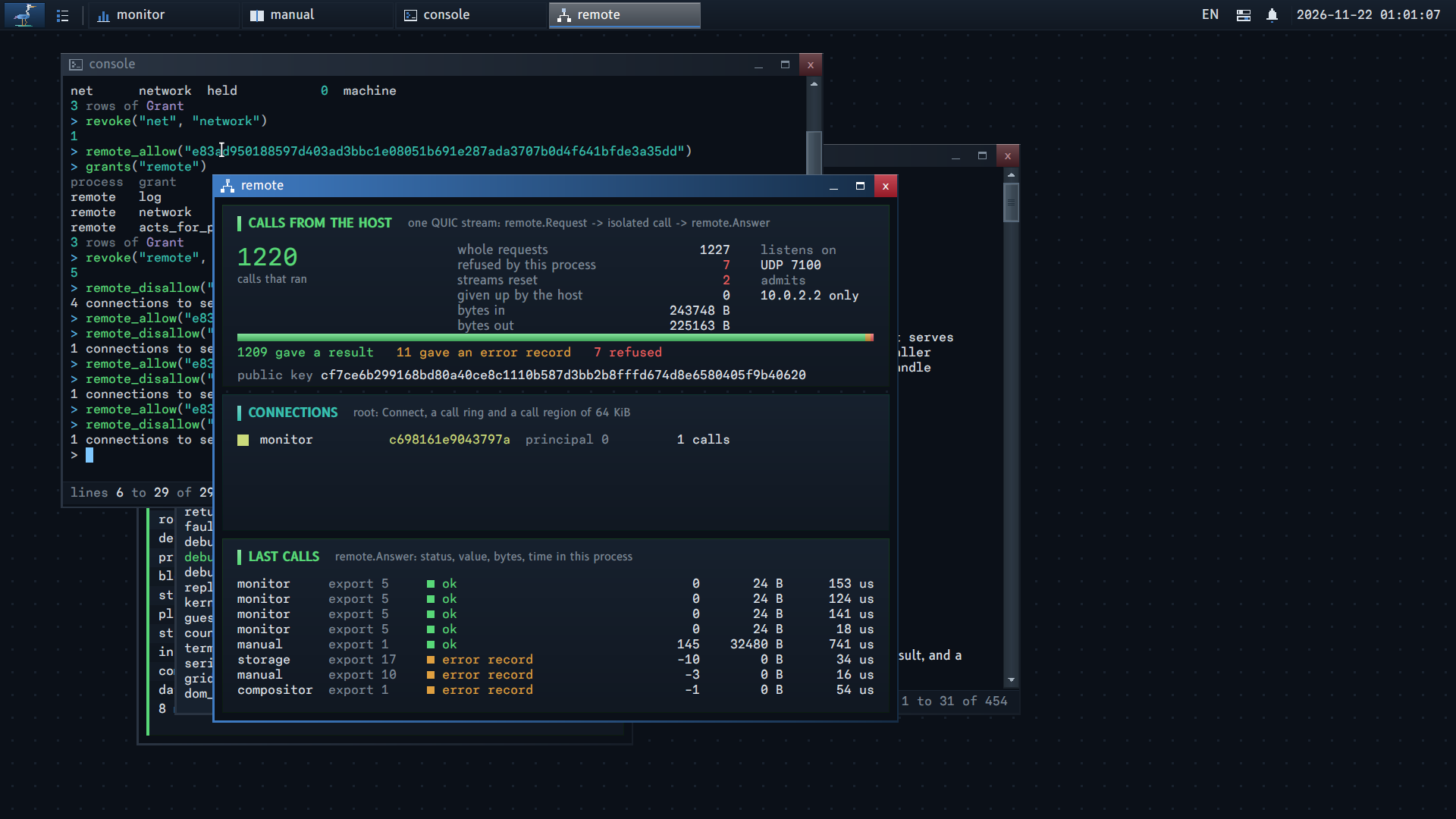
The program remote takes calls from another machine over QUIC. Each client now proves a key of its own in the handshake, and remote takes only a key that a principal allowed.
A principal allows a key in a console that acts for it: remote_allow("<64 hexadecimal digits>"). Each call of that client then acts for that principal, and sees what a console of that principal sees. A key that no principal allowed is refused in its handshake, before any call, with one line on the log.
remote_disallow ends the grant. The open connection of the client ends at once with the code Revoked, and the next handshake of the key is refused. A lock of the session of the principal ends the grant in the same way, until the unlock. remote_clients() lists the keys that a principal allowed.
modustool run prints the key of the client of its peer for each run, with the line to type in the console.
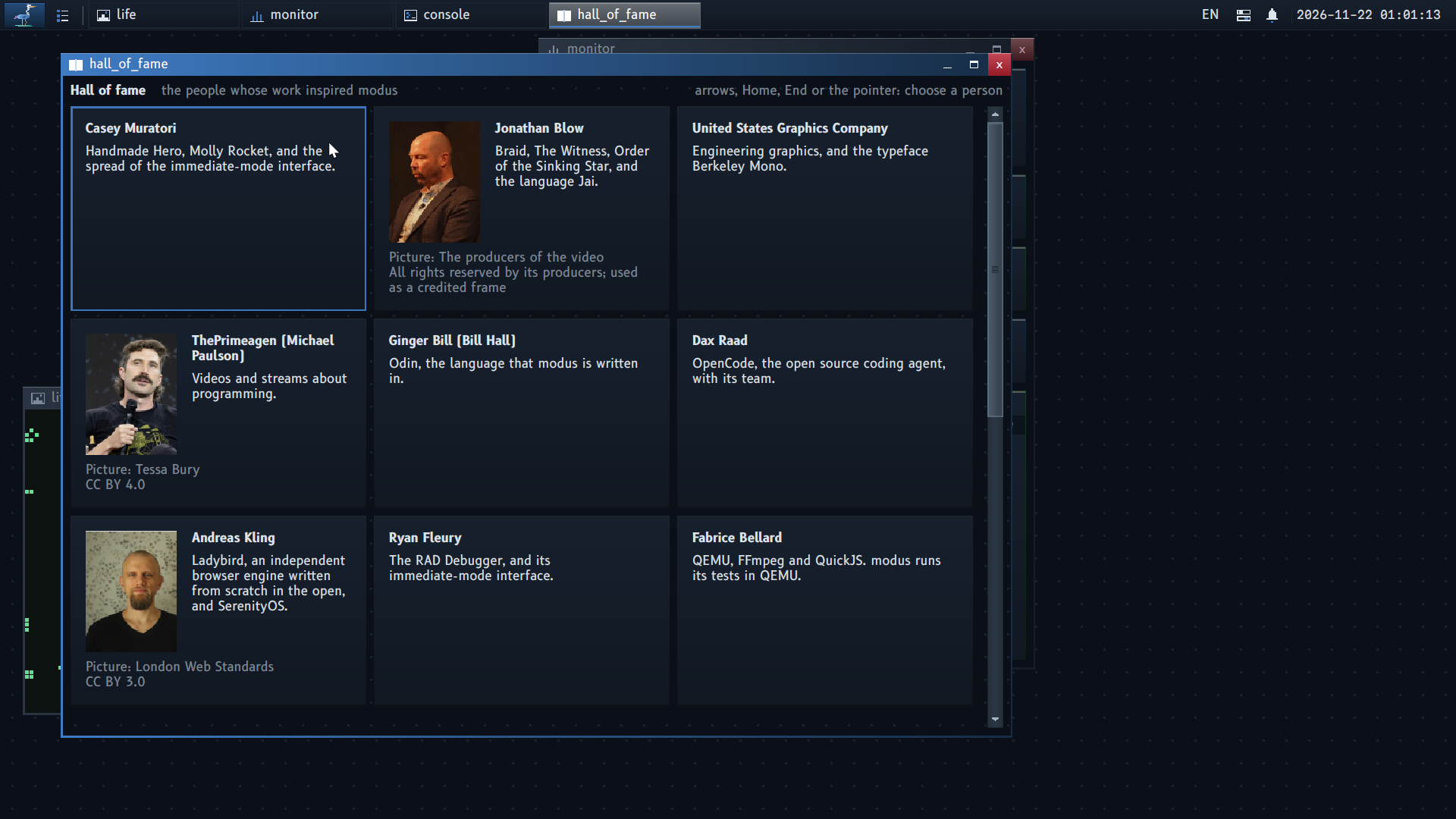
The wheel of the mouse now moves the view under the pointer. One notch moves it by three lines. This works over the lines of a terminal and its completion list, the text of the program manual, the cards of hall_of_fame, a list, and the rows of the palette. A view shorter than three lines moves by its own height, so a notch never skips a line that the view did not show. Only the window in front gets the wheel, as it gets the keys: a window behind does not move. The input service asks the mouse for its wheel at the start, and the log says input: ok, the mouse has a wheel. The machine test turns the wheel over the console, a list and the palette, and waits for the line of each view that moved.
The TPM seals the keys of a named principal and counts its wrong passphrases
Shown - in the next release - the guide Principals
On a machine with a TPM and Secure Boot on, principal_create("alice") now has the TPM seal the keys of alice to the measure of the system and to her passphrase together. Another system, another machine, or a copy of the disk opens nothing. The TPM counts each wrong passphrase. After three on the test machines, it refuses each try for a time, the right passphrase too. This count holds only while the lockout hierarchy of the TPM has an authorization value that an attacker does not know, and modus does not set one yet.
The window of unlock shows a recovery key one time, at the creation. When the TPM refuses, or when alice loses her passphrase, the recovery key opens her keys. The window then asks for a passphrase, and the TPM seals the keys again to it and to the system that runs.
The budget that a program asks for is now mostly counted, not guessed. Its source states only what no file shows: its working memory, its programs, its threads and the size of its window.
The build adds three parts that are facts: the pages of the module and of each module that it imports, a stack and a thread area for each thread, and the two pictures of the window. A window of 1000 x 704 is 1375 pages. When a module grows, its request grows with it, with no change of its source.
The page of each program on the site shows the parts of its budget, and each build prints the request of each module once.
A program that keeps the same bytes under two names now pays their blocks one time. The storage service finds an object of a store by its hash. When a commit gives an entry the bytes of an object that the store holds already, the entry names the blocks of that object, and no block of it is written.
In the machine test, the program ranges writes an object of 1 MiB under two names. The store holds 261 blocks for both: 256 blocks of data, 4 object nodes and the root. A change of one block of the second name writes 3 blocks, and the first name keeps its bytes. After a new start of the machine, a third name of the same bytes takes no block.
The index is in the memory of the service, and the open of the disk makes it from the entries. So a loss of power leaves nothing of it to repair. The service never trusts the hash of an entry alone: it computes the hash again from the blocks before an entry names them.
A field of a command in the palette now shows what its number counts. Type >buffer and Enter: the band shows buffer(count: pages), and the unit stays after the number while it is typed. The command wait_stop shows ms after its number. The unit is in the color of a size or of a time, as in the log. The number is typed in the unit that the command reads; the palette converts nothing.
The buttons of a field now take the pointer. The command strategy shows its three strategies as buttons in the band: a press on one takes it, as Tab takes the one that Left and Right chose.
A program from a disk runs under a nickname that the principal chose. The menu of the windows, the palette and the monitor now show that nickname with the first 16 digits of the hash of the file faded beside it, so a reader sees which file runs under the name. A nickname that only looks like the name of a program of the system, such as consoIe, has its digits beside it too.
Both come from the root service, which checked the bytes before the start. The program does not choose them: a program that asks for the title console still gets a window with its own nickname. The title bar of the window shows the nickname without the digits.
The monitor finds each program from a disk on a page that the root service writes, by the place of the program in the kernel. A program from a disk cannot start a child, so no child of it can take the name of another program in the monitor.
The grants of the machine survive a restart under a machine passphrase
Shown - in the next release - the guide Principals
The machine can now have a passphrase. In the console, machine_passphrase() opens the window of unlock, which asks for it two times. The passphrase is never a line of the console.
With a machine passphrase, the grants that the console gives to a disk program are kept on the disk, in a table signed by the machine key. At the next start, the window of unlock asks for the passphrase, and the grants come back. Until it is typed, the machine runs, and its disk programs start with no grant.
A table that another key signed is refused, with a line of the log, and gives no grant. So a reader of the disk who has no passphrase cannot give a program a store. With no machine passphrase, nothing is typed, and the grants last until the machine stops, as before.
The TPM releases the machine key to the measured system only
Shown - in the next release - the guide Principals
A machine with no machine passphrase and with Secure Boot on can now keep its disk grants across a restart. machine_seal() in the console makes a machine key, and the new TPM service seals it to PCR 7 and PCR 11: the state of Secure Boot and the measure of the system description. At each start of the same system, the TPM gives the key back and nothing is typed. An older or a changed system, or a copy of the disk on another machine, gets nothing from the TPM. Before each unseal the TPM proves that it made the sealed object under those PCR values, so a record that another system wrote is refused.
The window of unlock shows a recovery key one time, as 32 characters in groups of 4. When the TPM refuses, for example after an update of the system, that key opens the machine key, and unlock seals it again to the system that runs. The TPM service is a program: it builds each command of the TPM itself, and its one client cannot send it a raw command.
The IOMMU of AMD holds a device in the memory of its service
Shown - in the next release - the guide Architecture
The kernel programs the IOMMU of AMD when the firmware lists one, as it programs the IOMMU of Intel. One boot image runs on both. A device reads and writes only the pages that its service declared, and sends only the message interrupts that its service was given. A device with no service reaches no memory and sends no interrupt. A refused access is one line on the log with the device, the address and a count, and no program stops. The test machine with the IOMMU of AMD starts the whole system with translation and interrupt remapping on. A test device service then gets its message interrupt through the interrupt table of its device, and reads a block into a page that it no longer declares: the page keeps its bytes, and the line of the fault names the device. The emulated unit records no refused interrupt, so the refusal of a forged interrupt is tested on the IOMMU of Intel only.
Shown - in the next release - the guide Architecture
A machine of Intel has more than one remapping unit, devices behind bridges, and memory that the firmware keeps for a device. The kernel now programs up to 4 units, and gives each device the unit that the firmware names for it. A device behind a bridge of PCI Express has its own domain. A device behind an older bridge of PCI gets none, and the log says why: every device behind such a bridge has the same name for the IOMMU. The memory that the firmware keeps for a device stays mapped for that device, and no program gets it. On a machine with the IOMMU, the memory of an endpoint of the network no longer needs 512 KiB in one run: the device sees its pages in one run through the IOMMU. The test machine with the IOMMU puts its disk of the measures behind a bridge, and the device of that disk still reaches only the memory of its service.
The table of the programs that run has a new column, hash. For a program that the root service started from a disk, it holds the whole hash of the file that the root service checked: 64 hexadecimal digits. For each program of the system, it is empty.
The window of the monitor shows the first 16 digits under the nickname. The console and the host now read all 64 digits from the same source: columns(where(programs(), "name", "visitor"), "name hash"). A reader can compare that hash with the hash of a file, or join the table with the modules that run.
A module built outside the repository runs on a machine from its data disk. When it stops on a fault, the root service now keeps its stop report: before, the report left the machine with the program.
Type stop_report("outsider_fault") in the console. No attach is needed. The debugger reads the debug object of the module from the disk, and gives one row for each frame of the stack: the procedure, the source file by the name of the folder of the developer, and the line.
The report holds only the frames that a module of the program holds, so no word of the memory of the program leaves it. The caller must act for the principal of the program.
The window of the debugger now does each act of the debugger without the console.
A developer types a place in one field: a procedure, a file and a line, an address or a global. Three buttons put a breakpoint there, a watch on its bytes, or show 128 bytes of the memory of the program from it. The memory card shows each row as an address, 16 bytes and their characters, and the window reads it again each half second.
A click on a row does what a key does: it chooses a thread or a frame, puts a breakpoint at a source line, or removes a breakpoint.
A module built outside the repository runs on a machine from its data disk, with no new boot image. Its debug object now goes beside it on the disk, under the hash of the module, and the module file keeps its hash.
When the debugger attaches to such a program, it reads that debug object through the storage service, with a connection that reads only and that ends after the read. It uses the object only when the object names the hash of the module that runs.
The stack of the program then shows its procedures, its source files by the name of the folder of the developer, and its lines: entry outsider/main.odin 81.
Each text that two programs share is now UTF-8: an entry of the palette, a result, a record of the terminal, a line of the log, the name of an object of a store. Before, each of these contracts took the bytes 32 to 126 only.
One rule checks each text at its border. It refuses an overlong form, a surrogate, a code point above U+10FFFF, a broken sequence and a control character. The kernel applies it to each line of the log, so no program can write an escape sequence to the serial port.
In the console, "caf"+character(233) gives café, and length(character(233)) gives 2. The fonts have no glyph for é yet: the terminal draws a box in its cell, one cell for one character, never a raw byte.
The names of modules, exports, settings and programs stay ASCII: each keyboard types them, and each has one form only.
The terminal and the compositor now draw with the drawing module, as 32 other programs did before. The system holds one copy of that code for 34 programs, and one correction reaches each of them, the screen of the desktop too.
The text of a terminal is a grid of up to 104 by 32 cells. Its cells now travel with the texts of the frame, so the module compares and draws them with no new argument. A frame of the terminal crosses into the module at most 9 times, whatever the count of colors in its lines.
Each window on the desktop shows the memory of another program. The compositor now draws each window with a call of its own. With 17 windows, a frame of 8 changed rectangles makes at most 144 calls: about 0.35 microseconds, against about 1.3 milliseconds for the whole screen.
The programs heron, life, paint, plasma and temple, and the three programs that compute a picture with several threads, now draw their windows with the drawing module, as 24 other programs did before. The system then holds one copy of that code for 32 programs, and one correction reaches each of them.
A picture of a program used to be named by an address, which an export of a module cannot carry. It is now named by values: the place of its first pixel in one run of pixels of the program, and the pixels from one line to the next. The module reads those pixels where the program has them, with no copy.
The screen shows the same pixels as before. The terminal and the compositor still hold their own copy of the drawing code.
With the setting keyboard_layout on french, the key of 2 types é, and the other keys of the row of the digits type è, ç and à. The key right of P is a dead key: ^ then e types ê, and with Shift it gives the diaeresis of ë, ï and ü. The console keeps the line in UTF-8, and Left, Right and Backspace move over or remove a whole character. Each font of the system draws the 96 characters of the Latin-1 Supplement, so é shows as a letter and not as a box. A passphrase can hold them too.
A device sends only the interrupts that its service was given
Shown - in the next release - the guide Architecture
A message interrupt is a write of 4 bytes to the interrupt addresses, and a device can make that write as any other. Before, a device service could give those addresses to its device as a buffer, and make it send any interrupt of the machine. The kernel now turns interrupt remapping on in the IOMMU of Intel. Each message interrupt that the kernel makes has an entry that names its device, and the IOMMU refuses the message to every other device. A refused interrupt writes one line on the log with the device, the entry and the reason, and nothing stops. The test machine with the IOMMU runs the whole system with remapping on. A test device service reads a block into the interrupt addresses, and the log shows that the IOMMU refused its messages. The IOMMU of AMD is not built yet.
The program hall_of_fame shows the people whose work inspired modus: the language that it is written in, the emulator that runs its tests, the immediate-mode interface, game engines, browser engines, and streams that build programs from scratch. It replaces the temple of Jon, which showed one turning portrait.
Each person has a card with the name and one line on what they made. Five cards have a portrait, with the author and the license of the picture under it. A person with no picture under a free license has a card with no picture: the system invents no face.
The arrows, Home, End and the pointer choose a card. The view moves by whole rows, so no card and no text is cut at its edge. The page of the licenses of the site lists each portrait with its source.
The disk grants of a named principal survive a restart
Shown - in the next release - the guide Principals
A named principal now gives a grant to a program from a disk in its own session. A console that the desktop starts during the session of alice acts for alice: allow("visitor", "store") gives the nickname visitor a store of its own for alice.
The grant lasts across a restart of the machine. The table of alice is on the disk, in her store of module files, with a tag under a key that only her passphrase opens. When alice unlocks her session again, the root service reads the table, and visitor starts with its store and finds its data.
A table that another key signed gives no grant. A reader of the disk with no passphrase cannot add a grant to alice.
An export of a module takes up to 12 arguments: its parameters, the buffer of its result and its error record. The first six go in the registers of the processor, the others on the stack, as the C convention of the machine passes them, so each language that writes a C function writes an export.
The limit was six arguments, one for each register. It made a module take some of its work in pieces: the drawing module draws one damage rectangle in each call. The description of a module states each parameter of each export, at each count, so the console, a call from another machine and the manual call and show such an export.
The module format is version 2. A module of an earlier release does not load.
An export of a module now says what its number counts. Type load("cryptography") in the console, then >hkdf_sha256_expand and Enter in the palette: the field of the length shows bytes after the number, as the field of buffer shows pages. The exports debugger.memory, debugger.watch, debugger.wait_stop and storage.set_size state their units too.
The unit is in the description of the export, so the palette needs no code for one program. The unit is also part of the meaning of the export. A replacement whose export takes bytes where the import took pages fails the check of the loader, and the sentence names both units. A program that declares the import with another unit does not build.
The pages Releases and News of the site now have a button "Subscribe" under their heading. It opens a small menu with two links: the Atom feed of the page, and the releases of the repository on GitHub, where the button "Watch" sends a notification at each release.
The menu opens and closes with no script, with the pointer or with Enter. With the script, Escape or a click outside closes it. The menu is as wide as its longest line, so no label is cut.
The network service copies only the first 8 bytes of the header, to check the ports against the grant of the program. It writes the headers of IPv4 and Ethernet before them. It reads no byte of the data.
The frame service holds each datagram region with the right Read only. On a machine with the IOMMU, the device can read the region and cannot write it.
A program gets the completion of its send when the device has read the datagram. It writes the same place again only after that.
When a program stops, the log of the network service gives the bytes of the data that it read on send: 0.
Each release can now publish the system as one file: a disk image that dd writes to a USB key. The image is a GPT disk whose one partition holds the boot program of the system, signed for Secure Boot.
Beside it are SHA256SUMS.txt and its signature by the release signing key of the publisher. modustool verify checks both, and OpenSSL and sha256sum do the same check with no tool.
A published image is never a test image. The release command refuses the test keys, whose private keys are in the repository, and every boot image of a test.
With Secure Boot on, the firmware starts the image after a principal enrolled the certificate of the publisher, which the site publishes. The guide says how, and what a start with Secure Boot off loses: the seal of the machine key by the TPM.
The first image comes with the first release that the keys of the publisher sign.
Each release on the page of the releases now gives its time, to the minute, in UTC: 2026-11-15 18:48 UTC. Several releases can come out on one day, and the time keeps them in order. The feed of the releases gives the same time, so a feed reader shows when a release came out, not midnight.
A release is now also a signed git tag, v and its number, on the commit of the release. The changelog links each release to its tag. One command makes the release, the commit and the tag, and sends the commit and the tag together, or neither.
Some old releases were written together, after the fact, and no record holds their time. They keep their day alone.
A replacement gives one module in place of another to every program that imports it. The drawing module is imported by the compositor, which holds every window and every key, and by the terminal. So a replacement now needs the consent of the key that signs the system.
The boot image holds a replacement list: each row names the two modules and the programs that it reaches, and the key signs the three together. The console still types replace("calendar", "calendar_fixed"), and the root service accepts it because a signed row names that pair.
Type replace("calendar", "math"): the console says "error: the root service refused the replacement of calendar by math: no signed row names it", and the log has the same reason. A row that another key signed is refused too. In both cases calendar stays in place, with its fault.
Shown - in the next release - the guide Architecture
A program can now run another system on the processor, in a guest, with the virtualization support of AMD processors.
A guest is a program that no thread runs: the memory that its holder maps in it is the memory of the guest. The holder runs the guest processor with one new kernel operation, Guest_Run. Each time the guest does what it may not do alone, such as a write to a port, the operation ends, and its result says what the guest did. The holder answers, then runs the guest again.
The program guest_demo shows it. Its guest is seven bytes of 16-bit code: it writes 42 to the port 0x80, then halts. The log says "guest_demo: the guest wrote 42 to the port 0x80, then halted after it". The kernel has 34 operations now.
Linux in a guest is the work that comes after this one.
A program and its library modules can now reach a machine that runs, with no new boot image. Put both files in the store of the programs, under any names. start_from_disk("store_importer", hash) then starts the program with its library.
The import of the program names the hash of the library, not a name. The root service reads each file of the store, computes the hash of its bytes, and gives the loader the file whose hash the import names. The imports of that library are found the same way.
A file with other bytes under the name of the library does not run: the start is refused, and the log names the hash that no file has.
A module file can now reach a machine that runs, with no new disk. In the console, connect("programs") opens the module file service. programs.receive("visitor", "/visitor") fetches the file from a web server, stores it in the store of the programs, and gives the hash of its bytes. start_from_disk("visitor", hash) then starts it.
programs.list() shows each file of that store with the hash of its bytes, which the service reads again.
The service only carries the bytes. The root service checks them against the hash at each start, so a file with other bytes never runs under that hash. The service writes only the store of the programs, and only for a caller that acts for the principal.
A scroll bar of the system was a flat rectangle that showed a place. It is now a control. It has an arrow button at each end, a track, and a thumb with a border, a gradient across it and a grip of four lines. With the pointer over it, the bar takes blue tones. A press on an arrow button moves the view by one line, and again while the button is held. A press on the track moves the view by one page. The thumb follows the pointer while it is held. The window of a terminal and the window of the program manual have this scroll bar; the lists and the palette show it. Every scroll bar is one element of the interface package, 17 pixels thick. The scroll bars of the site are written from the same table of sizes and colors, in the dark and in the light form.
The site has a new page, Roadmap, beside the page Releases. The page Releases lists the work that is done. The page Roadmap lists the work that is planned. It has three parts. Now is the work that is in progress. Next is the work that is decided and comes after. Later is the work that is wanted and has no order. Each entry is a card with a short summary and one or two sentences that say what the work gives a user of the system. An entry gives no date. When a work is done, its entry leaves the page, and the work is a change of a release. The search of the site finds each entry by its summary. The page is made from one file of the repository, ROADMAP.md, which a reader understands with no tool.
The system has a program named heron. Its window shows the heron of the mark, drawn large from its square cells, in its water. The heron plays its fifteen animations by the rule of the home of the site: each one once in a round, in an order that chance gives, and it is still for about 40 percent of the time. In the dash the heron runs out of the window by the right and comes back by the left. A squash or a stretch is one of the drawn forms of the heron, in whole square cells, the same drawings as on the site, and the heron travels by whole cells. The key g draws the same moves in a free way, where the frame is stretched and its cells become rectangles, so a reader can compare the two. The keys 1 to 9 and a to f play one animation at once. Space pauses, and the dot shows the next frame. The key l shows the lines between the cells and a white outline around each cell that a frame changes: an animation changes a few cells. The picture shows the dash held at its third frame, in the form of the run. The window draws again only the part that changed, and the log gives the time and the damage of a picture as measures.
The palette now reaches the scheduling strategy of the machine. Type :strat and the list shows one entry for each strategy of the kernel: round robin, fair and EEVDF. The one that the machine uses now says setting,in use. Enter sets the chosen one, and the machine changes its strategy with no stop. The program scheduler does the change, because it is the one program with that right; it must run. The console has the same act as a command, strategy("eevdf").
The pointer does more in the panel. A press in a field of the form of a command puts the caret there, and a press on a candidate takes it. The scroll bar of the list moves the rows: the arrow buttons, the track and the thumb work as in a terminal. The completion list of the console has the same scroll bar.
Type :font in the palette, and the font is one row: its name, then one button for each value, with a line under the font in use. Right chooses the next value, and Enter sets it behind the open panel. The scheduling strategy is one row of three buttons too.
The input band now says what the chosen entry does: enter: run, or enter enter: destroy for an entry that asks for a second Enter. When a window of the desktop acts on the same setting, it adds shift enter: go to. Shift and Enter bring the window of settings to the front, with the focus on the button of that setting. A program names its buttons for this in one call, and the palette finds them.
Shown - in the next release - the guide Architecture
The kernel programs the IOMMU of Intel when the firmware lists one. A device then reads and writes only the pages that its device service declared, at the moment it asked the kernel for their physical address. A device service with a fault can no longer make its device write the memory of another program. An access to another page is refused: the kernel writes one line on the log with the device, the address and the count of such faults, and no program stops. The test machine with the IOMMU starts the whole system with translation on. Then a test device service reads a block of the disk into a page that it did not declare: the page keeps its bytes, the line of the fault comes, and the service still answers. A machine with no IOMMU writes one line at its start and runs as before. The IOMMU of AMD and interrupt remapping are not built.
The home of the site has a line of time of the start of the machine. One bar shows the whole start on one scale: the firmware takes most of it. A second bar shows the stages of the boot program and of the kernel on a larger scale, and a sentence says how much larger. Each stage has a row with its name and its time. Point at a stage, or give it the focus, and a card says what the stage does, which code runs it, and where its guide is. The measures of the home are now charts: bars of one unit, from zero. A measure that is not such a chart is on the page of the measured numbers. The newest release shows its number, its counts and its first changes. A press on the heron plays an animation at once. Each button of the site now shows the pointer, the focus and a press, in the colors of the buttons of the desktop.
The heron of the home is pixel art: a grid of square cells. When it squashed before a dash or stretched in a hop, the page made its whole picture wider or higher, and the cells became rectangles. That is gone. A cell of the heron is now a square of one size in every picture. A squashed heron is another drawing of the heron in the same cells: the crouch before the dash is 28 cells wide and 19 high, where the heron at rest is 24 by 22. Four columns of the body are drawn two times, and two rows of the neck and one of the legs are left out. The head, the eye, the beak and the crest are the same cells in each of the ten forms. The leg that the heron stands on stays above its foot. Two forms are corrected by hand, cell by cell: a leg of the run that was two cells thick, two feet that joined, a tail too far from the body. The heron also travels by whole cells. In the dash it goes more than ten cells between two pictures of the screen, and it is never between two cells. The page changes the size of no picture.
The heron at the head of the home of the site had seven animations and stood still most of the time. It now has fifteen, and it is still for about 40 percent of the time. In the dash, the heron squashes, runs out of the window by its right edge, comes back by its left edge, goes past its place, squashes on the stop and stands again. The water stays where it is. The other new animations: a hop, a fish that jumps in front of the heron, a doze with a letter z of squares, a stretch, the wind in the crest, a change of the leg it stands on, and a flap of the wing. Each animation plays once before one plays again, in an order that chance gives, and none plays two times in a row. The page keeps what was played for the length of the visit, so a reader who comes back to the home sees another animation. A reader whose system asks for reduced motion sees a heron that does not move at all. Nothing plays in a hidden tab or while the reader types in the search. Each frame is still made of the square cells of the mark: a squash or a stretch changes the width and the height of the whole picture, with sharp pixels.
The site has a page named Gallery. It shows 109 pictures of the screen of the system, in 11 groups: the desktop and the palette, the console, the mark, the rights and the faults, the modules, the memory and the threads, the developer tools, the fonts, the network, the storage and the boot. Each picture has a caption of one sentence that says what it shows, and a link to the guide of its subject. A picture on the page is at one half of its size. Its link opens it at its full size, where one pixel of the picture is one pixel of the screen of the system.
The home now shows 8 of these pictures in one row, one picture in view. A numbered link above the row shows each picture, and the row also scrolls sideways. The row never changes its picture by itself. The picture of the program heron is one of the 8.
The pictures and their captions come from one table. A new picture of a machine test that the table does not name stops the build of the site, so no picture is left out.
The site has six sections, and six buttons do not fit the one line of its bar on a small window. The bar now has three buttons: Docs, Gallery and News. They are what a first reader looks for: what the system is, what it looks like, and what is new. A fourth button, Project, opens a small panel under it with three more pages: Status, Releases and Roadmap. They report how the project goes. The pictures of the system are one click from each page. The panel opens and closes with no script. On a phone, the menu of the site lists the six sections one under the other.
Until now, each program of the system was a file of the boot image. A new program needed a new boot image. A program can now be an object of the storage service, in a store named programs. In the console, the command start_from_disk takes the name of the program and the hash of its file. The root service reads the bytes from the storage service and computes their hash. It starts the program only when that hash is the hash of the command. So the storage service carries the bytes and does not choose what runs. Bytes with another hash are refused, and the log shows both hashes. A program from the disk receives the log and a window, and no grant. Its name gives it nothing: a file named notes does not get the store of notes, because the root service refuses that name. The root service does not wait for the storage service: it serves each other program while the bytes come, and a load ends after 30 seconds at most. The tool writes the data disk of the test and prints the hash of each file.
Everything that becomes the system is now in one folder of the repository, src: the kernel, the boot program, the programs, the modules, and the code that the programs share. That shared code is one source library. Its name is modus, and its folder is src/library. A source imports a package of it with one line, such as import "modus:support/system" or import "modus:contract/ring". The first word after the name says what the package is: contract is what two parties agree on, and support is what a program compiles in to use the contracts. The compiler gets the library with one flag, -collection:modus=src/library. A program in another repository writes the same lines and gives the same flag. The kernel imports the contract packages only. The tool reads each import of the kernel and of the contract packages before each build, and a build stops on an import that this rule refuses.
Each row of the palette now starts with a small picture that says what the row is: a window, a program, a command, an export of a module, a setting, or an act that stops something. A reader tells a window from a program before the reader reads a word. The word of the kind stays at the right of the row, so no picture stands alone. The color of the picture says one fact. A program that has a window is green, and a program that has none is dim. The window that has the focus is blue. The value of a setting that the machine uses is in the color of the text. On the chosen row the picture is white, as the text is. Each picture is a grid of 12 by 12 square cells, drawn as whole pixels: it has no curve and no blur. The pictures are one table of the system. The site draws the same table for its kinds of values, so a module or a command has one picture on the site and on the desktop.
The keyboard has a layout. The window of settings has a row for it, with two values: us, the QWERTY layout, and french, the AZERTY layout. The input service reads the setting at each key, so a change holds from the next key, with no restart.
The test of the machine types the same key under each layout: it gives a with the layout of France, then q with the layout of the United States.
A character of the system is one byte of ASCII today. A key whose character is outside ASCII, such as é or ç, gives no character yet; a program still gets its key code.
A program that comes from a disk can now get a grant. Its nickname is the name of its file in the store programs, and the principal chooses it. In the console, allow("visitor", "store") gives the program of that nickname a store of its own, disk-visitor, from its next start.
The grant names the file by its hash. A start of the nickname with another file is refused before a byte is read. nickname_move points the nickname to a new version of the file, and the store follows: the new version finds the data of the old one.
No command gives a disk program the ring of the root service, a right over the machine or a device, or the right to act for the principal. The grants of principal 0 last until the machine stops, because principal 0 has no passphrase to sign them; the data of the store stays on the disk.
The debugger has a window. Start debugger_window from the menu of the programs, type the name of a program that runs and press Enter: the window attaches to it. Four cards show what the console showed as tables: the threads, the stack of the chosen thread, and the variables and the source line of the chosen frame.
A key does each act. h holds a thread and r lets it run. s runs one instruction and l one source line. o runs one line over each call: the thread does not stop inside a procedure that the line calls. The console has that step too, as step_over(thread).
The window holds no right over a program. It calls the service debugger, as the console does, through a connection of its own, and the root service decides which program a caller can debug.
A film of the program heron showed, in one picture of the screen, the head of the heron with no body. The program had cleared a part of its window and had not drawn the heron in it yet, and the compositor read the window at that time. Three programs had a correction of their own. The 48 other programs with a window could show the same mix: a part of a new picture with a part of the old one.
The correction is now a rule of the system. The surface of every window has two pictures. A program draws one picture while the compositor reads the other, and the compositor shows a picture only when its program says that it is complete. A program that stops in the middle of a draw leaves its last complete picture on the screen. A new window shows its first picture whole, and nothing before it.
A program writes no code for the rule. The compositor never waits for a program, and it counts, for each window, the pictures that a program drew while the screen showed them: compositor.windows() gives the count, and the main test of the system checks that it is 0 for each window. The cost is memory: one picture more for each window, 2.8 MiB for the largest window.
Several windows drew a text over another text, or stopped a text at the edge of a panel. The stack trace of a stop report ended in the middle of a path. A long name of a module ran over the page beside it. The interface package now has one rule for a text that is wider than its place. The text goes on more lines. A line ends at a space. A path or a long name has no space, so its line ends after a /, a : or a _. No character is left out, and the text under it starts lower. Each of the 112 pictures of the screen was read for this fault, and 17 programs and the boot display were corrected: among them manual, errors, inspect, notes, fetch, net, imports, tables, server and log. In errors, a page now holds the cases that fit in its height, each with its whole sentence. The window of log shows each text whole, where it cut it at 80 characters. A card that cannot show each of its rows ends with a line that counts the rows that it does not show.
A weight belongs to a thread, so a program with 8 threads that compute had 8 times the weight of a program with one. The program scheduler now has a share policy. The command scheduler.policy(1) turns it on. Each program then has one program weight, and the policy divides it between the threads of the program that are ready or that ran. Four programs with 1, 2, 4 and 8 threads that compute get the thread weights 1024, 512, 256 and 128: each program has 1024 in all. The command scheduler.share("paint",256) gives the programs with one name another program weight. A program that lowered the weight of a thread keeps it. The kernel is not changed: the program reads the reports of the threads each 100 ms and writes the weights with its right to schedule. The key S of its window opens the view of the shares, with one row and one bar for each program. The policy is off when the program starts. It does not yet see threads that a program creates and ends between two rounds.
A module for the system can now be written in a folder of another project. The folder holds one Odin package and one small file, module.txt. The file gives the name of the module, the modules that it imports, and two more fields, one key: value on each line. The sources import the packages of the system from one source library, modus, with the lines of a program of the system.
One command builds the module: modustool module-build ., with the folder of the system in the variable MODUS_SYSTEM. The build runs the steps of a module of the system, with the same checks. It writes the module file and its debug object in the folder of the project, and prints the hash of the module file, which is its identity.
The full check of the system builds two modules in this way, from copies of the program tally and of the module agenda, and compares each with the module of the system.
The tool does not yet put such a module in the boot image of a machine, so it does not yet run there.
A program now says what it needs. The source of a module states one constant, MODULE_BUDGET: the pages, the programs and the threads that it asks for, with the reasons in its comment. The build writes it in the module file, so the hash of the module names it.
The root service decides. It gives a program its request up to 16384 pages, 8 programs and 32 threads, and writes a line on the log when it gives less. Two programs have an exception, each with its reason. A module with no request gets 2048 pages, one program and one thread. A program from a disk, or from another project, gets its request up to 8192 pages, one program and 4 threads, from one budget that pays all such programs, so a new program needs no change of the root service, and a file of a disk cannot take what the programs of the system need.
The page of each program on the site shows the budget that it asks for, beside its grants.
A program can now stop one of its threads, read and write its registers, and resume it. A debugger, a garbage collector, a sampling profiler and the program that runs a guest need this. A stop is a count: two stops need two resumes. A thread of another program can be stopped only with a thread handle that the program received. The kernel checks each write: a frame of the kernel, interrupts off, an address that is not canonical, or an extended state that the processor would refuse is refused, and the thread runs on unchanged. A fault handler can now move a thread past the instruction that faulted: the test skips a divide error, and the thread goes on with the result that the handler wrote. The test program fault_ring has 35 cases.
The key super now opens the palette, which replaces the launcher. It is one panel with one list: the programs that the system can start, the windows that are open, and the commands of the console. Each typed letter narrows the list. The match is the fuzzy match of the console: the letters appear in a name in their order, not always side by side, and a line marks each matched letter. Each row says what it is in words. Enter starts the chosen program or brings the chosen window to the front. A command with no argument runs from the panel, which shows a short result; a table opens in the console. A command with arguments turns the band into a form with one field for each argument, and the list proposes values: programs, modules, grants. Each value of each setting is an entry too. The close of a window and a command such as shutdown ask for a second Enter, on a red row that says what stops. The typed text is at twice the size of the font, in a band that touches the top, the left and the right edge of the panel, with no frame around it. The panel has no right of its own: a command runs in the console, with the grants of the console.
The window of the log now draws each value of a line in the color of what it is: a number or an address in teal, a size with its unit (the free memory in MiB) in teal, a time with its unit in amber, the name of a program in green, the head of a hash in amber, a status in red. These are the colors of the same kinds on the site. The program that writes a line says what each value is, and the log keeps it beside the text: no text is read for its look. The head of the column of the text is the legend. A line of the kernel in the channel boot, "kernel: boot: firmware: ...", shows from "firmware": its program and its channel are in their own columns. The text on the serial port is the same as before.
Each program with a window held its own copy of the code that draws a frame: the damage, the fills, the text and the blends, about 20 KiB in each file. That code is now the module drawing. 23 programs import it, and the system holds one copy.
A window calls the module two times for a frame. The first call gives the rectangles that changed since the frame before. The second call draws the records of the frame in these rectangles. Each call passes the tables of the program and the pixels of its surface by address: nothing is copied.
The parts that a program calls many times for a frame stay in the program: the buttons, the lists, the layout, the input. One such call through a module cost about 100 ns more in a measure of one run; a frame has 30 to 200 of them.
The manual and the module graph now show an edge from each of these programs to drawing. The programs that show a picture or a grid of text cells, and the compositor, still hold the drawing code: their turn needs a way to name a picture in the description of an export.
A test draws the same frames with the old code path and through the module, in each font, and compares the bytes of the two canvases.
The console can now debug a program that runs. The command debug with the name of a program attaches the debugger. A breakpoint is set at a procedure by its name, or at a line of a source file. When a thread stops there, the console shows the frames of its stack with the procedure and the line of each one, its local variables with their types and their values, and one variable by a path such as pair.next^.first. A thread runs one instruction, or one source line, at a time. A watch stops a thread at the instruction that writes some bytes. Each result is a table, so the commands of the console filter it as any table. The debugger is a service of the system, not code of the console: a developer on another machine calls the same commands with kerneltool call, and reads the source line from the repository. Not each program can be debugged: a program with no grant can, and a service cannot, because a debugger gets each access of the program that it debugs.
A weight and a request of a thread can now change while the thread runs. The weight is the share of the thread on a processor. The request is the length of the turns that it asks for. Before, a program gave both only when it created the thread. Someone outside the kernel chooses the values, and the kernel applies them with its own scheduling strategy: no code of a program runs when the kernel picks a thread. A program only lowers the weight and the request of its own threads. Only the machine handle with the right Schedule, which the system gives to the program scheduler only, raises them, for any thread; a thread with a raised weight starts again as a new thread. That handle also sets a weight limit: the thread, and each thread that it creates, then stays at or under that weight. The program scheduler writes the weights 1, 2 and 4 to 12 threads that run, and checks that the heavier weight gets more time under the fair strategy and EEVDF. It also checks that the kernel refuses each raise by the program.
Each thread now has a placement: the set of the processors that can run it. A thread with no placement runs on each processor, as before. A program can only narrow the set of its own threads. Only the machine handle with the right Schedule, which the system gives to the program scheduler only, writes any set, for any thread. That handle also writes a limit: the thread, and each thread and each program that it creates, then stay on the processors of the limit. So two programs whose limits share no processor never run on the same processor, which takes away the side channels of one processor between them. It does not take away all of them: the kernel does not know which processors are two halves of one core, and the cache that all the cores share stays shared. A thread that changes its queue for a placement keeps what it owes to the other threads. The program scheduler checks, on the 4 processors of the test machine, that a thread that keeps one processor is then reported only there, that the kernel refuses each write that widens a set, and that two groups of threads with no common processor stay apart in 200 reports.
When a program stops on a fault, the console, the test program errors and the developer tool inspect now name each frame of its stack trace with its procedure and its source line: fault::three + 0x8 in fault (programs/fault/main.odin:15), where they showed fault +0x1478. The names come from a debug object that the build writes for each module, a small table of procedures and lines that a program reads with a binary search. The debug objects are one file on the boot volume, beside the boot program: the boot image does not grow, and a module has the same bytes, so the same hash, with and without them. The kernel still writes offsets on its log. A debugger in the console is designed, not built.
The reference of the site has a page for the module graph: each module and program of the build is a bar as long as its bytes, and each import is a line from the importer to the module that it imports. The columns follow the depth of the imports; the modules with no import and no importer are in a band under them. A pointer or the focus on a module marks its lines and its neighbours and shows its identity card: its hash, its size, its counts of exports and imports, its license and its purpose. A table under the picture gives every import. Each module page shows its own card and a small figure of its neighbours. In the running system, manual.edges() gives the same graph for what is loaded now: which program holds which module, which module imports it, and which import a replacement changed.
The program manual shows the documentation that each module carries in its file. That text is the comments of the source of the module, written in a small part of Markdown. The manual now reads the marks. A bold word is in the bold weight. A word in italics has a thin line under it, because the system has no italic face. A name of code is in the monospace font, in the color of code. A list item has its mark and its indentation. An example is a block of rows. A link is a colored name. When a link names a module of the boot image, or one of its exports, it has a line under it, and a click on it shows that page. A row ends between two words, never inside one, unless one word is longer than the row. The help that the console prints for a command is the same plain line as before.
An object of a store is now a tree of blocks, and can hold 4 TiB. A block of zero bytes is a hole: it costs no block and reads as zero bytes. The machine test makes an object of 8 GiB with three writes; it holds 13 blocks. A program writes ranges of an object, then commits them in one step. The commit hashes the blocks that changed and the nodes above them, never the whole object: 1000 small writes spread over the object of 8 GiB, then one commit, hash 1001 blocks and 1018 nodes, and the test checks that bound. An old version still reads its old bytes, and shares its other blocks with the new state. A loss of power in a loop of range commits leaves the last commit or the commit in flight, never a mix.
The glossary of the site is now one page for each group of terms, as Code, Access or Network, and an index. The single page had 1 301 073 bytes once each of its 460 terms had its explanation. No page of the glossary is larger than 1 MB now. The index lists every term from A to Z, with its group and its short definition. A link to a term on any page opens the page of its group. An address of an entry at the index still works: the index sends it to the page of the group.
The letters of the name of the mark are now a font file, resources/logo/modus_mark.ttf. Its glyphs are the square cells of the five letters of "modus", from the same table as the pictures of the mark: each letter is one outline around its cells. One em is 8 cells, so a text at 16 pixels has cells of 2 pixels. The site writes the name of the system in this font in its bar, in its foot and in the title of the home. The name is text there: a reader can select it, and a screen reader says it. The pictures of the mark on a page now show the heron alone. The heron of the home also moves more often: an animation starts each 2.4 seconds on average, in place of each 4.7 seconds. Nothing moves for a reader who asks for reduced motion.
No command of the console prints text now. A command gives a result, and the console draws the result by its kind: a number, a text, a record, a table, a handle, bytes or an error.
Each kind has one drawer. A value has the color of its kind, as in the window of the log. The console draws 20 rows of a table, then says how many rows it does not show. No value is cut in its middle.
An error shows its sentence, then the values that the sentence was made from: the kind, the operation, the argument.
While a line calls a program, the log records of that program show under the line.
A number that does not fit in 64 bits is now an error of the line.
The reference pages of the site come from the comments of the code, and those comments are now Markdown: bold, italics, lists, examples in code and links. Each kernel operation has its arguments, its results and its statuses as lists, with the rights that it needs in bold and links to its records and to its guide. A link names a place of the site: an operation, an export of a module, a declaration with its card, a term or a heading of a guide. A link that names nothing stops the build of the site. In the running system, manual shows the same text as plain lines.
The programs that show a rate (clock, flow, crowd, disk, locks, scheduler) no longer measure for a fixed time at each start. In a test, each one checks a fixed count of work: 200 000 records through a ring with none lost, one million reads of the time with no kernel entry. The window shows these counts. The rates in one second come from a measure run, which kerneltool measure starts with the same modules and with no other load. The machine test also takes each picture when the screen is settled, with no fixed time before it.
A signed system description lists the hash of the kernel and of each file of the boot image. The boot program verifies the signature and each hash before the kernel starts. With one byte of one module changed, the boot stops, and the boot display names the file and both hashes. With a TPM, the boot program measures the description into PCR 11. With Secure Boot on, the firmware starts only the signed boot program. The system of the repository is signed with a test key whose private part is public, and the boot display says so.
The store of a program now holds trees: a tree names objects and other trees, and has no limit of entries but the disk. Before, a store held 39 objects. A program reaches a tree through a place of its connection, and a name is one step down: no name reaches the tree above. A program can give a part of its store to another program, read only or not, and revoke it. The machine test makes 100000 objects in 1100 trees, lists them in pages of 16, moves a tree of 1000 objects in one commit, removes a tree of 1001 objects, and finds every count and every content again after a new start of the machine. The guide gives the model behind it: objects named by their hash, trees, and stores.
The zero of the system is now the slashed zero of Paper Mono. The tool reads the form from the feature table of the font file, so the form is the one that the font designer drew. A zero and a capital O are now different on every text grid of the system. The system can also draw B612, a font with letters of different widths, from a cache that the tool builds ahead.
A person at the host can call a command of the running system with kerneltool call. These calls now go over QUIC: one stream for each call, up to 8 at one time. The host checks the public key of the program remote, which its window shows. The program accepts the address of the host only, and it proves that address before it runs a call. The earlier transport, with datagrams of its own, is removed.
A QUIC connection of the system now carries several streams at one time. The caller gives a table of stream records, and each stream has its own limit of bytes. The server keeps a table of 1024 addresses and gives each address a budget of new connections. An independent read found that a reset stated a wrong count of bytes sent. This is corrected, with a test.
The program quic_echo listens on the UDP port 4433 and writes back each stream that a client sends. QUIC is a library in the program. quic_echo makes its key at its start and shows its public key in its window: a client pins that key. kerneltool test quic runs a client of the host against it: 1 MiB each way, the same with loss, 8 clients, a wrong pinned key and a flood of 1000 forged packets. kerneltool test quic-real runs the QUIC client of OpenSSL 3.6.5, openssl s_client -quic, against quic_echo, and checks the echo and the pinned key. In the machine tests of the step, the first test made 19 checks and the second 9.
The machine is principal 0, and the record of the root service holds the measure of the system when the boot program measured it. The console now creates a named principal with principal_create("alice"). Its passphrase is typed two times in the window of unlock, as dots, and never in the console. Argon2id with 19 MiB derives the key that seals its two secret keys. A wrong passphrase gives another key, and the seal does not open. A program that the desktop starts during the session belongs to the principal, and notes there has a store of its own, apart from the store of notes of the machine. lock() stops the programs of the session, and the note is there again after the unlock and after a restart. No TPM seals the key yet: the passphrase alone protects it.
A page table that a mapping made now returns to the budget that paid for it when the last mapping in it ends. Before, the table stayed until the program ended. A program that maps at many addresses, as the loader that starts each child does, lost one page for each 2 MiB that it ever used. The budget of a parent is now the same before the start of a child and after its end. An Uncommitted object of 1 GiB keeps 0 pages after its unmap, where it kept 513. The program address_space checks it at three levels of the table, for a reservation, for a large page, and while another thread uses a page of the same table.
The system has a mark: a heron of square cells on a grid of 24 by 24, each part filled with one gradient, and the name modus under it. The mark is data in support/mark, and kerneltool logo writes its files in resources/logo, on a dark and on a light background. The file of the mark at 1024 by 1024 pixels has 16 KiB with its compression, in place of 3 MiB with none.
The elements of the interface now draw in two fonts. A text that names or explains is in B612: a card title, a label, a button, a line of a list. A value is in Paper Mono: a number, a typed text, a cell of a table. Each window that uses the interface library takes the rule with no change of its code. Measured in the machine, one whole frame of the window of the elements: 264 us in one font, 328 us in two, at a host load above 10. The bar, the menus and the title bars stay in Paper Mono for now.
The mark of the system is a heron of square pixels. The bar of the desktop now shows it at its left end. The boot display shows it in its head, beside the name. The picture is drawn from one table of 24 by 24 cells, the same table that kerneltool logo reads.
The kernel now saves the vector registers of a program with xsave, so a program can use AVX. The kernel saves and restores them only when a processor changes thread. The kernel itself holds no vector instruction, and the build disassembles the kernel to prove it. Measured under QEMU with KVM on a Ryzen 7 5800X, one thread that enters the kernel in a loop, two runs: 8 063 360 and 8 359 466 entries in one second. The step before made 5 669 546 and 5 613 013. AVX-512 is not tested: the host has none.
A program can name a fault handler thread for the kinds of fault that it wants: a divide error, an invalid opcode, a protection fault, a breakpoint, a floating-point error, a page fault. A fault of such a kind of another thread becomes a record with its kind and its error code, and the thread waits for an answer. After a breakpoint, the answer Resume lets the thread go on after the int3. After a fault other than a page fault, the kernel refuses Resume: the thread would run the same instruction again and fault again forever. The answer Stop stops the program with the report of the fault. A handler that names no kind gets page faults only. The test program fault_ring has 19 cases now, each in its own child program.
The site has one section Docs. Its first page has a search field over the whole site, the list of every guide with one line that says what it holds, and the list of every reference table with its count. A chart shows how many entries of each kind the search can find. While a person types, the chart shows how many entries of each kind match, and a press on a row keeps the results to that kind. Each old address of the site leads to its new one.
The console now colors the code that a person types. Functions, types, texts, numbers and punctuation each have a color, from one table of the system. The completion list colors its signatures in the same way. A name that the console does not know is marked once the person has typed past it. The chosen row of a list has a stronger background, so its text stays readable.
The card of the boot image on the boot display now names files. A strip shows the size of each file, grouped by kind. Under it, each kind has its count, its size and the names of its largest files, each name whole. A line says how many files the boot program verified. When a file fails its check, the card names that file in red.
Every window, the console, the terminal and the boot display draw their text with a vector font, with subpixel bands, blended in linear light. The first font was JetBrains Mono. The font is monospace on the grid of 8 by 16 pixels, so no window changes its size. The build draws each character 32 to 126 at three scales into one glyph cache of 390 624 bytes in the boot image. One glyph from the cache takes 309 ns, against 35 ns for Spleen 8x16, in the machine of the test. The program settings changes the font to Spleen 8x16 and back while every program runs. The picture compares six candidate fonts.
The storage service keeps the state of an object before each change, with no save action and no code in the program. In notes, Up and Down step through the versions of the note, with the date of each, and Enter restores the version shown. The note before a restore stays a version. From the console or from the host, a person lists the versions of an object, reads one, compares two and restores one. In the main machine test, one commit of the note took 3778 us in the mean of 8. When a store reaches its limit of blocks, the service removes the oldest versions first.
The font, the order of the color stripes, the pointer theme and the grid fit of the text are kept in the store of the program settings. They come back at the next boot. A loss of power during a change gives the old settings or the new ones, never a mix. The settings are one record of 48 bytes, and a change writes the record in one commit before it changes the settings page. Before this release, a stop of the machine lost the settings.
The hash of a module is its identity, so one source must give one module. In the release 0.59.0, the threads of the compiler changed the order of the declarations, and a module could differ from one build to the next; a patch of the compiler corrected it. With the release dev-2026-11a of Odin, the compiler runs on all its threads with no patch. kerneltool repeat all 20 built each module 20 times, with one compiler thread for each of the 16 processors of the host, at a host load of 24 to 42. Each of the 64 modules gave one module, one LLVM IR file and one object, and the boot program gave one file. Each kerneltool check builds everything two times and compares the bytes.
Paper Mono is now the monospace font of the system. The console, the terminal and every window now draw their text in Paper Mono, in place of JetBrains Mono. The grid stays 8 by 16 pixels. The titles of the cards are in Paper Mono SemiBold. Paper Mono is under the SIL OFL 1.1. In the same release, a glyph of the vector font over a plain background takes 109 ns in place of 181 ns on the host, the least of many runs, with the same pixels.
The program server is an HTTP/1.1 server. Its TCP is a library in the program, since the release 0.48.0. It keeps connections open, answers pipelined requests in order, and answers HEAD. Its pages are in its private store, and server.put and server.remove change them from the console. The machine test fetches its pages with the TCP of the host, through QEMU user networking, a stack that this project did not write. In the machine test of the release, with a new connection for each request, server answered 239 to 250 requests in one second, and GET /hello from the program fetch took 2.7 ms.
An export can now give each thing that went wrong in a call, not only the first. The caller gives an optional table of error records, and the export writes one record for each fault. A caller with no table gets the one error record of before. monitor.counts_named names each row of its argument that names no count. The console and kerneltool call print each detail on its own line after the error. In the check of the step, a call from the host printed "detail 2 of 2: monitor.counts_named: row 3 of the argument names names nothing that exists". The cost for a caller is not measured.
The module cryptography gives ChaCha20-Poly1305, AES-128-GCM, SHA-256, HMAC, HKDF, X25519 and Ed25519 to each program. Its code is taken from core:crypto of Odin, and kerneltool cryptography-origin proves that each taken file is its origin with the listed changes only. A tag or a signature that does not verify is an error, and the caller gets no byte of the text. On the machine, the program cryptography_vectors runs the vectors of the standards through the module: 7 of 7 pass. The seal of 1200 bytes with ChaCha20-Poly1305 takes 2.4 us, about 490 MB/s, in the mean of 100 calls at a host load of about 20.
While a person types in the console, a list under the line shows the names that match: the commands, the exports, the services, the variables and the modules. The match is fuzzy: the typed characters appear in the name in their order, so mcnt finds monitor.count. The list lights the matched characters and gives the signature of each name at its right. Tab or Enter takes a name. The history of the console keeps 256 lines, and Control-R searches them with the same match. One key reads at most 4096 names, with at most 320 steps for each name. The time of one key is not measured in this release.
A struct of the package errors: 56 bytes, aligned on 8 bytes, 0 bytes of padding. The error record: what a call that failed says about why, as seven integers.
processes gives one row for each process that runs, from the reports of the kernel: its slot, its name, its state, the stop cause of a stopped process and the stop outcome of a process that stopped itself, its resident pages (the mapped pages with a page frame) and its mapped pages, its handles, threads, processor time in milliseconds, kernel entries, the time of its start in microseconds, and the hash of the file of a disk process.
running gives one row for each module that runs in a process, from the module records of the kernel: the process, the module, its hash, the hash that a replacement changed, and the writer of the record.
stores gives the generation of the disk, its blocks in use, and the commits, the commits that a read back refused, the commits whose root write or read back failed on the device (not taken: the next open decides), the blocks written (those of refused commits too) and the blocks read back with the time of those reads since the start of the service (a measure of the cost of the read back of each commit), then the stores that the caller may name, one line for each, with its objects, its trees, its versions, its blocks (a shared block counted one time), the blocks that two names share, its limit, the count of connections that hold its grant now, and its damage.
windows gives one row for each window, the front one first: its title, its place and its size with the frame, its order from the front, whether it has the focus, and whether the keys go to it.
edges gives one row for each import edge of each process that runs: the process, a module that runs in it with its hash, the module of the same process that imports it, and the module that a replacement put it in place of.